Any comments on this idea?
http://www.atsnn.com/story/104442.html
Note the comment "What he has done is to approach this idea from a new perspective creating a very simple device that also has the potential to extract hydrogen from water, which has value given the imperative of the Bush Administration to convert the US to hydrogen power."
(This kid actually went to my highschool. And Eddie Vedder's, lol).



PeakOil is You
The Ocean Wave Energy Thread (merged)
 by BiGG » Fri 27 May 2005, 18:12:44
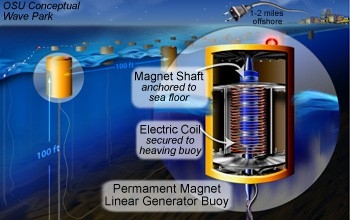
Each buoy could potentially produce 250 kilowatts of power, and the technology can be scaled up or down to suit a variety of energy needs. A fleet of about 200 such buoys could power the business district of downtown Portland.
Waves of Power
"The Stone Age did not end for lack of stone, and the Oil Age will end long before the world runs out of oil" ............ Former Saudi Arabian oil minister Sheikh Zaki Yamani,
-

BiGG - Tar Sands

- Posts: 800
- Joined: Mon 28 Mar 2005, 04:00:00
New wave power design
by Omnitir » Sat 08 Jul 2006, 23:27:23
There doesn’t appear to be many threads covering wave power, but based on the recent results of a new design by an Australian company Energetech, wave power appears to be one of the most promising sustainable energy sources in development. The results of the Port Kembla project indicate that this design could even be competitive with fossil fuel sources.
http://www.energetech.com.au/
Some quotes from the site:
$this->bbcode_second_pass_quote('', '
')Past laboratory studies and the analysis of an earlier trial deployment at Port Kembla had indicated the Energetech technology was capable of producing an annual energy output of at least 500 MWh at Port Kembla. However, this latest trial indicates the technology is capable of producing more power and fresh water than has previously been claimed. Based on the recent test results, a full scale project should power up to 1500 homes, or produce three million litres of water per day per production unit.
This is very encouraging, as the outcome of the trial ensures the economics of the design will be competitive not only with other renewable energy forms, but also with full cost fossil fuel sources.
[…]
Moderately good wave climates should produce power using first generation systems at a cost of around 10 cents US per kWh, and ideal sites at a cost around 5 cents. Over time, on moderately good sites, with capital cost savings from second generation designs, we can see the technology regularly delivering electricity at around 4 cents US kWh
[…]
Wave energy is:
• truly renewable - inexhaustible and occurring from natural phenomenon
• the most consistent of the intermittent renewable energy sources
• non-emitting - no emissions of harmful pollutants result from its use
• consumes no fuel in the operation of the system
[…]
Ocean waves contain enormous amounts of energy, but the energy in each crest is generally spread out along it. If all the energy could be transported to one point it could be harnessed far more readily.
It is possible to focus all the energy of a plane surface gravity wave crest, the type you see breaking on the beach, on to a single point using a parabolic wave focusser. The section of the wave is reflected by a parabolic wall and converges on the focus of the parabola. As the wave converges, the crest height grows to a maximum in the focus area.
[…]
Approximating what the device will produce in the way of power depends on the amount of energy extracted based on sea conditions on a particular day.
An illustration, however, may be useful. Consider a parabolic focuser with dimensions of 40 metres width, 20 metres length, and a focal length of 5 metres. Assume a coastal wave crest amplitude of 1 metre. This would render in the vicinity of ten million joules of energy for extraction from each wave. This equates to between 1 and 2 megawatts of power.
http://www.energetech.com.au/
Some quotes from the site:
$this->bbcode_second_pass_quote('', '
')Past laboratory studies and the analysis of an earlier trial deployment at Port Kembla had indicated the Energetech technology was capable of producing an annual energy output of at least 500 MWh at Port Kembla. However, this latest trial indicates the technology is capable of producing more power and fresh water than has previously been claimed. Based on the recent test results, a full scale project should power up to 1500 homes, or produce three million litres of water per day per production unit.
This is very encouraging, as the outcome of the trial ensures the economics of the design will be competitive not only with other renewable energy forms, but also with full cost fossil fuel sources.
[…]
Moderately good wave climates should produce power using first generation systems at a cost of around 10 cents US per kWh, and ideal sites at a cost around 5 cents. Over time, on moderately good sites, with capital cost savings from second generation designs, we can see the technology regularly delivering electricity at around 4 cents US kWh
[…]
Wave energy is:
• truly renewable - inexhaustible and occurring from natural phenomenon
• the most consistent of the intermittent renewable energy sources
• non-emitting - no emissions of harmful pollutants result from its use
• consumes no fuel in the operation of the system
[…]
Ocean waves contain enormous amounts of energy, but the energy in each crest is generally spread out along it. If all the energy could be transported to one point it could be harnessed far more readily.
It is possible to focus all the energy of a plane surface gravity wave crest, the type you see breaking on the beach, on to a single point using a parabolic wave focusser. The section of the wave is reflected by a parabolic wall and converges on the focus of the parabola. As the wave converges, the crest height grows to a maximum in the focus area.
[…]
Approximating what the device will produce in the way of power depends on the amount of energy extracted based on sea conditions on a particular day.
An illustration, however, may be useful. Consider a parabolic focuser with dimensions of 40 metres width, 20 metres length, and a focal length of 5 metres. Assume a coastal wave crest amplitude of 1 metre. This would render in the vicinity of ten million joules of energy for extraction from each wave. This equates to between 1 and 2 megawatts of power.
-
Omnitir - Tar Sands
- Posts: 894
- Joined: Sat 02 Apr 2005, 04:00:00
- Location: Down Under
Re: New wave power design
by blackfrank » Mon 10 Jul 2006, 17:20:27
there is a massive amount of power in waves more than we could ever use, but that is part of the problem any machine build to capture wave energy could also be destroyed in a storm
this has happened moer than once
there is another better way to get energy
this has happened moer than once
there is another better way to get energy
-
blackfrank - Wood

- Posts: 17
- Joined: Mon 10 Jul 2006, 03:00:00
Re: New wave power design
by Omnitir » Tue 11 Jul 2006, 01:03:29
$this->bbcode_second_pass_quote('', '
')any machine build to capture wave energy could also be destroyed in a storm
')any machine build to capture wave energy could also be destroyed in a storm
True, but the same could be said of wind power, yet there is still plenty of investment. Should we not try to develop wave power because we could occasionally loose a generator or two? Doesn't the potential economics, sustainability, saleability and environmental aspects of this technology make it well worth pursuing?
I look at the considerable technical achievements the oil industry has made in off shore oil rigs, and wonder why there is a strong perception that wave power technology will always be so fallible. Hasn’t it already been proven that things can be built capable of withstanding the elements?
The modest research put into wave power suggests it could be made sufficiently durable against large waves, and also a highly effective energy solution, not to mention a much needed source of fresh water.
-
Omnitir - Tar Sands
- Posts: 894
- Joined: Sat 02 Apr 2005, 04:00:00
- Location: Down Under
Re: New wave power design
by Doly » Tue 11 Jul 2006, 06:05:58
$this->bbcode_second_pass_quote('Omnitir', 'D')oesn't the potential economics, sustainability, saleability and environmental aspects of this technology make it well worth pursuing?
I have nothing against wave power in principle, but all the designs so far have produced little power. If somebody comes up with something that is far better than anything done before, I'm all for it.
-
Doly - Expert

- Posts: 4370
- Joined: Fri 03 Dec 2004, 04:00:00
Re: New wave power design
by Omnitir » Tue 11 Jul 2006, 22:51:50
$this->bbcode_second_pass_quote('Doly', '')$this->bbcode_second_pass_quote('Omnitir', 'D')oesn't the potential economics, sustainability, saleability and environmental aspects of this technology make it well worth pursuing?
I have nothing against wave power in principle, but all the designs so far have produced little power. If somebody comes up with something that is far better than anything done before, I'm all for it.
Results from Energetech's new design:
$this->bbcode_second_pass_quote('', 'T')his would render in the vicinity of ten million joules of energy for extraction from each wave
This seems to be far better then anything done before? 500 MWh from a signle generator is significant.
It seems to me like a promising solution for coastal communities, both for clean energy and for clean drinking water. I'm just wondering why interest in wave power isn't greater when it has such great potential. Especially in places like Australia where fresh water supplies are an issue.


 Where to begin? First pumping water is very hard work, the definition of foot pound being to raise a pound of (water) one foot from where it is now.Any water pump worth mentioning has a very large diesel engine roaring away on the other end of the shaft. Your typical fire truck has a three hundred and fifty horse diesel attached to a pump with a six or eight inch inlet pipe and can pump just a thousand gallons a minute. And that is adjusted by both how high above the water the pump sits and how high the outlet end of the pipe is.

