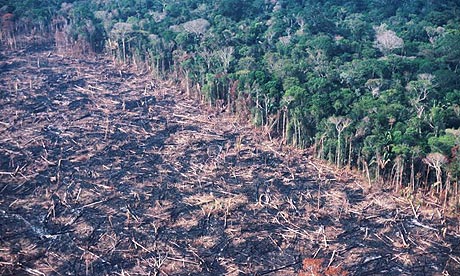
This is a subject I find compelling. Given that we have been technologically enabled to conquer most former wilderness areas and the dependence of these technologies on oil/ it seems logical that as these super human activities are rendered unfeasible/ oceans, deserts, high country and savanna could regain much of their former splendid isolation with subsequent benefits to natural ecosystems.
The business of kicking the impossible debt can down the road seems likely to bring the entire paradigm unstuck well before AGW boils us in the pot. Anyone who has watched a damaged forest regrow or taken part in successful restoration projects of land or waterways knows nature is resilient.
There are many issues around biodiversity, feral animals and weeds.
The balance will likely be utterly reset in most places, quite soon post human intervention.
To what extent oceans can recover and how fast could be the key to planetary survival.
Any thoughts?


PeakOil is You
How fast would wilderness return post crash?
How fast would wilderness return post crash?
 by SeaGypsy » Sat 01 Oct 2011, 05:17:38
- SeaGypsy
- Master Prognosticator

- Posts: 9285
- Joined: Wed 04 Feb 2009, 04:00:00
Re: How fast would wilderness return post crash?
by dolanbaker » Sat 01 Oct 2011, 06:51:29
Watch "Life after People" it has a good stab at what would happen to manmade infrastructure without people around to maintain it.
Religion is regarded by the common people as true, by the wise as false, and by rulers as useful.:Anonymous
Our whole economy is based on planned obsolescence.
Hungrymoggy "I am now predicting that Europe will NUKE ITSELF sometime in the first week of January"
Our whole economy is based on planned obsolescence.
Hungrymoggy "I am now predicting that Europe will NUKE ITSELF sometime in the first week of January"
-

dolanbaker - Intermediate Crude

- Posts: 3855
- Joined: Wed 14 Apr 2010, 10:38:47
- Location: Éire
Re: How fast would wilderness return post crash?
by dohboi » Sat 01 Oct 2011, 09:57:07
A couple things to consider--Global warming does not stop after we're gone. Feedbacks are likely to keep GHG levels high, perhaps even accelerating, if methane releases are really increasing at the rate they seem to be in the Arctic.
Already, plant and animal species are having to move at a rate of about a foot an hour away from the equator to survive. Various barriers and inherent limits of movement will keep increasing numbers from surviving this forced biological Bataan Death March to oblivion. And of course those closest to the poles are dying quickly.
Forests will mostly be drying up and burning, or will succumb to the many new predators that can now infect them unopposed.
Also keep in mind that, as resources get scarcer and scarcer and finally vanish, desperate, clever human apes will scour the landscape for anything they can eat, cut down to build shelter, feed to their animals, or burn for warmth. This will eliminate most of what is left on the land.
Meanwhile, we will see greater and greater swings between torrential rains that wash everything off the the land that does not have very deep roots, and long-lasting killing droughts that decimate anything that survived the deluge--then back through the cycle, over and over again.
At the same time, all nuclear fascilities will go critical and become worse than Fukushima and Chernobyl combined, since there will be fewer and fewer resources to mitigate the multiplying disasters, and more and more political paralysis and chaos.
Oh yeah, and we've also filled the world with a vast array of persistent chemical pollutants never seen by the natural world whose long-term effects are unknown, but not likely to be entirely benign in all cases. On of the latest classes of these was just published over at dd:
http://www.desdemonadespair.net/2011/09/blood-levels-of-flame-retardant.html
It took tens of millions of years, by some calculations, for life to recover from earlier mass extinctions. We are hitting the earth with multiple mass-extinction-causing forces at once. No one can say that they know for sure what the recovery time from such a massive assault on life will be. If it pushes recovery time back by an order of magnitude, that approaches the time when the sun becomes too hot for life to be sustainable on the planet, even without high levels of GHGs.
Sorry to be so cheery, but the idea that the moment we are gone, everything will go back to pristine paradise is unprovable and lets us all collectively off the hook a bit too easily.
Already, plant and animal species are having to move at a rate of about a foot an hour away from the equator to survive. Various barriers and inherent limits of movement will keep increasing numbers from surviving this forced biological Bataan Death March to oblivion. And of course those closest to the poles are dying quickly.
Forests will mostly be drying up and burning, or will succumb to the many new predators that can now infect them unopposed.
Also keep in mind that, as resources get scarcer and scarcer and finally vanish, desperate, clever human apes will scour the landscape for anything they can eat, cut down to build shelter, feed to their animals, or burn for warmth. This will eliminate most of what is left on the land.
Meanwhile, we will see greater and greater swings between torrential rains that wash everything off the the land that does not have very deep roots, and long-lasting killing droughts that decimate anything that survived the deluge--then back through the cycle, over and over again.
At the same time, all nuclear fascilities will go critical and become worse than Fukushima and Chernobyl combined, since there will be fewer and fewer resources to mitigate the multiplying disasters, and more and more political paralysis and chaos.
Oh yeah, and we've also filled the world with a vast array of persistent chemical pollutants never seen by the natural world whose long-term effects are unknown, but not likely to be entirely benign in all cases. On of the latest classes of these was just published over at dd:
http://www.desdemonadespair.net/2011/09/blood-levels-of-flame-retardant.html
It took tens of millions of years, by some calculations, for life to recover from earlier mass extinctions. We are hitting the earth with multiple mass-extinction-causing forces at once. No one can say that they know for sure what the recovery time from such a massive assault on life will be. If it pushes recovery time back by an order of magnitude, that approaches the time when the sun becomes too hot for life to be sustainable on the planet, even without high levels of GHGs.
Sorry to be so cheery, but the idea that the moment we are gone, everything will go back to pristine paradise is unprovable and lets us all collectively off the hook a bit too easily.
-
dohboi - Harmless Drudge
- Posts: 19990
- Joined: Mon 05 Dec 2005, 04:00:00
Re: How fast would wilderness return post crash?
by cualcrees » Mon 03 Oct 2011, 15:47:25
Great post, dohboi! +1!
"Growth for the sake of growth is the ideology of the cancer cell."
- Edward Abbey
- Edward Abbey
- cualcrees
- Peat

- Posts: 176
- Joined: Wed 28 May 2008, 03:00:00
- Location: Mexico
Re: How fast would wilderness return post crash?
by kublikhan » Mon 03 Oct 2011, 16:39:10
Life After People is a good show to watch if you are interested in this topic. There are also a few locations on Earth where this has already happened that you can check out such as Chernobyl, parts of Detroit, etc. Nature returns pretty fast once humans are out of the way.
$this->bbcode_second_pass_quote('', 'T')he city of Detroit has a very strange, wild appearance, in some parts like a city of ruins many years older than it actually is, where nature reasserts itself in vegetation that spreads over the city’s crumbling structures. Whole neighborhood blocks cleared of their houses by arson and then bulldozers have reverted to urban prairies.
Throughout Detroit, as half the population fled in the last half-century outward towards the suburbs and later towards more rural areas, the city itself has, ironically, become more rural, with wild animals and lush green plants coexisting with an industrial, modern metropolis. Nature, driven back by progress during the city’s 300 years, has aggressively reasserted itself in recent years, reclaiming land that people have given up on.
Even downtown, abandoned skyscrapers, with windows left open to the elements, become giant pigeon coops, their upper floors covered in inches of pigeon droppings, as generation after generation of pigeons live uninterrupted by humans in the middle of a major downtown. Buildings like the Wurlitzer, the Lafer and the Broderick house hundreds of pigeons between them.
Probably the most visible wildlife in the city are the roving packs of wild dogs in Detroit neighborhoods. Groups of four to seven dogs, each litter progressively wilder and stranger-looking than their predecessors, roam through even well-kept neighborhoods, occasionally making the news when they attack someone, usually children or mail carriers. Feral cats don’t just thrive by stalking mice through fields of wildflower and grass; sometimes take over entire buildings downtown.
Dogs and cats aren’t the only animals roaming the city; true wildlife has made its way back into Detroit after being pushed to the edges of the suburbs years ago. Pheasants have become commonplace in areas like Brush Park and Woodbridge, along the East riverfront, and in grassy parts of Highland Park. Even foxes, opossums, turkeys, roosters and raccoons have been spotted deep inside the city, some animals even roaming downtown where very little street-level brush exists as places to hide. Opossums occasionally are spotted wandering alongside buildings in the Central Business District. In the Detroit Building on Park, I once found raccoon tracks on floors that also contained foot-high vegetation growing in floor mush. Impressions of raccoon paws were along windowsills and the edges of doors.
Wild Kingdom$this->bbcode_second_pass_quote('', 'T')he city of Detroit has a very strange, wild appearance, in some parts like a city of ruins many years older than it actually is, where nature reasserts itself in vegetation that spreads over the city’s crumbling structures. Whole neighborhood blocks cleared of their houses by arson and then bulldozers have reverted to urban prairies.
Throughout Detroit, as half the population fled in the last half-century outward towards the suburbs and later towards more rural areas, the city itself has, ironically, become more rural, with wild animals and lush green plants coexisting with an industrial, modern metropolis. Nature, driven back by progress during the city’s 300 years, has aggressively reasserted itself in recent years, reclaiming land that people have given up on.
Even downtown, abandoned skyscrapers, with windows left open to the elements, become giant pigeon coops, their upper floors covered in inches of pigeon droppings, as generation after generation of pigeons live uninterrupted by humans in the middle of a major downtown. Buildings like the Wurlitzer, the Lafer and the Broderick house hundreds of pigeons between them.
Probably the most visible wildlife in the city are the roving packs of wild dogs in Detroit neighborhoods. Groups of four to seven dogs, each litter progressively wilder and stranger-looking than their predecessors, roam through even well-kept neighborhoods, occasionally making the news when they attack someone, usually children or mail carriers. Feral cats don’t just thrive by stalking mice through fields of wildflower and grass; sometimes take over entire buildings downtown.
Dogs and cats aren’t the only animals roaming the city; true wildlife has made its way back into Detroit after being pushed to the edges of the suburbs years ago. Pheasants have become commonplace in areas like Brush Park and Woodbridge, along the East riverfront, and in grassy parts of Highland Park. Even foxes, opossums, turkeys, roosters and raccoons have been spotted deep inside the city, some animals even roaming downtown where very little street-level brush exists as places to hide. Opossums occasionally are spotted wandering alongside buildings in the Central Business District. In the Detroit Building on Park, I once found raccoon tracks on floors that also contained foot-high vegetation growing in floor mush. Impressions of raccoon paws were along windowsills and the edges of doors.
$this->bbcode_second_pass_quote('', 'N')obody thought it possible at the time but 20 years after the reactor exploded on 26 April 1986, during an ill-conceived "routine" Soviet experiment, Chernobyl's radiation-soaked "dead zone" is not looking so dead after all. The almost complete absence of human activity in large swaths of the zone during the past two decades has given the area's flora and fauna a chance to first recover and then - against all the odds - to flourish.
Astonishingly, most of the animals appear to have returned to the zone of their own accord. The most recent count by the authorities showed that the zone (including a larger contaminated area in neighbouring Belarus) is home to 66 different species of mammals, including 7,000 wild boar, 600 wolves, 3,000 deer, 1,500 beavers, 1,200 foxes, 15 lynx and several thousand elks. The area was also estimated to be home to 280 species of birds, many of them rare and endangered. Breeding birds include the rare green crane, black stork, white-tailed sea eagle and fish hawk. Wild dogs are also in evidence, though they are prime targets for wolves.
The oil barrel is half-full.
-
kublikhan - Master Prognosticator
- Posts: 5064
- Joined: Tue 06 Nov 2007, 04:00:00
- Location: Illinois
Re: How fast would wilderness return post crash?
by Serial_Worrier » Mon 03 Oct 2011, 18:42:58
I'm pretty sure that a 100K years "after humans" will be enough to flush the toxic chemicals and nuclear waste from the environment. By then, nobody will know humans ever existed. 
-

Serial_Worrier - Heavy Crude

- Posts: 1549
- Joined: Thu 05 Jun 2008, 03:00:00
Re: How fast would wilderness return post crash?
by Loki » Mon 03 Oct 2011, 21:39:58
While I fear dohboi is correct, I'm sure there will be quite a bit of geographic variability. Some places will be stripped bare in a mad rush for the remaining resources (like Haiti) or devastated by climate change (particularly in the tropics). Other places will be less impacted.
I only really know my region, the Pacific Northwest. On the wet side I think climate change will have a less devastating influence than it will on the dry side, where climate-related forest pest and fire outbreaks are already occurring. Snowpack in the region has also already been affected by climate change. It's projected that more precipitation will fall as rain in the future, which is a problem for fish, especially salmon. It's also a problem for farmers, more water storage projects may be built in the future, though there are very few suitable sites that don't already have dams on them (BC's Fraser River being the glaring exception---I expect the Canadians to rape that river in the next few decades).
There may be some positive ecological effects from long-term economic decline, even in the face of climate change. I think pockets of wild will emerge, and hopefully expand. There will be a lessening of logging pressure on the region's forests---the collapse of the housing market has already had a significant impact on the forest industry, though my local mill is still buzzing (word is that the lumber is being shipped to China). Levees and riprap may be neglected and rivers may reestablish some of their sinuosity. Many back roads may be renatured. Distant wild areas will likely see a lot less tourist pressure as transportation becomes too expensive for many people, and the government can no longer afford to maintain the roads.
But even if industrial logging significantly and permanently declines, it will take centuries to restore old-growth forests, assuming long-term climate change doesn't make that impossible. And I don't think widespread oak savannah and bunchgrass prairie will come back to the Willamette Valley/Puget Trough any time soon. The Willamette River's once extensive riparian and wetland ecosystem has largely been eradicated and is unlikely to return. The Columbia River system is controlled by dozens of large dams, which will be around for decades to come. Most salmon stocks would have gone extinct long ago if not for the hatchery system, which isn't likely to survive serious economic collapse. As for marine fisheries, I suspect we'll finish strip mining them before fuel gets prohibitively expensive.
It's a grim long-term picture, ecologically speaking.
Continued population growth in my region is the gravest threat to biodiversity, though, and the hardest to predict. The ecological state of the Northwest in 50 or 100 or 500 years will largely be dependent on the size of the human population. If we continue our irresponsible immigration policies for a few more decades, and if millions of American climate refugees move here, I don't have high hopes for the region's biodiversity. Immigration is a matter of public policy and can be changed by an act of Congress. Internal climate refugeeism is harder to predict and control---unfortunately we can't build a wall at the California border
I only really know my region, the Pacific Northwest. On the wet side I think climate change will have a less devastating influence than it will on the dry side, where climate-related forest pest and fire outbreaks are already occurring. Snowpack in the region has also already been affected by climate change. It's projected that more precipitation will fall as rain in the future, which is a problem for fish, especially salmon. It's also a problem for farmers, more water storage projects may be built in the future, though there are very few suitable sites that don't already have dams on them (BC's Fraser River being the glaring exception---I expect the Canadians to rape that river in the next few decades).
There may be some positive ecological effects from long-term economic decline, even in the face of climate change. I think pockets of wild will emerge, and hopefully expand. There will be a lessening of logging pressure on the region's forests---the collapse of the housing market has already had a significant impact on the forest industry, though my local mill is still buzzing (word is that the lumber is being shipped to China). Levees and riprap may be neglected and rivers may reestablish some of their sinuosity. Many back roads may be renatured. Distant wild areas will likely see a lot less tourist pressure as transportation becomes too expensive for many people, and the government can no longer afford to maintain the roads.
But even if industrial logging significantly and permanently declines, it will take centuries to restore old-growth forests, assuming long-term climate change doesn't make that impossible. And I don't think widespread oak savannah and bunchgrass prairie will come back to the Willamette Valley/Puget Trough any time soon. The Willamette River's once extensive riparian and wetland ecosystem has largely been eradicated and is unlikely to return. The Columbia River system is controlled by dozens of large dams, which will be around for decades to come. Most salmon stocks would have gone extinct long ago if not for the hatchery system, which isn't likely to survive serious economic collapse. As for marine fisheries, I suspect we'll finish strip mining them before fuel gets prohibitively expensive.
It's a grim long-term picture, ecologically speaking.
Continued population growth in my region is the gravest threat to biodiversity, though, and the hardest to predict. The ecological state of the Northwest in 50 or 100 or 500 years will largely be dependent on the size of the human population. If we continue our irresponsible immigration policies for a few more decades, and if millions of American climate refugees move here, I don't have high hopes for the region's biodiversity. Immigration is a matter of public policy and can be changed by an act of Congress. Internal climate refugeeism is harder to predict and control---unfortunately we can't build a wall at the California border
A garden will make your rations go further.
-

Loki - Expert

- Posts: 3509
- Joined: Sat 08 Apr 2006, 03:00:00
- Location: Oregon
Re: How fast would wilderness return post crash?
by AgentR11 » Mon 03 Oct 2011, 22:17:05
Its really a question of, by what do you mean wilderness.
If anyone is hoping for a return to a perfection of the Quaternary period as existed just before civilization blossomed; they can probably forget that. We've pushed to many buttons on the console as it were; with, or without us, the future is guaranteed to be *very* different.
Its also unreasonable to hope for a return to a perfection such as the ole Dinosaurs enjoyed at the end of their periods.
The right place to look at for whats in store, is at the beginning of new climate regimes, after extinction events have ended. Low biodiversity. Plenty of biomass recovering, but dreary in its overwhelming generality. If there are copious mammals, but all of the mammals are rats; its life, but nothing close to the perfection that was before. To reach that perfection is a journey of millions of years, not hundreds or thousands.
And this all presumes that humans don't dominate through the crash, an assertion I'm not inclined to accept. I suspect instead of passing away, humans will be the high lord emperors of suffering and misery. The rats will have much to fear.
Can wilderness as it was, return? No. Can a new wilderness arise in its place, even with human occupants? Sure. It will be known as Hell.
If anyone is hoping for a return to a perfection of the Quaternary period as existed just before civilization blossomed; they can probably forget that. We've pushed to many buttons on the console as it were; with, or without us, the future is guaranteed to be *very* different.
Its also unreasonable to hope for a return to a perfection such as the ole Dinosaurs enjoyed at the end of their periods.
The right place to look at for whats in store, is at the beginning of new climate regimes, after extinction events have ended. Low biodiversity. Plenty of biomass recovering, but dreary in its overwhelming generality. If there are copious mammals, but all of the mammals are rats; its life, but nothing close to the perfection that was before. To reach that perfection is a journey of millions of years, not hundreds or thousands.
And this all presumes that humans don't dominate through the crash, an assertion I'm not inclined to accept. I suspect instead of passing away, humans will be the high lord emperors of suffering and misery. The rats will have much to fear.
Can wilderness as it was, return? No. Can a new wilderness arise in its place, even with human occupants? Sure. It will be known as Hell.
Yes we are, as we are,
And so shall we remain,
Until the end.
And so shall we remain,
Until the end.
- AgentR11
- Light Sweet Crude

- Posts: 6589
- Joined: Tue 22 Mar 2011, 09:15:51
- Location: East Texas
Re: How fast would wilderness return post crash?
by Ibon » Tue 04 Oct 2011, 06:30:20
Our planet's fragility is not the problem here. It is the opposite. It is the very resilience of our planet and the life forms on it that have allowed Kudzu Ape to reach this level of overshoot.
Dohboi seems to be speaking from his inner narrative, Acknowledging resilience is not rationalizing or defending the status quo which he seems to suggest.
IT takes a resilient planet and flora and fauna to have humans reach 7 billion and counting. This will not change after the crash.
The heroic efforts made today to preserve small islands of biodiversity in all major ecosystems, some large enough to maintain top predators, is key. These life rafts will quickly re colonize the planet post crash. Preserving these island refuges, particularly in biodiversity hot spots like the small national park in central Borneo, which today is surrounded by hundreds of thousands of acres of oil palms, is the key.
Tens of thousands of years after the crash the evidence of the 21st century will still be evident in the distribution of flora and fauna on the planet. Just think of a species like the Royal Palm, native to Cuba and the Caribbean which has been planted extensively in all the worlds tropical regions. In some areas this species will become permanently established and 10,000 years from now you may find remnant populations thriving far from the Caribbean. This is just one example. Many of these species will become established in the new areas where they were introduced. Most introduced species however will probably die off.
As soon as 200 years after the crash the planet will revert to being a surprisingly healthy wilderness. The resilience of nature is evident in any area left undisturbed even after a few short decades. In North America for example Grizzly bears could be roaming the canyons of Manhattan , having re established their former range within this time frame.
Localized areas around nuclear power plants will become hot spots for millennium but the background radiation globally will have an insignificant impact on species distribution.
The extant of species extinction will be determined by two main factors
1) Preservation of remnant habitat in biodiversity hot spots throughout the planet, both terrestrial and marine.
2) How quickly global climate change accelerates.
Dohboi seems to be speaking from his inner narrative, Acknowledging resilience is not rationalizing or defending the status quo which he seems to suggest.
IT takes a resilient planet and flora and fauna to have humans reach 7 billion and counting. This will not change after the crash.
The heroic efforts made today to preserve small islands of biodiversity in all major ecosystems, some large enough to maintain top predators, is key. These life rafts will quickly re colonize the planet post crash. Preserving these island refuges, particularly in biodiversity hot spots like the small national park in central Borneo, which today is surrounded by hundreds of thousands of acres of oil palms, is the key.
Tens of thousands of years after the crash the evidence of the 21st century will still be evident in the distribution of flora and fauna on the planet. Just think of a species like the Royal Palm, native to Cuba and the Caribbean which has been planted extensively in all the worlds tropical regions. In some areas this species will become permanently established and 10,000 years from now you may find remnant populations thriving far from the Caribbean. This is just one example. Many of these species will become established in the new areas where they were introduced. Most introduced species however will probably die off.
As soon as 200 years after the crash the planet will revert to being a surprisingly healthy wilderness. The resilience of nature is evident in any area left undisturbed even after a few short decades. In North America for example Grizzly bears could be roaming the canyons of Manhattan , having re established their former range within this time frame.
Localized areas around nuclear power plants will become hot spots for millennium but the background radiation globally will have an insignificant impact on species distribution.
The extant of species extinction will be determined by two main factors
1) Preservation of remnant habitat in biodiversity hot spots throughout the planet, both terrestrial and marine.
2) How quickly global climate change accelerates.
Patiently awaiting the pathogens. Our resiliency resembles an invasive weed. We are the Kudzu Ape
blog: http://blog.mounttotumas.com/
website: http://www.mounttotumas.com
blog: http://blog.mounttotumas.com/
website: http://www.mounttotumas.com
-

Ibon - Expert
- Posts: 9572
- Joined: Fri 03 Dec 2004, 04:00:00
- Location: Volcan, Panama
Re: How fast would wilderness return post crash?
by SeaGypsy » Tue 04 Oct 2011, 16:45:34
Some great posts here on both sides.
Personally I side with human impact being massively reduced post oil.
After all 7 billion humans is less than 1 cubic kilometer, H2O included.
Personally I side with human impact being massively reduced post oil.
After all 7 billion humans is less than 1 cubic kilometer, H2O included.
- SeaGypsy
- Master Prognosticator
- Posts: 9285
- Joined: Wed 04 Feb 2009, 04:00:00
Re: How fast would wilderness return post crash?
by The Practician » Tue 04 Oct 2011, 23:53:45
$this->bbcode_second_pass_quote('Ibon', '
')
The heroic efforts made today to preserve small islands of biodiversity in all major ecosystems, some large enough to maintain top predators, is key. These life rafts will quickly re colonize the planet post crash. Preserving these island refuges, particularly in biodiversity hot spots like the small national park in central Borneo, which today is surrounded by hundreds of thousands of acres of oil palms, is the key.
')
The heroic efforts made today to preserve small islands of biodiversity in all major ecosystems, some large enough to maintain top predators, is key. These life rafts will quickly re colonize the planet post crash. Preserving these island refuges, particularly in biodiversity hot spots like the small national park in central Borneo, which today is surrounded by hundreds of thousands of acres of oil palms, is the key.
More like re colonize the dinner plate. Hungry people don't just lay down and die as soon as the established food systems cease to function properly, and they certainly don't respect park boundaries.
- The Practician
- Lignite
- Posts: 270
- Joined: Wed 20 Jul 2011, 22:08:02
Re: How fast would wilderness return post crash?
by wisconsin_cur » Wed 05 Oct 2011, 04:28:36
I suppose it also depends upon what you mean by crash.
Around here marginal lands would turn to blackberry brambles and thistle in about two years (thank you bird droppings and wind). Five years after that birch trees (and some poplar) and other colonizers would appear and within a couple of years shade out the brambles.
This would be delayed by a few years in the healthy alfalfa fields and poorer soils might stay in the bramble/thistle or birch stage.
There are a number of successive species that would take over after that. Mostly maple and oak.
Animals would return instantly, they are already here and in large numbers. The only interesting quesitons are how long would it take the wolf population to increase to a point that it could bring the deer population under control and how long before mountain lion prints in the snow became a regular sight (as opposed to a rarity).
How bad of a crash would determine how many acres go out of use.
Around here marginal lands would turn to blackberry brambles and thistle in about two years (thank you bird droppings and wind). Five years after that birch trees (and some poplar) and other colonizers would appear and within a couple of years shade out the brambles.
This would be delayed by a few years in the healthy alfalfa fields and poorer soils might stay in the bramble/thistle or birch stage.
There are a number of successive species that would take over after that. Mostly maple and oak.
Animals would return instantly, they are already here and in large numbers. The only interesting quesitons are how long would it take the wolf population to increase to a point that it could bring the deer population under control and how long before mountain lion prints in the snow became a regular sight (as opposed to a rarity).
How bad of a crash would determine how many acres go out of use.
http://www.thenewfederalistpapers.com
-

wisconsin_cur - Light Sweet Crude
- Posts: 4576
- Joined: Thu 10 May 2007, 03:00:00
- Location: 45 degrees North. 883 feet above sealevel.
Re: How fast would wilderness return post crash?
by SeaGypsy » Wed 05 Oct 2011, 05:41:01
$this->bbcode_second_pass_quote('The Practician', '')$this->bbcode_second_pass_quote('Ibon', '
')
The heroic efforts made today to preserve small islands of biodiversity in all major ecosystems, some large enough to maintain top predators, is key. These life rafts will quickly re colonize the planet post crash. Preserving these island refuges, particularly in biodiversity hot spots like the small national park in central Borneo, which today is surrounded by hundreds of thousands of acres of oil palms, is the key.
')
The heroic efforts made today to preserve small islands of biodiversity in all major ecosystems, some large enough to maintain top predators, is key. These life rafts will quickly re colonize the planet post crash. Preserving these island refuges, particularly in biodiversity hot spots like the small national park in central Borneo, which today is surrounded by hundreds of thousands of acres of oil palms, is the key.
More like re colonize the dinner plate. Hungry people don't just lay down and die as soon as the established food systems cease to function properly, and they certainly don't respect park boundaries.
The validity of this statement rapidly evaporates with the end of cheap energy. How far can joe 6 walk on 3k calories a day? How about after 3 days on zero calories? Do the maths & mapping. A vast majority of humans will not venture outside their comfort zones with no ticket home.
- SeaGypsy
- Master Prognosticator
- Posts: 9285
- Joined: Wed 04 Feb 2009, 04:00:00