Why are US crude supplies "tumbling"? Are the tankers broke" Did Saudi quit pumping? Maybe
Venezuela dosen't need the cash this week? Why such incindiary language?
On the other side of the coin, there is no hyperbole in describing the near-record stockpiles of
gasoline and diesel fuel. Why is that?
It is becoming very clear to me that the oil business is crooked and manipulated, right down to
the financial journalists. Pathetic, in a world on the brink.
http://finance.yahoo.com/news/Crude-oil ... et=&ccode=



PeakOil is You
Crude Supplies "Tumble"
Crude Supplies "Tumble"
 by peeker01 » Thu 08 Sep 2011, 13:17:01
- peeker01
- Permanently Banned
- Posts: 725
- Joined: Fri 24 Jun 2011, 18:19:54
Re: Crude Supplies "Tumble"
by Daniel_Plainview » Thu 08 Sep 2011, 13:26:11
And oil reached $90 today ...
-

Daniel_Plainview - Prognosticator

- Posts: 4220
- Joined: Tue 06 May 2008, 03:00:00
- Location: 7035 Hollis ... Near the Observatory ... Just down the way, tucked back in the small woods
Re: Crude Supplies "Tumble"
by Sixstrings » Thu 08 Sep 2011, 13:45:17
According to the article, supplies are down 1.9% from a year ago and demand is down 2.9%.
I wonder which it is.. is supply down because demand is down, or is supply falling off due to peak oil / Libya and demand is just down because of prices and the recession?
Anyway, these are big numbers, 1.9% falloff in a year is a lot.
I wonder which it is.. is supply down because demand is down, or is supply falling off due to peak oil / Libya and demand is just down because of prices and the recession?
Anyway, these are big numbers, 1.9% falloff in a year is a lot.
-

Sixstrings - Fusion

- Posts: 15160
- Joined: Tue 08 Jul 2008, 03:00:00
Re: Crude Supplies "Tumble"
by peeker01 » Thu 08 Sep 2011, 13:54:00
Who can tell with this quality of reporting? If supply has tumbled, then demand has collapsed.
- peeker01
- Permanently Banned
- Posts: 725
- Joined: Fri 24 Jun 2011, 18:19:54
Re: Crude Supplies "Tumble"
by Pops » Thu 08 Sep 2011, 14:27:42
It's recession boys, plain as can be.
I still think the good ole GDP will be revised down (eventually) to show we are already well into the recession of 2011...
Double dip recession of '07...
21st Century Depression...
End of the Oil Age.
I still think the good ole GDP will be revised down (eventually) to show we are already well into the recession of 2011...
Double dip recession of '07...
21st Century Depression...
End of the Oil Age.
The legitimate object of government, is to do for a community of people, whatever they need to have done, but can not do, at all, or can not, so well do, for themselves -- in their separate, and individual capacities.
-- Abraham Lincoln, Fragment on Government (July 1, 1854)
-- Abraham Lincoln, Fragment on Government (July 1, 1854)
-

Pops - Elite

- Posts: 19746
- Joined: Sat 03 Apr 2004, 04:00:00
- Location: QuikSac for a 6-Pac
Re: Crude Supplies "Tumble"
by peeker01 » Thu 08 Sep 2011, 14:48:01
Ok Pop's, it's nothing to do with 10 percent ethanol in every gallon of gasoline. Nothing to do with
new jet engines. Nothing to do with CAFE mileage requirements. Nothing to do with increased
rail usage. Nothing to do with CNG, LNG, Propane usage. Nothing to do with electric cars. Nothing
to do with telecommuting and teleconferencing. Or the failure of the post office, or the onrushing
digital world. Can't possibly be the total exclusion of oil from electricity production either.
It's all peak oil, right? No compromise, no concessions, all peak oil. Right as always Pops.
Ok, now ban me for another week.......I'm ready.
new jet engines. Nothing to do with CAFE mileage requirements. Nothing to do with increased
rail usage. Nothing to do with CNG, LNG, Propane usage. Nothing to do with electric cars. Nothing
to do with telecommuting and teleconferencing. Or the failure of the post office, or the onrushing
digital world. Can't possibly be the total exclusion of oil from electricity production either.
It's all peak oil, right? No compromise, no concessions, all peak oil. Right as always Pops.
Ok, now ban me for another week.......I'm ready.
- peeker01
- Permanently Banned
- Posts: 725
- Joined: Fri 24 Jun 2011, 18:19:54
Re: Crude Supplies "Tumble"
by Pops » Thu 08 Sep 2011, 15:06:52
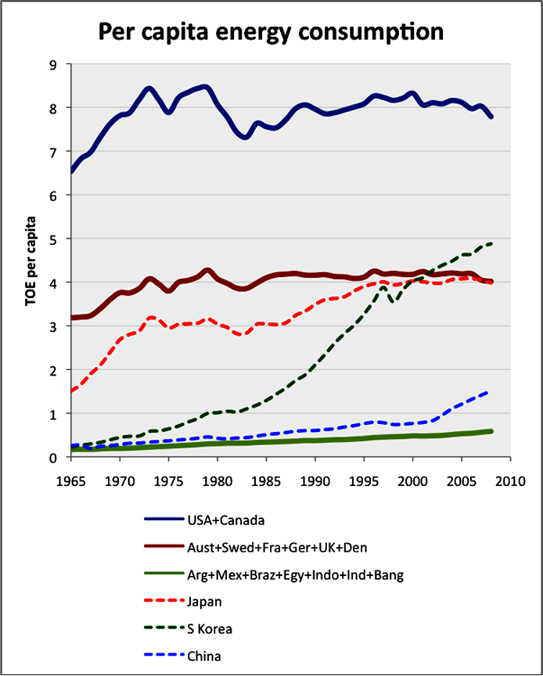
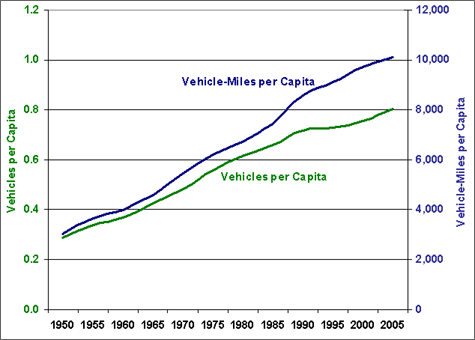
No, if the economy were good and gas prices low we would be continuing to use an increasing amount per capita and in total just as we always have - regardless of conservation and lowering energy "intensity".
Consumption is down because prices are up (yep PO) but mostly because people are out of a job...
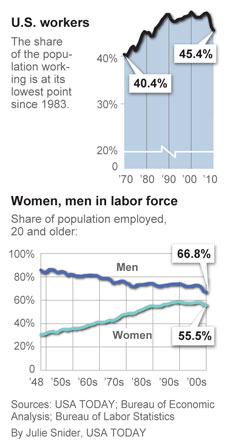
$this->bbcode_second_pass_quote('', 'O')nly 45.4% of Americans had jobs in 2010, the lowest rate since 1983 and down from a peak of 49.3% in 2000. Last year, just 66.8% of men had jobs, the lowest on record.
Consumption is down because prices are up (yep PO) but mostly because people are out of a job...
$this->bbcode_second_pass_quote('', 'O')nly 45.4% of Americans had jobs in 2010, the lowest rate since 1983 and down from a peak of 49.3% in 2000. Last year, just 66.8% of men had jobs, the lowest on record.
BTW, we've never banned anyone for being ill-informed.
The legitimate object of government, is to do for a community of people, whatever they need to have done, but can not do, at all, or can not, so well do, for themselves -- in their separate, and individual capacities.
-- Abraham Lincoln, Fragment on Government (July 1, 1854)
-- Abraham Lincoln, Fragment on Government (July 1, 1854)
-
Pops - Elite
- Posts: 19746
- Joined: Sat 03 Apr 2004, 04:00:00
- Location: QuikSac for a 6-Pac
Re: Crude Supplies "Tumble"
by peeker01 » Thu 08 Sep 2011, 15:18:13
"No, if the economy were good and gas prices low....." What kind of argument is that? That's
equivalent to saying "If the economy were good, then the economy would be good".
People teleconference, telecommute, burn LNG, drive little hybrids, conserve, convert from fuel
oil to NG for home heating, etc, etc, etc because petroleum is way too expensive and at times
artificially scarce.
The contrived shortages and high prices are one of the main causes of the recession. The demand shortfall is the fault of the oil industry, and it will get worse if commodity prices aren't returned to
oil products.
We may see peak oil in the future, but now you are witnessing peak demand.
equivalent to saying "If the economy were good, then the economy would be good".
People teleconference, telecommute, burn LNG, drive little hybrids, conserve, convert from fuel
oil to NG for home heating, etc, etc, etc because petroleum is way too expensive and at times
artificially scarce.
The contrived shortages and high prices are one of the main causes of the recession. The demand shortfall is the fault of the oil industry, and it will get worse if commodity prices aren't returned to
oil products.
We may see peak oil in the future, but now you are witnessing peak demand.
- peeker01
- Permanently Banned
- Posts: 725
- Joined: Fri 24 Jun 2011, 18:19:54
Re: Crude Supplies "Tumble"
by kublikhan » Thu 08 Sep 2011, 15:56:18
$this->bbcode_second_pass_quote('Pops', 'N')o, if the economy were good and gas prices low we would be continuing to use an increasing amount per capita and in total just as we always have - regardless of conservation and lowering energy "intensity".
That's not what the chart you posted in the energy intensity thread shows. It shows the US and Europe having a lower per capita energy consumption. There was an extensive study on this that found Jevon's paradox generally does not happen for mature systems. It does happen when a new disruptive technology is introduced such as steam engine, electric motor, developing nation replacing manual farming with a tractor, etc. But it generally does not happen for a mature system and non disruptive technology such as a more fuel efficient car, insulation for the house, etc.Just a few quick definitions:
K-B ‘hypothesis’ is roughly Jevon's paradox. "Rebound effects" are increased usage because of lower energy cost. "Backfire" is when a rebound effect is greater than 100% of the efficiency gain, ie, increased resource usage ends up using more total energy overall, despite gains in efficiency.
$this->bbcode_second_pass_quote('', 'S')imilarly, the empirical evidence for the postulate is indirect, suggestive and ambiguous. Since a number of flaws have been found with both the theoretical and empirical evidence, the K-B ‘hypothesis’ cannot be considered to have been verified.
There is no a priori reason to believe that ‘backfire’ is an inevitable outcome in all cases.
The K-B postulate seems more likely to hold for improvements associated with pervasive ‘general purpose technologies’, particularly when these are adopted by producers rather than final consumers and when the improvements occur at an early stage of development and diffusion. Steam engines provide a good illustration from the 19th-century, while electric motors provide a comparable illustration from the early 20th century.
In contrast, the K-B postulate seems less likely to hold for dedicated energy efficiency technologies such as thermal insulation, particularly when these are used by consumers or when they play a subsidiary role in economic production. These technologies have smaller effects on productivity and economic growth, with the result that economy-wide energy consumption is likely to be reduced.
Many energy efficiency opportunities are highly cost effective and will remain so even when rebound effects are allowed for.
$this->bbcode_second_pass_quote('peeker01', 'P')eople teleconference, telecommute, burn LNG, drive little hybrids, conserve, convert from fuel oil to NG for home heating, etc, etc, etc because petroleum is way too expensive and at times artificially scarce. The contrived shortages and high prices are one of the main causes of the recession. The demand shortfall is the fault of the oil industry, and it will get worse if commodity prices aren't returned to oil products. We may see peak oil in the future, but now you are witnessing peak demand.
The oil barrel is half-full.
-

kublikhan - Master Prognosticator

- Posts: 5064
- Joined: Tue 06 Nov 2007, 04:00:00
- Location: Illinois