PeakOil is You
Wanted: World oil production figures/chart
Re: Wanted: World oil production figures/chart
 by kiwichick » Tue 26 Jul 2011, 06:40:31
actually you need to work in a channel rather than just one line if you are really interested in identifying the trend
-

kiwichick - Intermediate Crude

- Posts: 2267
- Joined: Sat 02 Aug 2008, 03:00:00
- Location: Southland New Zealand
Re: Wanted: World oil production figures/chart
by TheDude » Tue 26 Jul 2011, 13:49:39
$this->bbcode_second_pass_quote('pstarr', 'A')re you out of your mind or are you the Minister of Trolls?
 Maybe I'll keep up this arguing, it is good for chuckles.
 Yes, the trend is there. Liberia is a country in Asia. The Ford Focus has 6 wheels. Giraffes are distinctive for their long trunk.
$this->bbcode_second_pass_quote('OF2', 'M')y chart shows we are right on schedule. So THERE!
Spoken like a true 2nd grader. No, you're stupid. I know I am, but what are you? Why do you keep hitting yourself?
Cogito, ergo non satis bibivi
And let me tell you something: I dig your work.
And let me tell you something: I dig your work.
-

TheDude - Expert

- Posts: 4896
- Joined: Thu 06 Apr 2006, 03:00:00
- Location: 3 miles NW of Champoeg, Republic of Cascadia
Re: Wanted: World oil production figures/chart
by kublikhan » Tue 26 Jul 2011, 14:44:18
$this->bbcode_second_pass_quote('Keith_McClary', 'B')TW, I asked in an edit above:
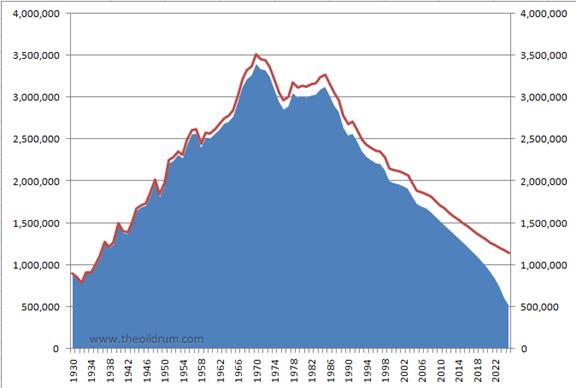
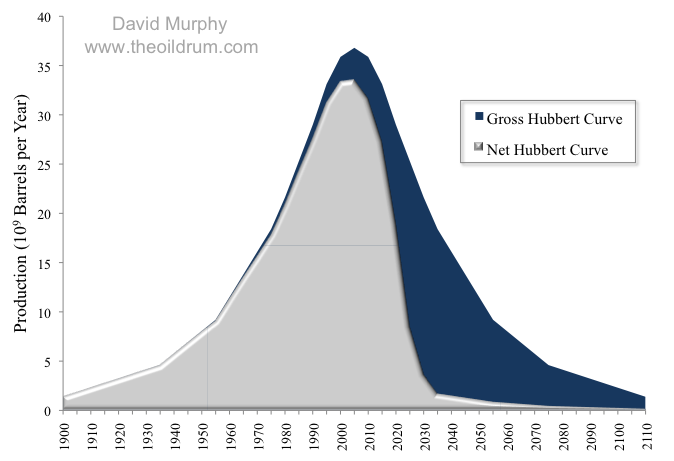
Also, since you mention EROEI in your sig, do you know of any charts of NET oil production (i.e., after subtracting the oil equivalent energy used to produce it)?
I did some digging to see if I can find this data for you. I found the figures for EROI ratios of oil production over time here, but this data is a few years old:Also, since you mention EROEI in your sig, do you know of any charts of NET oil production (i.e., after subtracting the oil equivalent energy used to produce it)?
$this->bbcode_second_pass_quote('', 'T')he running average EROI for the finding and production of US domestic oil has dropped from greater than 100 kilojoule returned per kilojoule invested in the 1930s to about thirty to one in the 1970s to between 11 and 18 to one today. This is a consequence of the decreasing energy returns as oil reservoirs are increasingly depleted and as there are increases in the energy costs as exploration and development are shifted increasing deeper and offshore. Even that ratio reflects mostly pumping out oil fields that are half a century or more old since we are finding few significant new fields. In other words we can say that new oil is becoming increasingly more costly, in terms of dollars and energy, to find and extract.
The same pattern of declining energy return on energy investment appears to be true for global petroleum production. Our preliminary results indicate that the EROI for global oil and gas was roughly 26:1 in 1992, increased to about 35:1 in 1999, and since has fallen to approximately 19:1 in 2005. The apparent increase in EROI during the late 1990s is during a period when drilling effort was relatively low and may reflect the effects of reduced drilling effort as was seen for oil and gas in the United States. If the rate of decline continues linearly for several decades then it would take the energy in a barrel of oil to get a new barrel of oil. Essentially all EROI studies of our principal fossil fuels do indicate that their EROI is declining over time, and the EROI declines especially rapidly with increased drilling rates. This decline appears to be reflected in economic results. In November of 2004 The New Your Times reported that for the previous three years of oil exploration companies worldwide had spent more money in exploration than they had recovered in the dollar value of reserves found. Thus even though the EROI of global oil and gas is still about 18:1 as of 2006, this ratio is for all exploration and production activities. It is possible that the energy break even point has been approached or even reached for finding new oil. Whether we have reached this point or not the concept of EROI declining toward 1:1 makes irrelevant the reports of several oil analysis who believe that we may have substantially more oil left in the world, because it does not makes sense to extract oil, at least for fuel, when it requires more energy for the extraction than is found in the oil extracted.
There is also some graphs here, but you have to scroll down to page 24 or 25 to see the graph you are interested in:
Energy Return on Energy Invested
The oil barrel is half-full.
-

kublikhan - Master Prognosticator

- Posts: 5064
- Joined: Tue 06 Nov 2007, 04:00:00
- Location: Illinois