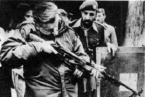
They're a seriously evil bunch:
Iraqis tell of guards' reckless behavior
$this->bbcode_second_pass_quote('', 'T')he young biology student pulled his car to the side of the busy traffic circle when he saw a fast-moving line of SUVs approaching from behind. As they flew past, he recalls, the lead vehicle appeared to intentionally smash into his sedan. But the worst was yet to come.
As the convoy sped off, a gunner inside the last sport utility vehicle sprayed the traffic circle with bullets. Pedestrians ran for cover. Seated in the car closest to the SUV, student Ali Karem Fakhri Hilal thrust his hands into the air to show he was unarmed.
But four cars behind him, Hussein Salih Mohammed Rabee, a retired businessman active in a local peace committee, was fatally wounded.


PeakOil is You
THE Blackwater Thread (merged)
Re: Blackwater security banned from Iraq
 by Zardoz » Mon 08 Oct 2007, 10:07:09
Why did that guy do that? I'll hazard a guess: Because he could.
"Thank you for attending the oil age. We're going to scrape what we can out of these tar pits in Alberta and then shut down the machines and turn out the lights. Goodnight." - seldom_seen
-

Zardoz - Expert

- Posts: 6323
- Joined: Fri 02 Dec 2005, 04:00:00
- Location: Oil-addicted Southern Californucopia
Re: Blackwater security banned from Iraq
by Zardoz » Fri 12 Oct 2007, 01:28:00
Blackwater Guards Fired at Fleeing Cars, Soldiers Say - First U.S. Troops on Scene Found No Evidence of Shooting by Iraqis; Incident Called 'Criminal'
$this->bbcode_second_pass_quote('', 'B')lackwater USA guards shot at Iraqi civilians as they tried to drive away from a Baghdad square on Sept. 16, according to a report compiled by the first U.S. soldiers to arrive at the scene, where they found no evidence that Iraqis had fired weapons.
"It appeared to me they were fleeing the scene when they were engaged. It had every indication of an excessive shooting," said Lt. Col. Mike Tarsa, whose soldiers reached Nisoor Square 20 to 25 minutes after the gunfire subsided.
His soldiers' report -- based upon their observations at the scene, eyewitness interviews and discussions with Iraqi police -- concluded that there was "no enemy activity involved" and described the shootings as a "criminal event." Their conclusions mirrored those reached by the Iraqi government, which has said the Blackwater guards killed 17 people.
$this->bbcode_second_pass_quote('', 'B')lackwater USA guards shot at Iraqi civilians as they tried to drive away from a Baghdad square on Sept. 16, according to a report compiled by the first U.S. soldiers to arrive at the scene, where they found no evidence that Iraqis had fired weapons.
"It appeared to me they were fleeing the scene when they were engaged. It had every indication of an excessive shooting," said Lt. Col. Mike Tarsa, whose soldiers reached Nisoor Square 20 to 25 minutes after the gunfire subsided.
His soldiers' report -- based upon their observations at the scene, eyewitness interviews and discussions with Iraqi police -- concluded that there was "no enemy activity involved" and described the shootings as a "criminal event." Their conclusions mirrored those reached by the Iraqi government, which has said the Blackwater guards killed 17 people.
"Thank you for attending the oil age. We're going to scrape what we can out of these tar pits in Alberta and then shut down the machines and turn out the lights. Goodnight." - seldom_seen
-
Zardoz - Expert
- Posts: 6323
- Joined: Fri 02 Dec 2005, 04:00:00
- Location: Oil-addicted Southern Californucopia
Re: Blackwater security banned from Iraq
by jboogy » Fri 12 Oct 2007, 02:06:39
Makes me wonder , are these seasoned , highly trained former special ops soldiers really so much more frightened and/or undisciplined than the young green soldiers that are there? They avoid a lot of the oversight and scrutiny that the legit armed forces operate under , by decree from the highest levels of government .Hmmm.... makes me wonder , remember the flattening of Fallujah ? What precipitated that was the killing of 4 Blackwater guys that had been sent into the lions den in undermanned , unarmored , underarmed SUV's. Hmmmm..... makes me wonder , these mens families seem to be hinting that their sons and husbands may have been sacrificed in pursuit of loftier goals , and interestingly enough Blackwater told these families they'd have to sue to get the incident reports and investigative results that they are understandably interested in seeing. I'm a wonderin' , could Blackwater and other mercenaries be there to provoke ? It seems as if the U.S. has done everything in it's power to destabilize Iraq , not the other way around . Is the endgame genocide ? We're doing a pretty good job of cleansing so far , 4 million? Iraq's have fled , mostly the educated middle class , a couple hundred thousand dead from disease , sanitation issues , another couple hundred thousand dead from either U.S. violence or Iraqi on Iraqi violence .Now we're arming the Sunni's ( the guys who have been killing our guys for the past 4 or 5 years) to fight the Shia's ! The Iraqi elected government is mostly Shia with ties to Iran !Zardoz , what if the invasion and occupation of Iraq isn't the most inept , monumental screw-up in the history of imperial conquest , but the most successful , cleverly disguised removal of an indigenous population since Europe colonized North America?Bush and Cheney say they sleep well at night ,... the sleep of the truly wicked?
Perhaps the population would be less swayed to socialism if we had fewer examples of socialism from our "Free Market Capitalists". -----fiddler dave
-

jboogy - Heavy Crude

- Posts: 1191
- Joined: Mon 06 Jun 2005, 03:00:00
- Location: the place where smartasses dwell
Re: Blackwater security banned from Iraq
by Zardoz » Fri 12 Oct 2007, 03:21:45
$this->bbcode_second_pass_quote('jboogy', '.')..what if the invasion and occupation of Iraq isn't the most inept, monumental screw-up in the history of imperial conquest, but the most successful, cleverly disguised removal of an indigenous population since Europe colonized North America? Bush and Cheney say they sleep well at night... the sleep of the truly wicked?
You're not the first to float that theory on this forum. It's been advanced several times, actually. As far-fetched as it may seem, you look at what we've done in Iraq, and the ever-deteriorating conditions, and it really does seem at times that the intent is to drive everybody out.
Is it all part of a diabolical plan? Who knows...
"Thank you for attending the oil age. We're going to scrape what we can out of these tar pits in Alberta and then shut down the machines and turn out the lights. Goodnight." - seldom_seen
-
Zardoz - Expert
- Posts: 6323
- Joined: Fri 02 Dec 2005, 04:00:00
- Location: Oil-addicted Southern Californucopia
Re: Blackwater security banned from Iraq
by eXpat » Sat 13 Oct 2007, 06:24:18
Families of Iraqis sue Blackwater USA link.Not that this would go anywhere mind you ...
"I learned long ago, never to wrestle with a pig. You get dirty, and besides, the pig likes it."
George Bernard Shaw
“You can ignore reality, but you can't ignore the consequences of ignoring reality.” Ayn Rand
George Bernard Shaw
“You can ignore reality, but you can't ignore the consequences of ignoring reality.” Ayn Rand
-

eXpat - Intermediate Crude

- Posts: 3801
- Joined: Thu 08 Jun 2006, 03:00:00
Re: Blackwater security banned from Iraq
by jboogy » Sat 13 Oct 2007, 18:45:51
I've suspected before but didn't want to believe , maybe the plan in the beginning was to have a stable puppet government but once it became clear the Iraqi's weren't going to cooperate they switched to re-locate and destroy mode. I don't think they'll ever be able neutralize all resistance , they might think they'll eventually be able to win a war of attrition or pound them into submission but I don't see it happening."One honest man defending his home is worth 10 trained soldiers"---Robin Hood
Perhaps the population would be less swayed to socialism if we had fewer examples of socialism from our "Free Market Capitalists". -----fiddler dave
-
jboogy - Heavy Crude
- Posts: 1191
- Joined: Mon 06 Jun 2005, 03:00:00
- Location: the place where smartasses dwell
Re: Blackwater security banned from Iraq
by bencole » Mon 20 Apr 2009, 22:37:21
http://www.msnbc.msn.com/id/30312789
Blackwater still operating as mercenaries in Iraq, without authorization. One could obviously conclude that blackwater has some sort of ties to intelligence agencies like the CIA which allows it to operate like this.
Blackwater still operating as mercenaries in Iraq, without authorization. One could obviously conclude that blackwater has some sort of ties to intelligence agencies like the CIA which allows it to operate like this.
- bencole
- Lignite

- Posts: 359
- Joined: Thu 26 Feb 2009, 03:29:52
Re: Blackwater security banned from Iraq
by Ferretlover » Wed 05 Aug 2009, 15:07:40
I know that this comes as a complete and utter surprise to me!:
$this->bbcode_second_pass_quote('', 'A')ugust 5, 2009 Blackwater boss and guards accused of murder and 'killing Iraqis for fun' Founder of security firm saw himself as a Christian Crusader whose task was to eliminate Muslims, former employees allege :
Two former employees of Blackwater have accused the private US security firm and its founder of killing Iraqis for fun, smuggling weapons and deceiving the State Department.
The men, who requested anonymity for fear of retaliation — one claimed that Blackwater management threatened to kill him — also claimed they had learnt that at least one person who has or planned to speak out against the US firm and its founder Erik Prince was “killed in mysterious circumstances”.
The claims were made in sworn statements filed in a court in Virginia earlier this week as part of a civil lawsuit by families of several Iraqis allegedly killed by Blackwater guards. …
$this->bbcode_second_pass_quote('', 'A')ugust 5, 2009 Blackwater boss and guards accused of murder and 'killing Iraqis for fun' Founder of security firm saw himself as a Christian Crusader whose task was to eliminate Muslims, former employees allege :
Two former employees of Blackwater have accused the private US security firm and its founder of killing Iraqis for fun, smuggling weapons and deceiving the State Department.
The men, who requested anonymity for fear of retaliation — one claimed that Blackwater management threatened to kill him — also claimed they had learnt that at least one person who has or planned to speak out against the US firm and its founder Erik Prince was “killed in mysterious circumstances”.
The claims were made in sworn statements filed in a court in Virginia earlier this week as part of a civil lawsuit by families of several Iraqis allegedly killed by Blackwater guards. …
Times Online
"Open the gates of hell!" ~Morgan Freeman's character in the movie, Olympus Has Fallen.
- Ferretlover
- Elite
- Posts: 5852
- Joined: Wed 13 Jun 2007, 03:00:00
- Location: Hundreds of miles further inland