


PeakOil is You
Nations Deficit a Surplus of Worry
First unread post • 12 posts
• Page 1 of 1
Nations Deficit a Surplus of Worry
 by deMolay » Tue 08 Dec 2009, 23:08:21
Unsustainable? http://www.washingtonpost.com/wp-dyn/co ... 03984.html
"We Are All Travellers, From The Sweet Grass To The Packing House, From Birth To Death, We Wander Between The Two Eternities". An Old Cowboy.
-

deMolay - Intermediate Crude

- Posts: 2671
- Joined: Sun 04 Sep 2005, 03:00:00
Re: Nations Deficit a Surplus of Worry
by timmac » Tue 08 Dec 2009, 23:29:44
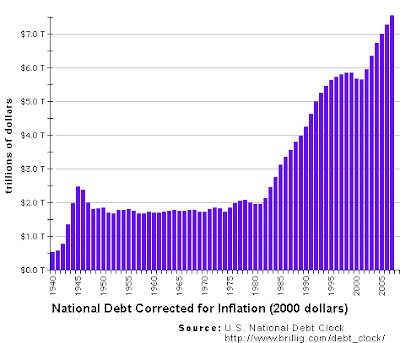
This is a very big problem for America right now [Debt], it will show its true ugly head around 2011 when we realize it is still growing out of hand and no stopping in site, it is almost equal to our GNP now and will exceed it late next year, to many countries right now are way over debt, this is going to blow someday and when it does it will finally be Doom for those that have been waiting for that day. 
-

timmac - Permanently Banned
- Posts: 1901
- Joined: Thu 27 Mar 2008, 03:00:00
- Location: Las Vegas
Re: Nations Deficit a Surplus of Worry
by Novus » Wed 09 Dec 2009, 00:18:10
People need stop shopping and consuming everything but you will never ever hear that from the media or TPTB because 70% of the economy is the consumer economy. We are in a no possible win situation here. A discontinuity event is coming where much has to reset. The consumer debt bubble economy has to be allowed to collapse so the 30% of the real economy can continue on.
-

Novus - Intermediate Crude
- Posts: 2450
- Joined: Tue 21 Jun 2005, 03:00:00
Re: Nations Deficit a Surplus of Worry
by deMolay » Wed 09 Dec 2009, 10:57:34
The Brits have quit trusting banks and have started stuffing their mattress's. http://www.dailymail.co.uk/news/article ... z0Yx3oZIOI
"We Are All Travellers, From The Sweet Grass To The Packing House, From Birth To Death, We Wander Between The Two Eternities". An Old Cowboy.
-
deMolay - Intermediate Crude
- Posts: 2671
- Joined: Sun 04 Sep 2005, 03:00:00
Re: Nations Deficit a Surplus of Worry
by rangerone314 » Wed 09 Dec 2009, 11:06:54
$this->bbcode_second_pass_quote('Novus', 'P')eople need stop shopping and consuming everything but you will never ever hear that from the media or TPTB because 70% of the economy is the consumer economy. We are in a no possible win situation here. A discontinuity event is coming where much has to reset. The consumer debt bubble economy has to be allowed to collapse so the 30% of the real economy can continue on.
AAAAAAAARGGGGGGGHHHHHHHHHHHH!
I'm going to build myself an actual Clue-by-Four made out of wood and hit people over the head whenever they quote 70%. I'm going to invent one that can fly like a boomerang or a UAV, so when I hear it on the radio or on TV, instread of cringing, I can hit the newcaster over the head, too.
That 70% is not an accurate figure, and was misquoted from original gov source, doesn't really truly mean 70% of the economy. First of even GDP excludes intermediate production and goods-in-process at the commodity, manufacturing, and wholesale stages. Things included in GDP like imputing rent that you pay yourself for owning a house, etc also distort GDP as a measure of the economy.
What stimulates the economy is business spending on capital goods, tax cuts, lower interest rates, and increasing productivity. Does it really help the US economy if you go to Walmart and buy some lead-infested toys manufactured by China?
Businesses are at the heart of the economy, not retail spending by consumers which is relatively stable, even during recessions.
40-50% is more of an accurate figure for what consumer spending really accounts for in the US economy.
At this point anyone who doesn't concede that national debts are a serious problem, and likely a crippling one in the future, is either lying to people or is deluded.
An ideology is by definition not a search for TRUTH-but a search for PROOF that its point of view is right
Equals barter and negotiate-people with power just take
You cant defend freedom by eliminating it-unknown
Our elected reps should wear sponsor patches on their suits so we know who they represent-like Nascar-Roy
Equals barter and negotiate-people with power just take
You cant defend freedom by eliminating it-unknown
Our elected reps should wear sponsor patches on their suits so we know who they represent-like Nascar-Roy
-

rangerone314 - Light Sweet Crude

- Posts: 4105
- Joined: Wed 03 Dec 2008, 04:00:00
- Location: Maryland
Re: Nations Deficit a Surplus of Worry
by pup55 » Wed 09 Dec 2009, 14:11:15
$this->bbcode_second_pass_quote('', 'P')eople need stop shopping and consuming everything
Therein is the paradox, isn't it?
If people consume less, there will be less demand for the stuff that a lot of us produce.....Autos and other manufactured goods, at the forefront, of course.....
How about if they quit buying houses, which they have: The market for appliances goes down to the level of the replacement rate for the old stuff.....
All of those auto workers and appliance sales people getting laid off? Surely you don't want that......a spiraling down effect....
Consumption must go on or the game comes to a quick close. But consumption at the scale we have been doing it can't continue because the supply of credit, a.k.a debt, is drying up.....
Like I said, therein lies the problem.
-
pup55 - Light Sweet Crude
- Posts: 5249
- Joined: Wed 26 May 2004, 03:00:00
Re: Nations Deficit a Surplus of Worry
by gnm » Wed 09 Dec 2009, 14:44:32
$this->bbcode_second_pass_quote('pup55', 'C')onsumption must go on or the game comes to a quick close. But consumption at the scale we have been doing it can't continue because the supply of credit, a.k.a debt, is drying up.....
Like I said, therein lies the problem.
Like I said, therein lies the problem.
And the scale at which it has been happening can't be supported by available resources much longer either - The whole of the peak oil argument.
Ranger, Obviously you need to distort GDP so the debt and deficits don't seem so bad. Hey, we are only running 12 trillion in debt, thats only 90% of GDP! Or Hey we're only running a 2 trillion dollar deficit, thats only 15% of GDP!

OK Never mind it sounds pretty bad still....
-G
- gnm
Re: Nations Deficit a Surplus of Worry
by yesplease » Wed 09 Dec 2009, 18:11:45
$this->bbcode_second_pass_quote('rangerone314', 'A')t this point anyone who doesn't concede that national debts are a serious problem, and likely a crippling one in the future, is either lying to people or is deluded.
Why wasn't a higher national debt compared to GDP crippling in the past?$this->bbcode_second_pass_quote('Professor Membrane', ' ')Not now son, I'm making ... TOAST!
-

yesplease - Intermediate Crude
- Posts: 3765
- Joined: Tue 03 Oct 2006, 03:00:00



 )
)