


PeakOil is You
Month by month peak oil
Month by month peak oil
 by PolestaR » Tue 28 Feb 2006, 11:48:09
Is there a month to month "production output" of oil available to look at? It would be helpful in predicting the peak I think.
- PolestaR
- Tar Sands

- Posts: 955
- Joined: Tue 21 Jun 2005, 03:00:00
Re: Month by month peak oil
by dada » Tue 28 Feb 2006, 11:59:22
IEA graphs for many countries for the past 10 years are available here:
http://omrpublic.iea.org/supplysearch.asp
Many of these 10 year graphs are quite dramatic. It looks like ODEC countries, as a group, are well into decline. OPEC, rather than increasing output, is decreasing. Saudi Arabia has not had a meaningful increase in production for over a year.
http://omrpublic.iea.org/supplysearch.asp
Many of these 10 year graphs are quite dramatic. It looks like ODEC countries, as a group, are well into decline. OPEC, rather than increasing output, is decreasing. Saudi Arabia has not had a meaningful increase in production for over a year.
-

dada - Wood

- Posts: 1
- Joined: Tue 28 Feb 2006, 04:00:00
Re: Month by month peak oil
by Leanan » Tue 28 Feb 2006, 12:10:16
You might find this story at the Oil Drum helpful.
-

Leanan - News Editor

- Posts: 4582
- Joined: Thu 20 May 2004, 03:00:00
Re: Month by month peak oil
by Zardoz » Tue 28 Feb 2006, 19:18:37

Any questions about when we hit the "undulating plateau" of the peak?
2008? 2012? 2115? We wish!
We're there, folks. Hirsch's worst-case scenario is unfolding right before our eyes, right now. It's only a matter of time before TSHTF.
Things are going to get very ugly, aren't they?
-

Zardoz - Expert

- Posts: 6323
- Joined: Fri 02 Dec 2005, 04:00:00
- Location: Oil-addicted Southern Californucopia
Re: Month by month peak oil
by turmoil » Tue 28 Feb 2006, 20:04:50
Enjoy the relative peace while it lasts...
"If you are a real seeker after truth, it's necessary that at least once in your life you doubt all things as far as possible"-Rene Descartes
"When you have excluded the impossible, whatever remains however improbable must be the truth"-Sherlock Holmes
"When you have excluded the impossible, whatever remains however improbable must be the truth"-Sherlock Holmes
-

turmoil - Heavy Crude

- Posts: 1088
- Joined: Fri 13 Aug 2004, 03:00:00
- Location: Richmond, VA, Pale Blue Dot
Re: Month by month peak oil
by PolestaR » Tue 28 Feb 2006, 20:09:11
Don't get me wrong, I want us to be peaked also, but......
The graph doesn't quite look like it has a plateau yet, or a real decline. Sure this COULD be the peak, but it could also not be, it isn't 100% proven yet I think.
The graph doesn't quite look like it has a plateau yet, or a real decline. Sure this COULD be the peak, but it could also not be, it isn't 100% proven yet I think.
- PolestaR
- Tar Sands
- Posts: 955
- Joined: Tue 21 Jun 2005, 03:00:00
Re: Month by month peak oil
by Revi » Tue 28 Feb 2006, 20:30:05
It may be that Ken Deffeyes was right and the peak was around the 16th of December, 2005. Whether it's the peak or not we are definitely on the plateau, so we aren't shooting up in production like we did the past five years or so. Even if we aren't at the absolute peak we are getting to the top of world oil production. It'll be a ride down soon. Enjoy the view from the summit!
-

Revi - Light Sweet Crude

- Posts: 7417
- Joined: Mon 25 Apr 2005, 03:00:00
- Location: Maine
Re: Month by month peak oil
by PWALPOCO » Tue 28 Feb 2006, 20:58:24
As dramatic as the graph above is , the post at The Oil Drum does point out that the slice of oil producing history being shown is quite small.
It would appear at first glance that the surging run of oil production maxed out at between 84-85mbd.
Putting it against the big historical context however ;
Link to image
The yellow area represents the area in the first graph in this thread. As you can see , in the big picture there have been little peaks and troughs and the occassional wobble in production along the way up till now.
Its obvious that based on previous patterns that you cant rely on a relatively short space of time to tell if youve peaked , hence the wisdom of the "rearview mirror".
Paul
It would appear at first glance that the surging run of oil production maxed out at between 84-85mbd.
Putting it against the big historical context however ;
Link to image
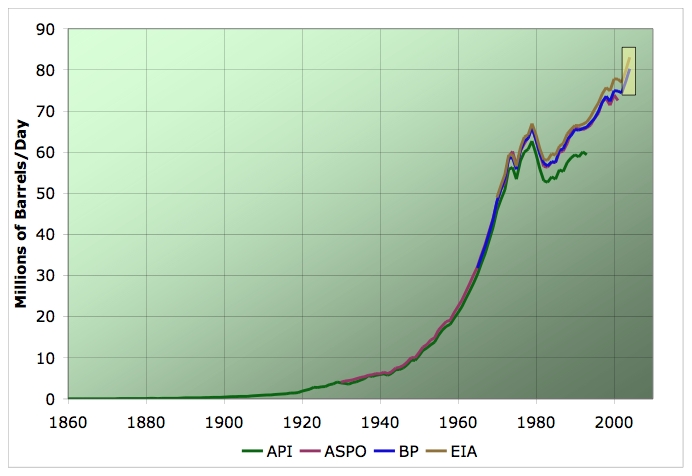
The yellow area represents the area in the first graph in this thread. As you can see , in the big picture there have been little peaks and troughs and the occassional wobble in production along the way up till now.
Its obvious that based on previous patterns that you cant rely on a relatively short space of time to tell if youve peaked , hence the wisdom of the "rearview mirror".
Paul
-
PWALPOCO - Lignite
- Posts: 296
- Joined: Sun 02 Oct 2005, 03:00:00
- Location: North Wales , UK
Re: Month by month peak oil
by Novus » Tue 28 Feb 2006, 22:02:48
$this->bbcode_second_pass_quote('Zardoz', '[')img]http://img211.imageshack.us/img211/6729/oilproductionjan062ay.jpg[/img]
Any questions about when we hit the "undulating plateau" of the peak?
2008? 2012? 2115? We wish!
We're there, folks. Hirsch's worst-case scenario is unfolding right before our eyes, right now. It's only a matter of time before TSHTF.
Things are going to get very ugly, aren't they?
Any questions about when we hit the "undulating plateau" of the peak?
2008? 2012? 2115? We wish!
We're there, folks. Hirsch's worst-case scenario is unfolding right before our eyes, right now. It's only a matter of time before TSHTF.
Things are going to get very ugly, aren't they?
The green line on that graph is the true oil out put after all revisions. According to the green line we hit a peak in October of 2004 just before Cantrell went into steap decline. I think the oil game it pretty much over now. The plateau will only last as long as Ghawar can maintain itself. After that the whole world goes into terminal decline. I think we will be in a heap of trouble by the end of the summer.
-

Novus - Intermediate Crude
- Posts: 2450
- Joined: Tue 21 Jun 2005, 03:00:00
Re: Month by month peak oil
by frankthetank » Wed 01 Mar 2006, 01:15:27
I wonder if it'll ever be possible to know the exact day we peaked?
-

frankthetank - Light Sweet Crude
- Posts: 6202
- Joined: Thu 16 Sep 2004, 03:00:00
- Location: Southwest WI
Re: Month by month peak oil
by rogerhb » Wed 01 Mar 2006, 03:33:06
$this->bbcode_second_pass_quote('frankthetank', 'I') wonder if it'll ever be possible to know the exact day we peaked?
I would not worry about that date, the ones you will remember are:
1. the date you lost your job
2. the date you were evicted
3. the date you first told your child there was nothing to eat
"Complex problems have simple, easy to understand, wrong answers." - Henry Louis Mencken
-

rogerhb - Light Sweet Crude
- Posts: 4727
- Joined: Mon 06 Sep 2004, 03:00:00
- Location: Smalltown New Zealand
Re: Month by month peak oil
by Revi » Wed 01 Mar 2006, 12:20:21
Is this it, the real Magilla? I have a feeling it might be the peak we all talk about. We'll see. I feel like Chicken Little, finally the sky is actually falling. See I told you this would happen. The problem is that the sky is falling on all of us.
-
Revi - Light Sweet Crude
- Posts: 7417
- Joined: Mon 25 Apr 2005, 03:00:00
- Location: Maine
Re: Month by month peak oil
by MfromAmsterdam » Wed 01 Mar 2006, 12:53:44
Sorry Guy's. We didn't mean to. It was just that the worlds that we let others create around us, were soo interesting that we forgot other more basic things.
Again we didn't mean to, we just weren't ment I guess...
Michel
Again we didn't mean to, we just weren't ment I guess...
Michel
- MfromAmsterdam
- Wood
- Posts: 40
- Joined: Wed 30 Nov 2005, 04:00:00
- Location: Amsterdam, Holland
Re: Month by month peak oil
by donshan » Wed 01 Mar 2006, 13:53:50
I too believe we are in the "undulating plateau" of peak oil now, but I would urge some caution about interpreting any one month's total production data.
The total production number includes increased production from new oil fields going into production minus depletion of old fields, weather events (Katrina/Rita) and geopolitical events ( e.g. Nigeria etc.).
In January, 2006 CIBI World Markets published a survey of 2006 that went into details about these factors.
See the Peak Oil discussion from last Jan for the link to the study:
http://www.peakoil.com/fortopic16539-0-asc-15.html
My point is that CIBI gives a table which shows over 30 new oil projects nearing significant new production in the next three years. They list new oil production of 3.6 million bbl/day in 2006, 3.7 in 2007, and 3.1 in 2008.
However they estimate 60% of this new production is needed to offset depletion leaving a net new production of about 3.5 million bbl/day increase in total production over the next 3 years. However this still leaves some room to expand total oil production IF weather and geopolitics don't interfere. However we all are seeing such news events every week. A reduction due to some world news event is NOT the geological peak in oil production we are looking for. Such a drop due to Katrina/Rita is clearly seen in the chart posted above.
My point is just to separate the underlying fundamental physical limits from production problems due to weather and geopolitics and technical problems and delays in new projects.
The CIBI study thinks there is a little room for another expansion in production to meet expanding demand for the next three years unless we have disruptions from Iran, Nigeria, Venezula, Iraq, Saudi Arabia etc , or more hurricane damage.
$this->bbcode_second_pass_quote('', 'S')ubtracting depletion of around 2.2 million barrels
annually from our estimates of new field production
capacity leaves about 3½ million barrels of daily
production available to support consumption growth
over the next three years. As noted previously, all of
the net increase in global production will come from
non-conventional sources such as deep-water and oil
sands production . Assuming that
consumption continues to increase at near a 2.5%
trend rate, spurred by rapidly rising energy demand
in countries like China and India, oil consumption will
soon exceed projected global supply growth, requiring
further price rationing to bring demand growth back
in to line with the very modest supply growth we see
lying ahead.
The total production number includes increased production from new oil fields going into production minus depletion of old fields, weather events (Katrina/Rita) and geopolitical events ( e.g. Nigeria etc.).
In January, 2006 CIBI World Markets published a survey of 2006 that went into details about these factors.
See the Peak Oil discussion from last Jan for the link to the study:
http://www.peakoil.com/fortopic16539-0-asc-15.html
My point is that CIBI gives a table which shows over 30 new oil projects nearing significant new production in the next three years. They list new oil production of 3.6 million bbl/day in 2006, 3.7 in 2007, and 3.1 in 2008.
However they estimate 60% of this new production is needed to offset depletion leaving a net new production of about 3.5 million bbl/day increase in total production over the next 3 years. However this still leaves some room to expand total oil production IF weather and geopolitics don't interfere. However we all are seeing such news events every week. A reduction due to some world news event is NOT the geological peak in oil production we are looking for. Such a drop due to Katrina/Rita is clearly seen in the chart posted above.
My point is just to separate the underlying fundamental physical limits from production problems due to weather and geopolitics and technical problems and delays in new projects.
The CIBI study thinks there is a little room for another expansion in production to meet expanding demand for the next three years unless we have disruptions from Iran, Nigeria, Venezula, Iraq, Saudi Arabia etc , or more hurricane damage.
$this->bbcode_second_pass_quote('', 'S')ubtracting depletion of around 2.2 million barrels
annually from our estimates of new field production
capacity leaves about 3½ million barrels of daily
production available to support consumption growth
over the next three years. As noted previously, all of
the net increase in global production will come from
non-conventional sources such as deep-water and oil
sands production . Assuming that
consumption continues to increase at near a 2.5%
trend rate, spurred by rapidly rising energy demand
in countries like China and India, oil consumption will
soon exceed projected global supply growth, requiring
further price rationing to bring demand growth back
in to line with the very modest supply growth we see
lying ahead.
I am in the camp that says we won't know for sure for several more years when the peak occurs. A small new peak in production is possible if peace breaks out.
Who will win- the forces of good trying their best to boost new oil production OR the forces of evil trying to destroy the world economy with Mother Nature stirring the pot? You can get a wide range of numbers in any given month depending on the answer. THe depletion rates used by CIBI also assume no sudden field collapse of Ghawar et. al.
An expert is someone who has made every mistake possible in their field and learned how to prevent them.
- donshan
- Lignite
- Posts: 279
- Joined: Wed 12 Oct 2005, 03:00:00
- Location: Washington State, USA
Re: Month by month peak oil
by Revi » Fri 03 Mar 2006, 10:29:34
Stuart Standiford from The Oil Drum seems pretty sure that the peak is now. Here's the blurb on his prediction from Mobjectivist:
http://mobjectivist.blogspot.com/2006/0 ... blimp.html
I would have given you the info from the Oil Drum, but I can't get it to come up any more on my computer for some reason. Hmmm....
http://mobjectivist.blogspot.com/2006/0 ... blimp.html
I would have given you the info from the Oil Drum, but I can't get it to come up any more on my computer for some reason. Hmmm....
-
Revi - Light Sweet Crude
- Posts: 7417
- Joined: Mon 25 Apr 2005, 03:00:00
- Location: Maine
Re: Month by month peak oil
by BO » Fri 03 Mar 2006, 11:20:10
$this->bbcode_second_pass_quote('donshan', 'H')owever they estimate 60% of this new production is needed to offset depletion leaving a net new production of about 3.5 million bbl/day increase in total production over the next 3 years. However this still leaves some room to expand total oil production IF weather and geopolitics don't interfere. However we all are seeing such news events every week. A reduction due to some world news event is NOT the geological peak in oil production we are looking for. Such a drop due to Katrina/Rita is clearly seen in the chart posted above.
My point is just to separate the underlying fundamental physical limits from production problems due to weather and geopolitics and technical problems and delays in new projects.
My point is just to separate the underlying fundamental physical limits from production problems due to weather and geopolitics and technical problems and delays in new projects.
I would agree, however, the CIBI projection of 60% of new production to offset depletion is wildly optimistic. Stuart Staniford at The Oil Drum reports the following:
$this->bbcode_second_pass_quote('', 'A')n analysis of Exxon's production suggests the problem. Their existing production apparently declines at rates varying from 6% to 14% per year. Thus all the new projects they bring on stream each year just serve to offset the declines in their current fields. This strongly suggests they are at or near peak. More recently, it emerged that in 2005, they hardly replaced any of their oil reserves - instead almost all of the quoted energy reserves they developed were actually natural gas (in Qatar). Shell is even worse off - they only replaced 60%-70% of production in 2005, and only 19% in 2004.
The situation does not appear to be much better in OPEC. According to the US EIA, Saudi production is declining 5% to 12% each year. So they have to bring on that much new production just to stay level. Similarly, Iranian production is estimated to decline 8%-13% each year.
This to me is the most compelling argument that we must be close to peak oil production. The amount of new production required every year just to stay level is enormous. We know this was the main symptom of US peak - all quotas were removed (oil production in Texas was managed via a quota system), and despite strenuous efforts to increase production, it never could climb higher. It is noteworthy that a number of OPEC officials were quoted in 2005 saying that OPEC was producing everything it could with effectively no quotas.
In order to believe the peak is years off, you must assume, as CIBI did, that decline rates are around 2-3%, which is ludicrous, as we can see in th e oil majors own production data, as well as SA, North Sea, Canterell, Burgan, etc. that the decline rate will almost certainly be between 8-10%, perhaps even higher.
Say its 8%, that means we need 6.72 Million barrels a day additional production, each year, just to stay even, and CIBI is projecting 3 maybe 4 million in new production, per year? We are in trouble now my friends
Growth for the sake of growth is the ideology of the cancer cell.
-Edward Abbey
http://permanentlyindignant.wordpress.com/
-Edward Abbey
http://permanentlyindignant.wordpress.com/
-

BO - Peat
- Posts: 111
- Joined: Fri 02 Sep 2005, 03:00:00
- Location: Philadelphia, PA