by Tyler_JC » Thu 24 Jan 2008, 17:14:15
$this->bbcode_second_pass_quote('pstarr', '
')
The Law of Receding Horizons is a particular model that Westtexas and others at the OilDrum created to examine and predict future access to nonconventional crudes. It has proven accurate. It is a pretty simple concept. As petroleum prices increases, petroleum extraction equipment (built with petroleum) prices also go up.
The confusion arises when those tool prices do not go up in lockstep, but only appear after a delay. Such is the nature of a complex industrial society. It takes time for inflation to filter through the system.
I take issue with two of your points.
The cost of non-oil resources hasn't increased in price even close to the increase in oil. Even when you factor in the lead time.
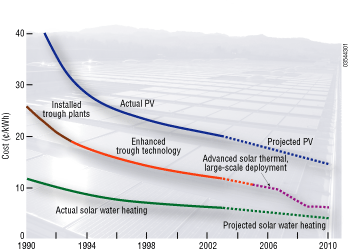
Wind turbine costs have risen, but only because they haven't built enough capacity to meet demand. It has nothing to do with the cost of oil, it has to do with supply and demand.
As oil gets more expensive, people swap to alternatives and push up demand for those alternatives.
The result is higher prices and higher profits for producers. The result of that is more capacity and lower prices.
Higher oil prices lead to more
demand for oil extraction equipment. It has little to do with the cost of producing the machinery and a lot to do with demand for oil wells.
The world's petroleum engineers are renting out every single piece of oil extraction equipment in order to make as much money as possible. They are paying top dollar for equipment because they know that they can make big profits given the high price of their output, oil.
Schlumberger, the world's leading oil services company, increased profits by 22% in the fourth quarter. Is that because their costs are skyrocketing because of higher oil prices? Or are they making big profits because the demand for oil services has increased dramatically with higher prices?
The LRH ignores cause and effect.