I am still not sure which way it will go. There are a number of things on each side that may cause inflation, such as the Fed, and there are other things that are causing deflation like the collapse of the economy in general and the huge amount of derivatives still out there that have to be paid off.
Will the Fed and other central banks be able to print enough money to get us into a real inflationary spiral?
Or will we fall back into a deflationary depression because asset prices just keep going down despite the best efforts of the money printers?



PeakOil is You
Inflation or Deflation? What will Peak Oil cause?
Inflation or Deflation? What will Peak Oil cause?
 by Revi » Mon 17 Sep 2012, 10:34:26
Deep in the mud and slime of things, even there, something sings.
-

Revi - Light Sweet Crude

- Posts: 7417
- Joined: Mon 25 Apr 2005, 03:00:00
- Location: Maine
Re: Inflation or Deflation? What will Peak Oil cause?
by Daniel_Plainview » Mon 17 Sep 2012, 11:05:46
If you define "deflation" broadly to include the collapse of credit/lending, and collapse of asset bubbles (and related derivatives), then there's no doubt in my mind that "deflation" will prevail.
Definition of deflation:
$this->bbcode_second_pass_quote('', 'I')n modern credit-based economies, a deflationary spiral may be caused by the (central bank) initiating higher interest rates (i.e., to 'control' inflation), thereby possibly popping an asset bubble or the collapse of a command economy which has been run at a higher level of production than it could actually support. In a credit-based economy, a fall in money supply leads to markedly less lending, with a further sharp fall in money supply, and a consequent sharp fall-off in demand for goods. Demand falls, and with the falling of demand, there is a fall in prices as a supply glut develops. This becomes a deflationary spiral when prices fall below the costs of financing production. Businesses, unable to make enough profit no matter how low they set prices, are then liquidated. Banks get assets which have fallen dramatically in value since the (mortgage) loan was made, and if they sell those assets, they further glut supply, which only exacerbates the situation. To slow or halt the deflationary spiral, banks will often withhold collecting on non-performing loans (as in Japan, most recently). This is often no more than a stop-gap measure, because they must then restrict credit, since they do not have money to lend, which further reduces demand, and so on.
Definition of deflation:
$this->bbcode_second_pass_quote('', 'I')n modern credit-based economies, a deflationary spiral may be caused by the (central bank) initiating higher interest rates (i.e., to 'control' inflation), thereby possibly popping an asset bubble or the collapse of a command economy which has been run at a higher level of production than it could actually support. In a credit-based economy, a fall in money supply leads to markedly less lending, with a further sharp fall in money supply, and a consequent sharp fall-off in demand for goods. Demand falls, and with the falling of demand, there is a fall in prices as a supply glut develops. This becomes a deflationary spiral when prices fall below the costs of financing production. Businesses, unable to make enough profit no matter how low they set prices, are then liquidated. Banks get assets which have fallen dramatically in value since the (mortgage) loan was made, and if they sell those assets, they further glut supply, which only exacerbates the situation. To slow or halt the deflationary spiral, banks will often withhold collecting on non-performing loans (as in Japan, most recently). This is often no more than a stop-gap measure, because they must then restrict credit, since they do not have money to lend, which further reduces demand, and so on.
However, the final "endgame" will include a total devaluation of fiat currencies, and when currencies become worthless, this is defined as "hyperinflation". Thus, the endgame contemplates that credit-deflation and fiat hyperinflation will coexist simultaneously.
-

Daniel_Plainview - Prognosticator

- Posts: 4220
- Joined: Tue 06 May 2008, 03:00:00
- Location: 7035 Hollis ... Near the Observatory ... Just down the way, tucked back in the small woods
Re: Inflation or Deflation? What will Peak Oil cause?
by mmasters » Mon 17 Sep 2012, 11:13:12
Both = Stagflation.
-

mmasters - Intermediate Crude

- Posts: 2272
- Joined: Sun 16 Apr 2006, 03:00:00
- Location: Mid-Atlantic
Re: Inflation or Deflation? What will Peak Oil cause?
by Pops » Mon 17 Sep 2012, 11:21:29
Commodities dependent on energy will be worth relatively more, assets like cars, houses, stocks, bonds and by extension; jobs, will necessarily be worth relatively less.
I have no idea how "money" will react.
I have no idea how "money" will react.
The legitimate object of government, is to do for a community of people, whatever they need to have done, but can not do, at all, or can not, so well do, for themselves -- in their separate, and individual capacities.
-- Abraham Lincoln, Fragment on Government (July 1, 1854)
-- Abraham Lincoln, Fragment on Government (July 1, 1854)
-

Pops - Elite

- Posts: 19746
- Joined: Sat 03 Apr 2004, 04:00:00
- Location: QuikSac for a 6-Pac
Re: Inflation or Deflation? What will Peak Oil cause?
by Pops » Mon 17 Sep 2012, 16:14:06
I wasn't very good describing that answer... I'll try again:
I think essentials will be more expensive and take an ever larger proportion of shrinking incomes (commodity inflation), leaving little left over for investing in assets like a 2,000sf SheetRock Shangri La or IRA (asset deflation).
Cheap energy makes essentials cheap, jobs plentiful and extravagance normal. Each of us reading this employ a couple hundred energy slaves so we are able to get more stuff than anyone, ever. It follows that fewer slaves means more expensive essentials, less stuff, fewer jobs/lower wages and the end of widespread extravagance.
"Money" will do this and that - who knows? But the facts on the ground will be McDonalds gets relatively more expensive and McMansions less so.
I think essentials will be more expensive and take an ever larger proportion of shrinking incomes (commodity inflation), leaving little left over for investing in assets like a 2,000sf SheetRock Shangri La or IRA (asset deflation).
Cheap energy makes essentials cheap, jobs plentiful and extravagance normal. Each of us reading this employ a couple hundred energy slaves so we are able to get more stuff than anyone, ever. It follows that fewer slaves means more expensive essentials, less stuff, fewer jobs/lower wages and the end of widespread extravagance.
"Money" will do this and that - who knows? But the facts on the ground will be McDonalds gets relatively more expensive and McMansions less so.
The legitimate object of government, is to do for a community of people, whatever they need to have done, but can not do, at all, or can not, so well do, for themselves -- in their separate, and individual capacities.
-- Abraham Lincoln, Fragment on Government (July 1, 1854)
-- Abraham Lincoln, Fragment on Government (July 1, 1854)
-
Pops - Elite
- Posts: 19746
- Joined: Sat 03 Apr 2004, 04:00:00
- Location: QuikSac for a 6-Pac
Re: Inflation or Deflation? What will Peak Oil cause?
by dinopello » Mon 17 Sep 2012, 16:55:51
I generally agree with pops, especially about money. But I think houses need to be in a special category too as it is location, location, location and not just the materials that it's made from. You can argue about what locations and what kind of living arrangements will inflate and which will deflate but I don't think it will be at all uniform.
-

dinopello - Light Sweet Crude
- Posts: 6088
- Joined: Fri 13 May 2005, 03:00:00
- Location: The Urban Village
Re: Inflation or Deflation? What will Peak Oil cause?
by Revi » Tue 18 Sep 2012, 12:27:04
I think it will be a combo of both. The prices of most of the things people need to buy will go up, while meanwhile the prices of a lot of big things go down. Houses are dropping, but good land seems to be holding its value. I think the economy is like a big yard sale. People are selling off anything they can, and spending it on necessities.
Deep in the mud and slime of things, even there, something sings.
-
Revi - Light Sweet Crude
- Posts: 7417
- Joined: Mon 25 Apr 2005, 03:00:00
- Location: Maine
Re: Inflation or Deflation? What will Peak Oil cause?
by dolanbaker » Tue 18 Sep 2012, 15:54:32
Until all of that QE money is released into the wild! (it's resting in the banks at the moment)
The inflation is likely to go through the roof, the banksters final throw of the dice.
The inflation is likely to go through the roof, the banksters final throw of the dice.
Religion is regarded by the common people as true, by the wise as false, and by rulers as useful.:Anonymous
Our whole economy is based on planned obsolescence.
Hungrymoggy "I am now predicting that Europe will NUKE ITSELF sometime in the first week of January"
Our whole economy is based on planned obsolescence.
Hungrymoggy "I am now predicting that Europe will NUKE ITSELF sometime in the first week of January"
-

dolanbaker - Intermediate Crude
- Posts: 3855
- Joined: Wed 14 Apr 2010, 10:38:47
- Location: Éire
Re: Inflation or Deflation? What will Peak Oil cause?
by vision-master » Tue 18 Sep 2012, 17:57:05
Dang, sounds like I better get that new Van I've been looking at for 2.99% interest before things start getting krazy........
- vision-master
Re: Inflation or Deflation? What will Peak Oil cause?
by dorlomin » Tue 18 Sep 2012, 19:17:38
Slowing of the velocity of money... deflation. Destruction of the value of notional assets... deflation. Going to take a lot of printing to keep up.
-

dorlomin - Light Sweet Crude
- Posts: 5193
- Joined: Sun 05 Aug 2007, 03:00:00
Re: Inflation or Deflation? What will Peak Oil cause?
by sparky » Wed 19 Sep 2012, 06:22:31
.
The last time ( 1973\74 ) there was a strong deflation
followed by rip roaring inflation when growth returned
the jobs didn't grow but money just exploded , that was the Stagflation
I agree with a bit of both ,
I'm just not sure in which proportion , when in the cycle
and which one is going to lead the dance
My fear is a really.... really ..long deflation of more than a decade
That seems to be Mr Bernanke fear too , he is madly pumping air into a busted football
The last time ( 1973\74 ) there was a strong deflation
followed by rip roaring inflation when growth returned
the jobs didn't grow but money just exploded , that was the Stagflation
I agree with a bit of both ,
I'm just not sure in which proportion , when in the cycle
and which one is going to lead the dance
My fear is a really.... really ..long deflation of more than a decade
That seems to be Mr Bernanke fear too , he is madly pumping air into a busted football
-

sparky - Intermediate Crude
- Posts: 3587
- Joined: Mon 09 Apr 2007, 03:00:00
- Location: Sydney , OZ
Re: Inflation or Deflation? What will Peak Oil cause?
by ritter » Wed 19 Sep 2012, 11:45:54
$this->bbcode_second_pass_quote('Revi', 'I') am still not sure which way it will go.
I'm really not sure it matters to most of us. Implosion or explosion. Either way it's going to destroy BAU. And then climate change and energy depletion will be along to finish us poor huddled masses off. Fun times.
- ritter
- Tar Sands

- Posts: 858
- Joined: Fri 14 Oct 2005, 03:00:00
Re: Inflation or Deflation? What will Peak Oil cause?
by evilgenius » Thu 20 Sep 2012, 11:24:23
Seeing as how the price of things can only reflect the money that people have to pay for them I have always thought that deflation was lurking post crash. That being said there are situations where those that demand payment can extort more money, even in a downward game. An increase in the price of renting is one example of how this can go on because of the dynamic of collapsing home ownership rates. Even when there is less money per person a market with a sudden increase in participants can see price rises. The same goes for what would happen with a severe food shortage. I suppose, given this, the outlook will be determined by the length of the crisis. Peak oil has not materialized as an all out trend, rather a series of plateaus and state changes largely manifested in economic reality. Some say this is nothing but a stall. While I tend to agree I also don't rule out recovery to one level of sustainability or another. It is whether equilibrium brings a continued reassessment, much like a game of musical chairs, or brighter ideas concerning the distribution of wealth that will ultimately answer the question.
-

evilgenius - Intermediate Crude
- Posts: 3730
- Joined: Tue 06 Dec 2005, 04:00:00
- Location: Stopped at the Border.
Re: Inflation or Deflation? What will Peak Oil cause?
by Revi » Mon 01 Oct 2012, 09:27:32
I think the Fed is doing everything possible to get inflation going instead of deflation. This morning's remarks by a Fed official sparked a vertical rise in silver of over a buck. Meanwhile oil is down. It's hard to tell what's going on by looking only at micro events. The bigger picture is probably asset price deflation for most people while the price of things we have to buy, or "giffen goods" going up. In the Irish potato famine the price of food kept rising because people had no choice but to buy it. That may be the way it will go with food here, and gasoline to some extent. I think it's replaceable, but most people feel they have no choice but to buy it. Meanwhile things like McMansions and boats will continue to fall, because they were things people bought back when they had money and they have almost no value now.
http://en.wikipedia.org/wiki/Giffen_good
http://en.wikipedia.org/wiki/Giffen_good
Deep in the mud and slime of things, even there, something sings.
-
Revi - Light Sweet Crude
- Posts: 7417
- Joined: Mon 25 Apr 2005, 03:00:00
- Location: Maine
Re: Inflation or Deflation? What will Peak Oil cause?
by shortonoil » Sun 14 Oct 2012, 14:22:01
evilgenius said:
$this->bbcode_second_pass_quote('', 'P')eak oil has not materialized as an all out trend
$this->bbcode_second_pass_quote('', 'P')eak oil has not materialized as an all out trend
Robelius in his "Giant Oil Fields – The Highway to Oil"
http://www.google.com/search?q=Uppsala+ ... =firefox-a
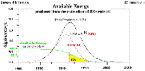
explains what is really happening with Peak Oil; which at this point should be called Plateau Oil. To summarize (for those who don't want to wade through the 168 pages of his study) most of the world's production comes from a very few fields. Of the world's 48,000 fields, 60% of the world's production comes from just 1% of those fields. 25% comes from 20 fields. These Mega producers have been on a plateau since 2005, but they probably won't be for much longer (end study).
Conventional crude peaked in 1999, but Canadian tar sands and Venezuela extra heavy (API-8) growth kept production increasing marginally until 2004 - 2005. Even though production has not declined significantly because of the plateauing of the Giants (this trend is distinctly displayed in our World Water Cut vs Time graphs) the energy required to produce oil has continued to increase (a 2'nd Law effect). The economic doldrums we are now experiencing are probably the result of the reduced quantity of energy that is being delivered to the end consumer; this has slowed economic growth, and exacerbated liability loads and loose monetary policy.
Over the next three to four years we can expect the Giants to start coming off their plateau; decline rates could be as high as 16% (Robelius). Of course, there will be no way to compensate for this lost production. The Middle East can perhaps cover some of this loss for a couple of years, but their production is also mostly dependent on their Giants.
Oil prices have increased over 450% during the last decade. If this trend continues (it will because production costs are increasing; we now have an eight year doubling time) oil will be over $200 by the early 2020's. Transportation fuels will be in the the teens by the mid twenties, and the integrated global economy which requires the world wide, low cost movement of goods will grind to a halt.
We have now extracted 84% of the the world's URR of petroleum. Even though that leaves a lot of oil yet to be removed (approx. 320 Gb), it doesn't help very much; the last 16% will cost orders of magnitude more to produce than did the first 16. Not withstanding, we can expect a lot more economic decline in the years ahead. Debt based monetary systems can not survive a contracting economy for very long; contraction leaves no way to service the debt that already exists. The FED has invested $14 trillion to rescue the banks from their bad debt. The ECB is attempting to do the same. Thus, inflation or deflation is probably a rhetorical question - it assumes a functioning and ongoing monetary system.
The Hill's Group
-
shortonoil - False ETP Prophet

- Posts: 7132
- Joined: Thu 02 Dec 2004, 04:00:00
- Location: VA USA
Re: Inflation or Deflation? What will Peak Oil cause?
by AgentR11 » Sun 14 Oct 2012, 15:22:10
Its really quite simple, a per-capita physically shrinking economy, expressed in the form of an arbitrarily increasing number of per-capita US$. Creates nominal growth, without creating real physical growth.
You thus get BS like a low CPI and people being amazed at how high their fuel&food spending have risen.
Anyone note the articles on the lowest cost of living adjustment for SS in years? Do you think those seniors, who are spending a sizable portion of their income on food&drugs, think inflation is almost non-existent????
This game is just getting started.
You thus get BS like a low CPI and people being amazed at how high their fuel&food spending have risen.
Anyone note the articles on the lowest cost of living adjustment for SS in years? Do you think those seniors, who are spending a sizable portion of their income on food&drugs, think inflation is almost non-existent????
This game is just getting started.
Yes we are, as we are,
And so shall we remain,
Until the end.
And so shall we remain,
Until the end.
- AgentR11
- Light Sweet Crude
- Posts: 6589
- Joined: Tue 22 Mar 2011, 09:15:51
- Location: East Texas
41 posts
• Page 1 of 3 • 1, 2, 3
Who is online
Users browsing this forum: No registered users and 12 guests