Half World's Fossil Fuel Assets Could Become Worthless by 2036 in Net Zero Transition (theguardian.com) 7
Posted by msmash on Friday November 05, 2021 @02:46PM from the closer-look dept.
About half of the world's fossil fuel assets will be worthless by 2036 under a net zero transition, according to research. From a report:
Countries that are slow to decarbonise will suffer but early movers will profit; the study finds that renewables and freed-up investment will more than make up for the losses to the global economy. It highlights the risk of producing far more oil and gas than required for future demand, which is estimated to leave $11tn-$14tn in so-called stranded assets -- infrastructure, property and investments where the value has fallen so steeply they must be written off. The lead author, Jean-Francois Mercure of the University of Exeter, said the shift to clean energy would benefit the world economy overall, but it would need to be handled carefully to prevent regional pockets of misery and possible global instability. "In a worst-case scenario, people will keep investing in fossil fuels until suddenly the demand they expected does not materialise and they realise that what they own is worthless. Then we could see a financial crisis on the scale of 2008," he said, warning oil capitals such as Houston could suffer the same fate as Detroit after the decline of the US car industry unless the transition is carefully managed.
https://www.theguardian.com/environment ... transition



PeakOil is You
Half World's Fossil Fuel Assets Could Be Worthless by 2036
34 posts
• Page 1 of 2 • 1, 2
Half World's Fossil Fuel Assets Could Be Worthless by 2036
 by BrianC » Fri 05 Nov 2021, 15:25:33
- BrianC
- Peat

- Posts: 90
- Joined: Tue 03 Mar 2020, 13:49:10
Re: Half World's Fossil Fuel Assets Could Become Worthless b
by Pops » Fri 05 Nov 2021, 16:33:44
$this->bbcode_second_pass_quote('BrianC', ' ')"In a worst-case scenario, people will keep investing in fossil fuels until suddenly the demand they expected does not materialise and they realise that what they own is worthless. Then we could see a financial crisis on the scale of 2008,"
Actually the worst case is people DO stop investing in fossils but governments like the US under the republicans plus Joe Coal Mansion don't go all out on renewables.
The depression we would fall into with a sudden drop in US shale of 5mm/bbls/day in ONE year plus a global decline of 6%-8% per year with zero fossil investment would make those stupid bets back in the oughts look like penny ante poker at the old folks home.
We're out on a limb. Fracking has never turned the profits it promised—or they wouldn't need to continuously borrow— the could simply re-invest a part of their profits. But LTO isn't profitable enough, it is dependent on US subsidizing the low interest rates and low returns everywhere else that causes institutions to throw good money after bad. It isn't necessarily low energy return on energy invested, who knows about that? But it is simple insufficient ROI in regular old dollars.
That tells us we are past the bubble. Our savior was a con-job. Sound familiar?
Generally Rs worry about energy cost more and Ds worry about warming more but 70% of all Americans are some or a lot worried about warming, the highest ever. The result will be more and more pressure to divest from carbon. But lots of people (like Coal Mansion and most elected Rs) are worried about their Sugar Daddy money. They will try to stop RE progress for the very reason posted above, money left on the table.
We need to ramp up diffuse energy collection at an even faster pace, much faster. Not just fast enough to outrun plain old decline, aka, the Red Queen, or to prevent the worst of warming but fast enough to outrun the failure to drill too.
A crazy thing to write
.
https://climatecommunication.yale.edu/p ... le-energy/
https://climatecommunication.yale.edu/p ... te-change/
The legitimate object of government, is to do for a community of people, whatever they need to have done, but can not do, at all, or can not, so well do, for themselves -- in their separate, and individual capacities.
-- Abraham Lincoln, Fragment on Government (July 1, 1854)
-- Abraham Lincoln, Fragment on Government (July 1, 1854)
-

Pops - Elite

- Posts: 19746
- Joined: Sat 03 Apr 2004, 04:00:00
- Location: QuikSac for a 6-Pac
Re: Half World's Fossil Fuel Assets Could Become Worthless b
by jawagord » Fri 05 Nov 2021, 16:37:38
I suggest the worst-case scenario is when energy companies fail to invest in new supplies based upon the stranded assets fear, while world population growth continues to drive demand and prices up to record levels and throws the world into a new recession. Happy to own O&G stocks in Brandon's ESG world.
A lack of investment in new oil and gas supplies, amid a shift in focus to cleaner fuels, is likely to drive price volatility in the next decade as demand for traditional energy sources grows, senior industry executives said.
Global energy investment saw its biggest fall on record in 2020 when the COVID-19 pandemic hammered demand, while a push for energy transition to meet greener targets pulled more funds into renewable resources.
"It seems likely that rather than falling, global oil demand is set to continue to rise as new markets and consumers emerge," Ben Luckock, co-head of oil trading at Trafigura said at the annual APPEC 2021 conference.
"That raises the prospect of potential cycles of higher prices for traditional forms of energy.
"Whilst that might be beneficial to oil producers in the short term, it also means significant costs to the global economy which is in nobody's long-term interest," Luckock added.
https://www.reuters.com/business/energy ... 021-09-28/
A lack of investment in new oil and gas supplies, amid a shift in focus to cleaner fuels, is likely to drive price volatility in the next decade as demand for traditional energy sources grows, senior industry executives said.
Global energy investment saw its biggest fall on record in 2020 when the COVID-19 pandemic hammered demand, while a push for energy transition to meet greener targets pulled more funds into renewable resources.
"It seems likely that rather than falling, global oil demand is set to continue to rise as new markets and consumers emerge," Ben Luckock, co-head of oil trading at Trafigura said at the annual APPEC 2021 conference.
"That raises the prospect of potential cycles of higher prices for traditional forms of energy.
"Whilst that might be beneficial to oil producers in the short term, it also means significant costs to the global economy which is in nobody's long-term interest," Luckock added.
https://www.reuters.com/business/energy ... 021-09-28/
Don't deny the peak!
- jawagord
- Lignite
- Posts: 314
- Joined: Mon 29 May 2017, 10:49:17
Re: Half World's Fossil Fuel Assets Could Become Worthless b
by Tanada » Fri 05 Nov 2021, 22:08:35
$this->bbcode_second_pass_quote('Pops', '')$this->bbcode_second_pass_quote('BrianC', ' ')"In a worst-case scenario, people will keep investing in fossil fuels until suddenly the demand they expected does not materialise and they realise that what they own is worthless. Then we could see a financial crisis on the scale of 2008,"
Actually the worst case is people DO stop investing in fossils but governments like the US under the republicans plus Joe Coal Mansion don't go all out on renewables.
The depression we would fall into with a sudden drop in US shale of 5mm/bbls/day in ONE year plus a global decline of 6%-8% per year with zero fossil investment would make those stupid bets back in the oughts look like penny ante poker at the old folks home.
We're out on a limb. Fracking has never turned the profits it promised—or they wouldn't need to continuously borrow— the could simply re-invest a part of their profits. But LTO isn't profitable enough, it is dependent on US subsidizing the low interest rates and low returns everywhere else that causes institutions to throw good money after bad. It isn't necessarily low energy return on energy invested, who knows about that? But it is simple insufficient ROI in regular old dollars.
That tells us we are past the bubble. Our savior was a con-job. Sound familiar?
Generally Rs worry about energy cost more and Ds worry about warming more but 70% of all Americans are some or a lot worried about warming, the highest ever. The result will be more and more pressure to divest from carbon. But lots of people (like Coal Mansion and most elected Rs) are worried about their Sugar Daddy money. They will try to stop RE progress for the very reason posted above, money left on the table.
We need to ramp up diffuse energy collection at an even faster pace, much faster. Not just fast enough to outrun plain old decline, aka, the Red Queen, or to prevent the worst of warming but fast enough to outrun the failure to drill too.
A crazy thing to write
.
https://climatecommunication.yale.edu/p ... le-energy/
https://climatecommunication.yale.edu/p ... te-change/
I am not nearly the climate optimist you are Pops. For one thing, the USA or event the USA + EU are not the world by a very long distance. China and India are still investing a lot of cash into building new coal burning facilities and they are not limiting that to their own territory. East Africa has a major grid expansion boom going on right now financed largely by China. India is doing a lot of internal coal based construction projects as are several of the "Asian tigers" including Indonesia. In North America + Western Europe RE is a smoke screen for building many more natural gas burning facilities.
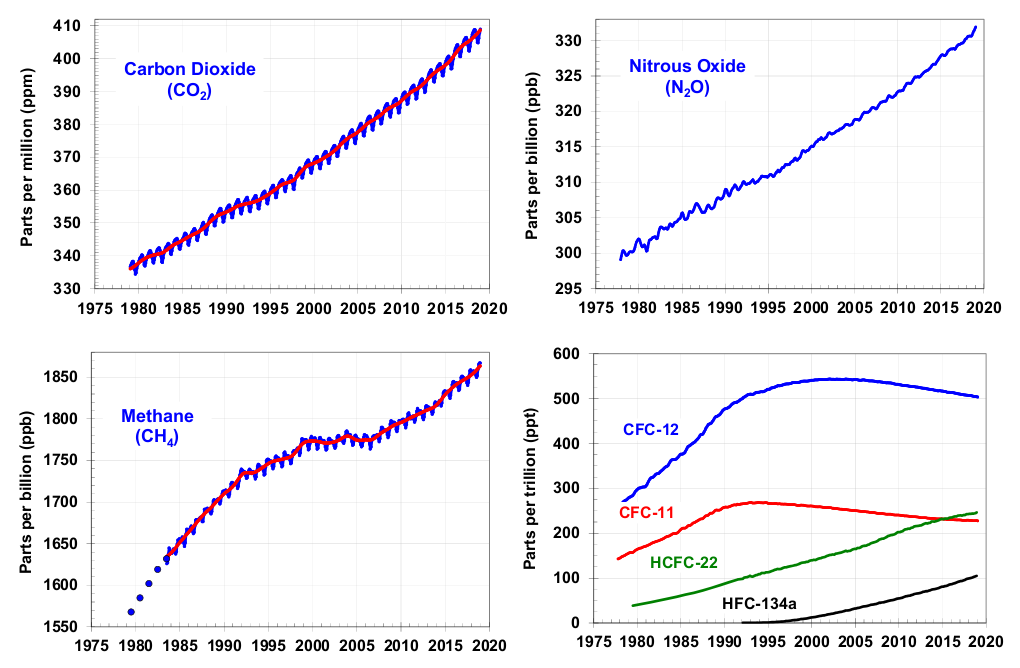
Western politicians give lots of lip service to climate change, but look at the record of what has actually been done. I don't think anyone can look at the real world data and claim we have made even the tiniest hint of progress since 1997.
$this->bbcode_second_pass_quote('Alfred Tennyson', 'W')e are not now that strength which in old days
Moved earth and heaven, that which we are, we are;
One equal temper of heroic hearts,
Made weak by time and fate, but strong in will
To strive, to seek, to find, and not to yield.
Moved earth and heaven, that which we are, we are;
One equal temper of heroic hearts,
Made weak by time and fate, but strong in will
To strive, to seek, to find, and not to yield.
- Tanada
- Site Admin

- Posts: 17094
- Joined: Thu 28 Apr 2005, 03:00:00
- Location: South West shore Lake Erie, OH, USA