Thanks for that I was massively interested in a bit more DIY solar around here.
I wanted a back up system to run a chest freezer and another system up near my car park, to charge an ebike,run an irrigation system from a tank up there, runs some lights and charge the car battery or run a vacuum or pressure washer as needed.
If I alter my existing PV system I void my current sweet feed in tariff rates.
So secondary systems are the way to go unless the law changes



PeakOil is You
Free Solar Energy training
Re: Free Solar Energy training
 by Shaved Monkey » Sun 12 Mar 2017, 21:41:43
Ready to turn Zombies into WWOOFers
-

Shaved Monkey - Intermediate Crude

- Posts: 2578
- Joined: Wed 30 Mar 2011, 01:43:28
Re: Free Solar Energy training
by GHung » Mon 13 Mar 2017, 12:55:18
We now have 5 independent PV systems on the place. Two are for water pumping (no batteries), two are 12 volt systems with batteries (one system for the greenhouse and the other powers my daughter's big camper while she builds her tiny house), and the big system for the main house: 24 volt 52 kWh battery system. Of course, no grid here. That's the beauty of solar; it's modularity makes it easy to distribute and provides redundancy. The water systems, on two different springs, can be cross-connected if needed, and most of the parts (panels and controllers) can be substituted for each other if needed. I also have a couple of small portable systems rigged up to charge things like portable tools and devices.
If one doesn't need to pass code enforcement, cheap panels and controllers can be found online that do an acceptable job for smaller projects. Sun Electronics in Miami often has "grade B and C", and used modules for dirt cheap prices. In my experience, they work fine and have lasted well.
Homepower magazine has been a great source for years for the DIY RE folks, especially some of their older off grid articles; many available for download or on DVD.
If one doesn't need to pass code enforcement, cheap panels and controllers can be found online that do an acceptable job for smaller projects. Sun Electronics in Miami often has "grade B and C", and used modules for dirt cheap prices. In my experience, they work fine and have lasted well.
Homepower magazine has been a great source for years for the DIY RE folks, especially some of their older off grid articles; many available for download or on DVD.
Blessed are the Meek, for they shall inherit nothing but their Souls. - Anonymous Ghung Person
-

GHung - Intermediate Crude
- Posts: 3093
- Joined: Tue 08 Sep 2009, 16:06:11
- Location: Moksha, Nearvana
Re: Free Solar Energy training
by KaiserJeep » Mon 13 Mar 2017, 14:39:20
Meeting the electrical codes, whether mandated or not, is a good thing. I remember the time about 8 years ago when I agreed to help out somebody who was running a remote water feature about 50' from his garden shed. He was a former electronics tech in my former department at my former employer, and he should have known better. He had one large PV panel, two 12v car batteries, and an inverter to run a 1/6th hp pond pump on a timer set to run noon to 4PM. There was one black and one red wire from the panel, laid directly on the galvanized steel shed roof and then run over the side, where the metal edge was cutting through the vinyl insulation. Then he had buried some jacketed 3-conductor SV wire from the shed to the pond pump which had actually had the outer EPDM jacket damaged in at least two spots, not to mention, a big wad of vinyl electrical tape which he had wrapped around the spot where he had spliced the SV wire into the original power cord.
He had never been a good tech, but he had frequently gifted me with fresh tomatoes, and we drank in the same bar. I gave him some good advice about safe wiring practices and easy-to-use PVC conduits, and offered to help him do this. He never took me up on that offer.
He had never been a good tech, but he had frequently gifted me with fresh tomatoes, and we drank in the same bar. I gave him some good advice about safe wiring practices and easy-to-use PVC conduits, and offered to help him do this. He never took me up on that offer.
KaiserJeep 2.0, Neural Subnode 0010 0000 0001 0110 - 1001 0011 0011, Tertiary Adjunct to Unimatrix 0000 0000 0001
Resistance is Futile, YOU will be Assimilated.
Warning: Messages timestamped before April 1, 2016, 06:00 PST were posted by the unmodified human KaiserJeep 1.0
Resistance is Futile, YOU will be Assimilated.
Warning: Messages timestamped before April 1, 2016, 06:00 PST were posted by the unmodified human KaiserJeep 1.0
- KaiserJeep
- Light Sweet Crude

- Posts: 6094
- Joined: Tue 06 Aug 2013, 17:16:32
- Location: Wisconsin's Dreamland
Re: Free Solar Energy training
by GHung » Mon 13 Mar 2017, 15:30:28
$this->bbcode_second_pass_quote('KaiserJeep', 'M')eeting the electrical codes, whether mandated or not, is a good thing. I remember the time about 8 years ago when I agreed to help out somebody who was running a remote water feature about 50' from his garden shed. He was a former electronics tech in my former department at my former employer, and he should have known better. He had one large PV panel, two 12v car batteries, and an inverter to run a 1/6th hp pond pump on a timer set to run noon to 4PM. There was one black and one red wire from the panel, laid directly on the galvanized steel shed roof and then run over the side, where the metal edge was cutting through the vinyl insulation. Then he had buried some jacketed 3-conductor SV wire from the shed to the pond pump which had actually had the outer EPDM jacket damaged in at least two spots, not to mention, a big wad of vinyl electrical tape which he had wrapped around the spot where he had spliced the SV wire into the original power cord.
He had never been a good tech, but he had frequently gifted me with fresh tomatoes, and we drank in the same bar. I gave him some good advice about safe wiring practices and easy-to-use PVC conduits, and offered to help him do this. He never took me up on that offer.
He had never been a good tech, but he had frequently gifted me with fresh tomatoes, and we drank in the same bar. I gave him some good advice about safe wiring practices and easy-to-use PVC conduits, and offered to help him do this. He never took me up on that offer.
Right KJ, there's a wide range of practices between meeting codes (having an inspection) and doing shabby work. My code comment was regarding less-than-perfect PV panels that aren't UL/CE certified which wouldn't be accepted for a grid tied system. Also, going from low voltage DC to 120 volt AC means going from relatively safe to lethal. People need to learn there's a big difference. Once one goes from DC to higher voltage AC, all standard wiring practices need to be met. My inverter at the greenhouse is mounted in a metal enclosure and wired directly into a breaker box. From there, everything runs in conduit, and everything is grounded. The DC wires from the batteries to the inverter are over-sized. I see people often under-sized their main inverter DC cables; a fire hazard. I also installed a high-amp DC breaker; pricey but necessary for safety. A 2000 watt inverter at full output will draw as much as 170 amps on the DC side.
In the case you cited, above, why use AC at all? My pumps are all DC submersible solar pumps on fused circuits. Not much danger there. KISS!
Blessed are the Meek, for they shall inherit nothing but their Souls. - Anonymous Ghung Person
-
GHung - Intermediate Crude
- Posts: 3093
- Joined: Tue 08 Sep 2009, 16:06:11
- Location: Moksha, Nearvana
Re: Free Solar Energy training
by KaiserJeep » Mon 13 Mar 2017, 16:08:17
My guess is he used the AC for the fluorescent lighting in the shed, one "shop light" with two 40 w tubes. He also had a 15-amp receptacle for small power tools. This was located on the chassis of the automotive-type 12v inverter he was using.
KaiserJeep 2.0, Neural Subnode 0010 0000 0001 0110 - 1001 0011 0011, Tertiary Adjunct to Unimatrix 0000 0000 0001
Resistance is Futile, YOU will be Assimilated.
Warning: Messages timestamped before April 1, 2016, 06:00 PST were posted by the unmodified human KaiserJeep 1.0
Resistance is Futile, YOU will be Assimilated.
Warning: Messages timestamped before April 1, 2016, 06:00 PST were posted by the unmodified human KaiserJeep 1.0
- KaiserJeep
- Light Sweet Crude
- Posts: 6094
- Joined: Tue 06 Aug 2013, 17:16:32
- Location: Wisconsin's Dreamland
Re: Free Solar Energy training
by sparky » Mon 13 Mar 2017, 16:29:06
.
wiring rules have evolved to be "good practice"
use them as guidelines , if you do not want to be fully compliant to whatever , that's fine
but the good practice are the distillation of decades of disasters , accidents and other unpleasantness
there is no point in ignoring it
the sizing of cables is critical , beside introducing unacceptable losses it's a major hazard
in engineering there are only two sizes , too big and too small
for your feeder cables , too big is the way to go
especially as demand has a way to grow , while upgrading the cables is never done
as for insulation and integrity ,
Power is a beast which WANT to escape and will look at the weak point , always , 24/7
would you keep a tiger in your back-garden tied by a string ?
wiring rules have evolved to be "good practice"
use them as guidelines , if you do not want to be fully compliant to whatever , that's fine
but the good practice are the distillation of decades of disasters , accidents and other unpleasantness
there is no point in ignoring it
the sizing of cables is critical , beside introducing unacceptable losses it's a major hazard
in engineering there are only two sizes , too big and too small
for your feeder cables , too big is the way to go
especially as demand has a way to grow , while upgrading the cables is never done
as for insulation and integrity ,
Power is a beast which WANT to escape and will look at the weak point , always , 24/7
would you keep a tiger in your back-garden tied by a string ?
-

sparky - Intermediate Crude
- Posts: 3587
- Joined: Mon 09 Apr 2007, 03:00:00
- Location: Sydney , OZ
Re: Free Solar Energy training
by Hawkcreek » Mon 13 Mar 2017, 16:48:51
One of the biggest reasons for following code is for home resale. Many sales fall through when an inspection finds expensive work required before a mortgage is possible.
That said, on my own off-grid PV work, I follow code when it makes sense to me, ignore it when I think it is overkill. I worked as an I & E designer and inspector for years and know that sometimes they try to outlaw risk that I find acceptable.
But if you don't know exactly what you are doing, follow the code.
That said, on my own off-grid PV work, I follow code when it makes sense to me, ignore it when I think it is overkill. I worked as an I & E designer and inspector for years and know that sometimes they try to outlaw risk that I find acceptable.
But if you don't know exactly what you are doing, follow the code.
"It don't make no sense that common sense don't make no sense no more"
John Prine
John Prine
- Hawkcreek
- Expert

- Posts: 1468
- Joined: Sun 15 Aug 2004, 03:00:00
- Location: Washington State
Re: Free Solar Energy training
by sparky » Mon 13 Mar 2017, 17:29:40
.
@ hawkcreek , you speak gold , as is to be expected from a fellow E/ I "God's gift to the process industry"
@ hawkcreek , you speak gold , as is to be expected from a fellow E/ I "God's gift to the process industry"
-
sparky - Intermediate Crude
- Posts: 3587
- Joined: Mon 09 Apr 2007, 03:00:00
- Location: Sydney , OZ
Re: Free Solar Energy training
by Hawkcreek » Mon 13 Mar 2017, 21:20:27
Thanks Sparky.
And to think that some people in the engineering world thought we were arrogant, never realizing just how great we were!
And to think that some people in the engineering world thought we were arrogant, never realizing just how great we were!
"It don't make no sense that common sense don't make no sense no more"
John Prine
John Prine
- Hawkcreek
- Expert
- Posts: 1468
- Joined: Sun 15 Aug 2004, 03:00:00
- Location: Washington State
Re: Free Solar Energy training
by sparky » Tue 14 Mar 2017, 10:34:30
.
in this civilization of ours , there is a Youtube for everything
what instrument think of electricians
https://www.youtube.com/watch?v=qcsoqIylmDI
in this civilization of ours , there is a Youtube for everything
what instrument think of electricians
https://www.youtube.com/watch?v=qcsoqIylmDI
-
sparky - Intermediate Crude
- Posts: 3587
- Joined: Mon 09 Apr 2007, 03:00:00
- Location: Sydney , OZ
Re: Free Solar Energy training
by Hawkcreek » Tue 14 Mar 2017, 13:22:18
Thanks, that was funny as hell.
I've worked both sides, but I tended to be involved more in the controls side.
But I've still done connections on everything from 24 volts to 13.8 equipment. This was after years as a fitter working on pneumatic instrumentation.
And I must admit, I have zapped some co-workers with a megger. Funny at the time.
Then when I got tired of working for a living I switched to the design side. Spent 25 years drawing it up for real workers to hook up.
My friends say that I make up for a low IQ by having more experience than God.
I've worked both sides, but I tended to be involved more in the controls side.
But I've still done connections on everything from 24 volts to 13.8 equipment. This was after years as a fitter working on pneumatic instrumentation.
And I must admit, I have zapped some co-workers with a megger. Funny at the time.
Then when I got tired of working for a living I switched to the design side. Spent 25 years drawing it up for real workers to hook up.
My friends say that I make up for a low IQ by having more experience than God.
"It don't make no sense that common sense don't make no sense no more"
John Prine
John Prine
- Hawkcreek
- Expert
- Posts: 1468
- Joined: Sun 15 Aug 2004, 03:00:00
- Location: Washington State
Re: Free Solar Energy training
by sparky » Tue 14 Mar 2017, 19:31:47
.
About the same , got dragged kicking and screaming into the electrical power side (some union demarcation issue)
ended up as high voltage specialist , but my heart is still with Foxboro
Edging back to the training side , we had to pass the full electrician course to get the license to connect
while the electricians had to pass the instrument course
we had a 100% success rate , they had 40%
Training come from "monkey show ..monkey do" to the full theoretical and practical
the devil is in between , the complexity of the system is to be considered
some are plug and play , like some IKEA furniture , other need a bit of calculation and measurement
how far would one trust an installation done by an amateur , some are good , some are lucky
About the same , got dragged kicking and screaming into the electrical power side (some union demarcation issue)
ended up as high voltage specialist , but my heart is still with Foxboro
Edging back to the training side , we had to pass the full electrician course to get the license to connect
while the electricians had to pass the instrument course
we had a 100% success rate , they had 40%
Training come from "monkey show ..monkey do" to the full theoretical and practical
the devil is in between , the complexity of the system is to be considered
some are plug and play , like some IKEA furniture , other need a bit of calculation and measurement
how far would one trust an installation done by an amateur , some are good , some are lucky
-
sparky - Intermediate Crude
- Posts: 3587
- Joined: Mon 09 Apr 2007, 03:00:00
- Location: Sydney , OZ
Re: Free Solar Energy training
by Shaved Monkey » Tue 14 Mar 2017, 21:24:58
Its a few wires
Its not rocket science
Its a course that any qualified solar sparky did a version of to learn in the first place.
but you need the rules to protect us from the idiots and to protect jobs
Its not rocket science
Its a course that any qualified solar sparky did a version of to learn in the first place.
but you need the rules to protect us from the idiots and to protect jobs
Ready to turn Zombies into WWOOFers
-
Shaved Monkey - Intermediate Crude
- Posts: 2578
- Joined: Wed 30 Mar 2011, 01:43:28
Re: Free Solar Energy training
by sparky » Thu 16 Mar 2017, 11:17:30
.
Remember the great roof isolation disaster , that was only a few fiber glass battens
done by really anyone who could walk and chew gum .
Remember the great roof isolation disaster , that was only a few fiber glass battens
done by really anyone who could walk and chew gum .
-
sparky - Intermediate Crude
- Posts: 3587
- Joined: Mon 09 Apr 2007, 03:00:00
- Location: Sydney , OZ
Re: Free Solar Energy training
by Shaved Monkey » Mon 20 Mar 2017, 03:05:18
$this->bbcode_second_pass_quote('sparky', '.')
Remember the great roof isolation disaster , that was only a few fiber glass battens
done by really anyone who could walk and chew gum .
Remember the great roof isolation disaster , that was only a few fiber glass battens
done by really anyone who could walk and chew gum .
The qualified electrician sent kids into a roof with a metal stapler and foil insulation without turning the power off and the other one didnt tell the kid to drink lots of water if he was going to work in a hot roof all day.
Ready to turn Zombies into WWOOFers
-
Shaved Monkey - Intermediate Crude
- Posts: 2578
- Joined: Wed 30 Mar 2011, 01:43:28
Re: Free Solar Energy training
by sparky » Mon 20 Mar 2017, 10:43:25
.
baha , the fuses are short circuit protection while the breakers are thermal overload
also the safeties respond differently to DC than to AC
if you want to be safe an have an AC circuit , install an earth leakage circuit breaker ,
they are compulsory here and usually rated at 20mA
that's well below the amount needed to electrocute someone with a dryish skin .
if you have a DC don't bother
baha , the fuses are short circuit protection while the breakers are thermal overload
also the safeties respond differently to DC than to AC
if you want to be safe an have an AC circuit , install an earth leakage circuit breaker ,
they are compulsory here and usually rated at 20mA
that's well below the amount needed to electrocute someone with a dryish skin .
if you have a DC don't bother
-
sparky - Intermediate Crude
- Posts: 3587
- Joined: Mon 09 Apr 2007, 03:00:00
- Location: Sydney , OZ
Re: Free Solar Energy training
by Tanada » Mon 20 Mar 2017, 11:49:40
$this->bbcode_second_pass_quote('baha', 'I')'ve learned something interesting as I analyze my power usage that directly applies to NEC codes.
My house still has the original fuse box powering the ceiling lights and some outlets. It has all 30 amp fuses in the 15 amp circuits. But when I migrate them to a circuit breaker I use a 15 amp breaker and all is well...Looking at loads I realize if you turn on the coffee pot and the toaster at the same time you are pulling 22 amps on one circuit. In the old days that would pop a 15 amp fuse instantly. But it turns out a circuit breaker is capable of carrying twice it's rated load for over 30 minutes. In fact it takes over 10 times the rated load to instantly kick a breaker.
This is because breakers are based on heat build up rather than instant current and are matched to the rating of the wires in the circuit. So if you put an oversized breaker on a circuit you run the risk of melting the insulation on the wires.
This points out the need to match the OPD (overcurrent protection device) to the size of the wire/circuit as spelled out by the NEC code. If your load kicks the breaker you need to move to a bigger circuit.
My house still has the original fuse box powering the ceiling lights and some outlets. It has all 30 amp fuses in the 15 amp circuits. But when I migrate them to a circuit breaker I use a 15 amp breaker and all is well...Looking at loads I realize if you turn on the coffee pot and the toaster at the same time you are pulling 22 amps on one circuit. In the old days that would pop a 15 amp fuse instantly. But it turns out a circuit breaker is capable of carrying twice it's rated load for over 30 minutes. In fact it takes over 10 times the rated load to instantly kick a breaker.
This is because breakers are based on heat build up rather than instant current and are matched to the rating of the wires in the circuit. So if you put an oversized breaker on a circuit you run the risk of melting the insulation on the wires.
This points out the need to match the OPD (overcurrent protection device) to the size of the wire/circuit as spelled out by the NEC code. If your load kicks the breaker you need to move to a bigger circuit.
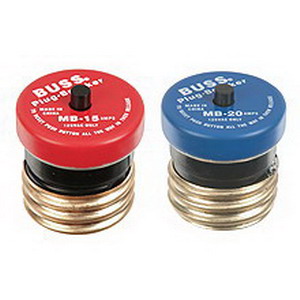
The last house I owned that had screw in fuses we replaced the disposables with 'breaker fuses'. They looked and fit like regular fuses of the same rating but instead of burning out the element would bend when overheated breaking contact, then after it cooled down the connection would resume.
$this->bbcode_second_pass_quote('Alfred Tennyson', 'W')e are not now that strength which in old days
Moved earth and heaven, that which we are, we are;
One equal temper of heroic hearts,
Made weak by time and fate, but strong in will
To strive, to seek, to find, and not to yield.
Moved earth and heaven, that which we are, we are;
One equal temper of heroic hearts,
Made weak by time and fate, but strong in will
To strive, to seek, to find, and not to yield.
- Tanada
- Site Admin

- Posts: 17094
- Joined: Thu 28 Apr 2005, 03:00:00
- Location: South West shore Lake Erie, OH, USA