Wow. That was some exhaustive calculating and deducting and messing around if I ever saw it. Looks like quite a bit of work went into it.
I didn't read the thing exhaustively, not having the rest of the evening to sit through it all, but I went through as much of the general methodology and assumptions as I could. It looked like what I would call a general "adding up" of expected outcomes.
He also appears to dis reserve growth numbers generated by the USGS without actually attacking the scientific basis they used to generate them...sort of a "kill the messenger" approach to modelling which isn't particularly effective at refuting the assumptions and scientific work which went into the numbers in the first place.
For reference, this is one of the guys who did early and interesting work, here is one of his general papers. My favorite is in the reference list, 5th reference down, its generally referred to as the "Enigma" paper.
http://pubs.usgs.gov/fs/fs-202-96/FS-202-96.html



PeakOil is You
Comments on the general approach to modeling depletion
Re: Comments on the general approach to modeling depletion
 by ReserveGrowthRulz » Sun 15 Jan 2006, 01:20:50
-

ReserveGrowthRulz - Permanently Banned
- Posts: 813
- Joined: Fri 30 Dec 2005, 04:00:00
Re: Comments on the general approach to modeling depletion
by WebHubbleTelescope » Sun 15 Jan 2006, 02:38:15
$this->bbcode_second_pass_quote('ReserveGrowthRulz', 'W')ow. That was some exhaustive calculating and deducting and messing around if I ever saw it. Looks like quite a bit of work went into it.
I didn't read the thing exhaustively, not having the rest of the evening to sit through it all, but I went through as much of the general methodology and assumptions as I could. It looked like what I would call a general "adding up" of expected outcomes.
He also appears to dis reserve growth numbers generated by the USGS without actually attacking the scientific basis they used to generate them...sort of a "kill the messenger" approach to modelling which isn't particularly effective at refuting the assumptions and scientific work which went into the numbers in the first place.
For reference, this is one of the guys who did early and interesting work, here is one of his general papers. My favorite is in the reference list, 5th reference down, its generally referred to as the "Enigma" paper.
http://pubs.usgs.gov/fs/fs-202-96/FS-202-96.html
I didn't read the thing exhaustively, not having the rest of the evening to sit through it all, but I went through as much of the general methodology and assumptions as I could. It looked like what I would call a general "adding up" of expected outcomes.
He also appears to dis reserve growth numbers generated by the USGS without actually attacking the scientific basis they used to generate them...sort of a "kill the messenger" approach to modelling which isn't particularly effective at refuting the assumptions and scientific work which went into the numbers in the first place.
For reference, this is one of the guys who did early and interesting work, here is one of his general papers. My favorite is in the reference list, 5th reference down, its generally referred to as the "Enigma" paper.
http://pubs.usgs.gov/fs/fs-202-96/FS-202-96.html
This is what Tufte calls "lying with graphics":
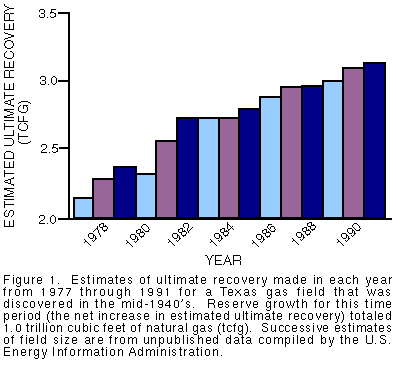
Notice that the moron does not plot it with the zero on the y-axis displayed. Do it that way and it does not look like an order of magnitude effect. However, the way he plots it, on first glance the effect looks huge.
You say you are an engineer. Engineers where I come from tend to give conservative estimates. They do this so they don't freakin get fired. I would sincerely ask what happened to the error bars on the plot as well. Could it be that they took the error bars off the plot to once again "lie with graphics"?
The only thing enigmatic so far is why you thought this holds some sort of secret.
-

WebHubbleTelescope - Tar Sands

- Posts: 950
- Joined: Thu 08 Jul 2004, 03:00:00
Re: Comments on the general approach to modeling depletion
by ReserveGrowthRulz » Sun 15 Jan 2006, 03:22:55
For starters, I would hardly call someone who has a bona fide example of reserve growth as a "moron" simply because I don't like the axis of his graph. And since the data is data, and you don't appear to refute the DATA, you are simply unhappy with the way it is displayed, this hardly constitutes a falsehood on the part of the author of the graph.
What you are talking about is nothing more than a relative effect, and no "moron" who I've ever worked with would be silly enough to be misled by it unless they were blind, mute and incapable of asking someone to tell them what the Y-Axis is, or some rank amateur who can't add 2 + 2 and get the same answer twice.
Please....is the insulting of other people necessary just because you don't like the conclusions they draw from THEIR data? What conclusions might YOU draw from their data which is different? How is their data flawed? How was it assembled incorrectly? All of this are reasonable lines of attack against something you don't like, name calling hardly qualifies as a device to dispute anothers conclusions.
For example, it required me a second to notice it isn't zero'ed at 0,0, and 2 seconds after that to size up the scale difference between year 1978 and year 1990 and notice its what, a 50% in stated ultimate gain over a 12 year time period? No order of magnitude problems even without a 0,0 point to reference off of.
As far as my credentials, this is the internet, I can manufacture whatever BS story I want, particularly at a forum like THIS one.....I have chosen not to. Please give me some benefit of a doubt than other people you are familiar with who evidently aren't capable of reading X,Y axis values and calculating differences off a simple and rather self explanatory cartesian graph.
As far as how engineers give conservative estimates, I would agree. From personal experience, when in doubt, being reasonable always struck me as a better path doing SEC reserves than getting hairbrained and going to the mat with the auditors. Your assumption on conservative being required as part of the job is wrong, bosses usually wanted you to show MORE on the reserve report than you were comfortable with. SEC reserves didn't require error bars on them when I did them, and I doubt they do now. The SPE reserves definitions only changed about a decade ago to include probabilities, and industry standard software that I am familiar with doesn't do probabilities of reserves at all except as some sort of half assed guess, its still expressed as a deterministic number.
Do you know anything at all about the oil industry, reserves calculations and probabilities or do you just make up all these hair brained assumptions to try and trick those of us who do this for a living?
The question I have for you goes like this....what is incorrect about the base conclusion drawn from the graph YOU provided, which looks like a 50% increase in ultimate over a 12 year time span? Otherwise known as a reasonable demonstration of reserve growth, and is demonstratable across wells, fields, counties, states and countries.
What you are talking about is nothing more than a relative effect, and no "moron" who I've ever worked with would be silly enough to be misled by it unless they were blind, mute and incapable of asking someone to tell them what the Y-Axis is, or some rank amateur who can't add 2 + 2 and get the same answer twice.
Please....is the insulting of other people necessary just because you don't like the conclusions they draw from THEIR data? What conclusions might YOU draw from their data which is different? How is their data flawed? How was it assembled incorrectly? All of this are reasonable lines of attack against something you don't like, name calling hardly qualifies as a device to dispute anothers conclusions.
For example, it required me a second to notice it isn't zero'ed at 0,0, and 2 seconds after that to size up the scale difference between year 1978 and year 1990 and notice its what, a 50% in stated ultimate gain over a 12 year time period? No order of magnitude problems even without a 0,0 point to reference off of.
As far as my credentials, this is the internet, I can manufacture whatever BS story I want, particularly at a forum like THIS one.....I have chosen not to. Please give me some benefit of a doubt than other people you are familiar with who evidently aren't capable of reading X,Y axis values and calculating differences off a simple and rather self explanatory cartesian graph.
As far as how engineers give conservative estimates, I would agree. From personal experience, when in doubt, being reasonable always struck me as a better path doing SEC reserves than getting hairbrained and going to the mat with the auditors. Your assumption on conservative being required as part of the job is wrong, bosses usually wanted you to show MORE on the reserve report than you were comfortable with. SEC reserves didn't require error bars on them when I did them, and I doubt they do now. The SPE reserves definitions only changed about a decade ago to include probabilities, and industry standard software that I am familiar with doesn't do probabilities of reserves at all except as some sort of half assed guess, its still expressed as a deterministic number.
Do you know anything at all about the oil industry, reserves calculations and probabilities or do you just make up all these hair brained assumptions to try and trick those of us who do this for a living?
The question I have for you goes like this....what is incorrect about the base conclusion drawn from the graph YOU provided, which looks like a 50% increase in ultimate over a 12 year time span? Otherwise known as a reasonable demonstration of reserve growth, and is demonstratable across wells, fields, counties, states and countries.
-
ReserveGrowthRulz - Permanently Banned
- Posts: 813
- Joined: Fri 30 Dec 2005, 04:00:00
Re: Comments on the general approach to modeling depletion
by DigitalCubano » Sun 15 Jan 2006, 05:07:02
RGR,
You'll soon come to learn WHT's modus operandi:
-Insult any source in disagreement
-Engage in a red herring about something trivial to conclude that the author is being dishonest (e.g. the graph's axes)
-Post a link to his model
-Post a picture of output from his model that shows we'll all be cannibalizing each other next week
-Launch a diatribe against the oil industry and all contrarians, potraying them all as righ-wind dingbats
Really, he's harmless. Let him vent and move on. It allows the discussion to move forward.
You'll soon come to learn WHT's modus operandi:
-Insult any source in disagreement
-Engage in a red herring about something trivial to conclude that the author is being dishonest (e.g. the graph's axes)
-Post a link to his model
-Post a picture of output from his model that shows we'll all be cannibalizing each other next week
-Launch a diatribe against the oil industry and all contrarians, potraying them all as righ-wind dingbats
Really, he's harmless. Let him vent and move on. It allows the discussion to move forward.
-

DigitalCubano - Permanently Banned
- Posts: 434
- Joined: Fri 19 Aug 2005, 03:00:00
Re: Comments on the general approach to modeling depletion
by DigitalCubano » Sun 15 Jan 2006, 05:10:02
$this->bbcode_second_pass_quote('dub_scratch', '')$this->bbcode_second_pass_quote('seahorse2', 'W')hy don't the optimist ever produce a model?
Yea, you would think that if they are so confident about supply giving us the peak later scenario, a depletion model would be easy.
So we've now moved on to proving the negative? Great! I contend that the sun won't rise tomorrow. The onus is on you to prove that it will. *shaking my head in disbelief*
-
DigitalCubano - Permanently Banned
- Posts: 434
- Joined: Fri 19 Aug 2005, 03:00:00
Re: Comments on the general approach to modeling depletion
by shakespear1 » Sun 15 Jan 2006, 06:28:17
Gents
Lets not get hot about reserve growth. It does happen and it happens due to better knowledge of the area. I stress the area. So North Sea is going dry. There is nothing to say that we won't find another pool in that area. The issue is will it be as big as the ones we have already found!!! This is the wishful part.
Reserves also grow because over time we applied better techonology: fracking, water injection, gas injection, pattern reconfiguration, horizontal wells and maybe 3-D seismic to really look close.
For more on this look here
Understanding the Enigma of ...
Reserves Growth: Enigma, Expectation or Fact?
Some interesting discussion on modeling issues
Natural Gas in the U.S.: How Far Can Technology...

Lets not get hot about reserve growth. It does happen and it happens due to better knowledge of the area. I stress the area. So North Sea is going dry. There is nothing to say that we won't find another pool in that area. The issue is will it be as big as the ones we have already found!!! This is the wishful part.
Reserves also grow because over time we applied better techonology: fracking, water injection, gas injection, pattern reconfiguration, horizontal wells and maybe 3-D seismic to really look close.
For more on this look here
Understanding the Enigma of ...
Reserves Growth: Enigma, Expectation or Fact?
Some interesting discussion on modeling issues
Natural Gas in the U.S.: How Far Can Technology...
Men argue, nature acts !
Voltaire
"...In the absence of the gold standard, there is no way to protect savings from confiscation through inflation."
Alan Greenspan
Voltaire
"...In the absence of the gold standard, there is no way to protect savings from confiscation through inflation."
Alan Greenspan
- shakespear1
- Heavy Crude

- Posts: 1532
- Joined: Fri 13 May 2005, 03:00:00
Re: Comments on the general approach to modeling depletion
by shakespear1 » Sun 15 Jan 2006, 06:35:54
Here is another Gem written in the early 90's. This may not belong in this thread but ... 
An exploration of alternative measures of natural
resource scarcity: the case of petroleum resources
in the U.S.
Cutler J. Cleveland
Center for Energy and Environmental Studies and Department of Geography,
675 Commonwealth AL’e., Boston, MA 02215, USA
(Received 23 September 1991; accepted 9 June 1992)
ABSTRACI
Cleveland, C.J., 1993. An exploration of alternative measures of natural resource scarcity:
the case of petroleum resources in the U.S. Ecol. Econ., 7: 123-157.
The concern about natural resource scarcity has traditionally focused on changes in the
cost, quality, and availability of energy and material inputs to the production process.
Ecological economists are increasingly concerned with an additional aspect of scarcity -
the growing scarcity of environmental services that sustain human economic existence. The
analysis here explores economic and biophysical indicators of natural resource scarcity. The
indices are quantified for the extraction of petroleum resources in the U.S. The economic
indicators are the market price of crude oil and natural gas, the unit (capital plus labor) cost
of extraction, and the average total cost of extraction (dollars per Btu extracted). The
biophysical index is the energy return on investment (EROI). All indices show a trend of
decreasing and then increasing scarcity of petroleum at the wellhead. The economic and
biophysical cost indices indicate that the 1960s marked the transition from a decreasing to
an increasing cost resource base. The market price of oil is influenced by nonscarcity forces
to the extent that it does not reflect that turning point. The increase in the energy cost of
petroleum extraction is in stark contrast to the changes in the energy cost of producing
other goods and services in the U.S. economy, which generally declined in the last 20 years.
The increase in the energy cost of extraction has important economic implications. From
1954 to 1987, the fraction of total industrial output in the U.S. generated in the petroleum
extraction sector declined almost 40%. Despite the declining share of its output, the
petroleum industry’s share of direct energy use (fossil fuels and electricity) generally
increased in that period. The result is a clear increase in the amount of energy diverted
from other potential uses to secure an additional unit of output in the petroleum sector.
None of the indicators reflect to any degree substantial nonmarketed environmental cost of
petroleum extraction. The biophysical perspective, however, emphasizes the coupling between
physical scarcity and the demands that extraction places on renewable resources and
ecosystem services. The extraction of one barrel-of-oil-equivalent, for example, requires 250
gallons of fresh water and emits more than 60 pounds of CO:, and these costs are
increasing.
An exploration of alternative measures of natural ...
An exploration of alternative measures of natural
resource scarcity: the case of petroleum resources
in the U.S.
Cutler J. Cleveland
Center for Energy and Environmental Studies and Department of Geography,
675 Commonwealth AL’e., Boston, MA 02215, USA
(Received 23 September 1991; accepted 9 June 1992)
ABSTRACI
Cleveland, C.J., 1993. An exploration of alternative measures of natural resource scarcity:
the case of petroleum resources in the U.S. Ecol. Econ., 7: 123-157.
The concern about natural resource scarcity has traditionally focused on changes in the
cost, quality, and availability of energy and material inputs to the production process.
Ecological economists are increasingly concerned with an additional aspect of scarcity -
the growing scarcity of environmental services that sustain human economic existence. The
analysis here explores economic and biophysical indicators of natural resource scarcity. The
indices are quantified for the extraction of petroleum resources in the U.S. The economic
indicators are the market price of crude oil and natural gas, the unit (capital plus labor) cost
of extraction, and the average total cost of extraction (dollars per Btu extracted). The
biophysical index is the energy return on investment (EROI). All indices show a trend of
decreasing and then increasing scarcity of petroleum at the wellhead. The economic and
biophysical cost indices indicate that the 1960s marked the transition from a decreasing to
an increasing cost resource base. The market price of oil is influenced by nonscarcity forces
to the extent that it does not reflect that turning point. The increase in the energy cost of
petroleum extraction is in stark contrast to the changes in the energy cost of producing
other goods and services in the U.S. economy, which generally declined in the last 20 years.
The increase in the energy cost of extraction has important economic implications. From
1954 to 1987, the fraction of total industrial output in the U.S. generated in the petroleum
extraction sector declined almost 40%. Despite the declining share of its output, the
petroleum industry’s share of direct energy use (fossil fuels and electricity) generally
increased in that period. The result is a clear increase in the amount of energy diverted
from other potential uses to secure an additional unit of output in the petroleum sector.
None of the indicators reflect to any degree substantial nonmarketed environmental cost of
petroleum extraction. The biophysical perspective, however, emphasizes the coupling between
physical scarcity and the demands that extraction places on renewable resources and
ecosystem services. The extraction of one barrel-of-oil-equivalent, for example, requires 250
gallons of fresh water and emits more than 60 pounds of CO:, and these costs are
increasing.
An exploration of alternative measures of natural ...
Men argue, nature acts !
Voltaire
"...In the absence of the gold standard, there is no way to protect savings from confiscation through inflation."
Alan Greenspan
Voltaire
"...In the absence of the gold standard, there is no way to protect savings from confiscation through inflation."
Alan Greenspan
- shakespear1
- Heavy Crude
- Posts: 1532
- Joined: Fri 13 May 2005, 03:00:00
Re: Comments on the general approach to modeling depletion
by WebHubbleTelescope » Sun 15 Jan 2006, 10:47:16
$this->bbcode_second_pass_quote('ReserveGrowthRulz', '
')What you are talking about is nothing more than a relative effect, and no "moron" who I've ever worked with would be silly enough to be misled by it unless they were blind, mute and incapable of asking someone to tell them what the Y-Axis is, or some rank amateur who can't add 2 + 2 and get the same answer twice.
')What you are talking about is nothing more than a relative effect, and no "moron" who I've ever worked with would be silly enough to be misled by it unless they were blind, mute and incapable of asking someone to tell them what the Y-Axis is, or some rank amateur who can't add 2 + 2 and get the same answer twice.
Of course not. But this is not about you or me. It is about the masses of people (sheeple) that get taken up by this sleight-of-hand. So I call him a moron because he deserves the same kind of framing that he is trying to put on others. I am planting a seed that he is incompetent, just like he is planting a seed to deceive.
-
WebHubbleTelescope - Tar Sands
- Posts: 950
- Joined: Thu 08 Jul 2004, 03:00:00


