
PeakOil is You
An update on the peak oil theory by Prof. J. Carlos Jarillo
Re: An update on the peak oil theory by Prof. J. Carlos Jari
 by kublikhan » Thu 19 Oct 2023, 16:37:29
$this->bbcode_second_pass_quote('mousepad', 'I') disagree. Any human activity has an impact on natures balance. Some more, some less. You go for a walk in the woods? You're going to upset some animals. You build a house at the edge of town? You destroy valuable land. You drive your tesla? You create break dust.
Yes. But fossil fuels do far more damage than taking a walk. They are not even in the same league. It is not wrong to try and reduce the amount of damage we are doing to the Earth. And the amount of damage renewables do to the Earth is far less than fossil fuels.$this->bbcode_second_pass_quote('mousepad', 'T')here's a solar farm in my neighborhood. 20 acres of prime farmland was taken out of farming and plastered over with solar panels. Was that priced into the cost of solar?
$this->bbcode_second_pass_quote('', 'T')he problem with renewable energy, so claim its critics, is that it is too diffuse. Solar and wind farms require vast amounts of land to harvest the low-density energy from the sun and wind. In contrast, they point out that power plants, like coal, natural gas, and nuclear, have relatively tiny footprints, requiring hundreds of times less land than renewables for the same power.
This argument has merit but it overlooks two essential points. First, it conveniently ignores the very large land footprint of the mines that produce the fuels for coal and nuclear plants. Second, each acre can only be mined once. After that, the acre is depleted forever and the mining companies must move on to the next acre. In contrast, an acre of solar, wind, hydro, or biomass will continue producing energy, year after year, forever. In other words, an acre is not just an acre.
Beyond acres and kilowatt hours: dual-use and reclamation
Renewables can hold their own against mining fuel on an energy per acre basis but it is the health of that acre where renewables demonstrate the best land footprint. The towers that hold those enormous turbines only require a tiny portion of a wind farm’s total land footprint—the rest can serve other purposes. Increasingly, land in wind farms has become “dual-use,” simultaneously supporting livestock grazing and agriculture. Solar farms, because they are typically more densely packed than wind farms, make dual-use more of a challenge, but pilot projects all over the world are proving that panels can co-exist with grazing and certain kinds of agriculture.
A report by the Appalachian Law Center found the US had spent $5.7 billion over 40 years to reclaim 800,000 acres of land damaged by mining but they also found 6.2 million acres were still awaiting reclamation (this federal fund is set to expire in 2021). Storing the 2 billion tons of coal ash left over from a century of coal power requires 1,100 ash ponds across the US. While the land required for ash is relatively small in terms of acres per GWh, the coal ash contains arsenic, mercury, uranium, and other toxic heavy metals. Reclaiming those acres will cost billions of dollars.
When you put all this together, the environmental impact of mining coal and uranium diminishes many of its benefits in land usage efficiency.
$this->bbcode_second_pass_quote('mousepad', 'P')utting a value on those things in $$$ is practically impossible, so let's not even try.
$this->bbcode_second_pass_quote('', '[')b]Summary
All energy sources have negative effects. But they differ enormously in size: as we will see, fossil fuels are the dirtiest and most dangerous, while nuclear and modern renewable energy sources are vastly safer and cleaner. From the perspective of both human health and climate change, it matters less whether we transition to nuclear power or renewable energy, and more that we stop relying on fossil fuels.
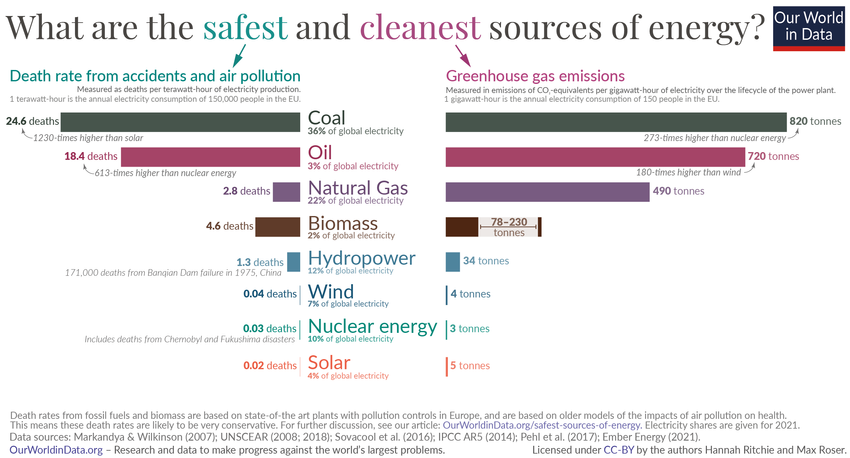
$this->bbcode_second_pass_quote('', '[')b]CO2 Emissions from Different Energy Sources
When looking at CO2 emissions, it is best to look at life cycle greenhouse gas emissions, which reflect all CO2 emissions over the entire lifespan of the technology—from equipment manufacturing and construction to operations and maintenance activities to plant decommissioning. Keep in mind that no CO2 is emitted into the atmosphere during wind-powered electricity generation.
In general, lifecycle greenhouse gas emissions from renewable sources are considerably lower than emissions from natural gas and coal. Wind energy produces around 11 grams of CO2 per kilowatt-hour (g CO2/kWh) of electricity generated, compared with about 980 g CO2/kWh for coal and roughly 465 g CO2/kWh for natural gas. That makes coal’s carbon footprint almost 90 times larger than that of wind energy, and the footprint of natural gas more than 40 times larger. Shifting electricity production away from fossil generation sources to renewable sources has a significant impact on lowering CO2 emissions from the power sector.
Impact of Air Pollutants on Public Health
During combustion for fossil-fueled electricity generation, other air pollutants—including nitrogen oxides (NOx) and sulfur dioxide (SO2) —are also released into the atmosphere. These gases often react to form particulate matter, smog, ground-level ozone, and acid rain. In turn, these resulting pollutants can cause adverse health effects, including asthma, bronchitis, lower and upper respiratory symptoms, and heart attacks. Air pollution is responsible for a large number of premature deaths relating to these illnesses.
The Bottom Line
When looking at the cost of wind energy versus other technologies, it’s tempting to look at just the cost of running a wind plant or its grid-system value. However, these comparisons do not consider the societal benefits provided by wind and other emissions-free sources of energy, both in terms of fighting climate change and reducing harmful air pollutants. If these external—but real—benefits are part of the equation, wind energy might take off even faster than it is today.
$this->bbcode_second_pass_quote('mousepad', 'Y')et it's certainly ironic that electricity prices creep higher and higher even though WAY cheaper renewables are supplying more and more of it.)
$this->bbcode_second_pass_quote('mousepad', 'W')hat I'm wondering is if those renewables can be built and supported in a world powered by renewables. Solar and wind are highest high tech. Requiring modern materials, precision manufacturing, electronics. Many of it was developed for consumer products. Solar and wind directly benefit from large consumer economies. Can renewables power all this to a level needed for its continuation?
I had this discussion before with kub. And of course he's on the optimistic side claiming smooth sailing into a wonderful land ahead of us. Maybe, maybe not. I guess once again, we have to wait and see... unless you have some input?