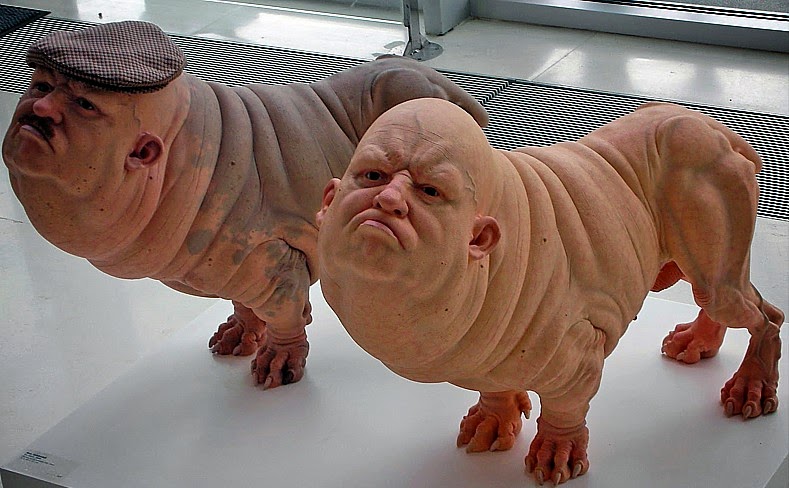
Here's a follow-up article published in phys.org about this story including replies to public comments by McCarthy himself (Koolokamba).
Human hybrids: a closer look at the theory and evidence
$this->bbcode_second_pass_quote('', 'W')e decided it would be worthwhile to take a closer look at the objections that were most commonly offered against the hybrid hypothesis. Chief among them was that the chromosome differences here are just too large to support a viable hybrid. One of the previous examples we gave, the zedonk (zebra parent, 2n=44, donkey parent, 2n=62), can and does result in female hybrid offspring that have been reported to produce offspring in backcrosses. The same is true for the geep (sheep, 2n=54, and goat 2n=60). While the reduction in fertility associated with large differences of this sort is often severe, the existence of fertile hybrids, particularly in backcrosses, invalidates this objection.
Another argument was that the morphological distance, or genetic differences besides chromosome number, are just too great. Most of us are familiar with the platypus. A paper published in Nature a few years ago demonstrated that the platypus genome contains both bird and mammal chromosomes, and therefore that the vastly different bird and mammal sex chromosome systems have been successfully bridged by this creature. This example is not offered as any kind of proof. But it does suggest that sometime, long ago, a cross occurred that would have been even more distant than that between a chimpanzee and a pig – one between a otter-like mammal and a duck-like bird. And if such was the case, the hybrids from the cross must have been able to produce offspring (otherwise they would have died out, and the platypus would not exist today).
The objection that mating between such different animals is just too strange has been addressed at length on McCarthy's website. Ample counterexamples have been given there and elsewhere, including the evidence for matings, without issue, between such strange pairings as a buck rabbit with female cat (or even with a domestic hen), or a dog with a monkey, or with a swan goose. In general, as McCarthy points out, it has long been known that many organisms, as adults, prefer to mate with whatever animal they are exposed to at the critical early stage in their lives when sexual imprinting occurs.



PeakOil is You
A chimp-pig hybrid origin for humans?
Human history becomes more and more a race between education and catastrophe. H. G. Wells.
Fatih Birol's motto: leave oil before it leaves us.
Fatih Birol's motto: leave oil before it leaves us.
-

Graeme - Fusion

- Posts: 13258
- Joined: Fri 04 Mar 2005, 04:00:00
- Location: New Zealand
Re: A chimp-pig hybrid origin for humans?
 by Beery1 » Fri 26 Jul 2013, 09:53:26
$this->bbcode_second_pass_quote('Graeme', '[')b]A chimp-pig hybrid origin for humans?
Oh for f***'s sake! This doesn't even pass the test of Occam's Razor. Sure, some nutter can write reams and reams of convincing-sounding arguments supporting a fricken wacko theory, but the whole point of applying Occam's Razor is to weed out theories with overly-complicated supporting arguments, because complications make a theory LESS likely to be true, not more so.
I could make fascinating and convincing (to some) arguments that the Kellogg's Corn Flake was not actually the invention of renowned 19th Century nutter and sexual deviant John Harvey Kellogg, but actually the result of a freak natural cross-breeding of corn and crinkly spinach, and that the Kellogg Company keeps its real origin a secret so that they can retain ownership of the patent. That's the kind of lunacy we're talking here. I mean, just because two things have attributes in common, that doesn't mean they are actually related.
Must this website continue to be a haven for fricken "ancient alien", "anal probe" and other similar conspiracy theory nutcases? Why can't these folks stay on their meds?
No wonder people think peak oil is a load of hooey when its most well-known forum is home to the terminally gullible and the loony tinfoil hat fringe.
F******************************************************************ck!
Last edited by Beery1 on Fri 26 Jul 2013, 10:39:16, edited 1 time in total.
"I'm gonna have to ask you boys to stop raping our doctor."
- Beery1
- Tar Sands

- Posts: 690
- Joined: Tue 17 Jan 2012, 21:31:15
Re: A chimp-pig hybrid origin for humans?
by SeaGypsy » Fri 26 Jul 2013, 10:32:11
$this->bbcode_second_pass_quote('pstarr', 'S')o which one was on top? Who's y chromosome? I am thinking (given the testicular girth) that it must have been the chimp.

Okay. I can see the attraction.
Okay. I can see the attraction.
I wonder did he consider the 'Pig + Frog' hypothesis?
- SeaGypsy
- Master Prognosticator

- Posts: 9285
- Joined: Wed 04 Feb 2009, 04:00:00
Re: A chimp-pig hybrid origin for humans?
by Graeme » Tue 30 Jul 2013, 16:46:18
Georgia geneticist challenges evolution, links humans to pigs
$this->bbcode_second_pass_quote('', 'T')o Athens geneticist Gene McCarthy, pigs used to conjure filth and greed. But after years of research into this species, McCarthy sees a kindred spirit. Pigs, according to his Hybrid Hypothesis published last month on his website, Macroevolution.net, helped create humans by mating with chimpanzees.
As radical as it sounds—not to mention a coupling that many of us would rather not visualize—McCarthy is also following the steps of scientists like Galileo who risked derision to revolutionize how we understand our world and how we got here. McCarthy has offended evolutionists and creationists alike and even had a ribald comedy sketch aired on late night TV.
McCarthy’s been working on this theory for decades. He first told me about it 20 years ago, when I first met him through his wife Rebecca, a former colleague at the Atlanta Journal-Constitution. Since then, he’s become an acknowledged expert on hybrids, having authored the Oxford University reference book, Handbook of Avian Hybrids of the World, published in 2006. On his website, he is publishing his massive collection of information on hybridization in mammals.
In his research into human origins, McCarthy employed the same methods he had seen other biologists use in identifying unknown hybrids. So he first made the assumption, based on chimpanzees being our closest living relative, that the chimpanzee would likely have been one of the two parents in the cross. He then made a list of all the characteristics that distinguish us from the chimpanzees. That list he realized would describe the traits of the second parent, if it still existed.
Among them: largely hairless skin, a comparable layer of fat beneath the skin, thermoregulatory sweating, light-colored eyes, a protruding rubbery (cartilaginous) nose, vocal cords, heavy eyelashes, humanlike molars, a short pelvis, a curved sacrum with short dorsal spines, similarities in the structure of the kidneys and other internal organs, tiny hooves (called ungual tuberosities) just beneath the skin on the tips of our fingers and toes, and a wide variety of other features.
All characteristics except two—big brain and upright posture—turned out to be present in pigs. McCarthy was shocked. Looking further, he found anatomical characteristics in either pigs or chimps that when combined in a hybrid would produce an increase in brain size and allow that hybrid to walk erect. Everything seemed to fit.
$this->bbcode_second_pass_quote('', 'T')o Athens geneticist Gene McCarthy, pigs used to conjure filth and greed. But after years of research into this species, McCarthy sees a kindred spirit. Pigs, according to his Hybrid Hypothesis published last month on his website, Macroevolution.net, helped create humans by mating with chimpanzees.
As radical as it sounds—not to mention a coupling that many of us would rather not visualize—McCarthy is also following the steps of scientists like Galileo who risked derision to revolutionize how we understand our world and how we got here. McCarthy has offended evolutionists and creationists alike and even had a ribald comedy sketch aired on late night TV.
McCarthy’s been working on this theory for decades. He first told me about it 20 years ago, when I first met him through his wife Rebecca, a former colleague at the Atlanta Journal-Constitution. Since then, he’s become an acknowledged expert on hybrids, having authored the Oxford University reference book, Handbook of Avian Hybrids of the World, published in 2006. On his website, he is publishing his massive collection of information on hybridization in mammals.
In his research into human origins, McCarthy employed the same methods he had seen other biologists use in identifying unknown hybrids. So he first made the assumption, based on chimpanzees being our closest living relative, that the chimpanzee would likely have been one of the two parents in the cross. He then made a list of all the characteristics that distinguish us from the chimpanzees. That list he realized would describe the traits of the second parent, if it still existed.
Among them: largely hairless skin, a comparable layer of fat beneath the skin, thermoregulatory sweating, light-colored eyes, a protruding rubbery (cartilaginous) nose, vocal cords, heavy eyelashes, humanlike molars, a short pelvis, a curved sacrum with short dorsal spines, similarities in the structure of the kidneys and other internal organs, tiny hooves (called ungual tuberosities) just beneath the skin on the tips of our fingers and toes, and a wide variety of other features.
All characteristics except two—big brain and upright posture—turned out to be present in pigs. McCarthy was shocked. Looking further, he found anatomical characteristics in either pigs or chimps that when combined in a hybrid would produce an increase in brain size and allow that hybrid to walk erect. Everything seemed to fit.
saportareport
Human history becomes more and more a race between education and catastrophe. H. G. Wells.
Fatih Birol's motto: leave oil before it leaves us.
Fatih Birol's motto: leave oil before it leaves us.
-
Graeme - Fusion
- Posts: 13258
- Joined: Fri 04 Mar 2005, 04:00:00
- Location: New Zealand