
Peak Oil is You
Donate Bitcoins ;-) or Paypal :-)


Page added on March 2, 2014

Why oil drilling in Ecuador is ‘ticking time bomb’ for planet
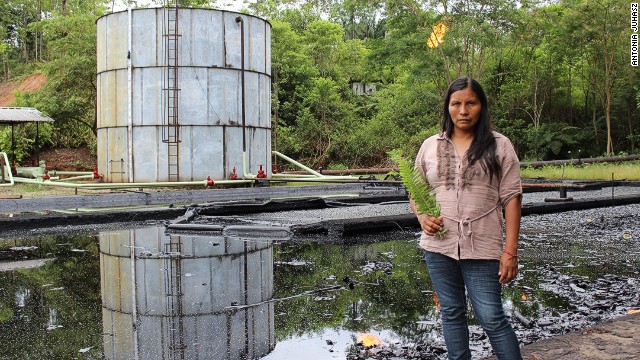
Alicia Cahuilla doesn’t try to hide her anger. The native Waorani tribal leader stands in front of an exposed, thickly black crude oil pit, as two gas flares burn violently overhead, the stinging stench of crude heavy in the air. Until about 50 years ago, this area, like most of the central Ecuadorian Amazon rainforest in which it sits, was Waorani land, a pristine expanse filled with nothing but trees and streams.
The Waorani have lived here, on the northwestern edge of one of the most biologically rich places on Earth, for thousands of years. But today their land is also home to hundreds of operations seeking to extract the vast oil reserves buried deep below the forest floor.
Experts believe that in order to avoid the worst of a future climate change catastrophe, most of the planet’s fossil fuels must be left in the ground. Ecuador’s ambitious Yasuni-ITT Initiative, launched in 2007, was hailed as a landmark plan to keep oil exploration out of the country’s most pristine forest and to preserve the homes of indigenous tribes living there. But Ecuador abandoned the plan last year, and drilling could now begin any time.
Leila Salazar of the U.S.-based NGO Amazon Watch equates oil exploration in Ecuador’s rainforests with “ignoring a ticking time bomb for the entire planet.” But the once global struggle to secure the Yasuni-ITT Initiative has now largely fallen on the shoulders of a few indigenous tribal communities who have pledged to fight, some to the death, to keep oil companies out of their communities and their oil in the ground.
Will the world back them up? It is a question with significance far beyond Yasuni National Park. The age of “easy oil,” if it ever existed, is over. What is left is in places like the Yasuni, previously deemed too sensitive, valuable, or risky to drill. The cost to both the planet and local people of pursuing such oil grows in tandem with the difficulty of extracting it. The Yasuni presents a critical opportunity to demonstrate that a different path is possible, though fortunately it is not the only place where the effort to leave our “oil in the soil” has taken root.
Yasuni: Biological and ethnic diversity worth saving
In November I travelled to the Yasuni National Park in northeastern Ecuador and marveled at its beauty, diversity, and bounty. It alone sits at the intersection of the Amazon, the Andes Mountains, and the Equator. It is a biological hot spot for mammals, birds, insects, plants, and more. One hectare of the Yasuni contains not only more tree species than are native to the whole of North America, but also 100,000 insect species, the highest diversity per unit area in the world for any plant or animal group, according to one estimate. The United Nations declared the Yasuni a World Biosphere Reserve in 1989.
READ MORE: Rainforest’s vast treasury of life
Within the park lies the Ishpingo, Tambococha, and Tiputini (ITT) area, home to one of the most intact sections remaining in the Amazon River Basin. Its natural bounty allows the ITT to support the only remaining uncontacted tribes left in Ecuador—two groups of Waorani who have remained in isolation from the outside world for thousands of years — the Taromenane and Tagaeri. It is also perched atop Ecuador’s largest untapped oil reserves.
Ecuador currently gets about half its national revenue from oil. President Rafael Correa hopes to increase this amount — and in so doing reduce rampant poverty — by carving up much of his country’s share of the Amazon into oil blocks.
Yet, in response to the global climate movement’s call for nations to leave their “oil in the soil,” in 2007 Correa made a bold proposal. If the global community agreed to put up $3.6 billion — roughly half the value of the 850 million barrels of crude estimated to be under the ITT area of Yasuni — Ecuador would leave the oil untouched indefinitely. World leaders failed to pay up, however, and Ecuador pronounced the death of the deal last year.
Drilling in the ITT will come at a steep price, explains Dr. Matt Finer, a research biologist with the Amazon Conservation Association. “You’re basically talking about the only spot on earth where you get this maximum diversity for everything, in addition to being one of the last places on earth where people can still live without any contact with civilization,” he said. “You have a national park created to protect that super mega diversity, and you will now have drilling [there]. It represents a serious incursion into what should be a refuge.”
Lives in the balance?
Cahuilla was born in the Yasuni but today lives in the tiny hamlet of Noneno wedged between two oil fields, the Cononaco and Armadillo, where President Correa is trying to expand oil production.
Her community considers it their responsibility to protect and speak on behalf of the uncontacted Waorani still living in the ITT and Yasuni, but this is not just out of loyalty. Oil operations are already pushing the Taromenani into contacted Waorani land, resulting in escalating violence, including murder, kidnapping, and territorial conflict.
Dr. Matt Finer, research biologist
As we talk, Cahuilla says she wishes she had her spear so she can “kill someone.” Though she is nonviolent, it is not a hollow threat. It is how the male elders of her village have pledged to deal with any oil firm that dares come near their home.
The Waorani leader argues that regardless of how they’re perceived, her people are not poor. “We have the richness of the forest and the river. We need for nothing, except what the oil companies destroy.” As for the rest of Ecuador, she adds, “All the people need clean air to live. Clean water. With this oil development, what kind of life is the government actually hoping to give its people?”
An estimated 1,500 people call the Yasuni and ITT home. In addition to the uncontacted tribes, there are Waorani and Kichwa who, just like Cahuilla’s community, are in contact with the outside world but still primarily lead lifestyles that are not far removed from the traditions followed by their ancestors. Though I saw the odd television and radio on my way through the forest, the majority of the peoples’ needs are still met directly from the land and water.
As I hiked in the ITT, I was shown trees used to build houses, blowguns for hunting, and canoes; plants used to make jewelry and plates, and to cure ailments; and a bounty of seeds, fruits and even a pack of wild boar comprising the majority of the communities’ diet. In return, the tribes treat the forest with deep respect.
“Cutting a tree is like cutting a person,” Kichwa tribal leader Holmer Machoa of the community of Llanchama in the ITT, told me. “If the oil companies come, they will cut and they will kill. They will be the destruction of the forest. They will kill the water and poison the land.”
Environmental concerns
The Napo region, including the Yasuni, is now one of the 14 major deforested areas in the world. Ecuador has the highest deforestation rate of any Latin American country, in part because oil is located so deep within the forest that extensive systems of roads must be built to reach it. The roads also fragment the Yasuni, harming already threatened animal species that require large intact forest areas to survive, and opening the park to new settlers and increased and illegal hunting.
This threat reaches beyond the Yasuni, as the two principal causes of global warming are the burning of fossil fuels and deforestation.
There are also other concerns. The Ministry of the Environment reported 539 oil spills in Ecuador between 2000 and 2010, a rate of nearly two a month. But INREDH, an Ecuador-based human rights group, says the rate is more than two a week, citing nearly 500 recorded spills from 2003 through 2005 alone.
Last June, Petroecuador’s Trans-Ecuadorian Oil Pipeline burst under the weight of a landslide caused by heavy rains. Some 420,000 gallons of oil was dumped into the Coca River, which then spread into the larger Napo River. The oil polluted the drinking water of Coca, a city of 80,000 people, and at least thirteen smaller communities.
The waterways of rural Ecuador are filled with people bathing, washing dishes and clothes, playing, and drinking from the water. As oil operations expand, so too do the dangers of this way of life. The Napo River, which marks the entire northern edge of the Yasuni, is now a major industrial highway with a constant flow of giant barges carrying equipment to support oil operations leaving black clouds of pollution in their wake.
Melissa Schoeb, Vice President of Occidental
A 2002 study in the International Journal of Epidemiology concluded that the prevalence of cancer was significantly elevated in those counties in Ecuador where oil firms operated versus non-oil-producing regions. The study found significantly elevated rates for “cancers of the stomach, rectum, skin melanoma, soft tissue and kidney in men and for cancers of the cervix and lymph nodes in women,” and an increase in haematopoietic cancers in children under age 10.
Cahuilla also points to Texaco’s legacy in Ecuador’s Lago Agrio region. In November Ecuador’s highest court ruled that California-based Chevron (which purchased Texaco in 2000) owes locally-impacted communities $9.51 billion for decades of substandard practices that severely polluted land and waterways and which continue to harm human health and the environment today. Chevron has appealed the court judgment, calling it “a manifest denial of justice.”
Others point to California-based Occidental’s (Oxy) operation in Ecuador from 1985 to 2006.Oxy settled a court case filed in 2006 in which Ecuadorian plaintiffs charged it with “unauthorized drilling, expropriation of tribal lands, utilizing child labor, and polluting the local water supply” in Oil Block 15. People protesting against Oxy’s operations there, they argue, were “attacked on or near Block 15, tortured, and illegally detained by the [government] Special Forces” acting for Oxy. Oxy has denied each such allegation in the case, which was settled under a strict gag order.
In response to a request for comment, Melissa Schoeb, Vice President of Occidental, said in a written statement: “We are not aware that any adverse health effects occurred due to our operations. During the company’s tenure [in Ecuador], Occidental had an exemplary record of environmental and safety performance, both in complying with laws and regulations and in pursuing numerous voluntary initiatives.”
The Ecuadorian government did not respond to multiple requests for comments for this story.
On my visit to the Kichwa community of Sani Isla situated on land in the Yasuni and across the Napo River in Oil Block 15, schoolteacher Maximo Grefa told me: “For decades, oil companies have been causing environmental damage to the water and air. I think it is the reason why we have so many kids with special needs, mental and physical disorders. The children drink the water without any treatment. That affects their health.”
Fighting back with ecotourism
Within virtually every community in and near the Yasuni, I am told that tourists, not oil companies, are the preferred outsiders. I am then pointed to Sani Isla, renowned for the Sani Lodge, a highly successful ecotourism venture catering to wealthy Western clientele.
At Sani Isla, Kichwa tribal leader Blanca Lourdes Tapuy Grefa says that oil development is incongruous with a healthy environment, including that desired by tourists, and is in direct conflict with the success of her community. Without Sani Lodge she asks: “What are we going to leave our children?”
Alicia Cahuilla, Waorani tribal leader
In May, her brother, Leonardo Tapui president of the community, told President Correa that Sani Isla opposed new oil operations and warned that if the army came, they would respond with war. It is a war that Blanca and her fellow Kichwa, just like Alicia Cahuilla and the Waorani, intend to fight with spears, blowguns and machetes.
“It doesn’t matter what the government says,” Blanca told me, “because I have my machete and I have my spear, and I’m going to defend this place. I’m not afraid. No matter what.”
A fight of global significance
Local organizations such as Quito-based Accion Ecologica have gathered more than half of the requisite signatures needed by April to hold a national referendum on halting drilling in the Yasuni. That President Correa still proudly displays the UN Visionary 2012 trophy he received for the Initiative may be evidence that he and his government can yet be convinced to change course, particularly if the global community finally commits to the $3.6 billion.
Moreover, the effort that led Correa to propose the Yasuni-ITT Initiative is not limited to this proposal or to Ecuador. Last month, an international gathering of indigenous groups, NGOs, and others convened in Ecuador under the auspices of the Global Alliance for the Rights of Nature, members of which came up with the original idea for the Initiative in 1997. They declared their commitment to fight not only for the Yasuni, but also for continued success elsewhere.
In April, for example, Mora County, New Mexico became the first U.S. county to permanently ban all oil and natural gas development (Shell Oil company has sued, claiming its rights as a “person” to those minerals), while in November three cities in Colorado joined dozens of others U.S. cities and town in voting to ban hydraulic fracking (a technique used for both oil and natural gas).
These efforts come from a growing realization that with the end of “easy oil” and the intensification of climate change, we are all now ultimately on the front lines of the battle over what is to be done with the world’s remaining fossil fuels.
11 Comments on "Why oil drilling in Ecuador is ‘ticking time bomb’ for planet"
Northwest Resident on Sun, 2nd Mar 2014 2:30 am
The government of Ecuador must be getting desperate. I guess as other countries become equally desperate, we’ll get to witness a lot more ecological and environmental destruction. Watching BAU die is not going to be a pretty sight by any means.
rollin on Sun, 2nd Mar 2014 3:57 am
NR is right, desperation has set in a while ago. The US and many others have been so desperate for so long they think that that is the normal way to live.
But desperation is not inevitable, it is a result of the self-inflicted monkey trap. Letting go of oil and it’s cousins while moving onward is the way to go. Allowing the past investment and old destructive ways to trap us in a continued desperate way of interacting with our world is foolish at best.
We need to walk away from previous investment, or at this late stage we need to run away. It will take much thought and courage which means the individual must do it.
Sacrifices to make the shift ASAP will be small compared to the huge amount of death and destruction caused by continuing BAU or even making a slow transistion.
Stilgar Wilcox on Sun, 2nd Mar 2014 5:07 am
The Waorani were there for thousands of years before the oil age and will remain there for thousands of years afterwards. For now Alicia should just get out of the way because if she puts up too much of a fuss they’ll nix her because greed comes first. Got to feel for her though standing there with that plant in her hand hoping somebody will help.
GregT on Sun, 2nd Mar 2014 9:07 am
“The Waorani were there for thousands of years before the oil age and will remain there for thousands of years afterwards.”
Human beings have been ‘here’ for thousands of years before the oil age, and in all likelihood will not survive afterwards. The choices that we make in the next few years will determine whether our species lives or goes extinct. If we don’t all listen to Alicia, the human experience will most likely be over.
“Got to feel for her though standing there with that plant in her hand hoping somebody will help.”
Alicia actually understands what is as stake here, unlike the rest of us. Gotta feel for all life on earth, if us ‘smart’ people don’t get our shit together, nothing will help.
Kenz300 on Sun, 2nd Mar 2014 3:37 pm
There are safer, cleaner and cheaper ways to produce energy.
http://www.smartplanet.com/blog/the-take/the-energy-transition-tipping-point-is-here/?tag=nl.e662&s_cid=e662&ttag=e662&ftag=TRE383a915
Stilgar Wilcox on Sun, 2nd Mar 2014 11:22 pm
“Human beings have been ‘here’ for thousands (millions) of years before the oil age, and in all likelihood will not survive afterwards.”
Respectfully I disagree GT. If a small rodent type animal was able to survive the extinction event of the dinosaurs surely we can live on after some global warming. I think there will be economic collapse in the coming years that will stop most of the GHG emissions, and sure there is a thermal inertia that will continue to warm the planet for 3-4 decades, but it seems very unlikely to be an extinction event for all people.
I also think there will be time to shut down nuclear plants to stop the meltdown scenario.
In my opinion the sooner an economic collapse occurs the better. We are on the precipice of oil’s descent from peak (as evidenced by reductions in major oil co. capex) and amplifying economic feedbacks will cause a quick collapse in the near future, i.e. by 2020? Even if it wasn’t until 2025 there would still be people. Not anywhere as many, but they will find niches to survive.
Northwest Resident on Sun, 2nd Mar 2014 11:30 pm
Stilgar, I find myself agreeing with you on all points.
Stilgar Wilcox on Mon, 3rd Mar 2014 12:20 am
Thanks NR, have a nice Sunday.
GregT on Mon, 3rd Mar 2014 5:52 am
Stilgar,
I would like to agree with your outlook, but I’m going with the scientists on this one. The original agreed upon upper limit of a 1 degree C mean global temperature increase, is no longer an option. The revised 2 degree C limit, would have given us a 50/50 chance of averting a catastrophic runaway greenhouse event. We have surpassed both now and are headed towards a 3.6-5 degree C mean temperature increase by mid century. These numbers do not include a myriad of positive feedback loops, which if triggered would render much of the Earths surface uninhabitable. Four degrees C is generally accepted to be the end of life (as we know it) on the planet Earth. It isn’t so much about human ability to survive, as it is about all other species abilities to adapt. We are already well into an extinction event, and it isn’t slowing down, it is accelerating.
I do agree with the rest of your comments though. We need change, and we need it soon. The sooner the better. I don’t have the confidence in human nature that you do however, I don’t see us stopping any time soon. Even a collapse won’t stop us from causing further environmental destruction. It might slow us down a bit, but the effects are accumulative.
Stilgar Wilcox on Mon, 3rd Mar 2014 6:49 am
I buy AGW, and know it’s getting worse, the weather will get much wilder, and also know we are causing this 6th extinction event. However I don’t buy some of the temp. rise numbers being thrown around, because if economic collapse occurs by 2020 then BAU to 2050 never happens. Gail T. is also of that opinion.
We are all seeing more and more we are in the throes of a tightening economic situation due to a decline in net energy. The bad news is getting very widespread. Tensions are rising between nations like china vs. japan and Russia vs. Ukraine and we haven’t even started down the other side, i.e. the descent from crude peak oil. Capex has been rising 10.9% on average in recent years and the majors are now starting to scale back exploration, which is yet another tipping point towards economic collapse. I adhere to the idea that once things begin to descend it will resemble a shark’s fin because the bottom tier of poorest will panic into chaos.
I do have faith in people surviving because they are extremely aggressive and cunning. Whatever there is left to eat they will consume. Even if it’s alligator they will eat it. People if pushed to the edge are tenacious. Like Troutman says to Will about Rambo, “The kid is resilient isn’t he?”
We all know about cannibalism. It’s the top taboo but that’s what people do when forced. I’m not in any way naïve about what is to come. It will be harsh, most will perish but enough will eek out existences. The toughest species will continue on.
Besides it would be ethically wrong for people not to suffer the consequences for many generations of this oil age greed-fest. A deserved hard lesson not to trash the planet should be served up so that there is a change in attitude towards flora and fauna.
GregT on Mon, 3rd Mar 2014 7:57 am
I agree with most that you say Stilgar. I am not so sure about the temperature rise though. I honestly hope that you are right, and I am wrong, but I don’t think so. We are only starting to get a taste of climate change, and we haven’t seen anything yet. If/ when the Arctic ice goes, it most certainly appears that things could get very ugly, very fast.
I also do not believe that the ‘bottom tier of poorest’ will be affected the most, maybe the bottom tier of modern societies initially, but those living in abject poverty around the globe are already living without a large input from oil. Their situations won’t change that much. I suspect that it will be the large cities that will panic into chaos first. More of what we have seen already, on a much larger scale. It is the people that have the most, that have the most to lose. They are also the ones that have the least idea as to how to live off of the land. A sense of entitlement does not bode well in a survival situation.
The hard lessons are indeed coming, unfortunately for our offspring, they look likely to last for centuries. If anyone does make it through to the other side that is. My plan is all about leaving a legacy for my children’s survival. So I do have a vested interest in being hopeful.