Toward a Finite-Planet Journalism

The Ozark National Scenic Riverways Park in southeastern Missouri was created in 1964 as the first National Park unit to protect a wild and scenic river system. Enclosing 184 miles of river and in many places scarcely wider than the banks of the rivers it protects, the park gets more than a million visitors in the summer, many of them from St. Louis (three hours to the northeast) and Springfield (three hours to the west). The park’s once-pristine waters are being damaged by overuse. Fecal coliform counts have led to the rivers’ being listed as “impaired” — unfit for their historic uses, including swimming, tubing, kayaking, and fishing. Some of the fecal pollution comes from horses (more than 3,000 are stabled in and near the park by trail-ride concessions, and many horse trails cross the rivers) and some comes from private septic failures in cabins, boats and RV campgrounds.
These and other human environmental impacts in the park could be reduced through tighter regulation and judicious redesign of usage patterns — moving trails out of the most sensitive areas, minimizing congestion at access points by separating them farther, that sort of thing. Clearly the park needs an update of its decades-old management plan.
The National Park Service has worked on that update, producing a draft
management plan that outlines four possible paths forward, from “no change” — an unsustainable option, Park Service scientists say — to establishing the park as a Wilderness Area. The Service’s preferred option lies in between. It would:
- close some historical river access points and open an equal number in less ecologically sensitive areas;
- close 65 miles of unauthorized horse trails and open 25 miles of designated trails elsewhere;
- set new regulations on where and when motorboats would be allowed; and
- close some roads, converting them to hiking trails.
The Park Service has been holding public hearings on the proposals, and some of the hearings have been the occasion of protest and controversy as some park regulars and nearby residents expressed their dismay at the proposed changes. Protest and “push back” are entirely expectable when government policy falls on the border where infinite-planet custom meets finite-planet reality. The transformation of our perpetual-growth society into a steady-state society, though inevitable, is unlikely to be quiet or automatic. It would be less painful if it were eased by environmental journalism worthy of the name, journalism that understands what’s at stake, journalism capable of stepping outside the infinite-planet premises of our social and political system.
Sadly, the new management plan for the Current and Jack Fork Rivers didn’t get that kind of coverage.
On Sunday, January 26, the
St. Louis Post-Dispatch ran a
front-page story about the new management plan. The prominence was appropriate; the Ozark National Scenic Riverways Park generates plenty of environmental value, as well as substantial local and regional economic impacts. (As a summertime escape from Midwestern heat, it figures prominently in the psychic health of the region too, though that’s harder to measure.) But the implications of the story reach even farther, all the way out to the widest scale possible — that of human civilization in history. That’s because the story of the Park’s need for a new management regime, and of the opposition to that regime, is not simply a story about political wrangling between a federal agency and some citizens affected by its decisions; it’s a story about the troubling collision between participatory democracy and physical reality.
This was not how the story was framed by the paper. Instead, the paper gave it a distinctly conservative spin: long-established users of the park are finding their habits and traditions threatened by unfeeling bureaucrats and flaky environmentalists. The story made a point that those who protested against new park regulations “love” the river, while no mention was made of the love of the river that leads environmentalists to want to see it protected. The only environmentalist the story quoted said the park was a “temple” that had been “desecrated” — as if John Muir’s pantheism was the animating force behind all environmental regulation, and subtly suggesting that the protestors had Constitutional freedom on their side. The story made no mention of fecal coliform counts, noting only that environmentalists “claim” the water is being polluted and quoting one Park Service official who said current uses are “unsustainable.” Absent the science that would back up either statement, a reader could dismiss both as personal opinions. (Indeed, the official was said to “feel,” not think, that the park needed a new regulatory plan.)
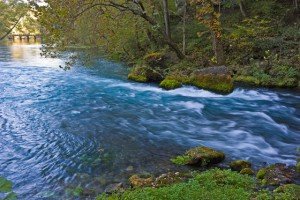
Continuous growth (in visitation to the Ozark Riverways, or more generally in population and consumption) requires regulation to address the consequences. Journalists should be reporting this principle (photo by David Porter).
Infinite-planet bias was present in the story in other ways. The report began within the first-person point of view of one of the citizens opposed to the new regulatory regime, immediately placing the reader on that side of the issue. Imagine if the story had begun with the work of one of the scientists whose findings shaped the report — or a swimmer who had bumped into raw sewage. The story gave a great deal of coverage to citizens worried that they might lose their livelihoods if tourist access to the park comes under greater control, but didn’t make the point that the river-supported economy of the area will collapse completely if the rivers aren’t kept healthy.
Basically, the news story pandered to populist sentiment against regulation. Yes, people don’t like to be told what they can and can’t do, especially when the rules cover behavior in a place that seems wild, natural, and incapable of being damaged by what we do. But looks can be deceiving. As climate change amply demonstrates, we no longer live on a planet so large that it can absorb any- and everything we care to throw at it. In the world we inhabit now, if we want to maintain the benefits and delights we derive from natural ecosystems — including necessities like clean water — we need regulations to manage our increasingly problematic ecological footprint.
Communication of that truth would have served the public interest. The problem is not that some people want more government just for the sake of more government, as a Post-Dispatch reader might justifiably conclude. The problem is that the human population and its high-throughput economy have collided with ecological limit, even in the backwoods of the Ozarks. If protestors want smaller government in general and less regulation of the Ozark Waterways in particular, they need to work to bring civilization back — far back — from the brink of ecological limits. The way to do that is to stabilize and perhaps even reduce population, decrease throughput, and increase the health and security of the planet’s ecosystems through conservation, restoration and preservation.
American political thinkers from Thomas Jefferson to John Dewey have emphasized the importance of newspapers to the country’s democratic project. To their appreciations we can add another of equal importance: only an ecologically knowledgeable electorate can reconcile democracy with non-negotiable ecological limits. If the majority of voters remain ecologically illiterate, they must give up either civilization or democracy; it’s impossible to retain both.
The country could get the educated polity it needs through an ambitious program of teaching ecological literacy in our schools. But for this method to produce an ecologically literate majority would take decades, and we haven’t got that much time. If the American public is to learn what it must learn in order to maintain democracy in the face of the dynamics that are pushing us, inexorably and for our own self-preservation, toward illiberal technocracy, then news outlets have to step up to the task of reporting fairly by dropping their infinite-planet bias. At a minimum they need to report what finite-planet, sustainable thinking has to offer on environmental and economic affairs. Further than that, they could begin connecting their environmental and economic reporting, framing the two as inseparable in every story. And they could emphasize that every story on this combined beat offers evidence of one outstanding practical need: the need to preserve our democracy and promote our well-being through the development of a steady-state society.
The Daly News




Davy, Hermann, MO on Wed, 5th Feb 2014 12:31 am
This river and others are in my back yard. Lots of heathens here in Missouri. The Bible belt start in the Ozarks. Some of these people are extremist in my view. Many of the habits of the locals have no concern for the wilderness that is left. ATV’s, poaching, and unrestrained horseback riding. What the Park service is promoting is common sense. There has to be a balance or the commons are ruined. In any case the groups that come down in the summer from the big cities are overwhelming. It is an orgy of drunkenness. I admit when I was in college I did it but that was before we knew just how fragile these places are. I tend to use the river during cool periods when few people are out. It is a really wonderful area being slowly ruined in the name of unrestrained usage and profit.
ghung on Wed, 5th Feb 2014 12:58 am
Humans are lazy, thoughtless animals, especially when they think they aren’t soiling their own nest. I’ve seen guys urinating in a protected river only feet from a restroom. Go figure. Maybe they want to become one with nature.
We put a lot of thought and $$ into protecting our water resource. We own the top of the watershed, so maybe our little water sources will only have to suffer the insults of burning coal west of here. Somebody pisses in or rides a horse through our water, I’ll shoot for maximum suffering. The deer get a pass, though it seems the wild animals have better sense than domestic livestock and humans.
DC on Wed, 5th Feb 2014 1:15 am
Its interesting to look at why we find ourselves in situations like the one above. First, North Americans build ugly, loud, noisy, polluting crime-ridden cities, where lets face it the, dominant activity is driving and consuming, neither or which makes for a healthy or peaceful environment.
*The population of those cities is constantly growing*.
The people in those cities, living either in ugly, unhealthy car-dependent suburbs or in ugly city cores, are constantly stressed out and always want to get ‘away’ from it all. And where do they want to get away from it all to?, away to the few strips of land their plastic suburbs, freeways, chemical factories, strip malls and CBD’s haven’t turned into a wasteland.
Now of course, when they flee the blighted cities and suburbs for there nature-vacation getaways, gotta bring that ATV, or boombox, or Jet-ski, or motorboat. IoW, they have to bring with them, as much of the things that make there regular lives barely tolerable back home out to forest as they possibly haul or tow. I wonder if the irony is lost on any of them?
Naturally, youll be hard pressed to find anyone that will actually admit their activities in the great outdoors are causing great harm. Its always, that ‘other guy or family’ that is irresponsible with their gas-burning boats or ATVs. But ‘me’, I am paragon of responsibility and never do harm. HIS ATV emits harmful pollutants and racket, mine emits rose petals and pollinates the forest as I speed around.
We seem to have completely forgotten the the preserve or park or refuge even, has to be a place where us ho-mans are off-limits-periods. We are just too destructive and careless, especially with our all gas-powered trash-cans, triply so. We regard parks as just (another) place where we can haul our boomboxes, and plastic trash with us to dump as feel fit. The goal of setting areas aside for ‘parks’ and then inviting 100s of thousands of people in for a swim or picnic is completely at odds with the goal of preserving natural ecosystems.
Makati1 on Wed, 5th Feb 2014 2:05 am
It’s ALL about money and greed. Nothing more and nothing less. Add in the dumbed down populace and you get pollution, destruction, and death.
As any football fan who is the star of their chosen team and they can probably give you his/fer entire biography, income, scoring record, trophies and the latest gossip. Or ask any female who is their favorite TV star and you will get the same long list of info. Ask them what coliform bacteria are and you will get a blank stare. Few could tell you anything about the real world they move around in. It doesn’t exist until it impinges on their imaginary one.
Well, the real world is soon going to do more than impinge and when that happens …
GregT on Wed, 5th Feb 2014 5:01 am
I have read that by the time the average child in North America reaches the 7th grade, he/she can identify over 100 corporate logos, but cannot name 10 plants or birds indigenous to where he/she lives.
It’s no wonder so many people are more concerned about the economy, than they are about the environment. It would appear that all of that TV advertising really does work!
Davy, Hermann, MO on Wed, 5th Feb 2014 12:24 pm
GregT on Wed, 5th Feb 2014 5:01 am
I have read that by the time the average child in North America reaches the 7th grade, he/she can identify over 100 corporate logos, but cannot name 10 plants or birds indigenous to where he/she lives.
It is tragic that we have lost our connection with what is higher and good. What is closer to the truth and true to our human nature. Our tv’s are full of the drugs of sex and violence. The commercials are trying to selling us junk or cars.
It is truly entropy at its highest form here on earth. No other species can take such high quality energy of all types, resources of the highest quality, and pristine earth itself and transform it into substances that for the most part are killing our health, dumbing us down, and ruining the earth.
Our knowledge and technology have brought us to this. It did not have to be this way. Is it inevitable that knowledge and technology lead to the highest level of entropy? I study systematic thought whenever a good article comes along. It seems to me this is part of the cycles in nature. We cannot divorce ourselves from nature. We are at the mercy of geologic processes of the earth and solar system. That filters down to our own ecosystem. That ecosystem is now the entire earth. We are the ecosystem and it is a bubble, it is overshoot, and it is a house of cards.
On an optimistic note. This horrible and tragic situation does create the opportunity for heroism. We here that are getting closer to the truth have the potential to prepare for a collapsed human ecosystem. We can make a difference in others’ lives and perhaps nothing more than save a small but beautiful spot in nature. We all generally have higher powers to reflect on. There are those that could give a damn and even those people are heroic in the sense that at least they respect the truth.
I say we are closer to the truth because we are talking about things that will not bring us profit, recognition, and or comfort. We are discussing death at its most crystal clear aspect and that is the death of our species and the ecosystem we inhabit. This may not happen tomorrow and the earth will no doubt regenerate. In the immediate future we go on with our lives. The global human society ticks on but with little time. Time is of the essence now. We are near something very great in the sense of a great turning!