
Peak Oil is You

Donate Bitcoins ;-) or Paypal :-)


Page added on December 5, 2020

To save life on Earth, consult this new map

- A new study shows that 50.4% of land on Earth needs to be protected to reverse biodiversity loss, halt climate change and prevent future pandemics, with Latin American countries poised to lead that movement.
- Eric Dinerstein, one of the study’s authors, says regions with rare and endangered species, which represent 2.3% of the Earth’s surface, are an immediate priority and should be protected over the coming three years.
- The authors say more ambitious conservation targets are needed if we are to have a future in which people and nature thrive together.
Reversing biodiversity loss, halting climate change and even preventing the emergence of new pandemics may seem like isolated objectives, but they are not. A group of scientists set out to create an interactive digital map to show which land areas are essential to meet these challenges and save life on Earth. Their findings, titled “A ‘Global Safety Net’ to reverse biodiversity loss and stabilize the Earth’s climate” and recently published in the journal Science Advances, concluded that there is an urgent need to preserve 50.4% of the Earth’s surface. Some 15.1% is already under protection, but this leaves 35.3% still lacking.
The research team, consisting of scientific research institute RESOLVE, the organization One Earth and several U.S. universities, created a map highlighting currently protected areas and those in need of conservation: five “realms” with rare species, areas of high biodiversity, large mammal assemblages, intact wilderness areas, and climate stabilization areas. And for the 35.3% of land that needs protection, the researchers also included a network of climate and wildlife corridors to connect the different habitats. This is important given that, according to the study, land loss and infrastructure development are pressures that could lead to the disappearance of any remaining connectivity within a decade. Currently, only half of the protected areas are connected.
Eric Dinerstein, one of the study’s authors and director of RESOLVE’s Biodiversity and Wildlife Solutions program, says the digital map, which can be analyzed by country or by 846 defined eco-regions, weaves together protected and unprotected areas that conserve the Earth’s biological wealth. By connecting these areas with corridors, we can “create a true safety net, one that can inoculate us from further biodiversity losses and future pandemics by conserving habitats where zoonotic diseases are likely to cross over to human populations,” he says
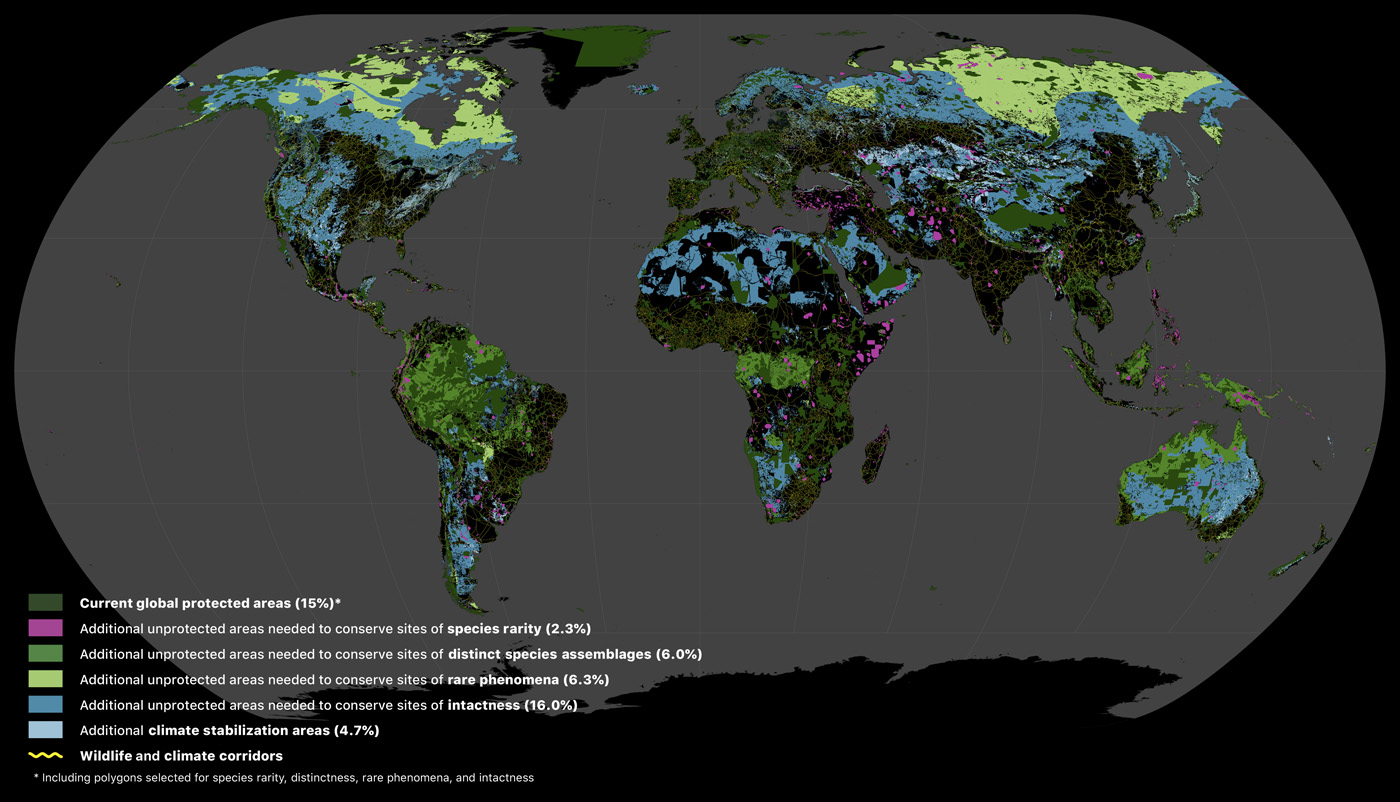
If global temperatures increase by more than 1.5° Celsius (2.7° Fahrenheit) above pre-Industrial levels, it will be difficult — almost impossible, the study says — to achieve the goals set by the U.N. Convention on Biological Diversity. On the other hand, if territories that provide important ecosystem services, such as carbon dioxide capture, are not protected, the climate targets of the Paris Agreement will not be achieved either.
The authors say more ambitious conservation targets are needed if we are to have a future in which people and nature thrive together. Moreover, they say the need is all the more urgent after witnessing the spread of COVID-19 and the risk of more pandemics as extensive deforestation in the tropics drives virus-bearing wildlife into closer contact with humans.
For Exequiel Ezcurra, a world expert in ecology and conservation and a professor in the Department of Botany at the University of California, Riverside, one of the highlights of this report is that it shows that protecting the planet’s biodiversity has a lot to do with stopping climate change. “Humans — that is to say, one species of humans, sapiens — have taken over half the planet, now we must allow the other half of native ecosystems be conserved. Is this ambitious? Yes. Is it impossible to achieve? No,” he told Mongabay Latam.
Is time running out?
While the deadline for protecting 50.4% of the planet’s land surface was not the specific question at the heart of the study, another of the authors, Karl Burkart, managing director of One Earth, says action must be taken as soon as possible to tackle deforestation. “According to Global Forest Watch, in 2019 we lost 24 million hectares [59 million acres] of forest. If this rate continues, we will lose approximately 2% by 2030, or 4% by 2040,” he says. Although the dates are not clear, Burkart says there is a recent coalition of governments calling for a minimum 30% protection of the Earth’s land surface by 2030.
Dinerstein says areas with rare and endangered species, 2.3% of the planet’s surface, should be the priority and should be protected within the next three years. He says many of these species are vulnerable to climate change and live in habitats that would be strongly affected by drought, such as tropical cloud forests. “There really is no time to lose,” he adds.
The degradation of the natural environment will not only affect ecosystems, which could collapse, but also human well-being. That is why, for Óscar Guevara, senior climate and biodiversity specialist at WWF in Colombia, this is the decade to hit the reset button and do things right. “The article says that to reduce the percentage of endangered species, we should increase the planet’s 2.3% conserved area. We could achieve that in two or three years because it requires a smaller effort compared with the 50.4% target. This is a goal we could achieve quickly,” he says.
Indigenous people also play a fundamental role in preserving biodiversity and mitigating climate change. The study found that ancestral peoples’ lands contribute greatly to CO2 storage — more than 74% of their mapped territories are climate stabilization areas that store more than 931 gigatons of carbon biomass, or nearly 22 times the total CO2 emitted by human activity globally last year.
Addressing Indigenous land claims and defending land tenure rights could also help achieve biodiversity targets in as much as a third of the areas required by the Global Safety Net, according to the study. In other words, there is a dual intent: to protect biological diversity while addressing social injustice and human rights concerns.
“Empowering Indigenous communities is the most important political initiative we can undertake to protect biodiversity and stabilize the climate,” Dinerstein says. At the same time, Burkart adds that many studies have shown that conservation within Indigenous lands is even more effective than within government-managed protected areas.
A key region for protection
Dinerstein and Burkart say Latin American countries could lead the movement to protect global biodiversity. If Colombia, Ecuador and Peru were a single country, Dinerstein says, it would be “by far” the most important nation on Earth in terms of biodiversity. Even disaggregated, as they are now, the map shows that Colombia is the most valuable country on Earth in terms of species diversity and threatened species. Ecuador has perhaps the greatest wealth of species per hectare. And the Amazon rainforest ecoregion in southwestern Peru, the Madre de Dios region, “is probably the Earth’s most valuable real estate asset for biodiversity,” Dinerstein says.
Burkart says the natural wealth of nations such as Colombia, Peru and Ecuador is subsidizing the rich countries of the Global North, providing them with ecosystem services for free, such as carbon storage and capture. “Latin American countries must come together and challenge the status quo that keeps them imprisoned in a cycle of debt they can never repay, when in fact it is the rich countries that have a debt. The Latin American region must take the lead and demand debt-for-nature swaps or other mechanisms to compensate the countries that preserve the biodiversity and ecosystem services that make all life on Earth possible,” Burkart says.
He points to a recent study showing that Colombia’s natural lands provide about $5,000 per hectare each year in ecosystem services. If Colombia’s share of the Global Safety Net covers an area of 79.6 million hectares (197 million acres), this is equivalent to approximately $400 billion per year in ecosystem services. “That’s more than the country’s entire annual GDP. Meanwhile, Colombia has a public debt of $172 billion. It seems that the main issuing countries, such as the United States, actually owe a large debt to Colombia,” Burkart says.
The authors say that Latin America as a whole is key to preserving life on the planet. Mexico, Dinerstein says, overlaps with 45 of the 846 eco-regions defined on the map. It is home to the richest desert ecosystem on Earth for many groups of living beings, and is ground zero for the conservation of endemic cacti. It has some of the most diverse tropical dry forests, as well as the richest pine-oak forests in the world, the largest number of oak species (more than 800 are currently known) and the largest number of sites for vertebrates in danger of extinction.
Guatemala has major tropical cloud forests in need of conservation, and shares the Mayan Biosphere Reserve with Belize. In Costa Rica, the Osa Peninsula and Corcovado National Park conserves the largest, wildest and most intact stretch of Pacific rainforest in Central America. Panama’s Darién rainforests, shared with Colombia, are full of endemic species. Venezuela has the tepui mountain formations, and highlands in general are a global conservation priority. Brazil contains 49 ecoregions and has the world’s largest dry forest complex (the Caatinga), the largest rainforest system in the Amazon, which must remain intact for global climate stability, and also the Pantanal, a wetland of global importance that it shares with Paraguay, where jaguars grow twice as large as in the Amazon, Dinerstein says.
Bolivia is home to the Chiquitania, one of the most intact dry tropical forests on the planet. The Gran Chaco, which extends over a part of Paraguay, is another dry habitat full of rare species. Chile has the Matorral, one of the most diverse Mediterranean climate systems on Earth. And Argentina, in addition to the Gran Chaco, has a unique assemblage of large mammals and one of the world’s most extensive temperate grasslands, in Patagonia.
How we live must change
The United Nations projects that the world’s population may reach 9.6 billion people by 2050, a figure which, while challenging due to the increased demand for food, does not make it impossible to meet the target of protecting half of the Earth’s surface, since almost all population growth is expected to be in urban areas. In the Global Safety Net, the authors have even delineated climate and wildlife corridors by excluding land that is currently under cultivation.
“A little-known fact is that we are currently growing more than enough food to feed 10 billion people. But our global food system is broken. Approximately a third of the food produced is wasted. And half of all our agricultural land is used to grow food for livestock and for biofuels, an incredibly inefficient way of feeding the world,” Burkart says, adding that the agricultural industry operates under an extractive model that sooner or later causes soil infertility, resulting in a subsequent search for new arable land.
Human nutrition is closely connected to climate change. If the temperature does not stabilize, vast areas will no longer be suitable for cultivation, which will also cause migration as people abandon unproductive land. This is already happening in parts of Honduras, where, according to the study’s authors, maize can no longer be grown.
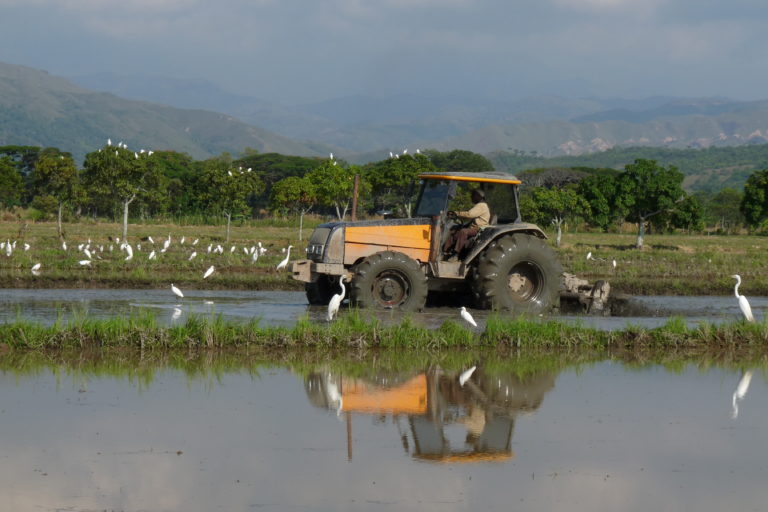
“What the researchers are proposing is completely achievable if we have, at the same time, an openness among humans about how we feed ourselves, because we are killing off our ecosystems to produce food for cows, chickens and pigs,” says Ezcurra, the Mexican conservationist. He says consumption of animal protein in Mexico is between 35 and 40 kilograms (77-88 pounds) per person per year, while 50 years ago it was less than 10 kg (22 lb). “Right now, almost 60% of the corn grown in the country is used to feed animals for our consumption. This shift in diet is the main driver of change in the agricultural landscape,” he says.
Ezcurra adds that in Argentina, for example, entire biomes of the Pampas prairie have vanished, along with its biodiversity, to make way for plantations of soybeans intended as food for livestock.
Mapping the way
The study is clear in stating that the advances promoted by the U.N.’s Convention on Biological Diversity and Framework Convention on Climate Change must be accelerated if we are to protect the diversity of life on Earth and stabilize the climate. The Global Safety Net, via the interactive map produced in association with Google Earth Engine, could serve as a guide for the development of “common but differentiated targets for each nation,” the study says.
This scientific collaboration, says Guevara at WWF-Colombia, aims to inform and strengthen the processes of global multilateral negotiations. He says this form of analysis could support decision-making during the implementation of international agreements.
“If we had started the change 10 years ago, we would be reducing our emissions by 2 or 3% a year,” he says. “But since we have not started, we will have to reduce them by 8-10% a year. It will become increasingly difficult, and the science says that if we don’t start now, the gap is likely to close by 2030 and we will not be able to achieve the 1.5°C target. We have 10 years left — that’s what the Intergovernmental Panel on Climate Change’s report tells us.”.
There are large ecosystems, such as the polar icecaps or the Amazon, which, if they were to collapse, would put planetary safety at risk and impact the global climate. For both Guevara and the authors of the new study, conserving and sustainably managing 50.4% of the Earth implies rethinking the relationship that humanity has with the planet. “What we have done so far is insufficient, the evidence is there,” Guevara says. “And what is in danger is not the protected areas, but us.”
20 Comments on "To save life on Earth, consult this new map"
FamousDrScanlon on Sat, 5th Dec 2020 12:18 pm
To save life on Earth,
consult this new mapjump off a bridgeFamousDrScanlon on Sat, 5th Dec 2020 2:19 pm
AGW Jacked Rain Bombs Keep Falling On Their Heads (and smashing their infrastructure to shit)
“Juneau, Alaska, smashed its all-time 24-hour rainfall record Tuesday and Wednesday, triggering destructive flooding and mudslides from an atmospheric river.
Juneau picked up 5.08 inches of rain in 24 hours ending 3 a.m. Wednesday, topping the previous record for any 24-hour period in Alaska’s capital city, 4.66 inches on Oct. 9-10, 1946, according to Rick Thoman, a climate specialist at the University of Alaska-Fairbanks.”
https://weather.com/news/news/2020-12-02-juneau-alaska-all-time-rain-record
FamousDrScanlon on Sat, 5th Dec 2020 2:27 pm
Tornadoes, Thunderstorms, 70-Degree Days: Is This the New Fall in Philly?
We’ve assembled a panel of climate experts, and they tell us that basically, regrettably, the answer is: yes.
“Of course, the reason for this is well documented: climate change, caused by humans. Warmer temperatures mean the atmosphere can hold more moisture; more moisture means larger storms; after those storms, thanks to warmer temperatures, more evaporation takes place, which means more water in the atmosphere and resulting larger storms. And so the cycle goes.”
https://www.phillymag.com/news/2020/12/03/philly-weather-severe-climate-change-fall/
FamousDrScanlon on Sat, 5th Dec 2020 2:33 pm
Washington winters are rapidly warming up and feeling more Southern
“The data is stark
Since 1970, Washington’s average winter temperature has risen 2.9 degrees from an average of 37.2 degrees in 1970 to 40.1 during the winter of 2019-2020. The change has been even more pronounced at Dulles International Airport, with the average winter temperature increasing by 4.4 degrees, from 32.8 degrees in the winter of 1969-70 to 37.2 last winter.
In addition to long-term climate change from increasing greenhouse gases, there has been a marked increase in urban development in and around Dulles Airport, which may also be intensifying its rate of warming.
The frequency of bitterly cold winter days is in decline. During the past five decades, Washington has seen the number of days with high temperatures below freezing fall from an average of about 10 to 6 per year. At Dulles, the count has dropped from roughly 16 to 10.”
https://www.washingtonpost.com/weather/2020/12/03/washington-warming-winters-snow/
FamousDrScanlon on Sat, 5th Dec 2020 2:36 pm
“We’re in December and we now have active wildfires still in our state,” California Governor Gavin Newsom told a news briefing. “These Santa Ana winds have been quite intense.”
Since the start of the year, wildfires have scorched more than 6,500 square miles (17,000 square km) of California land, according to the California Department of Forestry and Fire Protection.
The yearly land area burned in the western United States has grown eight times larger in less than four decades, the U.S. Forest Service Rocky Mountain Research Station said in research published last month.”
https://uk.reuters.com/article/uk-usa-wildfires/fire-crews-battle-to-tame-southern-california-wildfire-after-thousands-flee-idUKKBN28D2X4
FamousDrScanlon on Sat, 5th Dec 2020 2:40 pm
Severe wildfires burning 8 times more area in western U.S., study finds
“As we move into winter and what is typically the wet season for the western U.S., the 2020 fire season is finally winding down. But the damage is done: nearly 14 million acres have burned across the nation, about double the 10-year average and the most acres burned since reliable record-keeping began in 1983.
Five of the six largest fires in California history and three of the four largest in Colorado history all burned this year. This dramatic increase in the acres burned by immense wildfires is being driven by fires which are burning hotter and more intensely than they used to.
In fact, according to a new study, there’s been an eight-fold increase since the mid-1980s in annual area burned by high-severity wildfires — defined as a fire that kills more than 95% of trees. The transformation in fire behavior has happened fast, with this exponential increase happening in just one generation over the course of 30 years.”
https://www.cbsnews.com/news/wildfires-western-united-states-8-times-more-area/
Even the super wealthy won’t escape the AGW hammer. Might buy them an extra 5 min.
FamousDrScanlon on Sat, 5th Dec 2020 2:55 pm
Conservationists rescue a 16-foot giraffe after it became stranded on a flooding island off Kenya – and transport it four miles down river to safety
Eight giraffes became stuck on an island in Kenya when water levels rose
Conservationists constructed a massive boat made of steel and empty drums
They rescued one of the giraffes and took it four miles down the river
The teams plan to rescue more later this week and early next year
https://www.dailymail.co.uk/sciencetech/article-9011491/Conservationists-rescue-16-foot-Nubian-giraffe-stranded-flooding-island-Kenya.html
You’re supposed to be impressed with the selfless humans – not.
The only reason they need ‘saving’ is because the humans are a fucking malignant cancer.
Death on two legs.
I say STOP. Let them go extinct. Stop adding insult to injury. Stop dragging out their doom, so you can play hero for 5 more minutes.
The humans will have extincted millions of species by the time we have extincted ourselves in a few decades.
zero juan on Sat, 5th Dec 2020 2:58 pm
The selfish Prick JuanPpeee is at it again being loud and obnoxious with his StupidDrDumbass and others. FUCK JUANp
FamousDrScanlon said Conservationists rescue a 16-foot giraffe after it…
FamousDrScanlon said Severe wildfires burning 8 times more area in west…
FamousDrScanlon said “We’re in December and we now have active wildfire…
FamousDrScanlon said Washington winters are rapidly warming up and feel…
FamousDrScanlon said Tornadoes, Thunderstorms, 70-Degree Days: Is This…
FamousDrScanlon said AGW Jacked Rain Bombs Keep Falling On Their Heads…
FamousDrScanlon said bochen787, the Chinese say – ‘we have…
Ministry of truth said Exactly, offshoring production is not being ‘…
FamousDrScanlon said clog, when your American buddies talk about saving…
A rarely sober Jean Claude Juncker said Great reset perhaps. Force European people to buy…
bochen787 said We still love smoking opium in China, heck we are…
The Nationalist said It seems elements of globalisation celebrate the d…
FamousDrScanlon said clog, you are not part of ‘white AmericaR…
The Nationalist said The article shows the decline in aviation fuel use…
The Nationalist said And yet the latest electric Cadillacs are going to…
FamousDrScanlon on Sat, 5th Dec 2020 2:59 pm
Here’s you & yours in a decade or so.
Locals eat white clay mixture as famine hits southern Madagascar
“In the drought-hit south of Madagascar, people are forced to fill their bellies with white clay mixed with tamarind to cope with famine. More than a year of no rain is slowing leading locals to the brink of famine. The staple food like cactus fruit cannot be produced because of the drought.”
https://www.africanews.com/2020/12/03/locals-eat-white-clay-mixture-as-famine-hits-southern-madagascar/
FamousDrScanlon on Sat, 5th Dec 2020 3:03 pm
I agree I am part of this selfish behavior of JuanP becuase I am his sock.
FamousDrScanlon on Sat, 5th Dec 2020 3:04 pm
Psychopaths like JuanP have to inflate their ego by being loud and obnoxious
FamousDrScanlon on Sat, 5th Dec 2020 3:15 pm
I’m famous & do & say whatever the fuck I want.
Those who are hyper triggered & opposed to free speech should try lobbying (crying, bitching, sissy moaning) the owners of peakoil.com
Perhaps if you suck their dick daily (and call them daddy), they’ll convert peakoil.com into your personal safe space.
“Wa wa wa someone stop the bad man’s words. His words are like knives in my peanut brain Wa wa wa I DEMAND compliance or I’ll never stop copying & pasting my one & only response”
FamousDrScanlon on Sat, 5th Dec 2020 3:24 pm
Climate change is like an 8lb sledge hammer going to town on civilization which is made of Lego.
Economic losses sparked by Cyclone Amphan pegged at $14 billion
“Details: More than 2.8 million homes were damaged
The WMO report revealed that nearly 2.4 million people were displaced in India, primarily in Bengal and Odisha. Another 2.5 million were affected in Bangladesh when the cyclone made landfall in May.
Though a large chunk of people returned soon, over 2.8 million houses were damaged, resulting in the displacement of thousands.”
https://in.news.yahoo.com/economic-losses-sparked-cyclone-amphan-044932601.html
FamousDrScanlon on Sat, 5th Dec 2020 3:28 pm
Sea Ice in the Siberian Arctic Continues to Remain at a Record Low
https://i.redd.it/mcbe3l2e9d361.jpg
Abraham van Helsing on Sun, 6th Dec 2020 2:29 pm
Herrings in the world, unite!
https://www.shell.nl/media/nieuwsberichten/2020/niet-slaan-maar-draaien-nieuwe-manier-om-windmolens-op-zee-vast-te-zetten.html
“NIET SLAAN, MAAR DRAAIEN. NIEUWE MANIER OM WINDMOLENS OP ZEE VAST TE ZETTEN“
(Wind turbine monopiles: don’t ram, screw!)
Much less noise.
Abraham van Helsing on Mon, 7th Dec 2020 9:31 am
Sir Alfred Dubs wants to ensure that Brexit won’t be used as a pretext to keep poor refugees out, you know the type: dark, young, male, virile, beard, intense glance, Quran under the arm:
https://www.welt.de/politik/ausland/plus221892984/Grossbritannien-Brexit-gefaehrdet-Aufnahme-gefluechteter-Kinder.html
Quiz: what is the origin of sir Alfred Dubs:
1. Russian
2. Belgian
3. Spanish
4. Other, namely…
Antius on Mon, 7th Dec 2020 9:50 am
“Sir Alfred Dubs wants to ensure that Brexit won’t be used as a pretext to keep poor refugees out, you know the type: dark, young, male, virile, beard, intense glance, Quran under the arm”
Dubs (clearly not his real name) is a Czechoslavakian Juden. He received a life peerage from Tony Blair’s ZOG New Labour Party. A real nice character. Sadly, given that he is 88 already, he will have died of natural causes long before he is able to face the justice of the gas chamber.
doug nicodemus on Mon, 7th Dec 2020 9:51 am
you all have van gogh’s ear for music…
Brendon on Thu, 17th Dec 2020 5:41 am
It’s good that someone still believes it’s not too late to make a change for the better. Extremely ambitious and encouraging.
Abraham van Helsing on Thu, 17th Dec 2020 6:43 am
Test2