
Peak Oil is You
Donate Bitcoins ;-) or Paypal :-)


Page added on March 25, 2014

Thoughts About Norm Borlaug On : The 100th Birthday Of “The Man Who Fed The World”
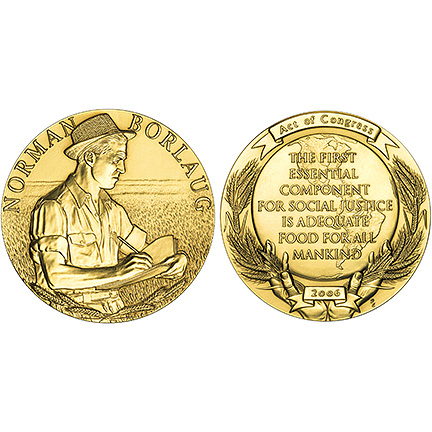
Norman Borlaug would have been 100 years old today. He has been called “The Man Who Fed The World,” and “The Father of The Green Revolution.” Norm Borlaug was the first plant pathologist to be awarded a Nobel Prize (1970) – for contributions to world peace. For all of use who are fellow plant pathologists, his work has been particularly inspiring. It is a good time to look back at how the challenge of feeding the world population was met during Borlaug’s career, because we have a similar challenge ahead of us. The chart below shows global population from 1950 with a projection to 2100.
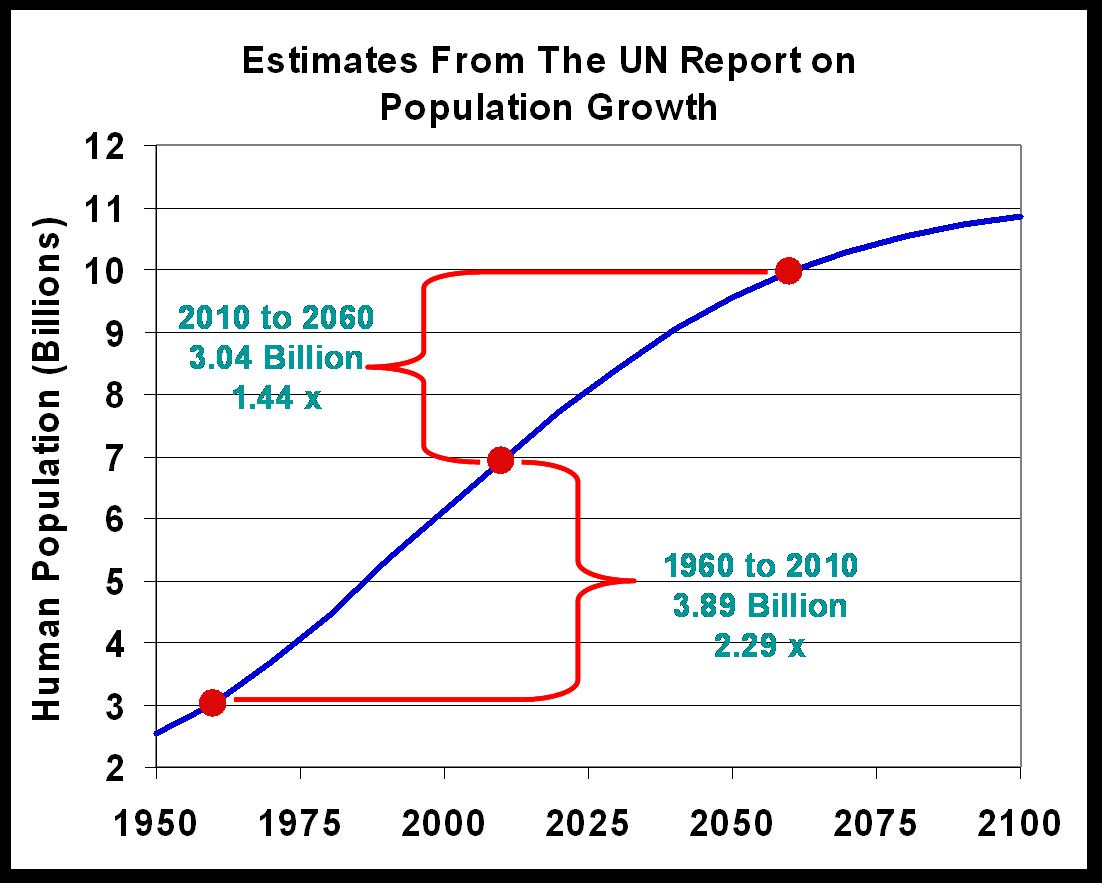
I’ve been looking at food production data available from the UN Food and Agriculture Organization (FAOSTAT). If we look at the half century since FAO started tracking it in 1960, global population increased by 3.89 billion. Between 2010 and 2060, global population is projected to rise by another 3.04 billion. Between 1960 and 2010, production of most crops did manage to keep up with population growth and for many crops there was actually more available per person in 2010 than in 1960. Living standards also improved in many parts of the world, which meant that people were able to enjoy that per capita increase. Fertility rates have declined with the education of women combined with improvements in living standards and food security. It is projected that global human population will level off by around 2100 due to these factors.
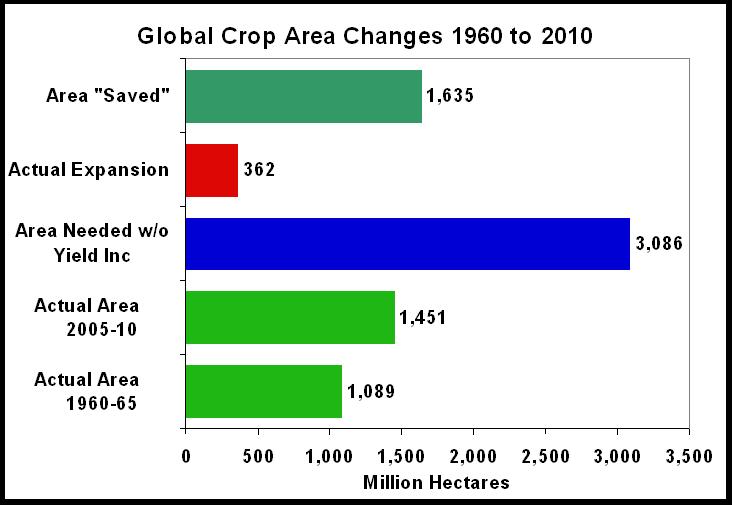
The increase in food production during Borlaug’s era was mostly achieved through increased yield on each acre or hectare grown, not from farming more land. That was made possible by agronomic improvements, including the breeding advances that came from the work of Borlaug and many others. In the graph above, the two bottom, green bars show the global crop area in the window 1960-65 (1.09 billion hectares) and 2005-10 (1.45 billion hectares). The increase, shown in the red bar, is 362 million hectares. That is an enormous amount of land, but without increased yield, it would have taken nearly 3.1 billion hectares (blue bar) to have provided the amount of food that was available to the world by 2010. That effectively means that the global farming community, and those that aided it with technologies, advice and expertise, “saved” more than 1.6 billion hectares of land from being converted from a natural state into farmland. Realistically, there is not that much land which could ever be farmed.
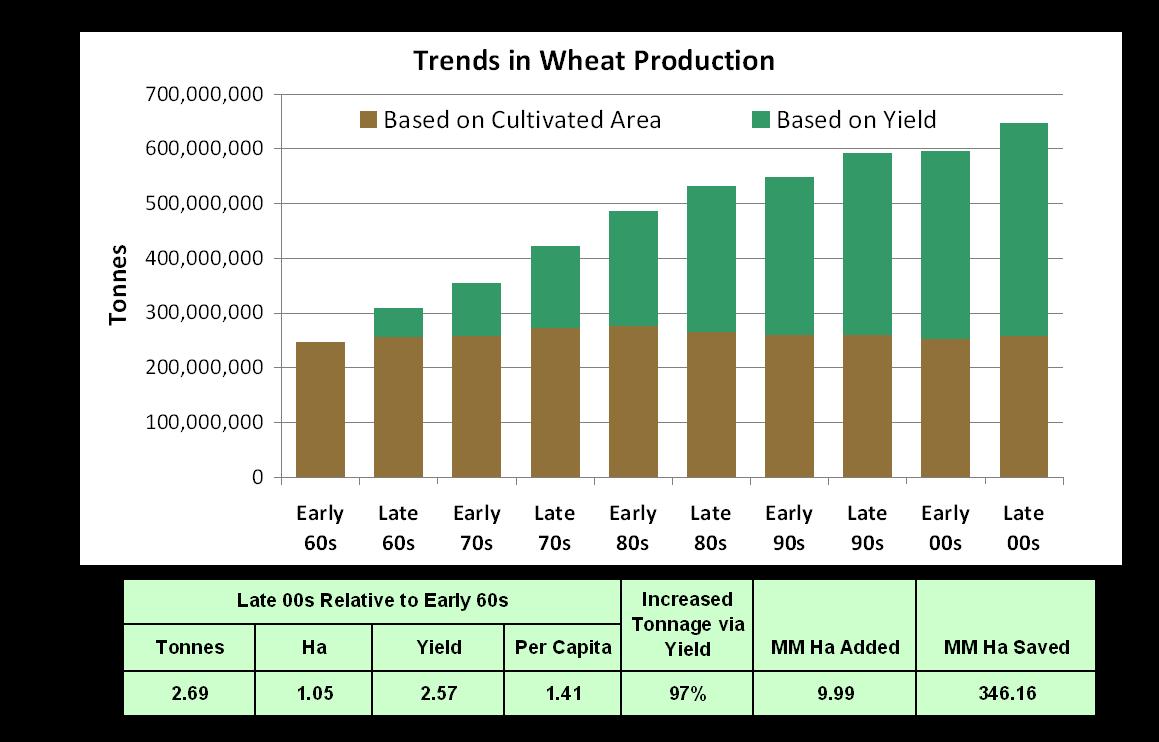
Many of Borlaug’s contributions were to the staple food crop – wheat. Wheat is not a single crop, but a collection of many different types of wheat grown for different kinds of food ranging from hearty breads, to pasta, to crackers, to flat breads to soft noodles. By the end of this 50 year window, the world’s wheat farmers were producing 2.69 times as much wheat as in 1960. However, 97% of that increase (green part of the bar) was enabled by higher yields. Only 10 million more hectares were being grown. That meant that the world could continue to have enough wheat without the need for adding 346 million more wheat hectares. That is the legacy of Borlaug and the other participants in the Green Revolution.
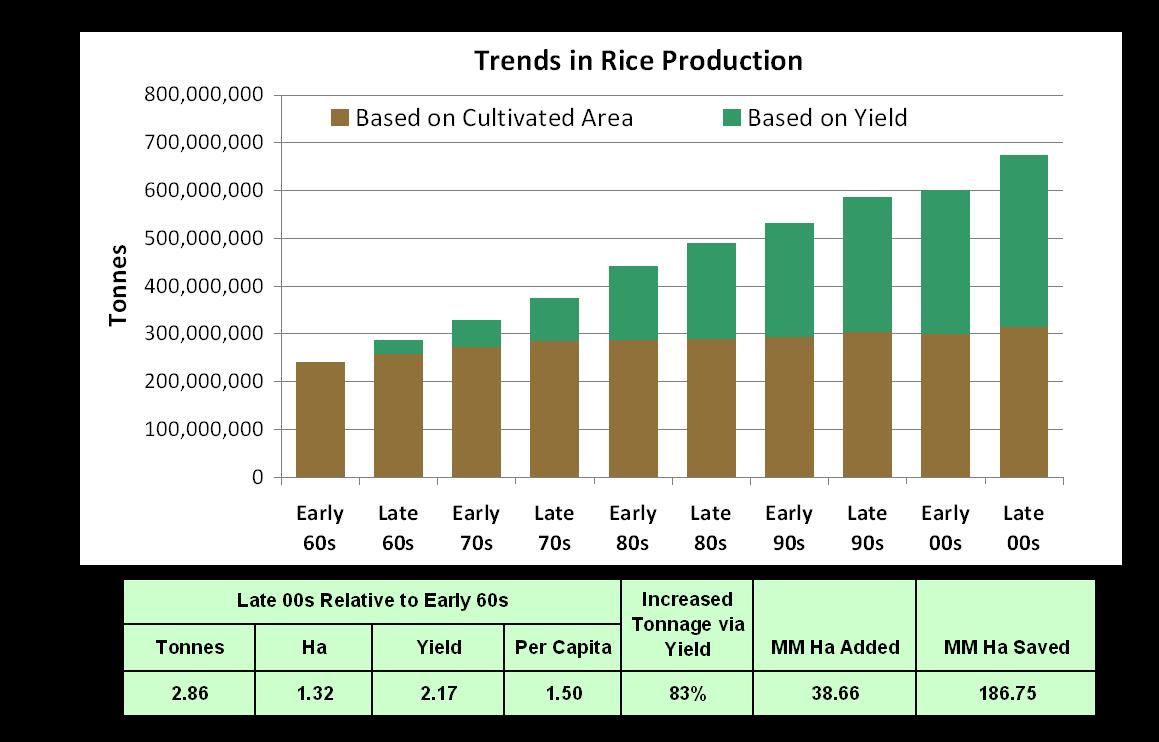
The story with rice is almost as positive. In 2005-10, humanity had access to 2.9 times as much rice as in 1960-65, and 83% of the increase was attributable to yield with 39 million new hectares added. That meant that there were 187 million hectares which did not need to be added to the rice production base. The story behind these higher yields is complex and varies across geographies.
The details of how we might continue this sort of progress through 2060 are also complex and will involve new challenges such as climate change. Even so, on this important anniversary it is fitting to look back at the remarkable accomplishments of the past to find inspiration for the challenges of the future. Lets hope that at the 150th anniversary of Norm Borlaug’s birth people will once again be able to look back and tell this kind of story. A story about humanity continuing to be fed, but without having had to add much if any new farmed land. Even into his 90s, Borlaug continued to be an articulate proponent for letting farmers use the full toolbox of technologies, including biotechnology, to pursue such goals. Now its up to us to continue to make that case. Image of the Norman Borlaug Congressional Medal from Wikimedia Commons.
11 Comments on "Thoughts About Norm Borlaug On : The 100th Birthday Of “The Man Who Fed The World”"
perfector on Tue, 25th Mar 2014 8:10 pm
“Between 1960 and 2010, production of most crops did manage to keep up with population growth”
That’s completely ass-backwards. It would be more correct to say “population growth did manage to keep up with production of most crops”.
J-Gav on Tue, 25th Mar 2014 9:03 pm
Well put, Perfector.
I’m not one to dump on Borlaug, since a 100th anniversary panegyric is to be expected and I’m sure he meant well. But he couldn’t foresee the dire (unintended) consequences of his genius. Thus it often goes with geniuses. Figure out how to feed a few billion more, you’ll get a few billion more … until nature steps in and reminds humanity that we’re not really in charge here.
Davy, Hermann, MO on Tue, 25th Mar 2014 9:15 pm
Gav, Mark Twain said:
Hunger is the handmaid of genius.
– Following the Equator
Kinda fitting isn’t it!
andyuk on Tue, 25th Mar 2014 9:38 pm
yeah well done for kicking the can down the road a couple of decades, making the problem many times worse and turning the world into a human breeding colony / food factory / natureless cesspool.
andya on Tue, 25th Mar 2014 10:03 pm
Norman Borlaug was well aware of the population problem, and mentioned it whenever he gave a lecture. He was a strong proponent of birth control. It’s a bit sad when people degenerate his work. It’s not his fault population has grown so much, he didn’t fuck all those women 🙂 At the same time his work was only one of 3 parts of the green revolution, the others are irrigation and fertilisers. The odds of a green revolution 2.0 are pretty slim when you think of what else is left to exploit.
perfector on Wed, 26th Mar 2014 12:07 am
Thankyou J-Gav.
He did do a lot of good (although if he hadn’t come along, its probable someone else would have done something similar).
But he was never willing to admit the risks in his innovations. He used ad hominem attacks (“you’ve never known hunger, your criticism is invalid)”.
And like so many others, he could not even comprehend that science may not, ever, find a better or equal replacement for fossil fuels.
Jerry McManus on Wed, 26th Mar 2014 2:02 am
Funny, not one single mention, not even a hint, nor a whisper, nary so much as even a sideways glance at the one thing that made all those yield improvements possible.
Namely, the massive amounts of fossil fuels and feedstocks that made all those chemical fertilizers, poisons, and fleets of tractors and trucks into the empire of industrial agriculture that it is today.
Norman Borlaug was just the guy that figured out how to turn oil and gas into food, that’s all.
Joe Clarkson on Wed, 26th Mar 2014 4:44 am
Jerry McManus,
You are absolutely right, but consider how much land would have had to have been converted to agriculture without petro-chemicals. Now, when the petrochemicals run out, there will still be some wilderness to help support that small population that survives the collapse of industrial agriculture.
By helping us to turn oil and gas into food, Borlaug only delayed the inevitable, but if that inevitable collapse comes quickly enough, a lot of land will have been saved from deforestation and depletion.
Still, I shudder to think what might happen if the collapse comes too slowly and we fortunate ones, together with the descendants of the billion people that Norman Borlaug ‘saved’, live long enough to scour the earth of every scrap of biomass.
energyskeptic on Wed, 26th Mar 2014 5:25 am
Borlaug shares the credit with Haber-Bosch (and many others) the population explosion to 7 billion from 1.5 billion people, soon to be 1 billion or less after die-off and undershoot. My first reaction to celebrating the green revolution was anger at the great tragedy ahead, but of course it was impossible to see the consequences at the time as j-gav and andyuk pointed out.
http://energyskeptic.com/2014/fossil-fueled-fertilizers-keep-5-billion-people-alive/
DISCOVER Vol. 22 No. 4 April 2001. By David E. Fisher & Marshall Jon Fisher.
The Nitrogen Bomb
By learning to draw fertilizer from a clear blue sky, chemists have fed the multitudes. They’ve also unleashed a fury as threatening as atomic energy
perfector on Wed, 26th Mar 2014 6:40 am
Even this article only references the harm caused by nitrogen runoff. It does not mention, at all, what will happen when the oil and natural gas is seriously depleted. The assumption that natural resources are infinite or infinitely replaceable permeates our society.
And Malthus was right. Happy people have lots of kids. Giving food security to poor hungry subsistence farmers makes them happy. Perhaps sometime down the line they come to take this for granted and find something else to be miserable about (i.e. consumerism) and the birthrate drops, but by this time the population has exploded and the damage as been done.
Jerry McManus on Wed, 26th Mar 2014 4:38 pm
@Joe Clarkson
You raise a very good point, and one that I know is also troubling others who have a good understanding of our predicament.
Can industrial civilization crash soon enough and fast enough to preserve any long term carrying capacity at all for humans on Earth? Or is mass extinction inevitable at this point?
Consider another scenario: Rapidly depleting energy and capital is diverted to food production, transport and storage in a desperate attempt to feed the population.
Long before people start starving the fact that there is no energy for heat, cooking, or hot water means that 7-billion-going-on-9-billion people will immediately start burning wood and other biomass.
Instant. Global. Deforestation.