
Peak Oil is You

Donate Bitcoins ;-) or Paypal :-)


Page added on April 15, 2011

The Road to Fukushima: The Nuclear Industry’s Wrong Turn
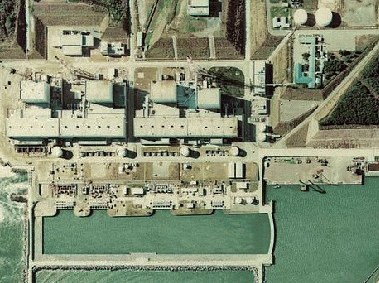
Nuclear researchers knew long ago that reactor designs now in wide use had already been bested in safety by another design. Why did the industry turn its back on that design?
Imagine a nuclear reactor that runs on fuel that could power civilization for millennia; cannot melt down; resists weapons proliferation; can be built on a relatively small parcel of land; and produces little hazardous waste. It sounds like a good idea, and it was a well-tested reality in 1970 when it was abandoned for the current crop of reactors that subject society to the kinds of catastrophes now on display in Japan.
This rather remarkable design is called the molten salt reactor (MSR), and it lost out for two reasons: 1) It wasn’t compatible with the U.S. government’s desire to have a civilian nuclear program that would have dual use, that is, that could supply the military with nuclear bomb-making materials. 2) Uranium-fueled light water reactors, which are in wide use today, already had a large, expensive infrastructure supporting them back in 1970. To build MSRs would have required the entire industry to retool or at least create another expensive parallel infrastructure. And, that’s how MSRs became the victim of lock-in.
One familiar example will show how lock-in works. Anyone who types on a standard English keyboard may already know that the arrangement of the letters was designed to slow down typists so that the typebars–the things which strike the paper in a typewriter to make the letters–would not get jammed together. Other keyboards have since been designed to allow much faster, less error-prone typing, but few people have adopted them–even with the advent of computers which, of course, have no typebars to worry about.
Decisions made early on in the history of keyboard technology locked in a path for nearly all subsequent adopters. Everyone learned to use the so-called QWERTY keyboard, and so manufacturers only made this configuration, which then obliged all those new to typing to learn it, and so on. So strong was the lock-in for QWERTY that it’s been that way since the 1870s regardless of changes in typing technology.
Lock-in has worked in much the same way for the nuclear industry. The decision within U.S. government circles to focus on light water reactors and abandon MSRs relegated the latter to a footnote in the history of civilian nuclear power. And, because the United States was the leader in civilian nuclear technology at the time, every nation followed us. So, should the world look again at this “old” technology as a way forward for nuclear power after Fukushima?
My sympathies are with the MSR advocates. If the world had adopted MSR technology early on, there would have been no partial meltdown at Three Mile Island, no explosion at Chernobyl, and no meltdown and subsequent dispersion of radioactive byproducts into the air and water at Fukushima. It’s true that MSR technology is not foolproof. But its very design prevents known catastrophic problems from developing. The nuclear fuel is dissolved in molten salt which, counterintuitively, is the coolant. If the reactor overheats, a plug at the base melts away draining the molten salt into holding tanks that allow it to cool down. Only gravity is required, so power outages don’t matter.
As for leaks, a coolant leak (that is a water leak) in a light water reactor, can quickly become dangerous. If there is a leak from an MSR, the fuel, which is dissolved in the molten salt, leaks out with it, thereby withdrawing the source of the heat. You end up with a radioactive mess inside the containment building, but that’s about it.
If the world had adopted MSRs at the beginning of the development of civilian nuclear power, electricity production might now be dominated by them. And, we might be busily constructing wind generators and solar panels to replace the remaining coal- and natural gas-fired power plants. Would there have been accidents at MSRs? Certainly. Would these accidents have been large enough and scary enough to end new orders for nuclear power plants as happened after the 1979 Three Mile Island accident in the United States? I doubt it.
Having said all this, I believe that MSR technology will never be widely adopted. The same problem that derailed it early in the history of civilian nuclear power is still with us. We still have lock-in for light water reactors. Yes, the new designs are admittedly quite a bit safer. But these designs still don’t solve as many problems as MSRs do, and they continue to rely on uranium for their fuel. MSRs have shown themselves capable of running on thorium, a metal that is three times more abundant than uranium, and 400 times more abundant than the only isotope of uranium that can be used for fuel, U-235. This is the basis for the claim that MSRs fueled with thorium could power civilization for millennia.
Attempts have been made to run current uranium-fueled reactors using thorium. But all the dangers remain because the reactors are still subject to catastrophic meltdowns. Only in the MSR, where the fuel is dissolved in molten salt, is this danger avoided altogether.
The Chinese have announced that they are interested in pursuing MSRs and the use of thorium to fuel them. Perhaps in China–where the nuclear industry is synonymous with the government and therefore does what the government tells it to–MSRs might actually be deployed. I have my doubts. Even China suffers from the lock-in problem. Back in the United States it is easier to predict that we’ll see little progress. In the U.S. it is the industry that tells the government what new nuclear technologies will be developed rather than the other way around. And, the American nuclear industry is committed to light water reactors.
I believe that even if the Fukushima accident had not occurred, nuclear power generation would probably have done no more than maintain its share of the total energy pie in the coming decades. Now, I am convinced that that share will shrink as people in democratic societies reject new nuclear plants. This could, in turn, free up funds to pursue energy sources that could serve us well and permanently. The cheapest is conservation. We desperately need to reduce our energy use significantly so that we can come into balance with the amount of power that renewable energy can realistically provide us. And, we need to build that renewable energy infrastructure, primarily wind and solar, while solving the problem of electricity storage that currently plagues it.
The nuclear future we were promised in the 1950s and 1960s never arrived. Fukushima tells us that it probably never will. We need to get on with the business of constructing an energy infrastructure that provides all of us a decent, healthy and dignified life while accepting the limits suggested by wisdom and ultimately imposed upon us by nature.
5 Comments on "The Road to Fukushima: The Nuclear Industry’s Wrong Turn"
Cabra1080 on Sat, 16th Apr 2011 2:43 am
I like the ideal of using Thorium-232 in a molten salt reactor as a semi-green energy source. That coupled with solar, wind and hydro power and a substanially reduced power demand through conservation and human population reduction may make for a workable future. Once the present “locked-in” society crashes and burns, I might add.
C-A-B-R-A-1-0-8-0
DC on Sat, 16th Apr 2011 6:26 pm
Gee, dont the promises of MSR sound exactly like the claims made by the current set of nuke boosters?, cheap, safe, clean, little risk, blah blah blah. The nuclear industry has not been able to deliver on even ONE of its last set of promises, despite trillions spent and over 60 years of experience. The most expensive and dangerous method of boiling water ever devised, we can do better I think..
EDpeak on Sun, 17th Apr 2011 11:03 am
“Gee, dont the promises of MSR sound exactly like the claims made by the current set of nuke boosters?, cheap, safe, clean, little risk, blah blah blah. The nuclear industry has not been able to deliver on even ONE of its last set of promises, despite trillions spent and over 60 years of experience”
Agreed and let’s add to that:
“If we’re going to throw out the phrase ‘molten salt’, why not use the molten salt pools technology for storage of energy from wind power??”
Not to mention other ways to store energy from wind, as in hilltop wind power (I’ll take the “eyesore” in a few places of the lung-sore and climate-chaos-sore from fossil fuels) which uses excess power to move water uphill for later use during peak demand times.
Another storage technology, is compressed air in caverns
The United States is spending almost a TRILLION per year on militarism. $900 billion if you count the wars and energy department military-related, and there’ more hidden in other departments (NASA etc). Just the Pentagon alone is about 700Billion+
Imagine if we spend a “mere” 200 billion per year, on massive wind and solar with these or other storage technologies (we don’t have to get the storage right in the first few years since it will be years to grow solar and wind to large enough a percent to need it) Let’s start by ramping it up to 5% and then 10% and then to 20%.
Why are we using radio-active dangerous and prolifection-causing nuke-plants to BOIL WATER? That’s what nuclear energy is about. There are smarter, safer, and more sustainable ways to boil water, like wind and solar.
They also have the advantage of democratizing power.
Power in the literal sense: local and regionally owned and people- or community-controlled power generations. Big Energy doesn’t like that. It wants monopoly control of huge centralized systems of energy.
Power to the People – literally! Local and Green, de-centralized. Terrorists want to fly into a 5 megawatt wind tower? Let them! We’ll have thousnds of others elsewhere distributed.
The religion in the US is that guns protect our democracy..we have seen the opposite, we have more guns than anyone else in the developed world, but less democracy. Replace “Guns” by “energy generation” and now you’re talking!
Local money, local energy, local enterprise and Wall Street doesn’t have you by the b***s quite as much as they do now, and you don’t have to bow down to “The Man” while in heavy debt…that’s what they fear
Kenz300 on Sun, 17th Apr 2011 12:02 pm
The nuclear disaster in Japan is still unfolding. What will be the ultimate cost of this nuclear power? What will it cost to cover and store the waste in Japan FOREVER? Too dangerous and too costly. Time to move on.
I agree with EDpeak. “There are smarter, safer, and more sustainable ways to boil water, like wind and solar.”
Cabra1080 on Wed, 20th Apr 2011 2:23 am
I have photovoltiac solar installed along with LED lighting both indoors and outdoors and enjoy 24-7 pollution-free locally generated energy. The weak link in this setup are the lead acid batteries. I agree we need far better storage technology. Not sure if it will be developed in time before the end-of-oil crash.
C-A-B-R-A-1-0-8-0