
Peak Oil is You

Donate Bitcoins ;-) or Paypal :-)


Page added on December 13, 2013

The great suffocation – will we have enough oxygen to breathe?
Everyone is worried about global warming, and correctly so. However, there is another side to the warming question: for every additional molecule of carbon dioxide (CO2) generated by burning fossil fuels, one molecule of oxygen (O2) must be consumed. That means less and less oxygen in the atmosphere. So, won’t suffocation be an additional problem to global warming? (some people seem to be actually worried that it could be)
Fortunately, the answer is “no.” We don’t risk to run out of oxygen; at least in the short run. But the story is not simple and we can learn a lot about what’s happening to our atmosphere, our climate, and our ecosystem if we look at the question in some detail.
First of all, what do we mean as “suffocation”? The present concentration of oxygen in the atmosphere is 21% in volume. We have evolved to live with this level of oxygen and the minimum level for humans to function normally is around 19% (See here). We are already in trouble below 17% and simply can’t survive below 10%. So, we have to be careful with what we do with our atmosphere; we can’t afford to lose more than 1%-2% of the oxygen we have.
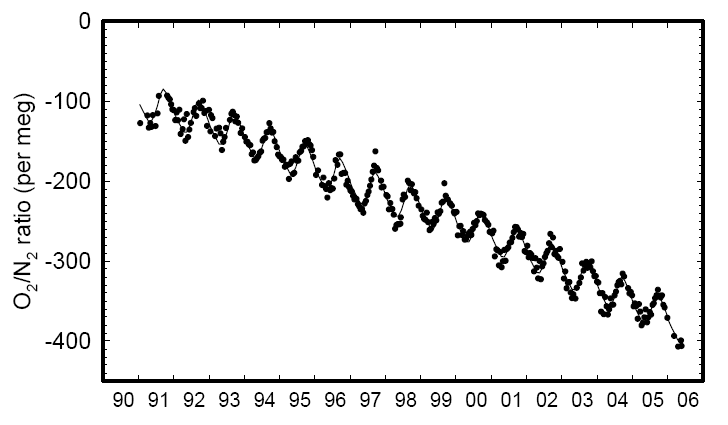
Now, how much oxygen have we consumed with burning fossil fuels, so far? Not much, really. Keeling found a 0.0317% reduction in the atmospheric oxygen concentration from 1990 to 2008. Clearly, we are not going to suffocate, at least not right away.
But we need to go more in depth in the matter. Consider that we have been burning fossil fuels for a long time before 1990. We can roughly calculate the total loss considering that the concentration of carbon dioxide in the atmosphere has increased of about 250 parts per million in volume over the past century. A similar amount has been absorbed in the oceans, so we can say that we have produced the equivalent of 500 ppm of CO2 and hence some 500 parts per million of oxygen (0.05%) must have gone. But we are still well within the safety limits.
How about the future? The Keeling results tell us that, at the present rates, we consume about 0.02% of oxygen every ten years. To arrive near the 1% safety threshold we would need centuries but, of course, we will not be able to keep burning fossil fuels at the present rates for such a long time. As we roll on the other side of the Hubbert curve, we won’t probably be able to do more than double the amount already emitted (and perhaps much less, according to the Seneca scenario that sees decline much faster than growth). Even in the most extreme assumptions, at most, we could emit no more than some four times the amount produced so far. That would correspond to a loss of about 0.2% of the total oxygen available. Not negligible but, as far as we know, not harmful.
So, burning fossil fuels would definitely not suffocate us; not directly, at least. But there are indirect effects. One is the loss of biomass caused by human activities. When plants and animals die, the carbon they contain is normally oxidized to carbon dioxide, consuming oxygen in the process. The total amount of carbon stocked in living creatures and soil is estimated as about 2100 billion tons (Gtons). If all this carbon were to react with oxygen, it would consume some 2800 Gtons of oxygen (taking into account that an atom of oxygen weighs more than an atom of carbon). The total mass of oxygen in the atmosphere is calculated as of the order of 1.2×10^9 Gtons (see also this reference). So, even the total burning of the planetary ecosphere would make only a small dent in the total oxygen concentration; about 0.2%.
We could consider also the release of the methane hydrates stored in permafrost; something that could happen as a result of global warming. Methane is a strong greenhouse gas, and so the process reinforces itself, that’s the origin of the so called “methane catastrophe” that would result in a disastrous greenhouse runaway effect. The total mass of methane stored in permafrost is estimated as of the order of 500-2500 gtons of carbon. In the worst case, methane could consume another 0.2% of the atmospheric oxygen.
Summing up everything we have considered so far, methane, organic matter, fossil fuels, we see that we are still below the 1% threshold. So, we would seem to be on the safe side. However, we should also take into account that by far the largest stock of organic (and hence burnable) carbon in the Earth’s crust is in the form of “kerogen”, the result of the partial decomposition of organic matter. (Figure below from Manicore.com).

10^10 gtons of kerogen is such a large value that if all of it were to combine with oxygen (about 10^9 tons), then there won’t be any oxygen left in the atmosphere. That would be, indeed, the “great suffocation”.
Fortunately, that is unlikely to happen. Kerogen can react with oxygen and it is, actually, the original source of the petroleum we extract and burn today. But the natural process is very slow and the human-made one very expensive. Human beings won’t be able, ever, to burn more than a microscopic fraction of the kerogen of the earth’s crust.
So, we see that oxygen loss, the great suffocation, is not something we should be worried about because we have much more oxygen in the atmosphere than what we could consume even in the worst possible hypothesis. We have this safety margin because free oxygen is the result of billions of years of photosynthetic activity which pumped lots of oxygen in the atmosphere. Of this oxygen, most was absorbed in inorganic oxides; principally iron oxides. Only a small fraction has gradually accumulated in the atmosphere, as we see in the following figure. (from Wikipedia – take into account that there is a big uncertainty in these estimates)


Note that a peak in the oxygen concentration was reached in the remote past, perhaps in correspondence with the peak in planetary biological productivity. At the peak, oxygen concentration may have reached a value of over 30% in volume – humans could not have survived in those conditions! Then, it may have gone down to about 15% and, again, we wouldn’t have been able to survive with that concentration.
So, oxygen is not simply accumulating in the atmosphere to remain there forever. It is a reactive gas and its concentration is linked to the evolution of the ecosystem. There are factors that can strongly change its concentration, probably involving reaction with the kerogen stock. We can’t know for sure what factors cause this reaction but a new dip in oxygen concentration as the result of the ongoing planetary changes cannot be excluded – even though that would probably be extremely slow by human standards. What we can be sure about is that we should be careful in the way we treat the Earth’s ecosystem – we are part of it!
3 Comments on "The great suffocation – will we have enough oxygen to breathe?"
rollin on Fri, 13th Dec 2013 2:02 pm
Completely neglected the ocean as the major source of oxygen. The continued creation of large anoxic regions from pollution and acidification could dramatically reduce the oxygen levels in the atmosphere.
BillT on Fri, 13th Dec 2013 3:54 pm
We are killing our oxygen factories, the oceans and the forests. And burning up what we have in cars, trucks, flaming off natural gas, etc. Humans are the dumbest animals on the planet.
GregT on Fri, 13th Dec 2013 4:48 pm
The 2 comments above, make much more sense than the article does.