
Peak Oil is You
Donate Bitcoins ;-) or Paypal :-)


Page added on February 13, 2014

The die off of the top predator

The post below, by Dmitry Orlov, is the result of an exchange of e-mails about the similarities between the collapse of the Soviet Union (30 years ago) and the ongoing collapse of several Mediterranean countries, including Italy. Read Orlov’s post to understand his interpretation of a phenomenon that I tend to see as the result of the behavior of the so called “Apex Predators” (or “Top Predators”). If you work with socioeconomic systems, you can’t miss the similarity these systems show with ecosystems. In particular, in a socioeconomic system you can identify the top predator as the government; that is, the entity that controls the police and the army and which has the power of levying taxes on citizens without any specified limit. Now, in these systems, there exists a tendency of going in “overshoot”, when a predator takes more preys than the capability of the prey population to reproduce itself, or when the preys destroy the resource on which they depend. In this case, the predator eventually destroys the prey population and, at that point, is left without resources and no other choice than disappearing in turn. Models show that, in this case, the top predator population is the last to disappear. That is, the government of a country tends to persist as long as citizens own something that can be taxed. But if the wealth of citizens depends on non renewable resources, such as fossil fuels, then in the long run most citizens are spoiled of everything they have and there remains nothing to tax for the government. At this point, we can see the government as a predator without prey: it has no other choice than to go extinct. It folds over and leaves; the state structure collapses and disappears. That could be a good interpretation of what’s happening today in many countries. (UB)
How To Time Collapses
by Dmitry Orlov
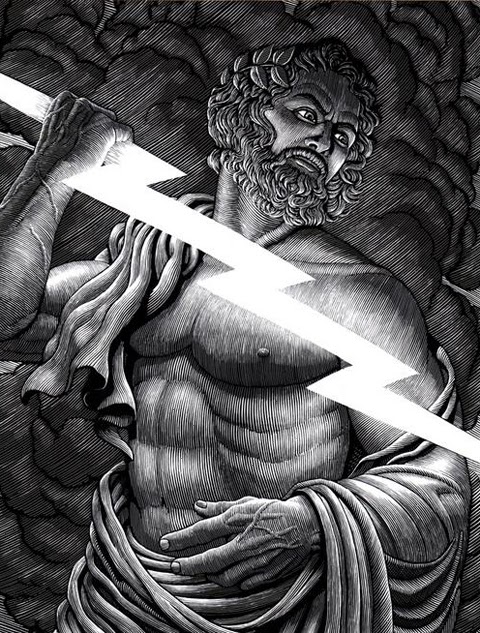 |
| Douglas Smith Zeus |
Over the past half a decade I’ve made a number of detailed predictions about collapse: how it is likely to unfold, what its various manifestations are likely to be, and how it will affect various groups and categories of people. But I have remained purposefully vague about the timing of collapse and its various stages, being careful to always append “give or take half a decade” to my dire prognostications. I wasn’t withholding information or being coy; I really had no way of calculating when collapse will happen—until five days ago, when, out of the blue, I received the following email from Ugo Bardi:
Hi Dmitry,
You may be interested in this post of mine.
Starting from this post, I’m trying to draw a parallel between the collapse of the Soviet Union and the impending collapse of Italy. There are, as always, similarities and differences. In particular, the Soviet Union collapsed almost immediately after that oil production flattened out and started declining. On the contrary, the Italian government survives despite a loss of 36% in oil consumption.
My impression is that it is all related to different taxation methods. I understand that the Soviet tax system was based mainly on commodity taxes and on taxes on production. When production stalled, people had nothing to buy and the government had nothing to tax because most people owned nothing and had little or no savings in banks. So, the government had no choice but to fold over and disappear.
Instead, the Italian system is based largely on income tax and property tax. The government is losing revenues on commodity taxes (e.g. on gasoline) but it can compensate with property taxes. Italians, on the average, are “rich,” in the sense that they have savings in banks and most of them own their homes. So, the government can tax their properties and their savings. As long as Italians still have something taxable, then the government will survive. It will disappear only when it has managed to strip citizens completely of everything they have.
Do you agree with this interpretation? (BTW, Italy as a state may be even more culturally diverse than the old Soviet Union was.)
Ugo
Hi Ugo,
Very interesting article. Yes, the entire southern tier of the EU is in some early stage of collapse, but so far it hadn’t occurred to me to draw parallels between it and USSR. Now that you mention it, the parallel is obvious: it is financial collapse triggered by something having to do with oil, but with polarities reversed, and delayed by a period of wealth destruction.
In the case of USSR, taxation wasn’t really a source of government revenue. The national economy was based on government ownership of everything, central planning and budgets, and a system of assigning ministerial contracts to enterprises owned by the ministries. The external economy was a matter of exporting hydrocarbons in exchange for foreign currency, which was used to buy grain—mostly feed grain for cattle, without which the population would become protein-deprived and malnourished. Over the so-called “stagnation” period of the 1980s the Soviet economy became hollowed out because of several trends. Too much spending on defense was one of them. Another was that investment in capital goods (machinery, plant and equipment) reached the point of diminishing returns, which is very difficult to characterize but not so difficult to observe. Lastly, Solzhenitsyn and the dissident movement had done irreparable damage to Soviet prestige, destroying morale. The coup de grace, when it came, consisted of two pieces. One was the inability to expand oil production given the state of Soviet oil extraction technology of the era. The other was the fall in oil prices, down to $10/bbl at one point, because North Sea and Alaska both went on stream, and the Saudis pumped as much oil as they could based on a tacit agreement with the US to depress oil prices and thus crush the Soviets. In this they largely succeeded. The USSR became heavily indebted to the West, and, at the very end, needed Western credit to keep the lights on in the Kremlin. One of the final scenes featured Gorbachev on the phone with [West Germany’s Chancellor] Helmut Kohl asking him to ask the Americans to release some funds.
Now, I can see parallels to this in what is happening now in the US and in the EU, but with all the polarities reversed: here oil flows in and money flows out, and the coup de grace [will be] high oil prices rather than low. Instead of failures of central planning, which failed to allocate production effectively, we have failures of the globalized market, where production is effectively globalized but consumption is ineffectively localized among the wealthy and the formerly wealthy, and has to be fueled by credit. Instead of diminishing returns from deployment of capital goods, we have diminishing returns from deployment of capital itself, where a unit of new debt now produces much less than a unit of economic growth. The damage to reputation and morale is mostly on the US side of the Atlantic, where in place of Solzhenitsyn and the dissident movement we have Abu Ghraib [scandal], [Wikileaks’ Julian] Assange and [Edward] Snowden. With the EU, most of the damage has to do with [the] experience of economic disparities between the rich core and the increasingly impoverished periphery, and the recent move in Ukraine to walk away from the EU, and the ensuing Western-financed mayhem in Kiev, show that the bloom is off the EU rose as well. The runaway military spending is likewise mostly a US issue, although epic failures in Afghanistan, Libya and Syria, in which the EU is complicit, are likely to have some effect as well.
Comparing USSR to Italy is difficult because of the disparity of scale: 1/5 of the planet’s dry surface versus a smallish peninsula; an economy that slowly decayed in isolation versus an integral part of the EU; a country where the choice is between burning hydrocarbons or dying of exposure versus one where the choice is between riding a scooter or taking the bus; a country with a ravaged agricultural sector unable to grow enough protein calories versus a nation of foodies where corner groceries make worthy subjects for oil paintings. But I think that when it comes to the actual collapse, when it finally comes, there will still be identifiable similarities. Financial collapse always comes first: all sorts of financial arrangements unravel as the center becomes unable to float the periphery, and in response the periphery starts to withhold economic cooperation. The result is a breakdown in supply chains, shutdown of production, and, shortly thereafter, shutdown of commerce. In the case of the USSR, this unfolded in 1989-91 as the various republics and regions refused to cooperate with Moscow. I suspect that this will also happen in the EU, at some point. But I think that you are exactly right that whereas the average Soviet citizen could not be fleeced, Italy, and much of the EU, still have plenty of fat sheep that the government can shear to keep things running. Thus we are looking at a few more years of steady decline before the lights start going out. This, then, is the key distinction: the USSR collapsed promptly because it was already skin and bones, whereas the US and the EU still have plenty of subcutaneous fat to burn through. But they are, in fact, burning through it. And so, the conclusion is, collapse will come, but here it will take a little longer.
-Dmitry
I agree with you, of course. It makes perfect sense to me and it is the main point I was making: the Soviet government couldn’t tax Soviet citizens too much because they owned very little.
…
The Italian government instead has some luck in the sense that Italians have some savings and most of them own their homes. So, the government is progressively strangling their citizens to squeeze out of them all that they have—while they still have something.
The last round of tax increases in Italy is targeting homes and it is really, really hurting, especially the poor. You can be poor here, and still own a house that you inherited from your parents. Now the government asks you to pay as if that house were revenue! That is truly evil. People who don’t have the money to pay this property tax can only indebt themselves with banks (or worse). Eventually, they’ll have to sell their homes or give them to the bank (or to the Mafia)—the result is disaster for everybody, including for the banks, and even the government. But the whole thing has a perverse logic. It has the advantage that it generates some immediate cash which is badly needed, then the hell with the future.
The [next] phase will be to target bank accounts. Then, when there will be nothing left, the government will decamp and say bye to everybody. Hell, what a planet I landed in…..
All the best,
Ugo
Cassandra’s legacy by Ugo Bardi
8 Comments on "The die off of the top predator"
Davy, Hermann, MO on Thu, 13th Feb 2014 12:35 pm
I agree with UB intro. We have to look at what is going on from a scientific point of view. We are part of an ecosystem and we have our own ecosystem within that ecosystem. If we use system theory and biological ecosystem study we see natural behavior unfolding in our human ecosystem. We can find a place for the energy and financial market and make a prediction of a path. We can see where we are in the current cycle and from that we can jump into the particulars of space and time. Good article!!
ohanian on Thu, 13th Feb 2014 1:10 pm
Er? You are talking about Detroit right?
Davy, Hermann, MO on Thu, 13th Feb 2014 2:30 pm
Good one O!
rollin on Thu, 13th Feb 2014 3:56 pm
It is extremely difficult to compare the huge resource rich USSR to Italy.
The USSR government controlled all external trade and traded even though their policy was one of isolation. This made for very difficult trade conditions. Their products were non-competitive with similar western products.
Spending on military zoomed up to the US level in the 1980’s even though they only had half the GDP of the US. Meanwhile the USSR reduced imports (even thought they could not feed their people) to balance the trade deficit. The centralized collective state was slow to move on needed changes to increase trade with the external world. Billions were sent each year to other countries to enhance their political aims.
Their insular centralized system did was not resilient and did not mesh well with the ROW. Their population near the collapse was higher than the US population.
Italy on the other hand has a resilient and thriving economy. They are reducing population and keeping up trade. They are 5th in the world in total wealth and 14th in per capita wealth.
The recession knocked GDP down about 5 %. Debt is high but mostly held within the country. Currently there is over 45,000 euro per capita. Total private wealth is over 1 trillion.
GDP per capita fell from $32,000 US to $28,000 from 2008 to 2013.
Italian industrial production did make somewhat of a recovery from the recession of 2008 but seems to be dipping now again.
Overall a totally different country, parliamentary government, citizens can force change in the government, non-isolationist and not involved in huge military spending or foreign empire building. Much more resilient and world engaging.
mike on Thu, 13th Feb 2014 9:30 pm
“Italian industrial production did make somewhat of a recovery from the recession of 2008 but seems to be dipping now again.
Overall a totally different country, parliamentary government, citizens can force change in the government, non-isolationist” – rollin.
Er – Italy has no government, and has not had one since Benito ended up finito – upside down with his mistress in Milano. Italian parliamentary democracy is an oxymoron. Italy is a republic of families with no sense of civic responsibility run by (not governed) industrialists, Inter Milan, corrupt “public” administrators, morthern politial parties (La Liga) and southern criminal gangs – the Camorra, Ndrghetta, and of cours the Mafia. And until recently, La Santa Chiesa, the Vatican mafiosi.
rollin on Thu, 13th Feb 2014 10:37 pm
But Mike, that is government.
Davy, Hermann, MO on Fri, 14th Feb 2014 12:02 pm
My girlfriend is italian and she would agree with the government view. Italians are really not a country and never were! That is why Italians are so fun all the chaos with creativity. It helps the women are hot and the food great. Throw in some beautiful tourist spots, history, great beaches, mountains, and cities.
Arthur on Sat, 15th Feb 2014 7:49 am
“Italians, on the average, are “rich,” in the sense that they have savings in banks and most of them own their homes”
That’s why Italy is financially the strongest country of the entire West and has ZERO financial problems and won’t collapse.
http://deepresource.files.wordpress.com/2012/12/dwo-eu-27nachhaltigkeitsran.jpg