
Peak Oil is You

Donate Bitcoins ;-) or Paypal :-)


Page added on June 8, 2016

Seeking Consensus on the Externalized Costs of Gas

What is meant by “externalized costs”?
Externalized costs are costs associated with energy consumption which is not reflected in the selling price of the energy. These costs are directly or indirectly paid by other sectors of the economy in forms such as increased healthcare expenditures, losses in property values, increased costs associated with natural disasters, and a reduction in the free services rendered by the biosphere.
Externalized costs of gas
Natural gas is the cleanest fossil fuel. When combusted, it releases only about 56% of the CO2 emissions per unit energy released compared to coal. However, the issue of fugitive methane emissions can substantially reduce the greenhouse gas appeal of natural gas. The IPCC adds about 25% to natural gas emissions due to this factor even though it is acknowledged that great uncertainty exists about the magnitude of this effect.
In addition to the relatively low greenhouse gas emissions, natural gas also allows for very clean combustion. The recent IMF working paper estimates air pollution externality from natural gas combustion as only 20% of the climate change externality.
Electricity
To estimate the climate change externality, we need to estimate the average global CO2 cost. According to the outline in the previous article ($53/ton for developed nations and $24/ton for developing nations), this amounts to $36/ton given that the projected buildout of new gas-fired capacity is 41/59 in developed/developing economies according to the latest IEA prediction. As shown below, the IPCC gives the total greenhouse gas intensity of new natural gas combined cycle plants as 0.49 ton/MWh. This value is higher than many people would expect and offers less than a 40% improvement relative to a new coal plant. These assumptions return a climate change externality of $18/MWh.

We will assume that the short-term local externality associated with natural gas is 20% of the climate change externality and apply a weighting factor of 0 for developing nations and 1 for developed nations. As discussed in the previous article, this accounts for the estimation that internalization of this short-term local externality will have no meaningful impact on economic development in developed nations, but will come at a cost greater than the externalized cost in developing nations by hampering the development of impoverished local communities. This calculation slightly increases the overall externality to $19/MWh.
The external cost of natural gas electricity using different CO2 costs and other external costs is given in graphic form below. All calculations reported here can be downloaded in Excel format here.

For perspective, the internalized cost of gas-fired electricity amounted to $60/MWh.
Heat
Using the same assumptions as outlined for electricity above, an externalized cost of $2.8/GJ can be calculated. The sensitivity of this number to different values of CO2 cost and other external costs is shown below.

The internalized cost of gas heating was found to be $6.6/GJ for comparison.
Transport
As shown below, the IEA puts the well-to-wheels greenhouse gas emissions of gas-to-liquids technology at about 120% that of conventional oil.
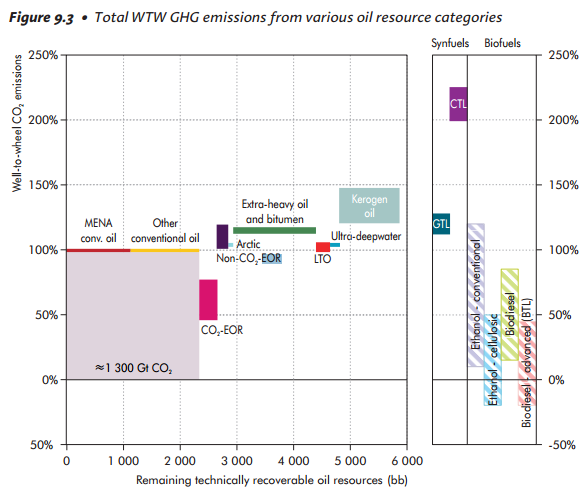
When assuming a 47/53 oil consumption ratio in developed/developing economies, a CO2 price of $38/ton and a total gas-to-liquids climate change externality of $20/barrel can be calculated.
The short-term local externalities are estimated in a similar way as in the previous oil externality article. The only difference is that the externality cost is multiplied by 120% under the assumption that other pollutants increase proportionally to greenhouse gasses. This yields an additional externality cost of $3/barrel, bringing the total to $23/barrel of final fuel ($0.15/litre or $0.55/gallon).
To illustrate the externalized costs of oil-derived transportation fuel under different assumptions, the graph below is given.
For perspective, the internalized cost was found to be $0.22/litre.
Commenting
In order to assist in finding the consensus view on this topic, please follow these simple commenting guidelines:
Three types of comments are welcome, each introduced by a keyword:
DATA: Please provide your estimate of the externalized cost of gas with a brief explanation. Each DATA comment will be weighted by the number of “likes” when the data is ultimately processed.
REBUTTAL: If you strongly disagree with an existing DATA comment, please write a short rebuttal. The “likes” received by a REBUTTAL comment will subtract from the “likes” of the DATA comment. A REBUTTAL comment can once again be rebutted to reduce its weighting.
CORRECTION: If you see a clear error in the numbers presented in the above analysis, please correct me so that I can correct the article.
Many comments are welcome. More data = greater accuracy.
Leave a Reply