
Peak Oil is You
Donate Bitcoins ;-) or Paypal :-)


Page added on December 27, 2013

PatternDynamics: Following The Way Nature Organizes Itself to Deal with Complexity

The natural world is staggeringly complex, and yet amazingly elegant in how it manages the multitude of interconnected parts into organized, unified wholes that thrive. What is the secret for harnessing this elegance for use in human systems? Tim Winton found that observation of the most common patterns found in the natural world led to the development of high level principles which can then be used to address the most complex challenges that human systems face.
After learning some of the common patterns found in all natural systems, we can then begin to recognize these patterns in human systems , and learn how to balance the ones that are skewed, and to integrate in the ones might add a greater level of enduring health. We can “make a deeper difference by changing the system!”
PatternDynamics is a systems thinking tool for creating systems level change that Winton has been developing over 20 years as he’s worked in diverse fields, including: environmental services contractor, organic farmer, sustainability educator, designer, project manager, consultant, executive leadership, and corporate governance.
What is unique about PatternDynamics is that it combines the patterns of nature with the power of language, to produce a sustainability pattern language.
In a recent paper by Barrett Brown, referring to a study he had done in 2012 of top performing organizational leaders, he observed that these top leaders “use three powerful thinking tools to design their initiatives and guide execution. They are (a) Integral theory, (b) Complexity theory, and (c) Systems theory. These models help them to step back from the project, get up on to the balcony, and take a broad view of the whole situation. They use these tools to make sense of complex, rapidly changing situations and navigate through them securely.”
And famed Permaculture teacher Toby Hemenway (author of Gaia’s Garden) recently posted on his blog the following recommendation: “To enrich our ability to use recipes and put them into context, without engaging in a full-blown design analysis from scratch, we can use pattern languages. The term was coined by architect Christopher Alexander to mean a structured grammar of good design examples and practices in a given field—architecture, software design, urban planning, and so forth— that allow people with only modest training to solve complex problems in design. … Like recipes, pattern languages are plug-and-play rather than original designs, but they allow plenty of improvisation and flexibility in implementation, and can result in rich, detailed solutions that fit. A handbook of pattern languages for the basic human needs and societal functions, structured along permaculture principles, would be a worthy project for a generation of designers.”[my emphasis]
PatternDynamics is firmly rooted in Integral theory, Complexity theory, and Systems theory, and as well contains Permaculture’s emphasis on patterns and principles (PatternDynamics was developed during Tim’s time as Director of the Permaforest Trust, a 170 acre Permaculture education center in New South Wales, Australia). In addition a fifth strong influence was Alexander’s ideas on pattern languaging. These five robust theories and practical application tools provide a very firm foundation that will continue to support PatternDynamics long into the future as it continues to evolve. It is probably not the recipe book that Hemenway envisions, rather the patterns are more like a set of key ingredients from which we are invited to collaborate to co-create the needed recipes for a given context. The goal is to facilitate collective intelligence.
“The key to complexity is systems thinking, and the key to systems thinking is patterns. The key to patterns is using them as a language – an idea I borrowed from architect and mathematician Christopher Alexander’s book ‘Notes on the Synthesis of Form’.”
– Tim Winton
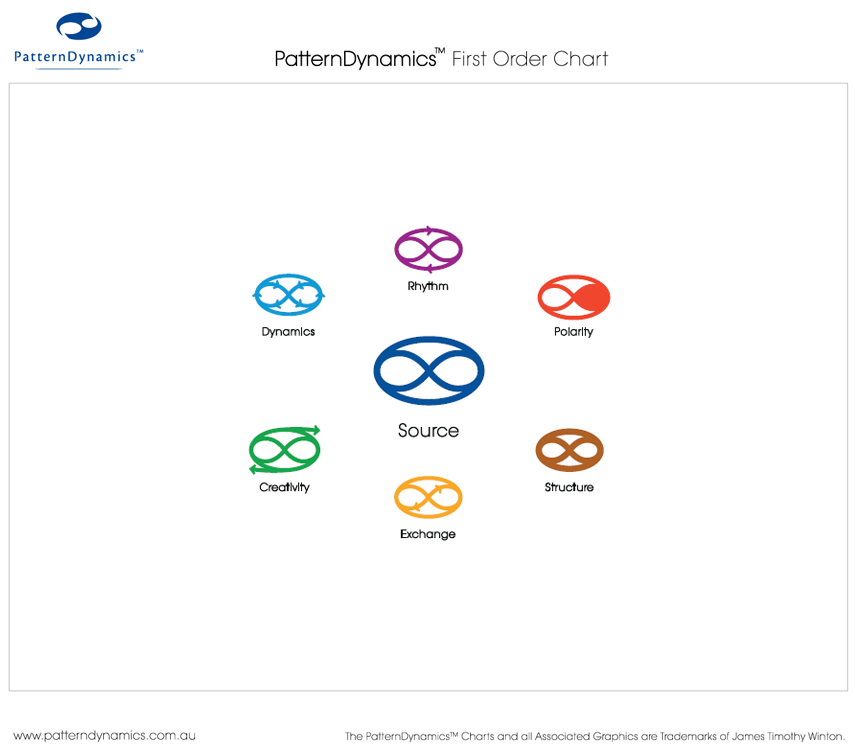
Systems thinking itself is complex and difficult to learn, which is why the series of Patterns in PatternDynamics can be so helpful in simplifying that complexity – “If we don’t have a symbol for something, it does not become enacted in our reality” Winton says.
Secondly, as these Patterns become part of a shared language, this gives us the ability to collaborate with others –hence the facilitation of collective intelligence. Noting the increased complexity in our human systems, Winton states that “No longer is any one person brilliant enough to solve the complex problems we face; we really have to use our collective intelligence.” This innovative method of facilitating collective intelligence is proposed as an essential 21st century skill.
Speaking for myself, after completing the Level II training in PatternDynamics, I notice that I am starting to see “wholes” much more often, in extremely diverse systems. Everything from systems at work in my own body, to systems in organizations I’m involved with, to the systemic problems facing our world, and all the way up to long term processes going on in our universe. Being able to see these wholes then helps the next step – ideas are flowing more easily on how to balance and integrate to improve the health of the systems I am involved with.
Therefore, it is with some excitement that I am preparing to host a One Day PatternDynamics Workshop on January 26, 2014 here in Bellingham, Washington. Click Here for more information about this event. A workshop is also being held in Oakland, CA on January18th – more info here.
8 Comments on "PatternDynamics: Following The Way Nature Organizes Itself to Deal with Complexity"
ghung on Fri, 27th Dec 2013 3:31 pm
The problem, as I see it, is that the key to our species’ short-term success (@ 2 million years) is our ability and tendency to ignore natural systems, their patterns and limitations, and that there is no “We”, except that ‘we’, collectively, have gone quite insane from a “Natural” perspective. I don’t see how you fix insane.
These folks are talking about fundamentally reprogramming the behaviour of the most populous higher life form on the planet. Good luck with that. Our magic will be the vector of our demise.
J-Gav on Fri, 27th Dec 2013 6:50 pm
I was introduced to the idea of ‘pattern literacy’ by Toby Hemenway’s work and I see it as a positive step away from the “insanity” you mention, ghung. I’m no raving optimist by any stretch but, if there is a chance for humans, “collective intelligence” (as far as that goes) will likely have something to do with it. However, not that much intelligence is actually required to understand the predicament we’re in if people are properly informed.
That’s not an easy one to overcome but 2 million years of hominids ain’t too bad awready … And let’s not forget that, for most of that time, they (we) did not live in ignorance of nature but either in relative harmony with and/or subservience to it, ie no relationship of total dominance. Thus the ‘reprogramming’ you speak of with a skepticism (which I share), may yet be within the realm of the possible, since it’s already part of us somewhere along the line.
GregT on Fri, 27th Dec 2013 8:16 pm
“Noting the increased complexity in our human systems, Winton states that “No longer is any one person brilliant enough to solve the complex problems we face; we really have to use our collective intelligence.”
It was our ‘collective intelligence’ that created the complex problems that we face to begin with. The energy crisis, the economic crisis, climate change, ocean acidification, deforestation, fisheries collapse, ozone depletion, soil degradation, overpopulation, and on, and on, and on, are ALL problems created BY human ‘intelligence’.
We lived on this planet in harmony with nature for a very long time, in comparison to the amount of time that we have become a major environmental destructive force.
‘We’ cannot fix the problems that ‘we’ have created, only nature has the ability to do that. The longer we keep pretending that we are somehow in control of this planet, the worse the consequences will be, for not only human existence, but for all life as we know it, on this planet.
We either end BAU, and human industrialized society now, and face unimaginable horrors, OR, we continue to try to maintain some semblance of BAU, and human industrialism, and face global mass extinction.
There is no human solution to the mess that we have created. We have only left ourselves, with a very, serious, dilemma.
ghung on Fri, 27th Dec 2013 8:59 pm
Gosh, J-Gav, the concept is great. How to implement such a concept? You say: “not that much intelligence is actually required to understand the predicament we’re in if people are properly informed.” This assumes that people want to be informed and understand. I would put the ratio of people I know that want to know these things at well under 50%. Most “let go, and let God” or somesuch. That was the point of my mentioning ‘magic”. They have neither the desire nor the capacity to adopt the changes discussed in the article. How do you get billions of humans to utterly change their world views? Having posed that question, it all looks great,, on paper.
The powers of delusion have some mighty tools at their disposal, and a pretty good understanding of how to use them. They have manufactured enormous consent to keep the status quo. There is no ‘collective intelligence’; just the mob.
J-Gav on Fri, 27th Dec 2013 9:10 pm
GregT – Though I don’t agree that it was our ‘collective intelligence’ that got us where we are (but rather the ‘hyper-intelligence’ of a small group commandeered for political and economic purposes by elites), I share your doubts about whether humans are capable of changing BAU before major trauma sets in. As you say, we cannot ‘fix’ the problems. It’s too late and there are too many of them. We still could, nevertheless, mitigate their impacts if enough people get off their duffs in the next decade and force a significant re-ordering of priorities, beginning with the recognition that the laws of nature are also the laws of spirit. NB – This is written by a non-militant atheist.
GregT on Fri, 27th Dec 2013 9:45 pm
J-Gav,
I quoted ‘collective intelligence’ from the article, and use the term quite loosely. While I agree that we could mitigate the impacts, the solution to doing so would entail a massive reduction in our populations. Somehow, I don’t see very many of us volunteering for the collective.
ghung makes a very important point; most people are either ignorant of our situation, or they are in denial. From my own personal experience, many would rather keep it that way.
I do wonder, however, if TPTB are making plans behind closed doors. As tragic as it may be, a dramatic cull of human population is our only hope. My wife and I have discussed this at length, and both of us agree that if we were the decision makers, we would have tough decisions to make.
Makati1 on Sat, 28th Dec 2013 12:32 am
Guys, the human animal, especially in the ‘developed’ i.e. controlled capitalist world is NOT going to change. It would take at least 2-3 generations of reverse propaganda to make that happen.
Remember when taking your car keys was a form of punishment? I do. It worked because my generation was tied to cars.
Now, try to take that cell phone from your teenager, or young adult, or their I-pad or other social connections and you will see the problem.
Nope, we are doomed. Do what you can to make the decline as comfortable as possible for you and yours and watch the ‘once in a species’ experience, extinction.
David MacLeod on Sun, 29th Dec 2013 11:37 pm
Hi folks,
Being a long time peak oiler myself, I have some resonance for the “we are doomed” sentiments. I think what is inevitable is energy descent, but I don’t think we can predict very accurately the rate and depth of that decline – nor can we assume it’s going to be the same everywhere for everyone. Which is why I appreciate David Holmgren’s idea of nested scenarios (see my post reviewing Holmgren’s “Crash on Demand”).
Regardless of how this all plays out, a meaningful life for me includes preparations on the home front, with both practical, physical projects, and inner work that enhances psychological and spiritual resilience.
It also includes work on the community level, because I know that if there is any chance of living through the long emergency, it will be possible only if there is some level of coherent community.
As I understand it, the first goal of PatternDynamics is to be useful in the first person experience of the person using it. The second goal is for it to be used as a collaborative tool (collective intelligence) to build understanding between people. The third goal is for it to be used to design better outcomes for more enduring health (sustainability) at whatever scale of organization it is applied to.
For me it is not meaningful to label myself an optimist or a pessimist. It is meaningful to be involved in attempting to make a positive contribution and moving in that direction, regardless of how likely it may or may not be to turn around the BAU trajectory we are on.