
Peak Oil is You
Donate Bitcoins ;-) or Paypal :-)


Page added on May 7, 2014

Of Fossil Fuels and Human Destiny
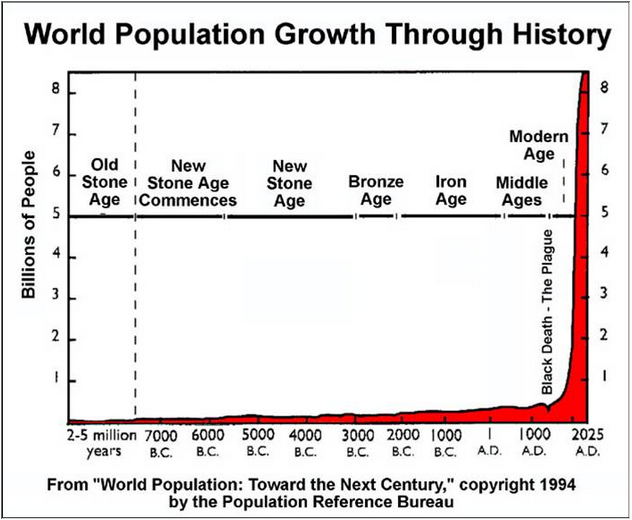
There have been hundreds of books and essays written on the evolution of Homo sapiens and I assume you are familiar with that history. In this short essay I am going to point out a few things that are usually left out of that story, the part that deals with the very nature of the species Homo sapiens.
First I would like to point out a few things that are common to all species, not just Homo sapiens.
All species produce more offspring than can possibly survive to adulthood and reproductive age. Some produce hundreds of offspring and leave it to chance that a few will survive. Others produce far fewer offspring and care for them for months to years to increase their chances of survival.
However if there is ever an abundance of food for any species, that species will multiply its numbers to take advantage of that abundance until its numbers are so great that the advantage disappears. An example would be the reindeer of St Matthew Island.
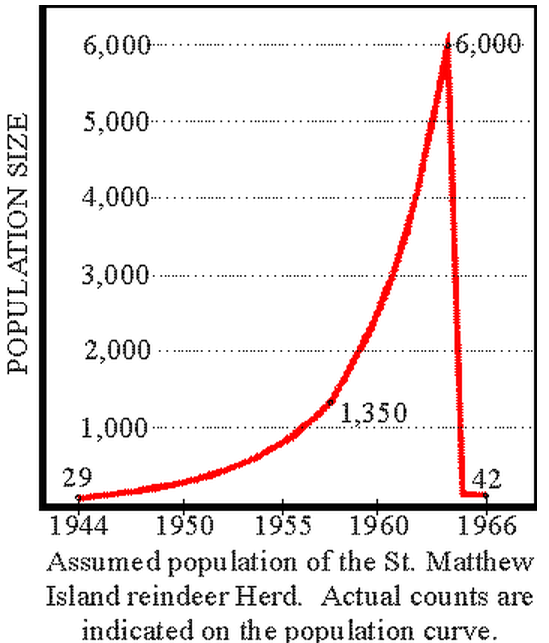
In August of 1944 the Coast Guard placed 29 reindeer on St. Matthew Island, a remote island in the Bering Sea. Earlier in the year they had established a radio navigation system there and the Reindeer were supposed to be emergency rations should the men be cut off from supply shipments.
A short while later, with the allies winning the war, the Coast Guard pulled their men off the island but left the reindeer there. But not to worry, the 32-mile long by 4-mile wide island had plenty of the reindeers favorite food. A mat of lichens over 4 inches deep covered the island. By 1957 the population had increased to 1,350; and by 1963 it was 6,000. But the lichens were gone, and the next winter the herd died off. Come spring, only 41 females and one apparently dysfunctional male were left alive.
Another example was documented by the PBS series NOVA titled Rat Attack. [1] This program documents the plight of rice farmers in a remote corner of northeast India. Surrounding the rice fields in this area are forests of bamboo, a common species called Melocanna bamboo, from which the locals build their homes. And living in this tropical bamboo forest are rats. This is not unusual as rats live in all tropical forest around the world. But the rats are few enough in number that they pose no serious threat to the rice and corn farmers in the area
However once every 48 years all the bamboo flowers, fruits then dies. The Melocanna bamboo produces a fruit, a seed pod, that is as large as an apple, some 200 times larger than the average bamboo seed pod. Over the period of a few months some 10 tons per acre of this fruit will ripen and drop. This indeed brings about times of plenty for the rats in the area.
One species of rat, the black rat, is particularly adapted to take advantage of this cornucopia of food. In the right conditions their numbers will shoot up exponentially.
When the bamboo fruit first appears around this one particular rice field the black rats numbered perhaps 100. By the time all the bamboo fruit had all ripened, fell and most of it consumed by the rats, a period of about six months, the black rat population numbered about 12,000. By then any fruit left in the forest had germinated and was inedible. This hoard of rats then moved into the rice fields devouring the crops causing famine in the local population.
Then, when all the food is gone the rats die off. They die of starvation. But a few, a very few will survive.
___________________________________
All species are in constant competition with other species, as well as with members of their own species, for food and territory.
All species have evolved adaptations that assist them in the struggle for mating and survival. The Eagle has flight, talons, telescopic sight and so on. All other species have similar adaptations.
Homo sapiens have several adaptations that aid them in their competition. But they have one that gives them a huge advantage over all other species, their brainpower. And make no mistake, we are in competition with other species for food and territory. And we are winning… big time. In fact we are in the process of wiping them out.
10,000 years ago humans and their animals represented less than one tenth of one percent of the land and air vertebrate biomass of the earth. Now they are 97 percent. [2][3]
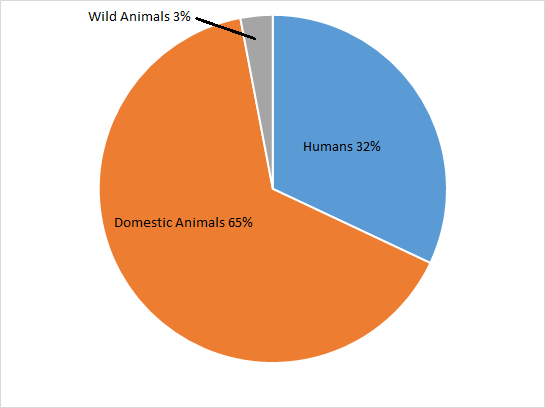
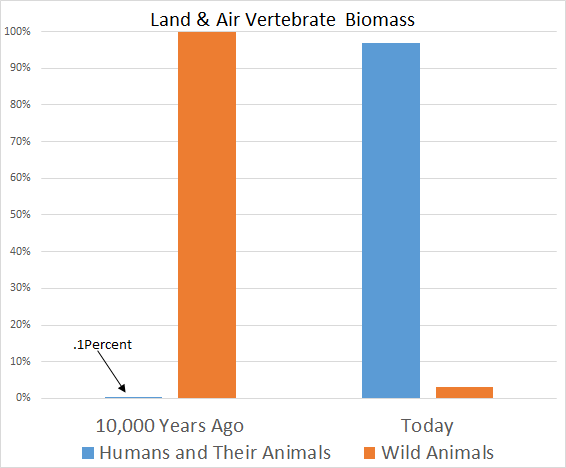
The charts above are the measure of our success. Our share of the earth’s pie is getting larger and the wild animal’s share is getting smaller. And the wild animals share will continue to get smaller until it is almost gone. Some will remain, rats, mice and a few small animals that are able to coexist with humans will survive.
The wild animals are going fast. Go to any open market in Sub-Sahara Africa and you will find “bush meat” for sale. Every kind of animal, except the very large animals like elephants and giraffes will be there. Of course the large cats or other predators will not be there. But they are disappearing nevertheless as their prey, their food supply, disappears.
Since the beginning of the industrial revolution in about 1750 the world’s population has grown ten fold, from about 700 million to over 7 billion.
This population explosion was powered by fossil fuel, first by coal then petroleum. Fossil fuel powered both agriculture and industry. In agriculture one man was able to produce enough food to feed hundreds. The green revolution increased production per acre ten fold in some cases.
But as people were forced off the farm cheap energy fueled industry that gave them jobs in the cities. Fossil fuel powered looms, furnaces and assembly lines gave jobs to millions. We are now living in the age of exuberance.
Our population exploded simply because it could. Humans, like all other animals, always live to the very limit of their existence. But when those limits are lifted, like they were for the black rats of East India or the reindeer of St. Matthew Island, the population will just naturally explode. And it will keep rising until it hits the natural limits of the food supply. And if that food supply shrinks, the population will do likewise. It will not be pretty and no amount of rationalizing will change that fact. Richard Dawkins put it this way:
The total amount of suffering per year in the natural world is beyond all decent contemplation. During the minute it takes me to compose this sentence, thousands of animals are being eaten alive; others are running for their lives, whimpering with fear; others are being slowly devoured from within by rasping parasites; thousands of all kinds are dying of starvation, thirst and disease. It must be so. If there is ever a time of plenty this very fact will automatically lead to an increase in population until the natural state of starvation and misery is restored.
Richard Dawkins: River Out of Eden
Fossil fuel is our bamboo fruit, our mat of lichens. We, as a species, are simply behaving like all other animals have behaved and would behave under similar circumstances. Millions of years of struggling to survive has left its mark in our DNA and our species cannot help but follow where it leads us. We raise our families and seek security for them and worry about their future. But the process of natural selection has always worked within local small populations. We are molded by our DNA to worry about provisions through the next winter and to defend ourselves from a possible attack by the tribe a few miles away. The goings on in the rest of the world have never been a concern to us. But globalization has changed the nature of the game and our genes simply are not aware of that yet.
We are by nature optimistic. That is, optimism is a survival characteristic, a product of natural selection. [4] Optimism has been highlighted as being an important evolutionary part of survival. In his book “Optimism: The Biology of Hope” [5] Lionel Tiger argues that is one of our most defining and adaptive characteristics.
Our future is locked in, it is in our genes. We will behave, in the future exactly as we have behaved in the past. We will act according to the dictates of our DNA. We will continue to consume our natural resources like a drunken sailor going through his rich uncle’s inheritance. And we will continue to be optimistic, we will continue to believe that fossil fuels will last forever, or at least until “something else comes along”.
But they will all decline, taper off until none is economically recoverable any more. The first to go will be crude oil, then natural gas and finally coal. Crude oil will peak in this decade and be almost completely gone by the end of the first half of this century. Then natural gas and coal will go in the second half.
We will not hear warnings of impending disaster and act. We will wait until the disaster is upon us then react. It is simply in our nature to behave in such a manner. And then we will eat the birds out of the trees. [6]
Ron Patterson
Notes:
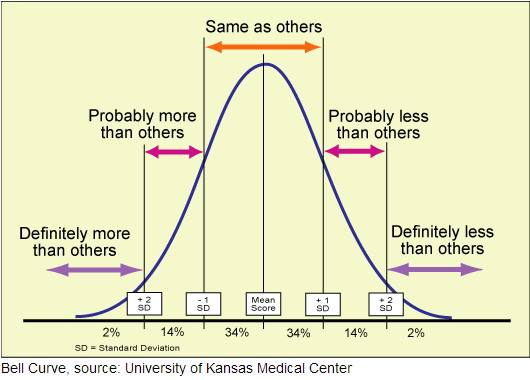
When I speak of the behavior of “we as a species” I am talking about the average behavior of the species as a whole, never about individuals. Every adaptation of any species is expressed slightly different in every individual. No two individuals are exactly alike. The strength or expression of every human characteristic can be plotted along a bell curve.
If it were possible to poll everyone in the world as to their outlook on life and asked them where they saw the world heading in the next half century or so, some would be extremely optimistic and positively sure that no serious problems could possibly ever befall humanity. But some would not be nearly as optimistic. However the vast majority of people would fall somewhere in the middle. And the middle would still be quite optimistic. There is no rule of nature however, that says the vast majority of humankind are correct. Where any opinion or other characteristic falls along the bell curve for the vast majority of humankind is simply the result of millions of years of evolution and is in no way a measure of its correctness. Or as H.L. Mencken put it: The most costly of all follies is to believe passionately in the palpably not true. It is the chief occupation of mankind.
1. Nova, Rat Attack
2. Paul MacCready Ted Talk
3. World Society for the Protection of Animals
4. Optimism and Pessimism
5. Optimism – the Biology of Hope
6. Ukraine Famine
10 Comments on "Of Fossil Fuels and Human Destiny"
MSN fanboy on Wed, 7th May 2014 7:54 pm
Funny, I have always been taught to believe human beings were better than every other life form.
Turns out we fuck have kids and fuck some more etc… just like other life forms.
I figure most people would consider people on this site dysfunctional. Just like that deer 😛
Still, When most of them are dead I guess that dysfunctional weird doomer deer will have the last laugh.
peakyeast on Wed, 7th May 2014 8:19 pm
Okay – this is insane. I didnt know we had reached 97%. I knew it was bad.. But this ratio is staggering.
DMyers on Wed, 7th May 2014 8:55 pm
I agree. We’re going to push it to the wall. It cannot be otherwise. We are an animal on Earth, and we behave as such.
Mike999 on Wed, 7th May 2014 9:40 pm
OMG, That Population Graph is an AL GORE HOCKEY STICK, quick Republicans Run and HIDE!
J-Gav on Thu, 8th May 2014 3:58 am
Peaky – Yeah that 97% figure is a shocker. John Muir must be squirming in his grave.
Deep on Thu, 8th May 2014 4:44 am
The comparisons of human’s with other life forms is misguided,hence the conclusions drawn are absurd.what human’s have is the power of imagination.Quality of life has consistently improved over a longer period of time.The last 200-300 years have seen dramatic improvements and the reason for that is fossil fuel is absurd.The two most powerful concepts which has laid the foundation for improved quality of life are one democracy and second finance.The concept of equity, evolution of exchanges and insurance has fundamentally changed how new ideas get commercialized and how risk is hedged.Deepening democracy ensures accountability towards tax payer,distribution of power and proper checks balances.These two pillars have created a framework in which modern ideas ,individual freedom and civilization thrives.
Davy, Hermann, MO on Thu, 8th May 2014 6:02 am
Deep said – The two most powerful concepts which has laid the foundation for improved quality of life are one democracy and second finance.
Two aberrations from the era of plenty that will go into the dust heap of history. Deep, you may continue to see some democracy when populations shrink and become more localized but the days of large countries having the type of democracy we have today are nearly over. Cheap energy, economic globalization, complex command and control, communications, finance, and a multitude of other variables have allowed this time of plenty. We don’t have democracy or free markets anymore really. They have been corrupted and distorted by the global oligarch of the rich and powerful in the unholy alliance of industry and politics globally. Two trends will be ahead a deterioration of quality of life physically and an increase in spiritual quality of life in some ways. We know those set to be hungry, cold, and sick will have neither but not all the world will contract in the same fashion. We are set to face a period of a heroic dynamics. In times of adversity the best and the worst come out of the human spirit. Many of us will feel a new sense of energy and purpose with the coming decent. We will lose weight (physical & metaphysical) and have little time for the modern distractions that are in effect killing us and our communities. Globalism is an evolutionary dead end and failure for the human species and the global ecosystem (in human terms). It is truly anthropogenic extinction event. This extinction is a natural part of the cycle of earth time. So deep, our democracy and finance are a “C-hair” on the human time line and microscopic on earth time. Yet, the human effects of this very short time will be a geological epoch. This is amazing to contemplate! No other species has rising and fallen in such a short time (10,000 yrs). I am writing humans off as major force in nature because we are already in the decent and our medium term landing is back at hunter gathers with small ag skills much like Native Americans. We will wonder the ruins of industrial man.
Cloud9 on Thu, 8th May 2014 6:12 am
Deep I love your optimism but I do not buy into it. Democracy is mob rule with no protection for the minorities. Rwanda was a classic example of democracy in play. A republic is the only way to protect the ever changing minorities from the predations of the ever changing majority. Our Bill of Rights was intended to provide a basis for a rule of law that could not be circumscribed by a scheming majority. Since the implementation of the NDAA we live in a post constitutional era. We are now under a fascist state that is ruled by multinational oligarchs. We are no longer citizens. We are subjects.
Our financial system is a pyramid scheme based on fiat currencies that are conjured out of thin air. Our current paper regime is slightly over one hundred years old. The dollar has lost 98% of its value and will lose its status as the world’s reserve currency within a decade.
Resource wars are underway all over the globe and Russia is rattling its nuclear sabers. An EMP burst either from the sun or a nuke could plunge us back into the dark ages in a moment.
Good luck with your optimism but I am long on beer, beans and bullet
Davy, Hermann, MO on Thu, 8th May 2014 6:23 am
yeap, cloud, I like that “long beer, beans, and bullets. As a matter of fact part of my prep stock is Kentucky bourbon. I am a collector of the many brands. I have not drank in 8 years but whisky will be good barter material!
zaphod42 on Thu, 8th May 2014 12:43 pm
Deep – you are talking about the quality of life. The article talks about survival of life. Two entirely different things, I think.
Of course, that wonderful quality of life you enjoy in the Western World is only possible by virtue of our access to energy, and that means the stored energy in fossil fuels. Plus, to a degree, some renewable resources such as solar, wind, hydro and Atomic energy. Mostly, though, fossil fuels, and more oil than anything else for about 100 or so years.
My question would be, “How do you hedge starvation?” when resources become scarce? If I read Ron’s post correctly, he is projecting we will wait too damned long and suffer a fate similar to the black rats in Thailand and the St. Matthews Island reindeer.
Sadly, I don’t see anything happening to make me believe otherwise.
Craig