



Which of these would you name as the world’s most pressing environmental issue? Climate breakdown, air pollution, water loss, plastic waste or urban expansion? My answer is none of the above. Almost incredibly, I believe that climate breakdown takes third place, behind two issues that receive only a fraction of the attention.
This is not to downgrade the danger presented by global heating – on the contrary, it presents an existential threat. It is simply that I have come to realise that two other issues have such huge and immediate impacts that they push even this great predicament into third place.
One is industrial fishing, which, all over the blue planet, is now causing systemic ecological collapse. The other is the erasure of non-human life from the land by farming.
And perhaps not only non-human life. According to the UN Food and Agriculture Organisation, at current rates of soil loss, driven largely by poor farming practice, we have just 60 years of harvests left. And this is before the Global Land Outlook report, published in September, found that productivity is already declining on 20% of the world’s cropland.
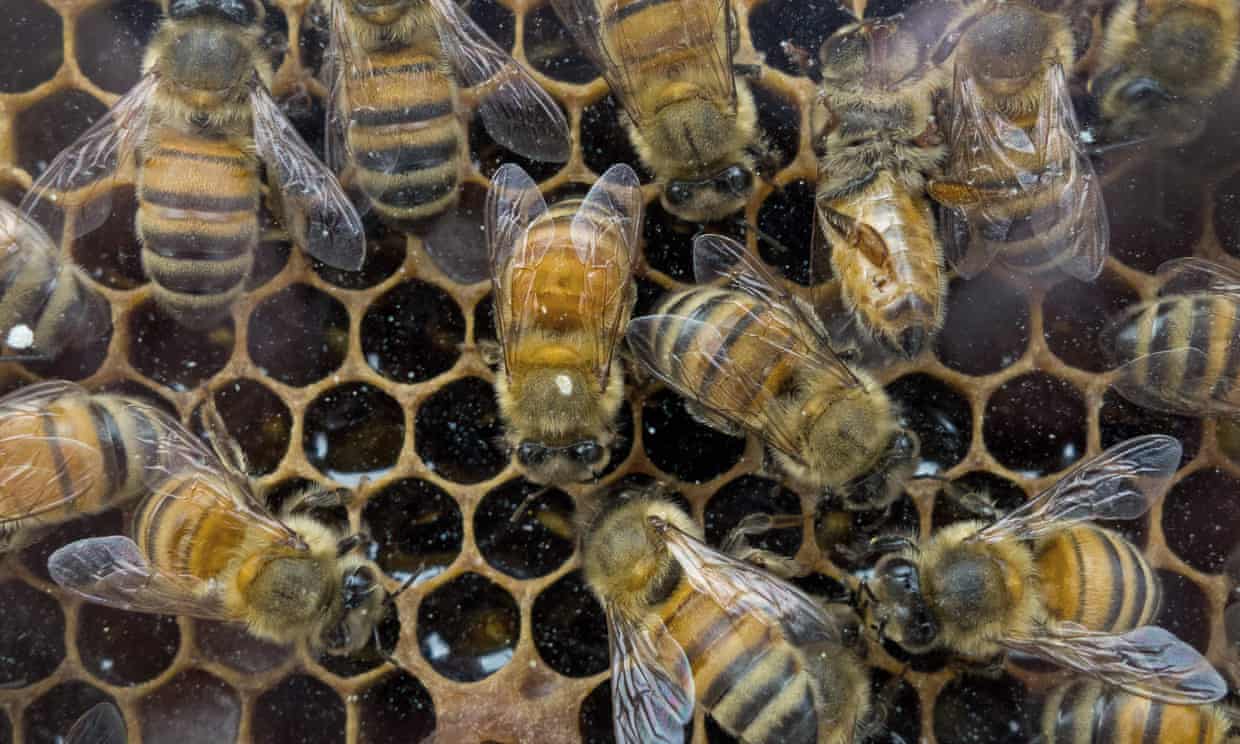
The impact on wildlife of changes in farming practice (and the expansion of the farmed area) is so rapid and severe that it is hard to get your head round the scale of what is happening. A study published this week in the journal Plos One reveals that flying insects surveyed on nature reserves in Germany have declined by 76% in 27 years. The most likely cause of this Insectageddon is that the land surrounding those reserves has become hostile to them: the volume of pesticides and the destruction of habitat have turned farmland into a wildlife desert.
It is remarkable that we need to rely on a study in Germany to see what is likely to have been happening worldwide: long-term surveys of this kind simply do not exist elsewhere. This failure reflects distorted priorities in the funding of science. There is no end of grants for research on how to kill insects, but hardly any money for discovering what the impacts of this killing might be. Instead, the work has been left – as in the German case – to recordings by amateur naturalists.
But anyone of my generation (ie in the second bloom of youth) can see and feel the change. We remember the “moth snowstorm” that filled the headlight beams of our parents’ cars on summer nights (memorialised in Michael McCarthy’s lovely book of that name). Every year I collected dozens of species of caterpillars and watched them grow and pupate and hatch. This year I tried to find some caterpillars for my children to raise. I spent the whole summer looking and, aside from the cabbage whites on our broccoli plants, found nothing in the wild but one garden tiger larva. Yes, one caterpillar in one year. I could scarcely believe what I was seeing – or rather, not seeing.
Insects, of course, are critical to the survival of the rest of the living world. Knowing what we now know, there is nothing surprising about the calamitous decline of insect-eating birds. Those flying insects – not just bees and hoverflies but species of many different families – are the pollinators without which a vast tract of the plant kingdom, both wild and cultivated, cannot survive. The wonders of the living planet are vanishing before our eyes.
Well, I hear you say, we have to feed the world. Yes, but not this way. As a UN report published in March explained, the notion that pesticide use is essential for feeding a growing population is a myth. A recent study in Nature Plants reveals that most farms would increase production if they cut their use of pesticides. A study in the journal Arthropod-Plant Interactions shows that the more neonicotinoid pesticides were used to treat rapeseed crops, the more their yield declines. Why? Because the pesticides harm or kill the pollinators on which the crop depends.
Farmers and governments have been comprehensively conned by the global pesticide industry. It has ensured its products should not be properly regulated or even, in real-world conditions, properly assessed. A massive media onslaught by this industry has bamboozled us all about its utility and its impacts on the health of both human beings and the natural world.
The profits of these companies depend on ecocide. Do we allow them to hold the world to ransom, or do we acknowledge that the survival of the living world is more important than returns to their shareholders? At the moment, shareholder value comes first. And it will count for nothing when we have lost the living systems on which our survival depends.
To save ourselves and the rest of the living world, here’s what we need to do:
1 We need a global treaty to regulate pesticides, and put the manufacturers back in their box.
2 We need environmental impact assessments for the farming and fishing industries. It is amazing that, while these sectors present the greatest threats to the living world, they are, uniquely in many nations, not subject to such oversight.
3 We need firm rules based on the outcomes of these assessments, obliging those who use the land to protect and restore the ecosystems on which we all depend.
4 We need to reduce the amount of land used by farming, while sustaining the production of food. The most obvious way is greatly to reduce our use of livestock: many of the crops we grow and all of the grazing land we use are deployed to feed them. One study in Britain suggests that, if we stopped using animal products, everyone in Britain could be fed on just 3m of our 18.5m hectares of current farmland (or on 7m hectares if all our farming were organic). This would allow us to create huge wildlife and soil refuges: an investment against a terrifying future.
5 We should stop using land that should be growing food for people to grow maize for biogas and fuel for cars.
Then, at least, nature and people would have some respite from the global onslaught. And, I hope, a chance of getting through the century.
Shortend on Sun, 22nd Oct 2017 10:09 am
Heard it all before… Should of, Would of, Could of….sure maybe tomorrow or the next..
Been hearing it for decades…
kanon on Sun, 22nd Oct 2017 10:29 am
Since pesticide companies need to make a profit . . . . Modern agriculture is designed for corporate profit, in service to the one true god of bank money. I think the ruling class would see eliminating insects as an accomplishment. The exceptional society that destroyed the global environment. I wonder if there will be an announcement; or maybe it would cost too much.
onlooker on Sun, 22nd Oct 2017 11:37 am
Somehow, I get the sense insects will survive. SO Many of them and they are very hardy. And certainly we need them more then they need us. So the 6th Mass Extinction continues apace. At some point our own extinction will loom over the horizon. The human scourge will be eradicated and all other surviving species will throw a party
JuanP on Sun, 22nd Oct 2017 11:52 am
We need to reduce the human population to a small fraction of what it is today. Everyrhing else is a waste of time. We won’t do it because it goes against our evolutionary, inherited biological traits. We will keep breeding unsustainably until we cease to exist as a species. It’s what we are: FUCKERS!
Sissyfuss on Sun, 22nd Oct 2017 12:53 pm
Forget Rachel Carsons ” Silent Spring.”
We are now approaching the silent four seasons.
Sissyfuss on Sun, 22nd Oct 2017 12:58 pm
George wants us to have a chance to get through the the century. Whatever on Earth for.
Anonymous on Sun, 22nd Oct 2017 1:06 pm
Great article. Industrial fishing is a huge, under-discussed problem.
Oh…and the guy actually makes his point up front. The other articles I ripped it wasn’t because I disagreed with them–it was because the morons didn’t write clear essays. There are people like Ron Patterson that I disagree with on the content but at least I can read what they say since they write clear statements!
Alice Friedemann on Sun, 22nd Oct 2017 3:01 pm
Chemical industrial farming is unsustainable.
Why poison ourselves when pesticides don’t save more of our crops than in the past?
Pesticides, herbicides, and insecticides destroy soil, ecosystems, and a third of the crop is still lost to pests, just as in the many millennia of farming before chemicals.
http://energyskeptic.com/2017/chemical-industrial-farming-is-unsustainable-why-poison-ourselves-when-pesticides-dont-kill-more-pests-than-in-the-past/
makati1 on Sun, 22nd Oct 2017 6:18 pm
“Need to do” LMAO My reply to each:
1. The US will never allow at ‘treaty’. Monsanto will make sure of that.
2. The US will never have an honest evaluation. Monsanto will see that that doesn’t happen either, just as in the past.
3. See answer #2.
4. This one will never happen either. Again, too much $$$ to be made.
5. Ah yes, gotta keep them carz running. More bullshit!
We will just continue to commit suicide by our wasteful habits and the need for profits.
BTW: Isn’t it interesting that they too agree that, if we stop raising beef, we could feed many, many more humans, just as I have said many times here.
DerHundistlos on Sun, 22nd Oct 2017 7:47 pm
Ocean Apocalypse:
https://www.youtube.com/watch?v=2zMN3dTvrwY&t=1197s
onlooker on Sun, 22nd Oct 2017 8:10 pm
Yes Derhund. Via Industrial fishing, AGW and Pollution we are really doing a number of the Oceans. Yet, nowadays I truly realize what the late George Carlin in his funny routines meant to say when he said “The planet will be just fine, its the humans who are f*cked.
dave thompson on Sun, 22nd Oct 2017 11:27 pm
In second grade science class I was taught about the food chain and how humans were at the top of the food chain. Soon all that will be left is human mummified corpses littering the planet because all of the microbes on up the food chain will be eradicated. BWAHAHAAA!
makati1 on Mon, 23rd Oct 2017 12:18 am
dave, I suspect that roaches and their cousins will be the new dominant species when we are gone. They can eat anything and are built to survive. “The cockroaches are an ancient group, dating back at least as far as the Carboniferous period, some 320 million years ago.” (Wiki) Real survivors, I think.
dave thompson on Mon, 23rd Oct 2017 12:29 am
I wonder if Chernobyl has radio active resistant cockroaches?
Boat on Mon, 23rd Oct 2017 12:40 am
dave,
Every night residents gather for the Fukushima glow fish festival.
dave thompson on Mon, 23rd Oct 2017 1:03 am
Yea Boat HA HA. The wholesale destruction of planetary life is a real laff riot.
DerHundistlos on Mon, 23rd Oct 2017 4:46 am
@ onlooker
Good to hear from you!!!!! Your response nailed it, although we seem determined to make the earth go venus. Our planet is on the innermost border (radiating from the sun) of the habitable zone, which means not a lot is required to push us into the too hot to harbor life category.
____________________________________________ on Mon, 23rd Oct 2017 6:12 pm
Hey, what do you expect from Germans? They are good exterminators.
Anyway stop bashing global worming. Stop using toxic chemicals and metals.
hey dumb fuck. Earth has so many feedback loops and buffers that it can add 20 degrees with no problems. The winter will get shorter. the north will get much warmer. there will be more rain everywhere.