
Peak Oil is You

Donate Bitcoins ;-) or Paypal :-)


Page added on January 20, 2016

How falling oil prices exposed the great green lie

Even though I have been reading about plunging oil prices for the past year, it still came as a pleasant surprise this week when I ordered 900 litres of heating oil.
It came to £264. Three years ago, it cost £609 to buy the same quantity.
I have already been saving money on road fuel. Over the past 18 months, the cost of filling my tank has fallen from around £70 to £53.
But for people with oil-fired central heating systems — which is most of us who live in the countryside, beyond the reach of a gas supply — the savings have been even more dramatic.
This is partly because tax makes up a smaller percentage of the retail cost of a litre of heating oil than it does of petrol and diesel.
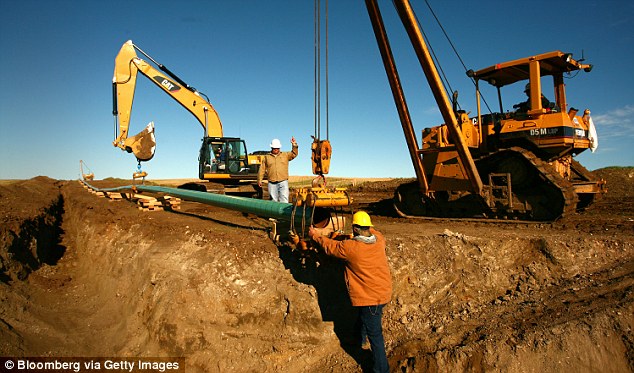
Fracking: Thanks to fracking— the controversial technique that involves fracturing oil-bearing rocks by pumping in water and sand at high pressure — the U.S. overtook Saudi Arabia as the world’s largest oil producer
For me, the cost of heating my home has more than halved, putting an extra £700 a year in my pocket to be spent on other things. Multiply those kind of savings across the economy and consumers, especially those in rural areas, are enjoying a huge bonus from low oil prices.
We have American oil companies and the Saudis to thank for that. For the past 15 months they have been engaged in a fight to the economic death.
Until recently, Saudi Arabia wielded enormous power in the oil markets.
Not only was it responsible for 13 per cent of global oil production, but it headed OPEC, the Organisation of Petroleum-Exporting Countries (Opec), which accounted for 40 per cent of world oil production.
Opec is a cartel that exists for one reason alone: to try to fix world oil prices in order to maximise profits for its members, which are made up mostly of Middle Eastern countries.
If the oil price fell, Opec would meet and agree to cut production in order to push the price back up.
If prices rose, Opec members would agree that it was safe to open the oil taps a little so that they could have more oil to sell.
In most developed economies, cartels are illegal because they work against the interests of the consumer.
But for decades Opec has been allowed to operate with impunity, keeping the price of oil higher than it would otherwise be.
Two years ago, however, something remarkable happened. Thanks to fracking — the controversial technique that involves fracturing oil-bearing rocks by pumping in water and sand at high pressure — the U.S. overtook Saudi Arabia as the world’s largest oil producer.
Saudi Arabia felt threatened, so when the price of crude oil began to fall on world markets, Opec changed tack.
Instead of cutting production, it increased it, hoping to drive down the price of oil and force U.S. producers out of business.

Low: Oil prices dropped as Saudi Arabia tried to drive down the price of oil and force US producers out of business
Opec certainly succeeded in lowering crude oil prices. The price of a barrel of crude oil has collapsed from a peak of $115 in the summer of 2014 to just $31 this week.
But still neither U.S. nor Opec producers have cut oil production. They have locked horns in a price war they hope will damage the other more than themselves.
Moreover, on Friday export sanctions that have been imposed on Iran by the West since 2007 are due to be lifted.
The result could be yet more oil flooding onto world markets. That is why crude oil prices have fallen by another 20 per cent since January 1.
While the oil price war has put hundreds of pounds a year in my pocket, it could have been a very different story.
Three years ago, with the price of heating oil still surging, I nearly fell for the propaganda of the green lobby, thinking hard about taking out my oil-fired boiler to replace it with something called an air-source heat pump.
This is, in effect, a refrigerator or air-conditioning system in reverse. It would pump water through a circuit that included my radiators as well as a series of fan units in the garden.
By pressurising the water before it is pumped through the radiators, and depressurising it before the water gets outside, it is possible to pump heat from outdoors to indoors, even though the temperature is higher inside than out.
The heating system would have cost me £10,000 and sent my electricity bills soaring, but the company trying to sell it to me assured me that it would pay for itself in the longer run because oil prices were bound to rise much faster than electricity prices.
Green protest: Demonstrators protested a fracking test drilling site in Upton, near Chester in Britain earlier this month
The world had reached ‘peak oil’, according to the theory, with the result that prices would soar ever higher as supplies dwindled.
I got as far as speaking to a couple of friends who had installed a heat pump in their own property, which was a little larger, but was brand new and much better insulated than my home.
While they had eliminated their gas bill, they were spending £2,000 a year on electricity (compared with my bill of about £500). My friends will be paying even more than that now.
While the price of heating oil has more than halved since 2013, the price of electricity has risen by 13 per cent, according to the Office of National Statistics.
One of the reasons behind this rise is that electricity companies are being forced to buy a certain proportion of their energy from expensive renewable sources.
These so-called ‘environmental and social costs’ account for 8.4 per cent of domestic bills, according to Ofgem. In my 18th century house, which has solid walls, I hate to think how much I would be paying to keep it warm with a heat pump.
Three years on, the prediction that we had reached ‘peak oil’ and that prices could only rise as oil ran out now looks silly.
It was a case of seeing a trend line on a graph and assuming the trend would continue.

Former Climate Secretary Chris Huhne argued for cleaner energy sources to replace oil and gas
The concept of ‘peak oil’ was just wishful thinking on the part of the green lobby, which wanted us to be forced to stop burning fossil fuels. While I didn’t quite fall for the myth, the Government did. As a result, we’ve been left with a national energy policy that assumes fossil fuel prices can only rise.
Huge subsidies — running at £3.4 billion a year — have been paid to subsidise solar, wind and other renewable energy.
All along, we have been told that showering renewable energy firms with public money — paid for through taxes and levies on consumers’ bills — was a wise investment that would save us money in the long run because it would make us less dependent on ever more expensive fossil fuels.
For example, the Coalition’s climate change secretary, Chris Huhne — remember him? — said in 2011: ‘Sticking with yesterday’s fuels could be tomorrow’s headache.
With rising energy prices and finite supplies of fossil fuels, not many want to bet against low carbon.’
I wouldn’t mind betting against it now. Falling oil and gas prices mean that subsidies for green energy would have to rise to keep them competitive.
Last month, world leaders met in Paris to thrash out a deal to reduce carbon emissions. At the end of their marathon ten-day talks they all agreed that they were going to slash emissions.
With the exception of Britain, however, hardly any countries have legally committed themselves to reducing emissions.
When it comes to the crunch, does anyone really think they will do as we have done: force their industries to drop fossil fuels and buy much more expensive green energy, thus losing competitive advantage?
The world certainly isn’t showing any signs of reducing its reliance on oil so far. Global consumption — as well as production — has never been higher than it was in the final quarter of last year.
Ironically, the one large industrial nation that has succeeded in reducing carbon emissions — by 9 per cent over the past decade — is the U.S.
This isn’t down to green energy, however, so much as to fracking.
Cheap gas has consigned to closure much dirtier coal-fired power stations — which emit around twice as much carbon for every kilowatt-hour of electricity.
We, and the rest of the world, could be slashing carbon emissions, too, if we switched from coal to gas rather than trying to rely on expensive and intermittent wind and solar energy.
I doubt whether we have reached ‘peak oil’ or ‘peak gas’ just yet. But hopefully we might just be past the point of peak hubris from the green lobby.
72 Comments on "How falling oil prices exposed the great green lie"
practicalMaina on Wed, 20th Jan 2016 2:56 pm
40% of coal produced in the US is from Federal land, so yeah… America definitely helps out its fossil fuel industry. Reading an article from the LA times that says a Boston based research group estimates tax payers were underpaid by 29Billion annually for the leases on federal land. Or in other words, way 2 much money for something that poisons our land and citizens.
Rodrian Roadeye on Wed, 20th Jan 2016 3:13 pm
Opec is a cartel that exists for one reason alone:
It was an idea proposed to Saudi Arabia by… Henry Kissinger, to help their economy.
ghung on Wed, 20th Jan 2016 3:56 pm
Lots of passion and barbs thrown here, especially by those defending their 19th century energy sources. I suspect that some of those defending fossil fuels (mainly by disparaging alternatives) are, like this article, from the UK – The Land of the Lost; lost glory, lost oil wealth, minimal resources, and no ‘Plan B’. Utterly reliant on the rest of the world to maintain their precious standards of living.
Pretty crappy place for solar, and they know there is little chance of their wind resources supplying enough uninteruptible energy to placate the spoiled, entitled masses. Maybe it’s fear I smell. Too bad they didn’t spend more of that North Sea oil income on things that really mattered. Nice ‘Millennium Wheel’ though.
Apneaman on Wed, 20th Jan 2016 4:41 pm
“Nice ‘Millennium Wheel’ though.”
HA! It’s about come full circle, just like the petroleum age.
Boatk humans can on Wed, 20th Jan 2016 5:55 pm
In the states there are different stories. Texas for example is up to 10% wind and still growing rapidly. Texas also has some of the worlds cheapest electricity. 8.3. Texas is also home to some of the cheapest nat gas in the world and growing.
Here is the rub. Fossil fuels are not charged for their pollution. The added cost of healthcare the pollution causes. This is much like coal who has never cleaned up their coal ash pits which dot the landscape. And occasionally cause great pollution problems for those living down wind and downstream. Then there is the nat gas flareing. Why is it allowed? Throwing fuel to the air because it’s cheaper.
I have no problem with renewables being charged for any and all pollution they create during manufracting. Any and all harm to society should be accounted for
Boatk humans can on Wed, 20th Jan 2016 5:58 pm
any pollution to create a fair playing field for energy. All of it is dirty in one way or the other. Seems like an easy fair fix until politics happen. But were human so that ain’t happening.
ghung on Wed, 20th Jan 2016 6:11 pm
As always, follow the money. There’s no way to put a hundred billion dollar industry on a level playing field with a multi-trillion dollar industry when they are offering the same services. Not in our economy.
makati1 on Wed, 20th Jan 2016 6:42 pm
ghung, you got it in one! ^_^
Marv on Wed, 20th Jan 2016 6:45 pm
Opec has caused prices of oil for years to hold the consumer hostage and make gas and oil very expensive. I do feel for the producers of oil in the US but there again the producers have artificially raised prices. I dont mind paying for the gas and oil that I use and paying for goods to be passed onto me but enough is enough. These fat cat producers have made millions on the consumer so now it is the consumer that is laughing all the way to the bank. I know as sure as I am setting here that the prices will go back to double or tripe the price but the consumer will have final say./
Dutchwayne on Wed, 20th Jan 2016 7:06 pm
What most people do not understand is the technology to produce oil is leaping forward and the US leads in a huge way. Fracking is an old technique that has been used since 1948. Greens jumped o it though since it sounds evil. The real change is horizontal drilling. US drillers reached 2-4 kilometers in 2004 in shallow wells and 6-8 in deep wells. In 2015, they routinely hit 24 kilometers in shallow and have successfully put two deep wells on line that reached 40 kilometers. 60% of the cost is setting up rigs, equipment and pipelines to collect the oil. Long reach wells have cut US drilling costs nearly 70%. Most new US wells come in at a break even point of $25 to 28 per well. Not even the Saudis can match that cost structure.
GregT on Wed, 20th Jan 2016 7:28 pm
You’re a little late to the game Dutch, you gots some catching up to do.
Here, try this:
US Oil Companies Headed For Bankruptcy? As Price Per Barrel Plunges, Morgan Stanley, Goldman Sachs and Citigroup Issue Warnings
http://www.ibtimes.com/us-oil-companies-headed-bankruptcy-price-barrel-plunges-morgan-stanley-goldman-sachs-2261213
Boat on Wed, 20th Jan 2016 7:46 pm
Dutch,
Your wrong. Most of world has a lower producing price than fracking. This is why 2/3 of the drilling rigs are offline in the US and counting. What ever Iran adds to the oil market will come out of the hide of frackers and other higher cost producers. The carnage will continue for at least a couple more years.
Chris P on Wed, 20th Jan 2016 7:58 pm
@ghung and Apneaman – The US and all 1st world nations are all the same – the US uses twice as much energy per head as Brits and have to import a large part of it. And BTW the Millennium wheel has been a huge source of profits. Why do you think they built one in Vegas and Singapore. Every democracy is in trouble – they have all traded future prosperity for short term benefit. (I’m an American – but I read)
Chris P on Wed, 20th Jan 2016 8:07 pm
US has only increased oil production by fracking – before that their peak oil decline was well defined. Fracking uses a lot of water – even if it doesn’t poison the system (which it may well do) and parts of the US are beginning to develop extreme droughts. Blips lasting 10 to 15 years can occur (as with discovery of Alaskan oil) but where are we going to be in 50 years – this article is short sited in the extreme
Apneaman on Wed, 20th Jan 2016 9:03 pm
Chris P, are you from GB? I’m from BC and I actually used to cut down trees and go to the lava-tory. I think Canadians use the most energy per capita, but I don’t think they count the military in that. You know how the Americans use the excuse for blowing folks up all the time is because they are exceptional? We use the excuse that we are a geographically huge winter wonderland for wasting energy and we waste it like fucking crazy. I’m not impressed with your wheel or any ape monuments to ape arrogance. Talk about an excuse for wasting energy – wake up.
https://www.youtube.com/watch?v=uyF1B9peWJE
makati1 on Wed, 20th Jan 2016 9:34 pm
You can tell who has an investment in fraking/oil/NG by their denial of the facts. Glad I’m not into that game. I sleep well at night.
ghung on Wed, 20th Jan 2016 9:59 pm
Chris P:
Whoosh. You either missed the point or are being obtuse. Money isn’t energy, and energy is a big problem for the UK, even the energy needed to run the ‘Millennium Wheel’. The UK pissed away the North Sea and now has to suck up to other energy producers; either that or change their behaviour in ways most Brits won’t like much. Your ‘profitable’ Millennium Wheel is an artefact of a dying industrial age; the one that the UK helped birth. How apropos.
doomintheuk on Thu, 21st Jan 2016 3:21 am
Yep, we have too many people and not enough space. Precious few resources left after a few centuries of plundering it. We do have some of the best wave and wind sites in the world, which will get us somewhere in the region of bugger all.
Every country will have their own set of problems and when they become apparent people will be too busy with them to worry about how other countries are doing.
The Millennium Wheel is just a few bits of tin, glass, and a couple of electric motors. Hardly the biggest folly this country has to offer – we can bugger things up on a far grander scale than that!
doomintheuk on Thu, 21st Jan 2016 3:31 am
Oh – and the Falkirk Wheel in Scotland is far sexier than the Millennium Wheel.
Or maybe from my neck of the woods, the Anderton Boat Lift.
https://www.scottishcanals.co.uk/falkirk-wheel/
https://canalrivertrust.org.uk/enjoy-the-waterways/museums-and-attractions/anderton-boat-lift
Davy on Thu, 21st Jan 2016 6:41 am
Welcome Doom from the UK. Yea, we got Nascar tracks and unneeded dome stadiums to house our awful version of football as our millennium wheels of folly. I am very happy the St Louis rams are moving to LA. They were talking a 1BIL new dome stadium to please Stan the Cronk (Walmart in-law) so he could make more money. I guess the family was down on him because his cash flow was not enough, bastard. We already had an adequate dome stadium that is almost paid for WTF. I guess dome stadiums will be great places to house the homeless sheeples when they power and gas goes off. Look at New Orleans after Katrina that dome stadium turned into a great big shelter!
Anyway, share some doom and prep from time to time. The geo-political BS is getting deep on our board. We actually used to have some great doom and prep discussion. Doom and Prep discussions offer hope and are practical. The same old news of how stupid and horrible Americans are is gets old and boring.
doomintheuk on Thu, 21st Jan 2016 7:18 am
The one thing we have going for us here is our willingness to put up with just about any amount of crap. I think this country is the epitome of the boiling frog syndrome.
With every step down, there will be some grumbling, but collectively we’ll just shrug and get on with it. The old folks will still be saying it was worse in their day! 🙂
Julien Peter Benney on Sun, 22nd Dec 2019 9:32 pm
Apneaman,
energy subsidies are a severe problem, especially in a country like Australia whose native fauna are adopted to use a third the energy of equivalent species elsewhere. Australia’s human population should be required to do so too, yet Australia has the highest per capita greenhouse emissions in the world.
In 1996 – when a just protocol would have demanded without compromise that Australia cut its net emissions to zero (indeed to negative net emissions by massive farmland revegetation) by 2005 or at the very least 2010 – dithering and unneeded debate between Europe and China allowed Australia to negotiate not a 100 percent cut preceding any cuts from those nations, but an 8 percent increase concurrent with actual cuts there!
We are seeing the consequences now in record hot weather and huge fires. Yet, rather than planning a carbon-free economy, a fully imported food supply an a wholly ecotourism based economy, Australia’s people and politicians refuse to let go of their silent, but vast, global power and their privilege of low-cost (in education) high-paying jobs totally dead in resource-impoverished Europe, East Asia and New Zealand.