
Peak Oil is You

Donate Bitcoins ;-) or Paypal :-)


Page added on April 4, 2014

Fracking depleting US water supplies
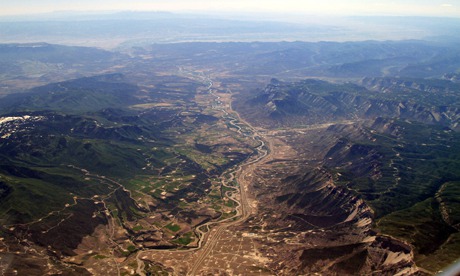
America’s oil and gas rush is depleting water supplies in the driest and most drought-prone areas of the country, from Texas to California, new research has found.
Of the nearly 40,000 oil and gas wells drilled since 2011, three-quarters were located in areas where water is scarce, and 55% were in areas experiencing drought, the report by the Ceres investor network found.
Fracking those wells used 97bn gallons of water, raising new concerns about unforeseen costs of America’s energy rush.
“Hydraulic fracturing is increasing competitive pressures for water in some of the country’s most water-stressed and drought-ridden regions,” said Mindy Lubber, president of the Ceres green investors’ network.
Without new tougher regulations on water use, she warned industry could be on a “collision course” with other water users.
“It’s a wake-up call,” said Prof James Famiglietti, a hydrologist at the University of California, Irvine. “We understand as a country that we need more energy but it is time to have a conversation about what impacts there are, and do our best to try to minimise any damage.”
It can take millions of gallons of fresh water to frack a single well, and much of the drilling is tightly concentrated in areas where water is in chronically short supply, or where there have been multi-year droughts.
Half of the 97bn gallons of water was used to frack wells in Texas, which has experienced severe drought for years – and where production is expected to double over the next five years.
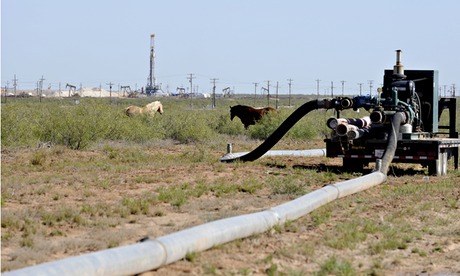 Large hoses run from hydraulic fracturing drill sites in Midland, Texas. Fracking uses huge amounts water to free oil and natural gas trapped deep in underground rocks. With fresh water not as plentiful, companies have been looking for ways to recycle their waste. Photograph: Pat Sullivan/AP
Farming and cities are still the biggest users of water, the report found. But it warned the added demand for fracking in the Eagle Ford, at the heart of the Texas oil and gas rush, was hitting small, rural communities hard.
“Shale producers are having significant impacts at the county level, especially in smaller rural counties with limited water infrastructure capacity,” the report said. “With water use requirements for shale producers in the Eagle Ford already high and expected to double in the coming 10 years, these rural counties can expect severe water stress challenges in the years ahead.”
Local aquifer levels in the Eagle Ford formation have dropped by up to 300ft over the last few years.
A number of small communities in Texas oil and gas country have already run out of water or are in danger of running out of water in days, pushed to the brink by a combination of drought and high demand for water for fracking.
Twenty-nine communities across Texas could run out of water in 90 days, according to the Texas commission on environmental quality. Many reservoirs in west Texas are at only 25% capacity.
Nearly all of the wells in Colorado (97%) were located in areas where most of the ground and surface water is already stretched between farming and cities, the report said. It said water demand for fracking in the state was expected to double to 6bn gallons by 2015 – or about twice as much as the entire city of Boulder uses in a year.
In California, where a drought emergency was declared last month, 96% of new oil and gas wells were located in areas where there was already fierce competition for water.
The pattern holds for other regions caught up in the oil and gas rush. Most of the wells in New Mexico, Utah and Wyoming were also located in areas of high water stress, the report said.
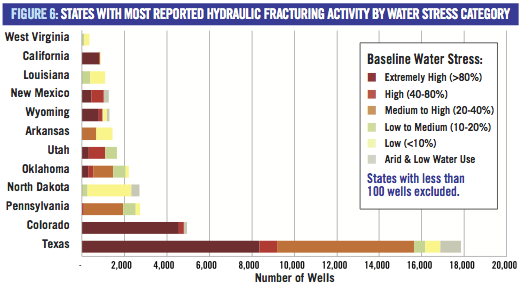 Source: Ceres Some oil and gas producers were beginning to recycle water, especially in the Marcellus shale in Pennsylvania, the report said. But it said those savings were too little to offset the huge demand for water for fracking in the coming years.
8 Comments on "Fracking depleting US water supplies"
Plantagenet on Fri, 4th Apr 2014 12:26 am
No problemo. Just use a water-free fracking method.
rockman on Fri, 4th Apr 2014 1:10 am
Well now for a bit of reality. First: “Local aquifer levels in the Eagle Ford formation have dropped by up to 300ft over the last few years.” OK dumb sh*t author: the Eagle Ford formation is not an aquifer today nor has it ever been. I suspect they are confusing it with the Edwards Aquifer. The EA has been the primary ground water source for more than half a century. Which is why the level has dropped…over the last half century and not as result of EFS frac’ng. They are either woefully ignorant or being intentionally deceitful IMHO.
More importantly: no one is “taking” water from anyone in Texas. Guess who owns all the fresh water in Texas: it’s all the people and municipalities that own the water. A rather simple concept, eh? When a company leases the rights to drill an oil well they have zero rights to the fresh water. In fact, state regs require casing to be in over the fresh water interval to protect it. This is one of he requirements to get a drill permit. Ever gallon of water used to frac wells in Texas was purchased for the person or municipality that owned it. And every owner of water has the right to sell it to whoever they want: an oil company, a farmer, a rancher, a municipality or use it themselves for whatever they want. Farmers/ranchers in Texas have sold water to oil companies because it was more profitable than growing crops/cattle. I know of one fellow that sold all the water from his big private lake on his property. So now he may have to wait a few years for the sparse rains to refill it. So now all he can do is sit on his porch, look at that dried out lake…and count the $750,000 he got for the water. He built the lake just for the aesthetics.
It’s no different than anyone here selling anything they own to whoever they want to. So who here would accept someone else’s judgment on their decision?
Sudhir Jatar on Fri, 4th Apr 2014 12:00 pm
That fracking requires enormous quantities of water is not in dispute nor that there is water scarcity in certain areas.
The point is not who owns the water. The point is not what the name of the aquifer is or whether it is an aquifer at all!
The point is whether we can go on using such quantities of water or whether “It’s a wake-up call,” as Prof James Famiglietti, a hydrologist at the University of California, Irvine says. “We understand as a country that we need more energy but it is time to have a conversation about what impacts there are, and do our best to try to minimise any damage.”
Kenz300 on Fri, 4th Apr 2014 12:41 pm
Time to transition to wind and solar…… save the water for drinking.
Makati1 on Fri, 4th Apr 2014 12:46 pm
Forever without oil … three days without water. Nuff said.
Northwest Resident on Fri, 4th Apr 2014 4:59 pm
I may own the water as it flows over my property, but eventually that same water flows off my property and onto somebody else’s property, and I don’t own it anymore, the next guy down the line does. Eventually that water flows into a water system owned by the public, and then it is no one person’s water — it belongs to everybody. If I pollute that water when I own it, then fact of the matter is, I am polluting it for everybody else. That is where the “ownership” of water falls apart, IMO. But of course, the laws are the laws, so here we are with a major issue that can’t be solved without rewriting those laws. Which of course is why we are screwed.
synapsid on Fri, 4th Apr 2014 10:31 pm
Just noticed that this article was published on 5 February.
?
Nony on Sun, 6th Apr 2014 7:06 pm
The only issue with water is location of it and purification of it. There are huge flows of water down the center of this continent. Use for fracking is tiny in comparison to what is available. Perhaps West (by God) Texas is different. But in North Dakota, they have flooding in the spring, and the Missouri River flowing by. If they’re short of water, they can just make a pond.
P.s. When I turn on my tap the water always comes out no problem. Even when I lived in California and everyone whined about droughts.