



China recently confirmed its plan to place the entire nation under a carbon market (cap-and-trade regime) to lower its annual rate of emitting carbon dioxide (CO2), the important greenhouse gas, beginning in 2016.
- China intends to continue lowering its carbon intensity, i.e., the amount of CO2 emitted for each US$ of gross domestic product (GDP) that the economy produces.
- The goal is to reduce the carbon intensity by 40-45% below the 2005 value by 2020. Averaged over this 15-year period, this corresponds to a reduction of 2.7-3% per year. This can arise from increased efficiencies in energy production and use from fossil fuels, and by increased production of energy from renewable sources.
- While this accomplishment would be highly significant, the objective does not directly address China’s total CO2 emission rate.
- China’s net annual rate of emitting CO2 is projected to grow between 2014 and 2040, with much of the increase occurring in the period up to 2020 (see the graphic below).
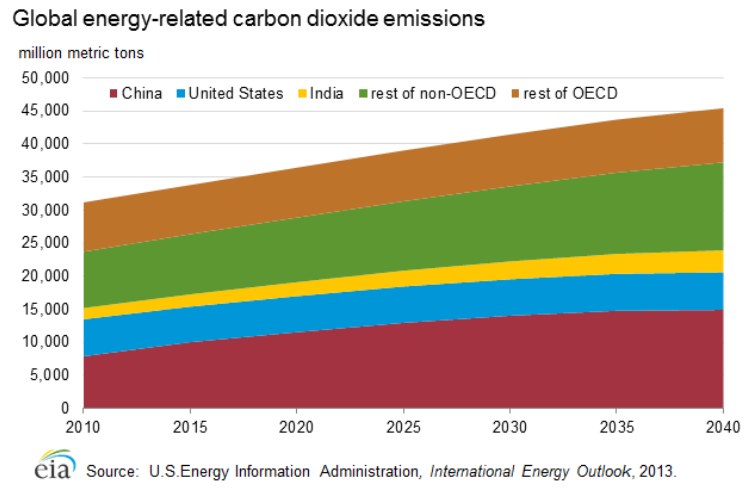
Global projected energy-related carbon dioxide emission rates per year to 2040. RED, China. OECD, Organization for Economic Cooperation and Development, representing already industrialized countries of the world; “rest of OECD” excludes the U. S. Non-OECD represents developing countries of the world; “rest of non-OECD” excludes China and India. Source: http://www.eia.gov/countries/cab.cfm?fips=CH
- The average growth rate for China’s energy-related CO2 emissions from 2010 to 2020 is about 5.3% per year, comparable to the growth in overall energy consumption, about 5.5% per year. Note that these objective data already reflect any improvements in carbon intensity.
- The national carbon market envisioned for China would be far larger than any other carbon market operating in the world today.
Significance
Cap-and-trade systems are one of two principal strategies for limiting greenhouse gas (GHG) emissions (especially CO2); the other is a direct tax on carbon-containing fuels. Cap-and-trade regimes limit emissions by capping each year’s allowed amount of GHG emissions, and lowering the cap each year. Low-efficiency facilities can acquire more allowances from more efficient ones by trading on an open market or exchange, thus establishing a price for emissions.
A small number of cap-and-trade regimes exists already. They have varying degrees of effectiveness. The European Union’s Emission Trading System was highly ineffective for several years because it distributed too large a number of allowances. The U. S. has not enacted any federal law regulating GHG emissions. Recently, however, President Obama’s administration has raised efficiency requirements for vehicles and has issued draft rules limiting emissions from electric power plants. The Regional Greenhouse Gas Initiative, in nine northeastern American states, operates an effective system, but one which is limited both in its goals and because it applies only to large electric power generators. The state of California is implementing a significant cap-and-trade regime covering its entire energy economy.
As noted above, China’s national cap-and-trade system will be the largest in the world by far.
China has been the world’s largest emitter of GHGs since 2009. China is projected to dramatically increase its overall energy consumption over the period 2010-2040, continuing its rapid growth in use of energy in recent years (see the graphic below). Most is supplied by fossil fuels.

Annual rates of energy usage for China, the U. S. and India. Actual use up to 2010; projected usage thereafter. 1 quadrillion = 1 million billion. Btu, British thermal unit. Source: U. S. Energy Information Administration; http://www.eia.gov/pressroom/presentations/sieminski_07252013.pdf (slide 5).
The drastic increase in China’s energy consumption in recent years has resulted in a corresponding growth in its annual rate of CO2emissions. Projecting forward over the period 2010-2040 the Energy Information Administration believes the emissions growth rate will average about 2.1% per year.
A major factor contributing to China’s high rates of CO2 emissions is its reliance on coal to provide almost 70% of its energy. Of all the fossil fuels, burning coal emits 50% to 90% more CO2 than the others in order to obtain the same amount of heat energy.
China’s Five Year Plans (FYPs) have programmed in the changes detailed here.
According to the report “Delivering Low Carbon Growth – A Guide to the 12th Five Year Plan”, during the 12th FYP, covering 2011-2015, the carbon intensity was to improve by 17%, and the 13thFYP (2016-2020) already included the reduction of 40-45% with respect to the carbon intensity of 2005 mentioned at the outset. The proportion of energy provided by non-fossil fuels is to be 11.4% in the 12th FYP and 15.0% in the 13thFYP. The actual increase in primary energy consumption was 6.3% per year in the 11th FYP, and intended to be 3.75-5% in the 12th FYP.
Market-based incentives. Already during the 12th FYP China set up 7 regional and provincial pilot cap-and-trade projects, placing limits on CO2emissions. The experience gained from these pilots is to provide useful background for setting up the nationwide system.
China and other developing countries, together with developed countries, have to agree to meaningful reductions in the world’s GHG emissions that are currently being negotiated under the United Nations Framework Convention on Climate Change. China, for one, has emphasized its achievements in lowering its carbon intensity, even though its use of fossil fuels has been increasing resulting in increased annual rates of GHG emissions. Agreement on a new emissions treaty is intended during 2015, and it is foreseen to enter into force by 2020. All nations of the world should approach these negotiations in good faith, and strive to achieve agreement on meaningful reductions in GHG emissions.
Plantagenet on Mon, 22nd Sep 2014 1:18 pm
China is the largest emitter of CO2 on the planet, largely because of their heavy reliance on coal-fired power plants and their rapidly growing economy and shift to the use of private cars. This announcement does nothing to change that reality.
Kenz300 on Mon, 22nd Sep 2014 3:01 pm
A step in the right direction………..
China is beginning to realize that that there is money to be made leading a clean economy with alternative energy sources.
China’s investments in wind, solar, wave energy, geothermal and second generation biofuels made from algae, cellulose and waste will drive down costs of these energy sources. They are also investing heavily in electric vehicles and if they are successful the rest of the world will follow.
These investments are a good thing for China and a good thing for the rest of the world.
Climate Change is real and we will all be impacted by it one way or another.
Kenz300 on Mon, 22nd Sep 2014 3:07 pm
Who will lead the clean energy investments of the future and profit from it?
US-China Rifts Put Aside for Clean Energy Research
http://www.renewableenergyworld.com/rea/news/article/2014/09/u-s-china-rifts-put-aside-for-clean-energy-research
Makati1 on Mon, 22nd Sep 2014 10:18 pm
Plant, China is also the largest population in any one country in the world. (1,301,000,000+) If the US had it’s population, we would use the same amount of coal as per EIA statistics. If we had not sent your job to China, we would be consuming the same amount as they do and the pollution would be here.
http://www.eia.gov/countries/
Davy on Tue, 23rd Sep 2014 6:38 am
Per-capita and situational inferences between nations are what simpletons use to support their ideology in this case western hate. A country can have a very large population or a high standard of living but not both in our finite world. China is demonstrating an attempt at it and this attempt is destroying the world. It is a doomed attempt. The US is losing its attempt at ever higher consumption. It is fair for the Chinese to consume more with a huge population. It is also fair for countries like the US to continue on their path of consumption. It is fair because there is no agreements otherwise. Nature will mitigate these bubble in consumption and population. I am of the opinion these bubbles are beyond human management and will just have to run their natural course.
foxv on Tue, 23rd Sep 2014 8:56 am
hmm, it all sounds good on paper except this is being done in a communist country with a long standing history of corruption and market manipulation.
Actually it’s not even good on paper. Creating a “market” for Carbon dioxide is doomed right from the get go because there is no REAL market for carbon dioxide. So now the Chinese are going to force their people to buy what nobody wants? Will they use the police and guns to enforce/ensure demand? Will “enforcement” be evenly applied or to only select enemies and competitors of the connected?
Anyone see the movie “Blood Diamonds” and the expression TIA (This is Africa). Well this is China. Rules, commonsense and logic do not apply. It’s the Wild West dressed up in Asian civility (barely)
Just talk to Alibaba investors in a years time what it means to do business in China. They will tell you quite a tale I’m sure.
Kenz300 on Wed, 24th Sep 2014 12:54 pm
Every nation large and small must join in to fight Climate Change. It will impact us all.
Obama Presses Chinese on Global Warming – NYTimes.com
http://www.nytimes.com/2014/09/24/world/asia/obama-at-un-climate-summit-calls-for-vast-international-effort.html?emc=edit_th_20140924&nl=todaysheadlines&nlid=21372621