
Peak Oil is You

Donate Bitcoins ;-) or Paypal :-)


Page added on September 6, 2014

Canada’s oil sands
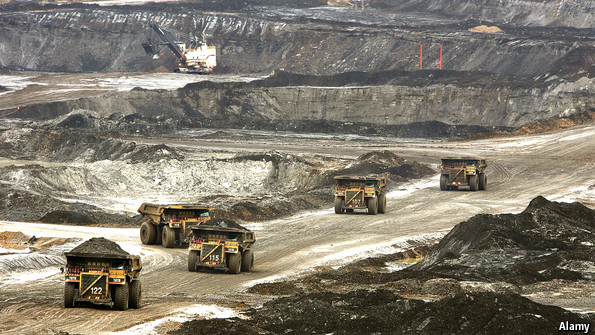
ONE of the bleakest scenes of man-made destruction is the strip mining of oil sands in the forests of Alberta, Canada. The sand is permeated with natural bitumen, a type of petroleum with the consistency of peanut butter. Once dug from the surface, the sand is hauled to an extraction plant where it is mixed with lots of hot water and chemicals to liberate the oil and make it flow into pipelines or be taken by tankers to refineries. Not all of the water can be recycled and what remains is a goopy toxic waste contained in some 170 square kilometres of man-made ponds.
It is hardly surprising that environmental campaigners want to restrict or shut down the growing “tar sands” industry, as it is also called (as tar is a man-made substance, the industry uses the term oil sands). But the commercial stakes are high. Only Saudi Arabia and Venezuela have greater proven oil reserves than Canada, but 97% of Canada’s 174 billion barrels are in oil sands, mostly in Alberta.
In the past decade high oil prices have made the oil sands profitable to exploit. But the oil industry, whose reputation for protecting the environment is already poor, has come under pressure to find more efficient and cleaner ways to extract the oil. The results of that innovation are now starting to be deployed.
Many operators now extract the bitumen without strip mining. “In-situ” production, as it is called, involves injecting high-pressure steam, heated to more than 300°C, into deep boreholes. The steam, emerging from millions of slits in a steel borehole liner, liquefies the bitumen and allows it to be pumped out.
Using steam extraction means that nine-tenths of the land above a reservoir can be left intact. There is no need for waste ponds because the sand is left underground and most of the water recovered from the bitumen can be cleaned with distillation for reuse. Steam can also produce bitumen from a reservoir half-a-kilometre underground, whereas strip mining is only economical for deposits less than 70 metres or so from the surface.
The proportion of bitumen produced with steam now stands at 53% and will continue to grow, says the Alberta Energy Regulator (AER), a government agency. One of the newer methods, steam-assisted gravity drainage (SAGD), has proved particularly effective, says Ken Schuldhaus of the AER. SAGD involves drilling two horizontal wells through an oil-sands reservoir, one about five metres below the other. Steam is then released from the top well and over a few weeks can melt bitumen as far as 50 metres above and to the sides of the bore. The bitumen then percolates down and into the lower well, from which it is pumped to the surface.
All that gas
Generating steam, though, requires burning a lot of natural gas, and this creates emissions. Another innovation promises to reduce energy and emissions. In a trial last year, Suncor, an Alberta firm, found that adding oil-based solvents to steam increases recovery while reducing the amount of water that has to be heated by 15%. Suncor will begin commercial production within a year using solvents that include butane, propane and a proprietary substance that weakens the surface tension between liquids and solids. Another Alberta firm, Laricina Energy, reckons it can cut the amount of water that needs to be heated by 25% or more. Such reductions promise to reduce break-even costs.
Costs and emissions could be reduced even further in a $100m trial begun this year near Cold Lake. Imperial Oil, based in Calgary, has replaced steam altogether by injecting solvents under high pressure but at much lower temperatures. Pius Rolheiser, the firm’s head of government affairs, says success hinges on being able to separate and reuse the solvents pumped to the surface along with the bitumen.
More radical processes are on the way. This year Suncor began building facilities in Alberta to test melting bitumen with microwaves. It will insert a microwave-transmitting antenna into a horizontal borehole with the circumference of an arm but the length of a football pitch. The idea, says Don Clague, Suncor’s senior vice-president of in-situ technologies, is to melt bitumen without wasting energy heating sand and rock—just as domestic microwave ovens heat moist food but not its glass or ceramic container. Laboratory tests suggest this could slash energy costs by 80%.
Other technologies may come into play. Germany’s Siemens is developing a system that floods a thick copper cable with an electrical current to create an alternating magnetic field to melt bitumen. Les Little of Alberta Innovates, a government body that has worked with Siemens on the project, hopes it will be tested in the province within a few years. The electricity required to run such a process might come from small nuclear reactors, says Jerry Hopwood of Candu Energy, a nuclear-technology company based near Toronto. It has studied designs for reactors that would be small enough to be trucked from Edmonton to the big oil-sands operations around Fort McMurray, Alberta.
Use of the new technologies is spreading quickly, says Suncor’s Mr Clague, thanks in part to a body called the Canadian Oil Sands Innovation Alliance, in which member firms share information about their developments. The new techniques might not allay the fears of some conservationists, but as oil companies are typically obliged to restore the landscape once extraction is complete, making less mess in the first place should help ensure they do a better job of cleaning up.
40 Comments on "Canada’s oil sands"
JuanP on Sat, 6th Sep 2014 9:24 am
“… the growing “tar sands” industry, as it is also called (as tar is a man-made substance, the industry uses the term oil sands).”
Yeah, I’m sure that is why they prefer to call them oil sands in the industry, rather than tar sands. I am positively, verifiably, 100% certain that it has absolutely nothing to do with how those terms polled in industry financed research polls.
Welch on Sat, 6th Sep 2014 9:33 am
Well, any party elected to run Canada WILL go after this stuff, so these efforts are good news, at least.
JuanP on Sat, 6th Sep 2014 9:47 am
I found the technical info very interesting.
rockman on Sat, 6th Sep 2014 10:59 am
“ONE of the bleakest scenes of man-made destruction is the strip mining of oil sands in the forests of Alberta, Canada.” True of course. But what’s also true: One of the bleakest scenes of natural destruction is the exposure of oil sands in the forests of Alberta, Canada. IOW the land has been an environmental nightmare for hundreds of thousands of years. The strip mining itself is actually improving the surface conditions by removing the hydrocarbons. But at a price: the mobilization of the unrecovered hydrocarbons and the potential contamination of the runoff of the extraction chemicals.
The anti-oil sands folks like to post lots of pictures of the mining efforts but intentionally avoid showing pictures of Mother Earth’s nightmare predevelopment landscape and some of the reclaimed land after recovery. Obviously it’s not a simple dynamic suited for a bumper sticker campaign but that doesn’t stop either side of the debate from focusing on such techniques.
If any anti-development group thinks they’ll stop the process they are truly delusional IMHO. Likewise the developers are delusion if they don’t expect an environmental pushback. IMHO the need for compromise by both sides is obvious. Just as it’s obvious to me that neither side is prepared to compromise.
But the bottom line won’t change IMHO: with $TRILLIONS of revenue for companies, governments and many citizens the deposits will be developed. The only question is the net cost to the environment. And with no willingness to compromise it with follow it’s well establish path.
Plantagenet on Sat, 6th Sep 2014 11:51 am
Every energy system involves mining and/or destruction of natural habitats. Even apparently innocuous reliance on firewood has resulted in massive deforestation of upland areas in Nepal and other high elevation areas.
Poordogabone on Sat, 6th Sep 2014 12:04 pm
Bitumen is a half baked cake. Instead of leaving it in the ground for another few million years to let the natural process turn it into oil, we greedily extract it at great environmental damage and costs and waste NG to terminate the process. Future generations can eat shit.
Perk Earl on Sat, 6th Sep 2014 12:29 pm
Our species is amazingly innovative, but to what end? Just more CO2 to insure a climate change catastrophe later.
As ideas go though, I like the microwave approach.
shortonoil on Sat, 6th Sep 2014 12:46 pm
Having worked in Canada for a good portion of my professional life I can tell you that there is a lot more to this subject than the articles is telling. The open pit method of extraction for the tar sands is in considerable danger. The first extraction attempts were in the Fort McMurray area, and several people I knew quite well worked on them. Originally, the overburden (unusable waste) was about 15 feet thick, and the bitumen deposit over a 100. As mining operations moved away from Fort McMurray three things began to happen. The overburden increased, the bitumen seam decreased, and the bitumen content (barrels per ton) fell. Anyone in the open pit mining business can tell you that combination is the kiss of death for an open pit mining operation. The open pit mining method for extracting bitumen probably has at most 10 years before it becomes economically nonviable.
“In-situ” and SADG were developed to circumvent the oncoming train wreck, except they have a problem also. They both require huge amounts of NG to heat the water, an even though there is a lot of stranded gas in that area, it is not infinite. Most studies indicate that the tar sands will run out of NG before they run out of tar. NG also has a dollar problem. If NG prices were to rise to $8.00/MM BTU in North American the producers would find it more profitable to sell the gas than to use it to produce bitumen. Either way, dependence on NG also has a self life of perhaps 10 years.
The miracle solutions to the problem at this point are just that. Using microwave sounds like a great idea until you look at its problems. Microwave takes a huge amount of electricity to produce. Producing that power from NG has the same problem as SADG; a finite amount of gas, and a potential price barrier. Building nuclear plants to produce bitumen would have about as much chance as a snowball in hell. One – it would be politically impossible, two – there is not enough water in the area to cool the plants, three – construction costs would probably prevent any such an attempt. The author of the article is hallucinating on this point.
We are approaching the end of the oil age, and as we point out in our study non conventional will be phased out before conventional. The tar sands will be just one more example of that phenomenon.
http://www.thehillsgroup.org/
Davy on Sat, 6th Sep 2014 1:06 pm
I am spiritually connected to Mother Nature. I only do well for a few days in populated and developed places. I can’t stand the pollution of many types from noise, visual, and bad air. Often when in St Louis I look around and then reach into my mind and view what St Louis was like before the on-slot of modern man. I have many books on pre-European landscape of my state. With that said we are here now where we are at in a world humanly reconstructed over vast expanses. Really no areas are untouched. No one planned this it is natural evolution of nature through a species. Again with that said we only have a few more years of this level of manipulation of nature. Our complexity, energy intensity, and economic activity are set to decrease many fold. We currently need each and every possible contribution to our liquid fuel supply to maintain our complexity. When this complexity decreases we risk a bifurcating implosion where many people will die from lack of food and support. I personally would like to see a little more BAU so we can build lifeboats and prepare in some way. We are nearly completely unprepared now. If we can have a crisis of say maybe 10 years where BAU functions but barely maybe we can make some changes to lifestyles and attitudes that can limit the death ahead. Tar sands are a part of this time purchase. They are doing a huge amount of damage both environmentally and with the climate but they are contributing to the all-important liquid fuel equation.
Solarity on Sat, 6th Sep 2014 1:11 pm
As Rockman states, a land-surface permeated with natural bitumen is not a very hospitable environment to begin with, and shows that nature herself can be bleak. Regardless of the intermediate mess made in exploitation, the post-development mitigation will probably leave the area better than it initially was.
Perk Earl on Sat, 6th Sep 2014 1:38 pm
“Regardless of the intermediate mess made in exploitation, the post-development mitigation will probably leave the area better than it initially was.”
Wow, that is optimistic! Even though the landscape did not appeal to our sense of what is naturally attractive beforehand, our excavating overburden and oil sands, subsequent carbon emissions from end product, oily brackish ponds and toxic wastewater leaking downstream are a step up?
synapsid on Sat, 6th Sep 2014 3:38 pm
JuanP,
I’ve been calling them oil sands for years, because the stuff is, um, oil, y’know? LaBrea Tar Pits, in LA, ought to be called bitumen pits or oil pits but that would make no sense because the name itself has a long history.
The Athabasca stuff is relatively new in the public eye so why not name it accurately? “Bitumen” is correct but “oil” is easier to say and not inaccurate.
Poordog,
As close to the surface as the oil sands are, the bitumen would not have become oilier-type oil. It was on its way to the surface; much of it arrived there long ago, in fact, and is long gone.
Nony on Sat, 6th Sep 2014 3:38 pm
It’s a very big country and the area has low population density. They clean up after the mining. It’s fine.
Funny how nature-hugger are all the people who live in New York City (concrete jungle) and how the people in Alaska, ‘berta, etc. are fine with mining). Then again liberals are two faces.
adamx on Sat, 6th Sep 2014 3:49 pm
You know, it’s easy to call any ecosystem you wish to destroy “bleak”. You hear terms like “wasteland” (which was used to refer to pretty much any wild land in the past), but these terms are from a human perspective. I should remind everyone that swamps were thought of as “pestilent wastes” in the past (and in fact do harbor mosquitos, which can spread many diseases), but those same swamps are necessary as breeding ground for countless animals, from birds to shimp, and also act to clean water coming down the line.
Rockman, I respect you greatly, but I think you would never call a swamp a “waste”, as you have lived in places like Louisiana where entire cultures have made their lives on those swamps. The oil sands are not a wasteland either. They aren’t a “pretty” ecosystem like a coral reef, but they are an ecosystem with it’s own rules and it’s own life. What you say about the area is misleading at the least.
In regards to development in the area, we should recognize that it is not unique – hydro dams and strip mines exist across the world, and are similarly destructive, if not much more so (the impact of dams in particular is hard to overstate, with the loss of lands submerged by reservoirs behind the dams being perhaps the least of it). Perhaps we should ask “what are we actually destroying, how much are we destroying, what actually lives here, are we gaining enough to justify it, and when we are done how will it look?”. I think the plan with the surface mined portion is to turn it into grazing land in the end? Well, we can say that the land will never be wild land as it was before. What about the other things that live there?
I know this isn’t a very popular opinion, but humans and their domestics aren’t the only living things that have a right to exist on this earth.
rockman on Sat, 6th Sep 2014 4:53 pm
Adam – I didn’t tag them as wastelands. I just described what they are like predevelopment which is an indisputable fact. As general rule I don’t consider any land a waste…it’s just land. Nothing more…nothing less. I grew up in New Orleans on land that was once swamp that was drained. So was it waste before or is it now? Not an absolute judgment…dependent on who you are.
Land is transformed. Is that good or bad? IOW is anyone on this site living on a patch of land that wasn’t a patch of “pristine wilderness” at one time? So essentially everyone here is taking advantage of “wasteland” transformed to something beneficial. Just like the folks who are benefiting from the oil sands lands being transformed.
So how do you pass judgement on any land transformation: it it benefits you it’s good and if it doesn’t it’s bad? I think the term is “relative morality”. IOW is your judgement of the folks in Alberta any more valid then their judgment of your lifestyle?
And again the same basic question: how many folks who are critical of the oil sands development
have lifestyles dependent upon consuming fossil fuels produced by someone? IOW is the energy you use to live your life coming from “good fossil fuels” or “bad fossil fuels” like the oil sands and Deep Water GOM fields?
Poordogabone on Sat, 6th Sep 2014 5:27 pm
“As close to the surface as the oil sands are, the bitumen would not have become oilier-type oil. It was on its way to the surface; much of it arrived there long ago, in fact, and is long gone.”
That is interesting Synapsid, are you a geologist or do you have a link to back up these statements. Normally things tend to get bury deeper over time. Close to the surface fossils are usually younger than deeper ones.
Richard Ralph Roehl on Sat, 6th Sep 2014 6:48 pm
Maybe we could replace the horrors of the tar sands insanity with the ongoing radioactive contamination horror emanating from the Fukushima time-bomb nuke plants in Japan!
Being an associate member of the ‘Anarchist $ociety’… we ardently and passionately endorse the Pope’s edict to stop all birth control on the planet as the best solution to stop all this madness.
Or… as Russians grimly joked during the $talinist era: “The worse, the better!”
adamx on Sat, 6th Sep 2014 11:44 pm
Rockman, I think we’re basically on the same page. It is human nature to develop land and change the environment. I just think that before we do so we should be more critical of how we do it, and consider the impacts more. To say that the natural state of the area is “bleak” is both subjective and not particularly meaningful. It’s a word used to excuse what you’re going to do.
Some of the more severe issues have to do with the tailing ponds, which become death traps for migrating birds, and disputes over how much of the land has actually been recovered after mining.
As you said, the need to compromise is obviously there, but neither side feels like it should. The oil companies have the money, and currently the advantage of a government that is very favorable to them. The other side tends to be blindly idealistic, but is also much less powerful. As you said, with neither side interested in compromise, it will follow its current path.
I do hope they get new, less destructive tech in use as soon as possible. The best solution is the one that disturbs the least. To say the post-development land will be “better” doesn’t mean anything until “better” is defined, and “better” rarely means “better for the animals that lived in what we just mined”.
forbin on Sun, 7th Sep 2014 8:56 am
hmm, as far as the UK goes I don’t think theres been any “pristine” land for thousands of years , virtually all of our landscape is man made in one way or another
and reading the book 1491 suggests USA maybe the same , Canada yes I can think of that as pristine after the Ice scraped the last lot of top soil off….
@Poordogabone : its a reference to the origins of the Oil Sands
1.) These sands are the remnants of a once vast reserve of crude oil that, over extremely long periods of time, has escaped or been destroyed microbiologically; thus leaving behind some bitumen and also converting the lighter crude oil into bitumen through bacterial processes.
2.) The bitumen evolved from highly organic cretaceous shales (similar to oil shale). Underground pressure forced the bitumen out of the kerogen rich shales where it soaked into existing silt grade sediments and sand bodies.
I hope that helps – if you want links Google is you friend
or wikipedia
Forbin
forbin on Sun, 7th Sep 2014 9:02 am
As for if all these “new” development methods get used the answer is Rockman’s Price Dynamic
I’d posit that if it’s not economical at $100/$115 then it’s unlikely to be economical soon
Shortonoil covers the other obstacles , the price per barrel and can afford it at that price being the main one with each method stated
Forbin
NOTE: if it meets Net Present Value then it will be developed
rockman on Sun, 7th Sep 2014 11:22 am
Adam – No, I don’t think we view the situation very differently. My rant was directed more towards those who wish to ignore the hypocrisy of their positions. All fossil fuel extraction has some negative effect on the land. But so does building a subdivision, a hospital, a school, etc.
It’s very rare we see anyone here criticize ff extraction that benefits their lifestyle. And when they do they notably ignore the benefits they receive why blasting others who benefit from their sources. How many Albertans have we seen here criticize oil sand development? And any that might do they also reject the benefits they receive? I would respect any Albertan that rejected all the financial aid they received from the province. But I’ve yet met such a truly righteous person. LOL.
Same for folks in NY that criticize frac’ng but don’t demand banning NG from PA that fires their power plants. Same for CA folks who criticize offshore oil production in the Gulf of México yet burn gasoline made from oil shipped along the same route that the Exxon Valdez followed to the largest US oil spill up till then. And let’s not forget our cousins in Washington state who, while not “destroying” any of their land with oil extraction, have the fifth largest collections of refineries in the country. Refineries cracking a lot of oil produced from the North Slope and some from Alberta.
To be my typical “crude” self much of the comments seem to fall into the category of “Your sh*t stinks but mine don’t”. LOL.
rockman on Sun, 7th Sep 2014 11:22 am
Adam – No, I don’t think we view the situation very differently. My rant was directed more towards those who wish to ignore the hypocrisy of their positions. All fossil fuel extraction has some negative effect on the land. But so does building a subdivision, a hospital, a school, etc.
It’s very rare we see anyone here criticize ff extraction that benefits their lifestyle. And when they do they notably ignore the benefits they receive why blasting others who benefit from their sources. How many Albertans have we seen here criticize oil sand development? And any that might do they also reject the benefits they receive? I would respect any Albertan that rejected all the financial aid they received from the province. But I’ve yet met such a truly righteous person. LOL.
Same for folks in NY that criticize frac’ng but don’t demand banning NG from PA that fires their power plants. Same for CA folks who criticize offshore oil production in the Gulf of México yet burn gasoline made from oil shipped along the same route that the Exxon Valdez followed to the largest US oil spill up till then. And let’s not forget our cousins in Washington state who, while not “destroying” any of their land with oil extraction, have the fifth largest collections of refineries in the country. Refineries cracking a lot of oil produced from the North Slope and some from Alberta.
To be my typical “crude” self much of the comments seem to fall into the category of “Your sh*t stinks but mine don’t”. LOL.
rockman on Sun, 7th Sep 2014 11:22 am
Adam – No, I don’t think we view the situation very differently. My rant was directed more towards those who wish to ignore the hypocrisy of their positions. All fossil fuel extraction has some negative effect on the land. But so does building a subdivision, a hospital, a school, etc.
It’s very rare we see anyone here criticize ff extraction that benefits their lifestyle. And when they do they notably ignore the benefits they receive why blasting others who benefit from their sources. How many Albertans have we seen here criticize oil sand development? And any that might do they also reject the benefits they receive? I would respect any Albertan that rejected all the financial aid they received from the province. But I’ve yet met such a truly righteous person. LOL.
Same for folks in NY that criticize frac’ng but don’t demand banning NG from PA that fires their power plants. Same for CA folks who criticize offshore oil production in the Gulf of México yet burn gasoline made from oil shipped along the same route that the Exxon Valdez followed to the largest US oil spill up till then. And let’s not forget our cousins in Washington state who, while not “destroying” any of their land with oil extraction, have the fifth largest collections of refineries in the country. Refineries cracking a lot of oil produced from the North Slope and some from Alberta.
To be my typical “crude” self much of the comments seem to fall into the category of “Your sh*t stinks but mine don’t”. LOL.
rockman on Sun, 7th Sep 2014 11:22 am
Adam – No, I don’t think we view the situation very differently. My rant was directed more towards those who wish to ignore the hypocrisy of their positions. All fossil fuel extraction has some negative effect on the land. But so does building a subdivision, a hospital, a school, etc.
It’s very rare we see anyone here criticize ff extraction that benefits their lifestyle. And when they do they notably ignore the benefits they receive why blasting others who benefit from their sources. How many Albertans have we seen here criticize oil sand development? And any that might do they also reject the benefits they receive? I would respect any Albertan that rejected all the financial aid they received from the province. But I’ve yet met such a truly righteous person. LOL.
Same for folks in NY that criticize frac’ng but don’t demand banning NG from PA that fires their power plants. Same for CA folks who criticize offshore oil production in the Gulf of México yet burn gasoline made from oil shipped along the same route that the Exxon Valdez followed to the largest US oil spill up till then. And let’s not forget our cousins in Washington state who, while not “destroying” any of their land with oil extraction, have the fifth largest collections of refineries in the country. Refineries cracking a lot of oil produced from the North Slope and some from Alberta.
To be my typical “crude” self much of the comments seem to fall into the category of “Your sh*t stinks but mine don’t”. LOL.
rockman on Sun, 7th Sep 2014 11:27 am
Damn. I know I seem verbose but I didn’t do that. LOL. Maybe the Cloud went a little nuts.
forbin on Sun, 7th Sep 2014 11:30 am
oh dear rockman !
lets not get into “cloud Wash” 🙂
hehe
Forbin
JuanP on Sun, 7th Sep 2014 11:38 am
Got it, Rock! 🙂
JuanP on Sun, 7th Sep 2014 11:39 am
On second thought, let me read that once more. LOL
Hugh Culliton on Sun, 7th Sep 2014 11:39 am
I’m not a “tree-hug gin’ liberal – in fact, back in my navy days I loved rigging hoses and blasting Greenpeace pinkos off the sides of my ship (good times!). But back in the early ’90s when I was a junior RCN officer, I had the opportunity to visit Estonia as part of a Partnership For Peace program. They were poor in those days: digging up old tires from playgrounds and putting them back on trucks – poor. I’ll never forget one scene though: the way the Soviets did tank maintenance. They’d warm up 100s at a time, and park them in one really big field, and then drain the oil onto the ground, fill ’em up again, and drive off. Week after week, month after month, year after year, and decade after decade – all in the same spot, and a T-72 holds a LOT of oil.
That was the most desolate, polluted, indeed sinful environmental damage I’d ever seen – until I viewed our own fair tar sands from the air. Sure, what’s going on in Alberta is out of sight and doesn’t immediately affect many people -except the First Nations – but no one cares about them anyway. But the damage being done – the fresh water being irretrievably poisoned, the destruction of some of the last pristine boreal forest on the planet, the vast Mackenzie River watershed that sustains it and drains into the still- mostly pristine Arctic Ocean – If we count that against the financial profits being made from the tar sands, we’ll see how much of a looser for Canada and the world they really are. I pray for demand destruction to kick in soon because I fear that big oil has the governments so firmly by the nuts that no amount of lobbying or protest can stop it.
Perk Earl on Sun, 7th Sep 2014 12:00 pm
Great post, thanks Hugh for offering up a more realistic view of what is actually occurring in Alberta.
synapsid on Sun, 7th Sep 2014 2:01 pm
Hi Poordog.
Forbin, down at the 8:56 post, gave a very good answer to your question.
I think the key is that the bitumen didn’t form where we find it; from a geological point of view, the stuff is in motion–slow motion, of course, but migrating from where it formed. The stuff it’s migrating through is not flat-lying and actually reaches the surface, and that’s where the bitumen has been leaking out forever, out where it could be used to caulk canoes and, eventually, be mined. Ice sheets have moved over that part of the continent repeatedly and have no doubt helped keep the exposures fresh.
I am a geologist, yes, though not an oil geologist.
synapsid on Sun, 7th Sep 2014 2:04 pm
JuanP,
Good approach. I wouldn’t put it past him to change a word here and there out of (gentlemanly) cussedness.
(Let me know if he did; I just read the first one.)
synapsid on Sun, 7th Sep 2014 2:06 pm
rockman,
You forgot the Bakken. That comes in by rail. The refineries welcome it all.
Norm on Sun, 7th Sep 2014 6:04 pm
i know how to more effectively mine the tar sands.
1. Drill a hole down to the tar layer. 2. Insert a medium-yield fission nuclear bomb.
3. Light fuse, and get away.
4. ker-boom !!
5. a nice big hole is automatically dug, and drive the bulldozers in. Also the excess heat from the explosion, will liquify the oil into a nice oil lake at the bottom of the crater.
6. thanks to the nice circular symmetry, when finished push all the dirt back in with dozers.
7. stick some tree seedlings on the top.
problem solved, yay !!
Kenz300 on Sun, 7th Sep 2014 7:08 pm
Climate Change will impact all of us in one way or another…….. we should all be concerned.
Poordogabone on Sun, 7th Sep 2014 7:50 pm
forbin and synapsid thanks for the explanation.
synapsid on Sun, 7th Sep 2014 10:46 pm
Norm,
The Soviets did that very thing, if memory serves. Back in the 1950s. Wound up with radioactive everything at a spot in Siberia.
Google will know.
Apneaman on Mon, 8th Sep 2014 2:21 am
rockman have you been there? I have spent a couple years of my life in camps there. I’m a retired Boilermaker, so I built and did maintenance on all sorts of vessels at the plants. No matter how fucked up it looks in pictures, I can guarantee you that It’s much much worse in person. Mordor popped into my head the first time I laid eyes on it and I had worked at plenty of industrial plants before that. Obviously, I have always been a long ways from being an environmentalist (I used to log in BC too) but it makes me fucking sick to know that no amount of destruction is too much. Apparently, we have no limits. None. I left in 2000 and it’s probably 4-5 times as big now. All that matter is the money. Until and unless you go there, don’t say a fucking word bout it.
shortonoil on Mon, 8th Sep 2014 12:27 pm
Apneaman said:
“Mordor popped into my head the first time I laid eyes on it and I had worked at plenty of industrial plants before that.”
My first trip to Fort MacMurray was a car trip with a friend in the late 90’s. As we approached he said, “Oh my God, the martians have landed, and they brought Mars with them”. The place is surreal when you see it. It makes stripped mined West Virginia look like a pristine arboreal forest. There is always talk of reclamation! When these outfits finally go broke they will walk, and leave the mess just like the strip miners in West Virginia did. The bonds they post will pay for about 5% of the reclamation cost, and the rest will be up to the Province. Since this area is at the A-hole of the world, no will give a dam. Some future generation will wander up there some day and say, “Oh my God, the martians did land, and they brought Mars with them”!
Apneaman on Mon, 8th Sep 2014 4:50 pm
There is a good chance that one of the new normal “once in a 1000 year floods” will cause one or more tailings pond to burst or over flow or both. The consequences would be unprecedented.