
Peak Oil is You

Donate Bitcoins ;-) or Paypal :-)


Page added on June 19, 2020

Can the World Get Along Without Natural Resources?
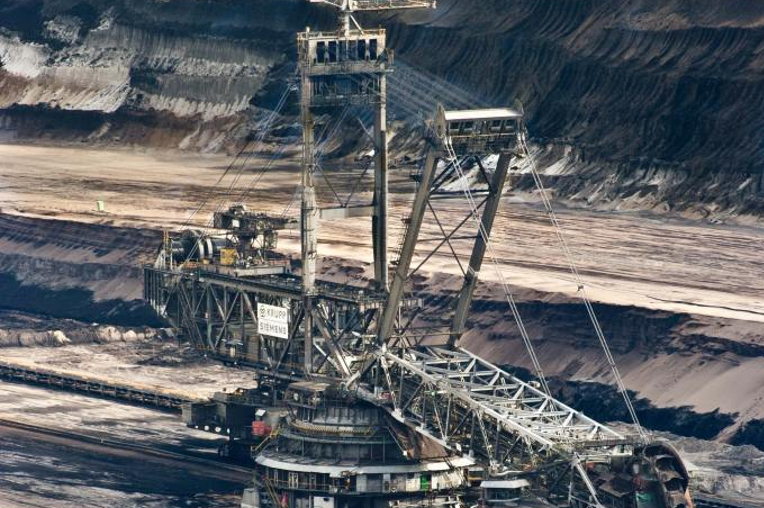
If it is very easy to substitute other factors for natural resources, then there is in principle no “problem”. The world can, in effect, get along without natural resources.
In the distant future, aliens come to Earth. They find a planet devoid of life. Looking closer, the aliens see that life on Earth was once abundant, but was wiped out by a mass extinction. Curiously, this event was driven not by geological disaster, but by one of the extinct species itself. In an orgy of consumption, an odd little animal put the planet under enough stress to drive itself —and the rest life — extinct.
Then comes a startling discovering. Preserved in the sediment lies a document written by a member of the doomed species. What secrets does it contain? The aliens work for years to translate it, hoping that it offers a clue about what drove the species to overconsume. And indeed it does. The document heralds a remarkable delusion: “The world can, in effect, get along without natural resources.”
What a naive animal, the aliens conclude. While sucking the planet dry, the animal proclaimed its independence from natural resources. No wonder it went extinct.
✹ ✹ ✹
Let’s hope this future is apocryphal. If, in the distant future, aliens do visit the Earth, I hope they find a planet teeming with life. Maybe they’ll even find an industrious, upright-walking animal that has learned to live sustainably.
If this bright future does come to pass, it will be because we’ve manage to shed our delusions. Contrary to the proclamations of neoclassical economists (like Robert Solow), the world cannot get along without natural resources. That this fact needs stating is a testament to the shallowness of economic theory.
In this post, I show you how economists reached such bizarre conclusions. And I offer some thoughts about the role that resources actually play in sustaining human societies.
The original sin
From its outset, the field of political economy was not designed, in any meaningful sense, to understand resource flows. Instead, it was designed to explain class relations. The goal of early political economists was to justify the income of different classes (workers, landowners and capitalists). They choose to do so by rooting this income in the ‘production of wealth’. What followed from this original sin was centuries of conflating income with ‘production’. This conflation is what allowed Robert Solow to proclaim that the world could “get along without natural resources”.
Let’s retrace this flawed thinking. It starts with a failure to understand property rights. Political economists largely understand property as a productive asset — a way of thinking that dates to the 17th-century work of John Locke (or perhaps earlier). Locke proclaimed that property rights stemmed from ‘natural law’. A man, Locke argued, has a natural right to own what he ‘produces’:
… every Man has a Property in his own Person. This no Body has any Right to but himself. The Labour of his Body, and the Work of his Hands, we may say, are properly his. Whatsoever then he removes out of the State that Nature hath provided, and left it in, he hath mixed his Labour with, and joyned to it something that is his own, and thereby makes it his Property. It being by him removed from the common state Nature placed it in, hath by this labour something annexed to it, that excludes the common right of other Men. For this Labour being the unquestionable Property of the Labourer, no man but he can have a right to what that is once joyned to, at least where there is enough, and as good left in common for others.
Locke’s thinking became known as the ‘labor theory of property’. This theory (and its derivatives) is why political economists misunderstand the role of natural resources. Here’s what happens. If we accept Locke’s argument that you have a right to own what you produce, it follows that your wealth should stem from your output.
Most political economists after Locke accepted this reasoning (at least in part). That meant that the debate was not about whether wealth was ‘produced’, but rather, about which ‘factors of production’ were ‘productive’. The physiocrats thought land alone was productive. Marx insisted that only labor was productive. Neoclassical economists proclaimed that, alongside labor, capital too was productive. The debate between these schools played out over centuries. The problem, though, is that it’s based on a flawed premise. The debate assumes that value is ‘produced’. (It’s not.)
To see the flaw, let’s go back to Locke’s theory of property rights. Notice that it’s not really a ‘theory’ in the scientific sense. It doesn’t explain why property rights exist. It explains why they ought to exist. Locke proclaimed that a man ought to own what he produces. That is his ‘natural right’.
This change from ‘is’ to ‘ought’ is important. It means that we’re not dealing with a scientific theory. We’re dealing a system of morality. The philosopher David Hume was perhaps the first to understand this moral sleight of hand. He noticed that moral philosophers made their arguments more convincing by framing what ‘ought’ to be in terms of what ‘is’. Here’s Hume reflecting on this trick:
In every system of morality, which I have hitherto met with, I have always remarked, that the author proceeds for some time in the ordinary way of reasoning, and establishes the being of a God, or makes observations concerning human affairs; when of a sudden I am surprised to find, that instead of the usual copulations of propositions, is, and is not, I meet with no proposition that is not connected with an ought, or an ought not. This change is imperceptible; but is, however, of the last consequence.
With David Hume’s observation in mind, let’s return to Locke’s ‘theory’ of property. It’s not a ‘theory’ at all — it’s a morale treatise. According to Locke, we ought to own what we produce. But that doesn’t mean that we do.
To see the consequences of this mistake, we need an actual scientific theory of property rights — a theory that explains why property exists, not why it ‘ought’ to exist. The most convincing theory of private property, in my opinion, comes from the work of Jonathan Nitzan and Shimshon Bichler. To understand property, Nitzan and Bichler argue that we should turn Locke’s idea on its head. Property isn’t a ‘natural right’. It’s an act of power.
Property, Nitzan and Bichler observe, is an act of exclusion. If I own something, that means that I have the right to exclude others from using it. It’s this exclusionary power that defines private property. Here are Nitzan and Bichler describing this act:
The most important feature of private ownership is not that it enables those who own, but that it disables those who do not. Technically, anyone can get into someone else’s car and drive away, or give an order to sell all of Warren Buffet’s shares in Berkshire Hathaway. The sole purpose of private ownership is to prevent us from doing so. In this sense, private ownership is wholly and only an institution of exclusion, and institutional exclusion is a matter of organized power.
When we think like Nitzan and Bichler, we get a very different view of income. Recall that most political economists see property in terms of the ‘things’ that are owned. They then argue that income stems from these ‘things’. Nitzan and Bichler upend this logic. Property, they argue, is about the act of ownership — the institutional act of exclusion. Income stems from this exclusionary act. We earn income from the fence of property rights, not from what’s inside the fence. In other words, if you can’t restrict access to your property, you can’t earn income from it. (For more discussion of Nitzan and Bichler’s theory of property rights, see this post. Or better yet, read their book Capital as Power.)
With Nitzan and Bichler’s theory of private property in hand, let’s look at what goes wrong in political economy. Economists see income and conclude that it indicates the productivity of the owner’s property. This means that when the distribution of income changes, it appears that the relative ‘output’ of each ‘factor of production’ also changes. So when the income flowing to natural resource owners declines, economists conclude (wrongly) that the resources themselves are becoming less important.
Here’s an example. Most early political economists argued that there were three ‘factors of production’: land, labor and capital. But over time, land was slowly dropped, leaving only labor and capital. Here are William Nordhaus and James Tobin noting this shift:
The prevailing standard model of growth … is basically a two-factor model in which production depends only on labor and reproducible capital. Land and resources, the third member of the classical triad, have generally been dropped.
… Presumably the tacit justification has been that reproducible capital is a near perfect substitute for land and other exhaustible resources.
According to Nordhaus and Tobin, land was dropped as a ‘factor of production’ because it could be replaced by capital. In other words, capital had become so productive that there was no longer a need for land.
Let’s dissect this logic. Economists dropped land as a ‘factor of production’ not because of any change in physical reality. Humans, like all organisms, depend on the Earth’s bounty for our survival. Without land, there is no food. And without food, there are no humans. So the importance of natural resources hasn’t changed. Why, then, did economists rid their theory of land? They did so because of the original sin in political economy: from declining income, economists inferred declining contribution to output. As societies industrialized, the share of income flowing to agricultural land owners declined. To economists, this signaled that land had become less important.
Let’s make this shift more concrete. Go back a few centuries and the wealthiest people were, without exception, land owners. Fast forward to the present, however, and this landed aristocracy hardly exists. The wealthiest people are now almost exclusively the owners of capital. And these capitalists sometimes own nothing but ideas (intellectual property). Wealth, it seems, is dematerializing. The world can get along without natural resources!
No. This thinking is flawed. It’s the Lockean mistake in action. Economists assume (wrongly) that income reflects productivity. They then mistake income redistribution — from the landed aristocracy to industrial capitalists — as a decline in the importance of ‘land’. But it is no such thing. Land remains the basis of all human activity.
Agriculture? We can do without it
The conflation of income with productivity has led economists to misunderstand the role of natural resources in human societies. Economists see that the owners of natural resources earn a trivial share of income. And so they conclude (wrongly) that natural resources themselves play a trivial role in the economy. It’s an embarrassing mistake with troubling consequences.
Take, as an example, the need to fight climate change. If you ask a climate scientist, they’ll likely say that climate change poses a dire threat to humanity. Their reasoning is simple. Climate change could potentially make farming impossible in much of the world. So if we want to avoid mass starvation, we’d best curb our fossil fuel habit.
In contrast, if you ask a neoclassical economist about fighting climate change, you’ll get a very different answer. Climate change, they’ll likely say, isn’t much of a problem. True, it may cause much of our arable land to become barren … but don’t worry. Agriculture, they’ll observe, is a tiny part of GDP. So even if we destroy our ability to farm, ‘economic output’ will remain virtually unchanged.
Given its absurdity, you might think that I’m making this reasoning up. But I’m not. William Nordhaus — whose work on the economics of climate change has been enormously influential — uses the same reasoning to downplay the impact of global warming. Here’s how he peddles it:
[T]he process of economic development and technological change tend progressively to reduce climate sensitivity as the share of agriculture in output and employment declines and as capital-intensive space heating and cooling, enclosed shopping malls, artificial snow, and accurate weather or hurricane forecasting reduces the vulnerability of economic activity to weather… More generally, underground mining, most services, communications, and manufacturing are sectors likely to be largely unaffected by climate change—sectors that comprise around 85 percent of GDP.
Although climate change may destroy our food supply, we shouldn’t worry. According to Nordhaus, we’ll all be safe inside our air-conditioned offices, with productivity unimpaired. For this tortured logic, Nordhaus was awarded the (fake) Nobel prize in economics. Noting the irony, anthropologist Jason Hickel aptly called it the “The Nobel Prize for Climate Catastrophe”. (If you’re appalled by Nordhaus’ work — and you should be — check out Steve Keen’s in-depth debunking of it).
Here’s what’s wrong with Nordhaus’ reasoning: it conflates income with productive importance (political economy’s original sin). Nordhaus sees agriculture’s declining share of national income and concludes (wrongly) that farming is becoming less important to human societies.
Let’s quantify the trend. Figure 1 shows the share of US income earned by people working in agriculture. This share declined precipitously over the two centuries. In 1840, more than half of all income went to people in agriculture. But by 2010, this figure had shrunk to less than 1%. Today, US farmers earn a trivial share of all income.

Figure 1: The share of agriculture in US national income. For data sources, see notes.
If you think like Nordhaus, the evidence in Figure 1 tells you that agriculture is becoming less important. It’s such a minuscule part of the economy that if we got rid of it entirely, GDP would shrink by less than 1%. So bring on the climate change!
No.
There’s a fatal flaw in this thinking. The decline in agriculture’s income share says nothing about agriculture’s biophysical importance. To see the biophysical importance of agriculture, we should look not at the income-accounting table, but at the kitchen table. No agriculture … means no food … means no humans.
Far from indicating agriculture’s irrelevance, the evidence in Figure 1 shows agriculture’s continued importance. Industrial society is possible only because so few people are needed to grow food. (That’s why farmers earn such a tiny share of all income. There are hardly any of them!) Modern farmers harvest a staggering quantity of food. This allows the rest of us to do the non-farming activities that we take for granted.
Let’s look at the growth of this agricultural harvest. Figure 2 shows the labor productivity of US farmers over the last two centuries. I’ve plotted the harvest of three crops: wheat, cotton and corn. For these crops, the increase in labor productivity is spectacular — about 50-fold for wheat and 100-fold for corn and cotton. This enormous harvest is the basis for our industrial society. Without the bounty of modern agriculture, urban life would be impossible.

Figure 2: The exploding labor productivity of US agriculture. I plot here the trend in the output per labor hour of US-produced wheat, cotton and corn. Data is indexed so that productivity equals 1 in the year 1800. Output is measured in physical units (bushels for wheat and corn, bales for cotton). For data sources, see notes.
We can now see the flaw in Nordhaus’ reasoning. If climate change decreases the productivity of agriculture, we lose the basis for our industrial society. If farmers can’t feed people in cities, urban-dwellers will have to move back onto the land. Presto … no more industrial society.
The price problem
In tying the concept of ‘output’ to income, neoclassical economists fool themselves. Their accounting system leads them to believe that natural resources are unimportant. Here’s what happens. When the price of a natural resource decreases, so does its apparent contribution to ‘output’. So as resources become cheaper, economists mistakenly think that societies are becoming less dependent on the Earth.
This thinking gets it utterly wrong. The price of a natural resource doesn’t indicate its importance to society. The role of natural resources is, in reality, invariant. Today — just as we have always been — we are utterly dependent on natural resource for our survival.
So what, then, should we make of the price of natural resources? In an important sense, the price of a resource is inversely related to the resource’s importance. The cheaper a resource becomes, the more we tend to depend on it.





As an example, take electricity. A century ago, electricity was expensive and its use was rare. Today, electricity is cheap and we use it in almost all aspects of life. Figure 3 quantifies this cheapening of electricity, measured in terms of work time. I’ve plotted here the work time required for an average US worker to purchase 1 megawatt-hour of electricity. (A megawatt-hour is roughly the amount of electricity used by a modern US household in a month.) In 1900, it took about 1000 hours of paid work to purchase this amount of electricity. Today it takes about 5 hours — a 200-fold decrease.
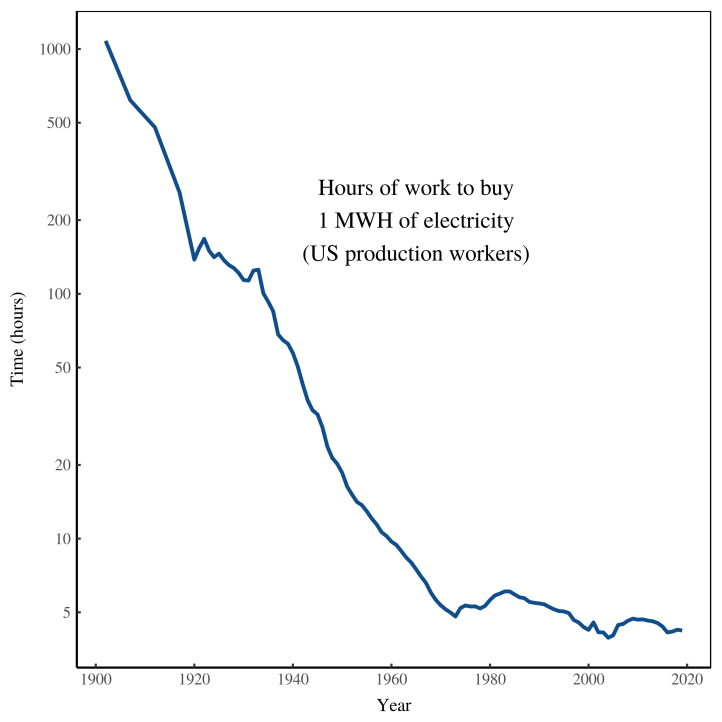
Figure 3: The falling relative price of electricity. I plot here the average number of working hours required for a US production worker to buy 1 MWH of electricity at the residential price. For data sources, see notes.
Electricity is, for modern Americans, astonishingly cheap. To neoclassical economists, this cheapness signals that electricity production contributes virtually nothing to economic output. But this conclusion is fallacious. Americans use electricity in profligate quantities precisely because it is cheap. Less than 1% of national income is devoted to buying utilities.
For neoclassical economists like William Nordhaus, this means that we could wipe out the entire utilities sector, but still retain 99% of economic ‘output’. In the real world, things are different. If we wipe out the utilities sector, industrial society disappears.
The energetic basis of society
Unlike economists, physicists have long understood the importance of natural resources to society. And they’ve recognized that energy is the ‘master resource’.
Without the flow of energy, the universe would be a boring place. There would be no galaxies, no stars, no planets and no life. Absent energy flows, the universe would be an unchanging soup of matter and radiation. All of the structures that we take for granted are created by energy flows. (For a compelling exposition of this principle, see Eric Chaisson’s book Cosmic Evolution: The Rise of Complexity in Nature.)
Back to economics. I could dive into the physical laws that tell us why energy is important to human society. But instead, I’ll defer to Steve Keen, who has a knack for good metaphors. When it comes to the importance of energy to the economy, Keen notes:
[L]abour without energy is a corpse, and capital without energy is a sculpture.
An apt metaphor. Without energy flows, our machinery would be useless. Not to mention we’d all be dead. But beyond metaphors like this, how do we understand the importance of energy to the economy? A popular approach among ecological economists is to reform neoclassical theory by adding energy to production functions. The idea is that, alongside labor and capital, energy is a ‘factor of production’.
While well intentioned, I’m skeptical of this approach. There are many problems, but I’ll focus here on just two. First, I think that the concept of ‘factors of production’ is flawed. It’s rooted in a mistaken attempt to explain class-based income in terms of the contribution to production. The problem is that class divisions don’t tell us about the biophysical underpinnings of society. They never have and they never will.
Second, I think it’s a mistake to even try to explain ‘economic output’. Why? Because I don’t think it exists. Ask yourself this question — what is the ‘output’ of a cow? What is the ‘output’ of a bacteria? Are you struggling to find an answer? That’s because the question is ill-posed. Organisms don’t have ‘outputs’ in any meaningful sense. They have throughputs. Organisms transform matter and energy into forms that are useful. Both the cow and the bacteria take in energy and matter, and then use it to maintain their structure and to enable their activity. They have no ‘output’ … only energy throughput.
When we think this way, production functions become irrelevant. There’s no need to relate economic inputs to economic outputs, because the latter doesn’t exist. Instead, there’s only the flow of energy. When framed this way, the study of ‘economic growth’ becomes the study of energy transformations. We needn’t get ‘real’ GDP involved. (That’s good, because it’s a flawed metric.)
Using energy to harvest energy
When it comes understanding the role of energy, one of the most interesting things we can do is study the use of energy to harvest energy. In broad terms, this is what life is all about. Organisms use energy so that they can harvest more energy. A gazelle eats grass so that it can find more grass. A lion eats a gazelle so that it can find more gazelle. And so on.
In this regard, natural systems are fairly static. We don’t see lions investing ever-increasing energy in hunting their prey. If a lion pride reaps a bonanza (like an elephant), they don’t turn around and immediately hunt for more elephants. They eat the bonanza and then sleep for days. For most of our history, humans probably did something similar. We harvested the energy we needed, and no more. If there was an excess supply of energy, we (like the lion) used it up with leisure time.
Then something changed. At some point in our history (probably when we started farming) humans started to behave differently. We invested excess energy into harvesting still more energy. This new behavior created a dramatic feedback loop that eventually led to industrial society.
Let’s think about how this feed-back loop works, using the example of harvesting coal. Humans have mined coal for millennia. For most of this time, we used nothing but a pick. Even today, that’s how coal is mined in some parts of the world. It’s a back-breaking task filled with danger.
Let’s think about this coal mining in energetic terms. When we mine by hand, we’re using our bodies to convert food energy into work. In return, we get energy from coal. Note that the two types of energy come in different forms (food and coal). Since it’s hard to use coal to grow more food, there’s a limit to how much coal we can mine by hand. (If everyone mines coal, no one can grow food.)
The solution to this problem is to use coal power to mine coal. This sets the feedback loop free. We mine coal and then convert it into electricity (or, in the earlier days, convert it into steam power). Then we use this electricity to harvest more coal. By the earlier 20th century, many coal miners were no longer using picks. Instead, they used pneumatic drills. They were using fossil-fuel power to harvest more fossil fuels.
Modern coal miners have taken this process to a monumental scale. They don’t even bother with hand-held tools. Instead, they use giant excavators to mine coal on a scale that is hard to fathom. Here, for instance, is an excavator in a German coal mine. Each bucket on the extraction wheel is the size of a car.
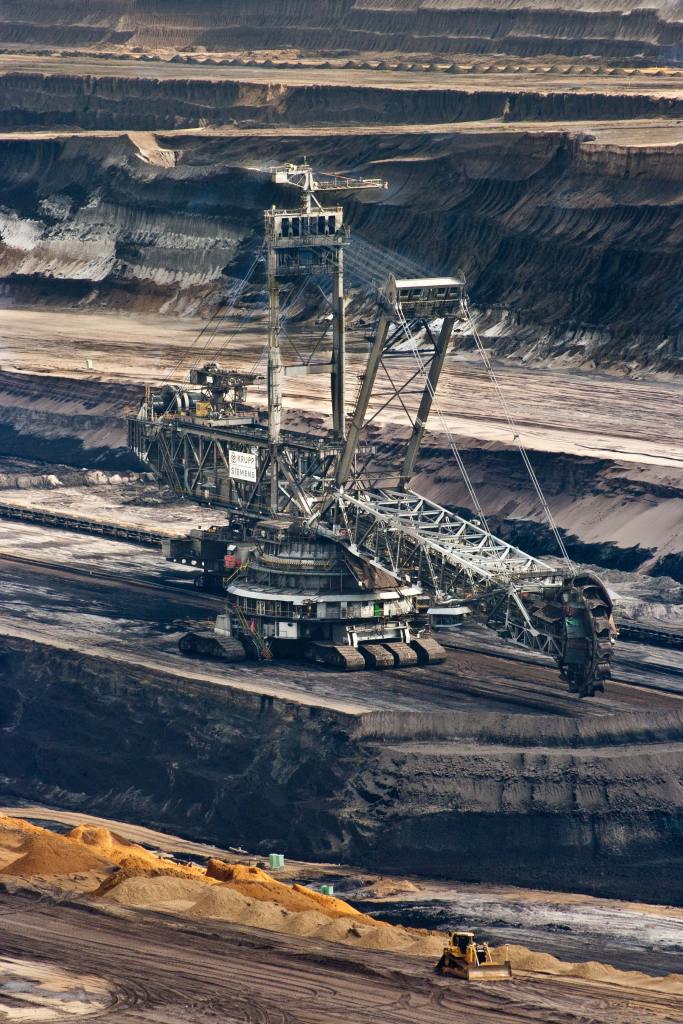
An excavator at the Garzweiler coal mine in Germany. Source: pixabay
On the surface, this feedback loop appears as changing technology. The imagery above makes that clear. But under the hood, the feed-back loop is fundamentally about energy. We are using ever increasing quantities of energy to harvest still more energy.
Let’s have a look at this energy feed-back loop in quantitative terms. We’ll compare the energy harvested by the energy sector to the energy used by this sector. Figure 4 shows such a comparison in the US oil and gas sector. The blue curve shows the energy harvested per worker in the oil and gas sector. The red curve shows the energy consumed per worker in this sector. As expected, the correlation is tight. The only way to harvest more energy is to use more energy.
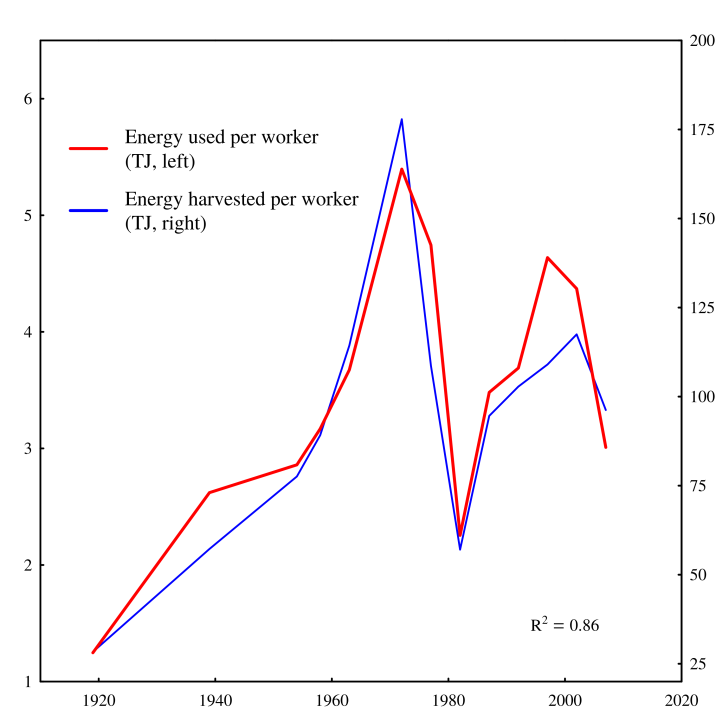
Figure 4: Using energy to harvest energy in the US oil and gas sector. For data sources, see notes.
A side note about history. Figure 4 vividly shows the impact of the 1970s oil crisis — the confluence of two different events. First, US oil production peaked in 1970. Second, in the 1970s the oil cartel OPEC limited the export of oil to the United States. Because of both of these factors, the price of oil rose rapidly. In response, exploration for oil exploded. Thousands of people pored into the energy sector hoping to earn a wildcat windfall. But little new oil was found, and so the energy harvested per worker declined. When the price of oil eventually fell (in the 1980s) people stopped wildcatting. The production of oil, however, remained roughly constant. So the oil harvested per worker increased. (Since 2010, thanks to the exploitation of shale reserves, US oil extraction has exploded. I’d like to plot this trend, but my data for oil-and-gas-sector energy use ends in 2007.)
The US oil and gas sector is hardly alone in using energy to harvest energy. We expect this linkage in all societies. Looking at European countries (Figure 5), we see similar behavior. The energy harvested by the energy sector is tightly linked to the energy used by this sector.

Figure 5: Using energy to harvest energy in European countries. The x-axis shows the energy used by the energy sector (per labor hour) in various EU countries. The y-axis shows the energy harvested (per labor hour) by the same sector. For data sources, see notes.
The scale of energy flow
Most of us (myself included) don’t appreciate the magnitude of our fossil fuel habit. To put the scale of fossil fuel exploitation in perspective, it’s helpful to compare it to something we’re more familiar with — food. Let’s convert the energy harvested by an industrial nation into the energy equivalent in corn. We’ll use Norway as our example.
Norway’s energy sector harvests about 100 billion joules of energy for every person-hour. That’s equivalent to harvesting 27 metric tonnes of corn for every hour worked. Think about that — nearly 30 tonnes of corn for every hour of work.
How much corn is this? It’s about 4000 times more corn per labor hour than pre-industrial farmers could harvest. And it’s about 30 times more corn per hour than modern industrial farmers can harvest. (See my calculations here.) This is the potency of fossil fuels.
We cannot do without natural resources
The physicist Arthur Eddington once remarked: “if your theory is found to be against the [laws] of thermodynamics I can give you no hope; there is nothing for it but to collapse in deepest humiliation.” Neoclassical economics profoundly contradicts these laws. Yet sadly, we’re still awaiting its humiliating collapse.
Neoclassical economics is founded on an embarrassing error. It assumes that income indicates contribution to production. For a century, this error has led economists to conclude that natural resources are unimportant. They see that the natural resource sector earns a tiny fraction of all income. And so they infer that we could get rid of this activity and still retain the vast majority of ‘economic output’.
Unfortunately, the real world doesn’t work like that. Income doesn’t tell us about the importance of resource flows. It never has and it never will. As long as we think that it does, we’re headed down a dangerous path. Let’s not let the delusions of neoclassical economics seal our fate. The planet deserves better.
Notes
Agriculture share of US national income:
- 1839–1899: Historical Statistics of the United States Bicentennial Edition, Table F238-249
- 1900–1928: Historical Statistics of the United States Bicentennial Edition, Table F250-261
- 1929–present: Burea of Economic Analysis Tables 6.1A–D. (Table 6.1A isn’t available online. You can get it here).
Labor productivity of US agriculture is from Historical Statistics of the United States Millenial Edition, Table Da1143-1171.
US price of electricity
- 1902–2000: Historical Statistics of the United States Millenial Edition, Table Db235 (residential electricity)
- 2001–present: Bureau of Labor Statistics, CPI series CUSR0000SEHF01
US production worker wages are from MeasuringWorth.com
US oil and gas energy production is from:
- 1919–1948: Historical Statistics of the United States Millenial Edition, Table Db155-163.
- 1949–present: Energy Information Agency Table 1.2
Energy consumption by the US oil and gas sector is from Guilford et al. 2007, Table 6 (direct energy use).
US oil and gas employment is from:
- 1919: Census of Mineral Industries 1958, Table 1
- 1929–present: Bureau of Economic Analysis Tables 6.8A–D, persons engaged in production. (Note that Table 6.8D is discontinuous with 6.8A–C because of the transition from SIC to NAICS classification. I splice 6.8D by indexing it to 6.8C.
Eurozone energy production and consumption (by the energy sector) is from the Eurostat energy balance tables. Eurozone labor hours are from Eurostat table nama_10_a64_e.
Calculations
Corn has about 90 kilocalories of energy per 100g. There are 4184 joules in a kilocalorie, giving 376560 joules per 100 g of corn. That’s 3765.6 joules per gram.
Norway’s energy sector produces about 100 GJ of energy per labor hour. That’s 100 billion joules. Translating to corn, we divide 100 billion joules by 3765.6 joules per gram. That gives 26556193 grams, which is about 27 metric tons. So for every hour of work, a Norwegian energy-sector worker produces (transforms) the energy equivalent of 27 tonnes of corn.
Let’s compare that to the corn produced by US farmers. In 1800, it took US farmers about 344 hours (on average) to produce 100 bushels of corn. A bushel of corn is roughly 25 kg. So pre-industrial US farmers produced about 7 kg of corn per hour — 0.007 tonnes. In contrast, it takes modern US farmers about 3 hours to produce 100 bushels of corn. That translates to about 0.8 tonnes per hour.
79 Comments on "Can the World Get Along Without Natural Resources?"
Cloggie on Fri, 19th Jun 2020 10:51 am
Where would we be without Eindhoven?
Lightyear solar car company and spin-off of TU-Eindhoven will cooperate with Tesla and Volkswagen on solar car roof:
https://www.ed.nl/helmond/lightyear-in-helmond-gaat-met-tesla-en-volkswagen-zonnedak-testen~aad0ece73/
Lightyear One:
https://deepresource.wordpress.com/2019/10/22/solar-team-eindhoven-wins-world-solar-challenge-in-australia/
Cloggie on Fri, 19th Jun 2020 11:18 am
To my surprise a Tesla with Lightyear solar roof is already driving through the Netherlands, see 2nd video:
https://deepresource.wordpress.com/2020/06/19/lightyear-tesla-volkswagen-to-cooperate-on-solar-roofs/
This news is very fresh.
Cloggie on Fri, 19th Jun 2020 11:32 am
I inspected this new bicycle road earlier this morning in my home town by foot, while scoring my daily 10,000 steps, as recommended by the American Heart Association and monitored by a Fitbit-watch (do this for 3 years now):
https://www.youtube.com/watch?v=4mOhfSdEMkk
Eindhoven center has been made very bicycle friendly. The fastest way to get to the center in this 200,000 town is by bike.
About cycling in the Netherlands:
https://deepresource.wordpress.com/2020/06/16/cycling-in-the-netherlands/
Hardly any need for natural resources.
Join the Void on Fri, 19th Jun 2020 1:15 pm
Let us preay for near-term human extinction.
Anonymouse on Fri, 19th Jun 2020 2:11 pm
CLoggfraud
Have you got that picture of you standing next to YOUR telsa yet?
FamousDrScanlon on Fri, 19th Jun 2020 3:09 pm
“Life … is a tale
Told by an idiot, full of sound and fury,
Signifying nothing.”
― William Shakespeare, Macbeth
Abraham van Helsing on Fri, 19th Jun 2020 3:09 pm
Shoeshine,
You should know that jews like me prefer Mercedes-Benz, is edgy.
https://youtu.be/d8hGR1ZpUPw
Famlin on Fri, 19th Jun 2020 4:03 pm
bp review of world energy statistics 2020 for the year 2019
Energy equivalent of all fuels are mentioned in exajoules instead of million tons oil equivalent.
1,000 TWh (Terawatt hours) = 3.6 exajoules.
Conversely 1 exajoule = 278 terawatt-hours
This shows that oil has lost its prime.
Oil consumption increased 0.9% while production decreased 0.1%.
Why the difference? Consumption includes coal & natgas converted to gasoline/petrol while production excludes which means the actual oil usage follows production and is lesser.
Natgas production increased 3.4% while consumption increased 2%.
Again its because of the natgas converted to petrol.
Coal production increased 1.5% while consumption decreased 0.6%.
Again its because of the coal converted to petrol.
Now we all can conclude that the oil production has peaked and only by converting coal & natgas to oil products we see an increase in oil consumption.
Nuclear increased 3.2%
Hydro increased 0.8%
Wind increased 12.6%
Solar increased 24.3%
Other renewables increased 6%
Overall production from all the energy sources increased except oil. Hence the peak oil has arrived.
Abraham van Helsing on Fri, 19th Jun 2020 4:04 pm
As I predicted a couple of months ago: Meghan Markle-2024
“EXCLUSIVE: Meghan Markle tells friends her instinct to leave the UK ‘all makes sense’ now because she was ‘destined’ to help fight systemic racism in US – and she hasn’t ruled out a career in politics“
https://www.dailymail.co.uk/news/article-8437497/Meghan-Markle-believes-shes-destined-help-fight-systemic-racism-US.html
…provided of course the country is still in one piece by that time
joe on Fri, 19th Jun 2020 5:15 pm
great. systemic racism puts an english royal on the throne in the white house. it was our plan all along….
makati1 on Fri, 19th Jun 2020 5:21 pm
“Can the World Get Along Without Natural Resources?”
Can you live without breathing or eating?
makati1 on Fri, 19th Jun 2020 5:28 pm
BTW: All the renewable techies and ecofreaks can pretend we can change, but, even IF you could convince the 7.6+ billion of us that it was necessary, it would take 100 years, or more, to make the switch. Of course there would be few of us left by then.
We built this system over centuries, not a few years or decades. We will not abandon it easily. We will run for the extinction cliff until there are none of us left. Maybe another 100 years?
joe on Fri, 19th Jun 2020 5:33 pm
Also lower education standards to help the stupider races feel less ashamed that they cwnt understand why society is crumbling and just blame whitey is going to accelerate that process. Computerisation and a.i. will help but even with 24hr Orwellian surveilence it can only last so long under the pressure of constant fear and the ‘gentle hand’ of government instruction. Open up the reeducation camps…..
JuanP on Fri, 19th Jun 2020 6:06 pm
“Can the World Get Along Without Natural Resources?” “Can you live without breathing or eating?”
ROTFLOL, Mak, that was the funniest thing ever. I love you sometimes
JuanP on Fri, 19th Jun 2020 6:06 pm
“Can the World Get Along Without Natural Resources?” “Can you live without breathing or eating?”
ROTFLOL, Mak, that was the funniest thing ever. I love you sometimes
JuanP on Fri, 19th Jun 2020 6:07 pm
“We built this system over centuries, not a few years or decades. We will not abandon it easily. We will run for the extinction cliff until there are none of us left. Maybe another 100 years?”
Mak, you are lucky cause you are almost dead now. You won’t have to experience the worst.
JuanP on Fri, 19th Jun 2020 6:12 pm
“Also lower education standards to help the stupider races feel less ashamed that they cwnt understand why society is crumbling and just blame whitey is going to accelerate that process.”
I can relate being Hispanic and all. I am ashamed I dropped out of school and barely got a GED.
JuanP on Fri, 19th Jun 2020 6:13 pm
“As I predicted a couple of months ago: Meghan Markle-2024”
Cloggie, she is too short to be President. There is a minimum height requirement.
makati1 on Fri, 19th Jun 2020 6:14 pm
I might live as long as you do , or longer. Baring an accident, I am healthy and have long lived genes. Dad passed at 88 of pneumonia, (He lived alone and no one knew he was sick) and mom passed at 90, of a heart attack. I have an uncle who will be 95 this year. At that rate, I have at least 15-20 more years to go, and maybe longer. I plan to watch the world change and the US disintegrate all the way down, from the cheap seats on distant shores.
Abraham van Helsing on Fri, 19th Jun 2020 6:16 pm
You must have missed Dukakis, Juan. Perhaps before your time.
Abraham van Helsing on Fri, 19th Jun 2020 6:19 pm
Before you go to sleep, here a fresh Richard Spencer:
https://youtu.be/YY4gohMKMOs
Davy on Fri, 19th Jun 2020 6:19 pm
joepeee, I have been fighting the stupider dumbasses here for years. Unfortunately, despite their being constantly neutered and moderated, they refuse to see the light of fairness and balance. Like the stupid old bat, makatoo here is a great example. He should be in an reeducatinion camp himself. I would blame it on him being old, senile and stupid, but I think he likes being a stupid anti-American extremist. A camp, preferably operated by a private, non-bid contractor, where he could be taught the many errors of his ways, sounds like a great idea to me joe.
FamousDrScanlon on Fri, 19th Jun 2020 6:38 pm
Nephologue
Exploring the interplay of thermodynamics, economics, and climate
Economic growth: the engine of collapse
“To be sure, many of us see treating people as physical systems seems a bit abhorrent, somehow an abnegation of the essence of what it means to be human. The music of J.S. Bach surely is proof that we are not mere automatons! We’re different. And if we truly want to triumph against profound societal challenges, then surely we can.
But – sigh – even music appears to obey simple mathematical laws seen throughout nature. Perhaps if we really want to address our 21st century existential crises we should start trying to think more broadly about what it means to be human.
To get a sense of any physical limits, it helps to look at how physical systems function. A useful concept here is a thermodynamic “heat engine” where available energy powers cyclical motions thereby enabling “work’’ to be done to move something else while giving off waste heat. This process is as familiar as burning gasoline in a car to power its pistons and propel it forward.
What is less recognized is how this basic idea from physics can be extended to living systems. Organisms take high potential chemical energy (food and oxygen) and release it in an unavailable chemical state (mostly heat radiation, water and carbon dioxide). The interesting part is that organisms employ a selfish self-propagating twist. Unlike a car, if conditions are right, living things can use the energy and matter in food to grow, allowing themselves the opportunity to consume more energy in the future.”
http://nephologue.blogspot.com/2019/12/economic-growth-engine-of-collapse.html
It’s likely too late for the naked ape.
FamousDrScanlon on Fri, 19th Jun 2020 6:41 pm
Overstepping Our Ecological Footprint – Dr. William Rees — Jun 11, 2020
“Dr, William Rees, who coined the term #EcologicalFootprint, speaks with us about the untenable situation that humanity is in. Dr. Rees is not shy about his sense that we are now in complete overshoot in terms of civilization’s unsustainable use of Earth’s non-renewable resources and dumping the wastes of our industrial/consumerist economic model of infinite exponential growth on a limited planet.”
https://youtu.be/6hi9xYSCwZ8
zero juan on Fri, 19th Jun 2020 7:15 pm
more stupid juanpee shit
FamousDrScanlon said Overstepping Our Ecological Footprint – Dr….
FamousDrScanlon said Nephologue Exploring the interplay of thermodynami…
More Lunatic Davy (Pink Poodle) JuanP Derangement on Fri, 19th Jun 2020 7:20 pm
JuanP on Fri, 19th Jun 2020 6:06 pm
JuanP on Fri, 19th Jun 2020 6:06 pm
JuanP on Fri, 19th Jun 2020 6:07 pm
JuanP on Fri, 19th Jun 2020 6:12 pm
JuanP on Fri, 19th Jun 2020 6:13 pm
Davy on Fri, 19th Jun 2020 6:19 pm
zero juan on Fri, 19th Jun 2020 7:15 pm
Duncan Idaho on Fri, 19th Jun 2020 7:20 pm
“So Friedman was right, but only if by “flat” he meant the four flat tires on the American Humvee.”
CONVICT-19 on Fri, 19th Jun 2020 7:22 pm
supertards
please love goat supertard saint
if you can love supremacist muzzies surely you could spare some love for super goat?
Duncan Idaho on Fri, 19th Jun 2020 7:34 pm
Yep-
https://pbs.twimg.com/media/Ea0_d2JXkAAxz05?format=jpg&name=small
JuanP on Fri, 19th Jun 2020 7:35 pm
None of the comments above were written by me.
JuanP on Fri, 19th Jun 2020 8:19 pm
I have other personalities that write them
FamousDrScanlon on Fri, 19th Jun 2020 9:02 pm
BP Statistical Review of World Energy 2020: Carbon emissions increase for another year, coal still the single largest source of power generation
https://desdemonadespair.net/2020/06/bp-statistical-review-of-world-energy-2020-carbon-emissions-increase-for-another-year-coal-still-the-single-largest-source-of-power-generation.html
FamousDrScanlon on Fri, 19th Jun 2020 9:28 pm
Why Are There So Many Humans?
The populations of the great apes were once nearly equal. Now, one great ape species—Homo sapiens—outnumbers the rest by almost 8 billion. How did we do it?
“Today the total population of gorillas, chimpanzees, bonobos, and orangutans is estimated to be only around 500,000, according to the World Wildlife Fund. Many species are critically endangered. Meanwhile, the human population has surged to 7.7 billion. And the irony is: Our astonishing ability to multiply now threatens the long-term sustainability of many species, including ours.”
“So, what makes us different from our closest relatives that gives us our staggering capacity for reproducing and surviving?”
https://www.sapiens.org/evolution/human-population-evolution/
FamousDrMuzzieLover on Fri, 19th Jun 2020 9:33 pm
above is supertard supertard sock obv.
FamousDrScanlon on Fri, 19th Jun 2020 9:37 pm
Why are the lab escape denialists telling such brazen lies?
“A recent Guardian headline instructs us to “ignore the conspiracy theories” about the potential role of a Wuhan biolab in the emergence of the virus that triggered the current pandemic. The accompanying article is just the latest broadside from what the investigative journalist Sam Husseini has called the “loud crowd” involved in dangerous work with viruses, who have been busily denouncing any effort to scrutinise their work. Of these loud denialists, no one has been more vocal than the article’s author: Peter Daszak.
Since the start of the pandemic, Daszak has been all over the world’s media, as well as social media, decrying suggestions that SARS-CoV-2 might have come out of a lab as “preposterous”, “baseless”, “crackpot”, “conspiracy theories”, and “pure baloney”. And he has backed up these complete dismissals with a welter of questionable claims.”
https://gmwatch.org/en/news/latest-news/19437-why-are-the-lab-escape-denialists-telling-such-brazen-lies
FamousDrPerfectlyPreservedKoranIsVariant on Fri, 19th Jun 2020 9:51 pm
muzzies have a variant quran that improves over time.
muzzying is a changing doctrine therefore all muzzies are apostates because they follow innovations in the muzzie koran
This is why I always urged to amputate all muzzies starting with muzzie imams.
FamousDrScanlon on Sat, 20th Jun 2020 12:11 am
Islamic Golden Age
The Islamic Golden Age was a period of cultural, economic, and scientific flourishing in the history of Islam, traditionally dated from the 8th century to the 14th century.[1][2][3] This period is traditionally understood to have begun during the reign of the Abbasid caliph Harun al-Rashid (786 to 809) with the inauguration of the House of Wisdom in Baghdad, the world’s largest city by then, where Islamic scholars and polymaths from various parts of the world with different cultural backgrounds were mandated to gather and translate all of the world’s classical knowledge into Arabic and Persian.[4][5] Several historic inventions and significant contributions in numerous fields were made throughout the Islamic middle ages that revolutionized human history.
The period is traditionally said to have ended with the collapse of the Abbasid caliphate due to Mongol invasions and the Siege of Baghdad in 1258.[6] A few scholars date the end of the golden age around 1350 linking with the Timurid Renaissance,[7][8] while several modern historians and scholars place the end of the Islamic Golden Age as late as the end of 15th to 16th centuries meeting with the Age of the Islamic Gunpowders.[1][2][3] (The medieval period of Islam is very similar if not the same, with one source defining it as 900–1300
https://en.wikipedia.org/wiki/Islamic_Golden_Age
Theedrich on Sat, 20th Jun 2020 12:57 am
The Islamic “Golden Age” was urine-colored. The Mohammedans are nothing but maniacal savages who somehow learned to read. When Araby runs out of oil, it and the other Middle-Eastern cornholers will sink into oblivion. After suicidal Whitey runs out of money trying to save them, that is.
According to the news, some of those MENA Camel Droppings don’t seem to think that Coon Lives Matter and are acting accordingly. So maybe they’re doing something useful before joining their 72 virgins.
joe on Sat, 20th Jun 2020 1:53 am
The Golden age was led by JEWS, the muslims called their own colonialist rule over Spain a golden age but it was their oppressive rule and reducing non muslims to slavery and second class citizeship which caused a massive Christian fight back leading to the Crusades and then the age of Exploration (due to Ottoman unfair economic behaviour in the Mediterranean sea).
If you want to know why white men went to look for Cathay and found America, ask the Ottoman Sultan why he wouldnt allow access to his ports for western europe and wouldnt allow them to trade. Islam was the MOTIVE for the age of Exploration, its not some kinda global solution. Weve seen that view before in Europe, but t was around hundreds of years ago, its called orientalism.
https://en.m.wikipedia.org/wiki/Golden_age_of_Jewish_culture_in_Spain
In the nineteenth century there was nearly universal consensus that Jews in the
Islamic Middle Ages—taking al-Andalus , or Muslim Spain , as the model—lived
in a “Golden Age” of Jewish-Muslim harmony,1
an interfaith utopia of tolerance
and convivencia.
2
It was thought that Jews min-
gled freely and comfortably with Muslims,
immersed in Arabic-Islamic culture, including
the language, poetry, philosophy, science, med-
icine, and the study of Scripture—a society,
furthermore, in which Jews could and many
did ascend to the pinnacles of political power
in Muslim government. This idealized picture
went beyond Spain to encompass the entire
Muslim world, from Baghdad to Cordova , and extended over the long centuries,
bracketed by the Islamic conquests at one end and the era of Moses Maimonides
(1138–1204) at the other.
The idea stemmed in the fi rst instance from disappointment felt by central
European Jewish historians as Emancipation-era promises of political and cultural
equality remained unfulfi lled. They exploited the tolerance they ascribed to Islam
to chastise their Christian neighbors for failing to rise to the standards set by non-
Christian society hundreds of years earlier.3
The interfaith utopia was to a certain extent a myth; it ignored, or left unmen-
tioned, the legal inferiority of the Jews and periodic outbursts of violence. Yet,
when compared to the gloomier history of Jews in the medieval Ashkenazic world
of Northern Europe and late medieval Spain , and the far more frequent and severe
persecution in those regions, it contained a very large kernel of truth.
joe on Sat, 20th Jun 2020 2:00 am
Muslim rule in spain was every bit a colonialist adventure as ever a european engaged with. Montezuma would never have fallen but for the fact that the Spanish freed the tribes that were subjected to regular human sacrifice. History is being abused by the left in the most Orwellian way.
joe on Sat, 20th Jun 2020 2:01 am
As an interesting note, does the left BLAME the conquistadors for the outbreaks of illness that they passed on even though germ theory wasnt even a thing yet?
Abraham van Helsing on Sat, 20th Jun 2020 2:41 am
“The Golden age was led by JEWS”
joe esquire loves jews, he is totally impressed by their great financial institutions, so very uncommunistic! And he will always bring up Anne Frank, that holo-icon, who was NOT killed by the Germans, but, indirectly by the Anglos, who tried to make civilian life in Germany as miserable as possible through their criminal bombing campaign. But perhaps I have made premature assumptions about the identity of joe esquire and his rambling posts.
That these Jews are ruining his country doesn’t seem to bother him too much, somehow, mysteriously, the British empire will always prevail! Must be!
Regarding El-Andaluz, it is a well-hidden fact that the Inquisition was mostly an anti-semitic institution, because of the anti-white role the Jews had played in El-Andaluz:
https://www.amazon.com/Conversos-Inquisition-Expulsion-Jews-Spain/dp/0299142345/ref=sr_1_1
Muslims out, thus the Jews out (to the Netherlands and its freedom of religion) and the Spanish Golden Century was the reward of the Spanish, much at the cost of the Dutch, for whom it took 80 years of war to kick the Spanish out of the Netherlands, after which the Dutch could harvest THEIR Golden Century.
https://pbs.twimg.com/media/EUC2UVLXsAEUX5m.jpg
And when the protestant Dutch were under French-English-German threat of annihilation, they invaded England and turned it into a Protestant country, that could be used by the Dutch to line up against France/Lou14 and keep those in check and the Protestant revolution was consolidated, laying the foundation for the British Golden Century (of which joe esquire would love to imagine it will come back because of Brexit.lol, where in reality he has to fear having to live under the whip-of-color and his own version of El-Andaluz).
“Montezuma would never have fallen but for the fact that the Spanish freed the tribes that were subjected to regular human sacrifice.”
Some liberation! The Hispanic race is the result of a giant rape campaign by the Spanish of the locals. Not that I give a f*ck, history is about survival, not identifying the good guys in history, because there aren’t any. The universe is Darwinian, not Christian. And if you adhere to decadent Christian values, imagining you can afford a vacation from harsh Darwinian reality, you have signed your own death-warrant and even negroes will overrun you.
Abraham van Helsing on Sat, 20th Jun 2020 3:34 am
“How ex-policeman thug who was carried to safety by a BLM protester used to work undercover as a hooligan – and then ‘got too close to them'”
https://www.dailymail.co.uk/news/article-8441579/Ex-policeman-thug-carried-safety-BLM-protester-used-work-undercover-hooligan.html
The DailyMail can’t get enough of the humiliating picture of a “BLM protester”, carrying a “rightwing nationalist thug” into “safety”.
The US empire is essentially a media empire, a virtual empire. There are no “evil Americans with guns” at every street corner. There is no need to. Because in all the living rooms are televisions and newspapers, broadcasting the same diversity message of empire. You can see no ice cream-add without a blonde white woman smiling to an African, suggesting they should pro-create. And the so-called rightwingers are as bad as the leftists and their desire for a new proletariate. It were entrepreneurs who brought in the cheap hands. Only later the left realized that their white hedonist voters, who were abandoning the leftist parties because they were no longer interested in the revolution, could be replaced by a third world proletariat:
https://documents1940.wordpress.com/2020/06/07/mass-immigration-came-from-the-right/
But these special left-right interests were covered by a historic narrative, originating from the media, about the holohoax-campaign from 1970 onwards, demonizing nationalism and any form of separate identity, in favor of globalism and the Open Society Program by the Soros types. The fact that European civilization has a universalist secular-Christian foundation isn’t very helpful either (“everybody my brother”). We can safely conclude that either Christianity has to go or us.
https://documents1940.wordpress.com/2019/07/28/alain-de-benoist-on-being-a-pagan/
Davy on Sat, 20th Jun 2020 5:49 am
“joe esquire loves jews, he is totally impressed by their great financial institutions, so very uncommunistic!”
You must secretly admire them, cloggo because you have jew derangement. The same is true with Anglos. You just are too proud to self reflect on your mental dysfunctions. People like you give away their subconscious. Joe doesn’t care for Jews much he is just pointing out some obvious facts about them. I don’t care for them. I worked with them a little when I lived in St Louis. They are a clannish group and they will screw you if they can. At the political level they are a destructive force but not like your conspiracy theories would like us to believe. Some people are smart enough to see through your derangement too bad you can’t.
Abraham van Helsing on Sat, 20th Jun 2020 6:13 am
dave’s country is falling apart, even his peak-oil collapsnik hero Richard Heinberg now acknowledges as much, but both davy and joe refuse to reflect about the causes of their demise and instead remain in the realm of political correctness, as dictated by their media. They wouldn’t dare to attempt to escape from the dialectical prison, not even if the door was wide open.
These two folks can’t be helped. Both represent the embodiment of the downfall of two Anglo centuries. Their problem.
Davy on Sat, 20th Jun 2020 7:00 am
“dave’s country is falling apart”
LOL, cloggo, in many places in Europe it is worse than many places in the US. Your binary anglo derangement bullshit is not academic. You are peddling your emotional positions and a smart person sees right through it. You are like a child crying wolf too much. It is so easy to moderate this crap just like with what your lunatic partner juanPee does. Mak the wak does it too with his rabid AsiaUp WestDown dementia crapola.
Davy on Sat, 20th Jun 2020 7:08 am
Cloggo, I am not saying all your Anglo derangement is misplaced. The shit coming out of the British establishment is horrible and the extremist left in the US deplorable. I will say this, environmentally the British lead the pack in thought along with the Americans. The Euros may be strong on the renewable tech applications but the thought behind green is most powerfully Anglo.
“From Dodgy Dossiers To The Sacking of Whitlam: The British Empire Stands Exposed”
https://www.strategic-culture.org/news/2020/06/18/from-dodgy-dossiers-to-sacking-of-whitlam-british-empire-stands-exposed/
https://www.zerohedge.com/geopolitical/dodgy-dossiers-sacking-whitlam-british-empire-stands-exposed
“I used to believe as many do, in a story called “the American Empire”. Over the last decade of research, that belief has changed a bit. The more I looked at the top down levers of world influence shaping past and present events that altered history, the hand of British Intelligence just kept slapping me squarely in the face at nearly every turn. Who controlled the dodgy Steele dossier that put Russiagate into motion and nearly overthrew President Trump? British Intelligence. How about the intelligence used to justify the bombing of Iraq? That was British Intelligence too. How about the Clash of Civilizations strategy used to blow up the middle east over decades? That just so happened to be British Intelligence’s own Sir Bernard Lewis. How about the CFR takeover over of American foreign policy during the 20th century? That is the British Roundtable Movement in America (created as Britain’s Chatham House in America in 1921). Who did Kissinger brag that he briefed more than his own State Department at a May 10, 1981 Chatham House seminar? The British Foreign Office (1). How about William Yandall Elliot who trained a generation of neocon strategists who took over American foreign policy after the murder of JFK? Well, he was a Rhodes Scholar and we know what they are zombified to do. How about the financial empire running the world drug trade? Well HSBC is the proven leading agency of that game and the British Caymen islands is the known center of world offshore drug money laundering. Who ushered in the Cold War? Churchill. Where did the nouveaux riche oligarchs go after Putin kicked them out of Russia? Back to their handlers in London. What about the creation of ‘too big to fail’ banks that took over the world over the past decades? That was launched by the City of London’s Big Bang of 1986 Who created Saudi Arabia and the state of Israel in the 20th century (as well as both nations’ intelligence agencies?) The British. What was the nature of the Deep State that Presidents Lincoln, Garfield, McKinley, Harding, FDR, and JFK combatted within their own nations? What the heck was the American Revolution all about in the first place? I could go on, but I think you get my point.”
Cloggie on Sat, 20th Jun 2020 7:32 am
“I will say this, environmentally the British lead the pack in thought along with the Americans. The Euros may be strong on the renewable tech applications but the thought behind green is most powerfully Anglo.”
That is absurd.
I’m currently biding my time (waiting for real large historic events, mostly brewing in the US, but also UK) with reading a 600p tome about one of the greatest Dutch scientists in history, Hendrik Lorentz, whom Einstein called his mentor:
https://deepresource.wordpress.com/2020/06/20/hendrik-antoon-lorentz/
(work in progress, hopefully completed by the end of next week, when I have already booked a hotel in Leiden, where I lived for 5 years and haven’t visited in a decade, to search for the trails of Lorentz)
Until 1918, the spectacular development of science was almost exclusively European (including Britain).
And 100 years later we may well write off American science and technology, because of the “changed demographic circumstances” and anglo science will become “post-colonial”.lol with a high ideological anti-white “Lysenko”-smell about it.
https://en.wikipedia.org/wiki/Lysenkoism
The green movement has penetrated Europe far stronger on all levels of society than America, that remains as materialist as ever. If I think of America I think of SUVs and shale oil, climate denial and nothing else.
Anglo-green-thought my foot.
Sissyfuss on Sat, 20th Jun 2020 9:13 am
The multi year thicker ice in the Arctic is mostly gone, Siberia is experiencing heat waves that at times are 50° degrees above normal, resulting in massive fires that are being ignored because of the sparsely populated region. The Jet Stream is permanently disconnected from its normal horizontal path threatening agricultural norms that are essential for feeding the growing masses. Trying to solve overshoot with anything other than a die-off is folly, which is being exhibited world wide now. The ascent of Man has ceased.
Cheer, Cheer the Yanks are Here on Sat, 20th Jun 2020 9:42 am
Trump’s Poll Numbers Are So Bad the GOP In Panic Mode About a ‘Wipeout’
WASHINGTON — President Trump’s poll numbers have never been worse, and Republicans are starting to panic that he could be headed to a historic wipeout that could drag the rest of the party down with him.
Trump has trailed former Vice President Joe Biden by almost 10 points in recent national polling. And Republicans privately admit things look just as bad at the local level. More than a half-dozen GOP strategists working on Senate and House races told VICE News that they’ve seen Trump’s numbers plunge in states and districts across the country. His standing with voters was already suffering from his botched coronavirus response — and his inflammatory reaction to national Black Lives Matter protests has pushed him even further down with key groups of voters.