


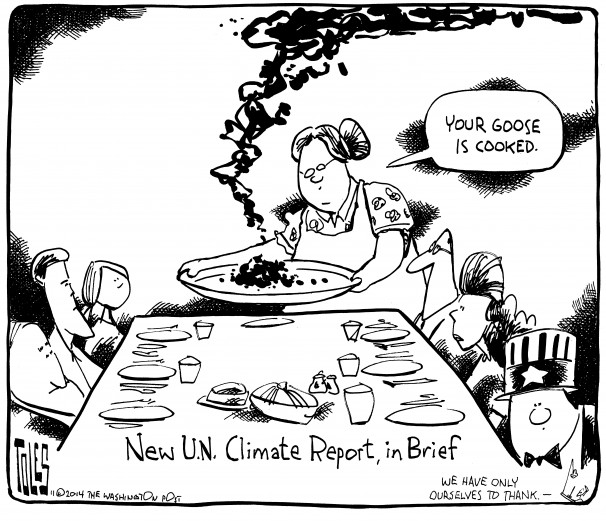
It is no secret we live in house on fire.
This December in Paris world leaders will meet for the 21st time in 22 years in an ongoing attempt to form a bucket brigade and put out the fire. Each time the fire is larger and less easy to control, and each time they end up going home without throwing a single drop of water. Among the issues are where the buckets are, who will be at the front of the line and who at the back, whether those less responsible for starting the fire can opt out of the work, or even rekindle the fire if it starts to lag, and whether, on a cost-risk-benefit analysis, it might be better to let it burn for a few more years before taking time away from profitable economic activities.
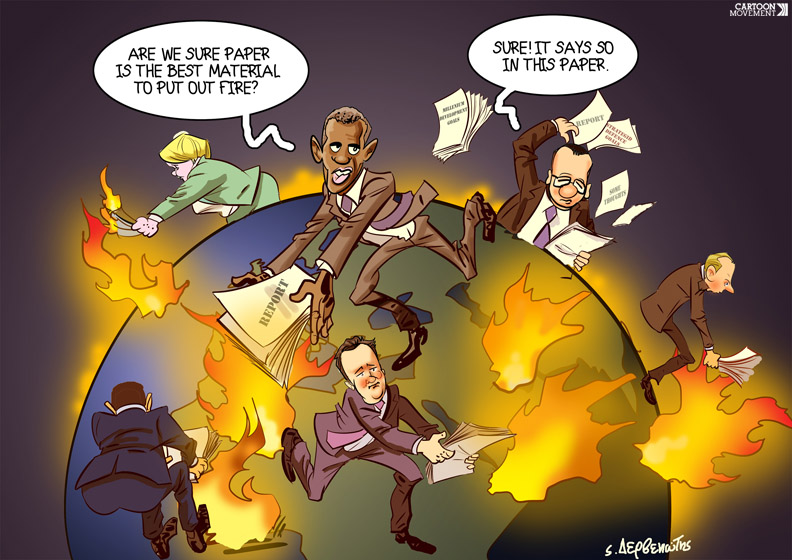 At the outskirts of this debate will be those of us in the UN Observer community who are yelling at the muddled delegates standing around watching the fire to please, will you, just do something! Of course, among the screaming rabble will be those who are quite certain there is no problem and doing nothing is the right course, and those who have placed their fate and the world’s in the hands of an all-knowing bearded Superman who can be relied on to save His chosen, even if everything else goes up in smoke. Their voices will blend with ours to make the cacophony even harder to parse.
We go to these crazy confabs because we have a simple solution to offer, a suite of tools that will counter the carbon menace and send it to ground, buying the human race time to deal with other game-enders — like the overfecundity of our species, Atoms for Peace, and Peak Everything, for instance.
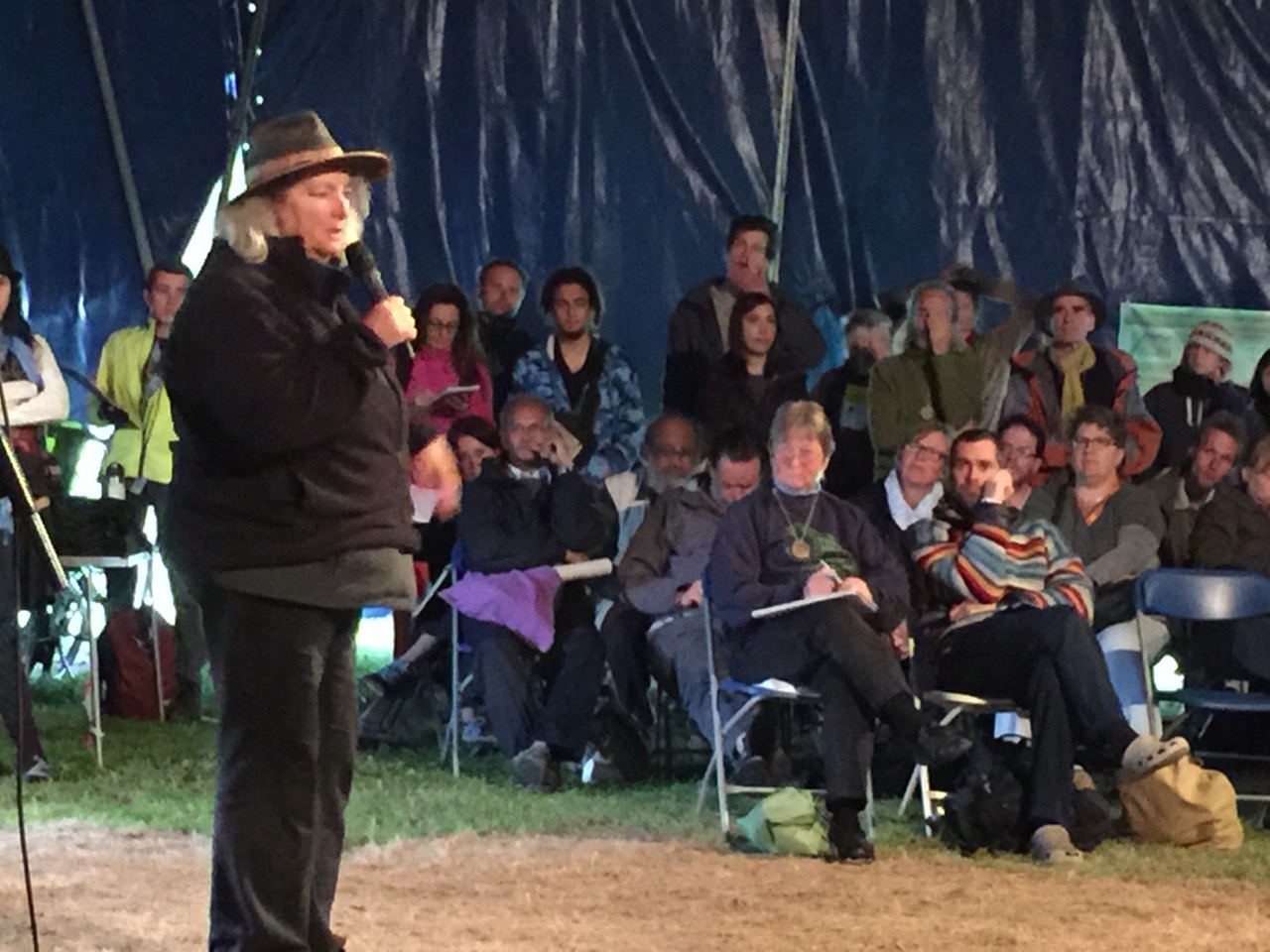 |
| Starhawk addresses the IPCUK Plenary |
As the International Permaculture Convergence in England was drawing to a close last month we were in the big tent listening to Starhawk read from the climate change working group’s statement, a document intended to be taken to Paris to give voice to permaculture designers. There came an objection from a gentleman who clearly had not taken the time to educate himself on the subject of biochar and thus was of the opinion it was a Ponzi scheme or Snake Oil and wanted mention of it deleted. We held our tongue.
Well you need not feel so all alone
Everybody must get stoned
— Dylan, Rainy Day Woman
Having given extensive biochar talks at Permaculture Convergences in Jordan and Cuba, and more in England, including a controlled burn facilitated by Dale Hendricks two days earlier, we thought we had already answered our skeptics in the permie crowd and won them over. This fellow was apparently a late arrival.
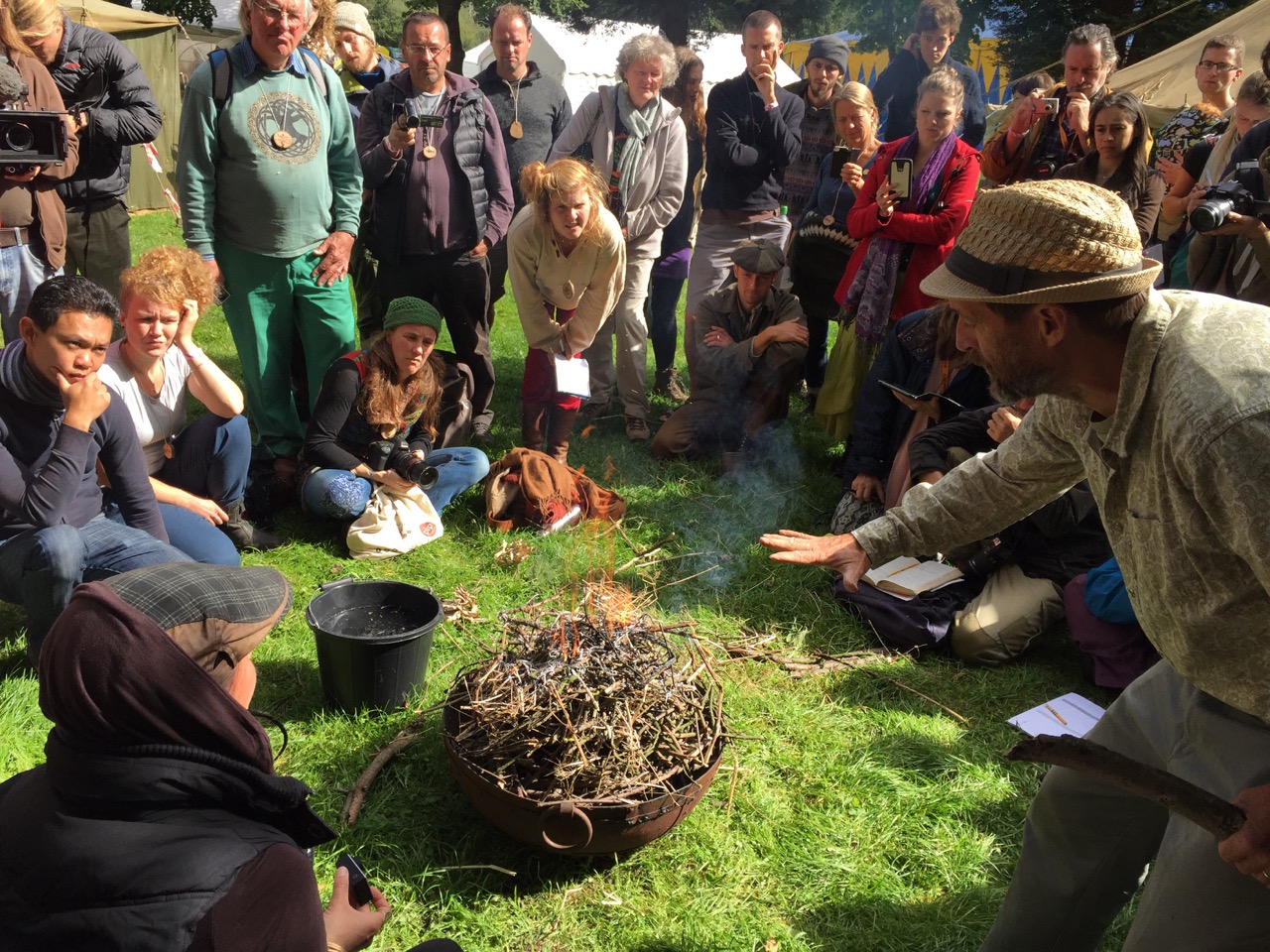 |
| Dale Hendricks explains the cone kiln method at IPCUK |
Starhawk had made biochar with us in Belize the previous February, and we had gone over the ethical principles with her in Cuba and Jordan, so we knew she was no stranger to the questions. She deftly handled the heckler by making a small adjustment to the text, placing the words “sustainably produced” in front of the word “biochar” to acknowledge his point about the potential for misuse.
Having had a hand in the drafting of the document, we let it pass that this was the only use of the word “sustainable,” a word we abhor, that crept in.
Still, the document is a good one, and we reproduce it in its entirety below.
 |
| Can an all-knowing bearded Superman save us from Fire Earth? |
We encountered critics of biochar even before we penned The Biochar Solution. The loudest of them is Biofuelswatch, an organization we previously respected but no longer do because they are tone deaf to serious science. Because they are close with many social justice, ecology and indigenous rights organizations, their completely irrational arguments against biochar have been picked up by many in the environmental community and repeated as if they had not already been shown to be completely without merit, and ridiculous. In our book we discussed the critics’ few arguments that we thought had some merit – such as the temptation for large landowners to monocrop genetically modified plantations of fast-growing trees to make biochar for carbon credits and what could be done to require biochar to be produced more responsibly. Indeed, the word “biochar” should itself connote ecologically responsible sourcing and production, in much the same way that “biodynamic” cannot be used by food growers who don’t follow the rules for that technique.
Nonetheless, it is hard to get very excited by toothless critics when there are so many positive developments. Faced by wildfire and severe drought as the Sonoran desert migrates north to claim California, local government entities in the Golden State are responding with a strategy long overdue but never too late: ecological restoration.
We quote at length from the Placer County Biomass Energy Initiatives, just released.
Placer County includes over 550,000 acres of heavily forested landscapes in the central Sierra Nevada foothills and mountains. This area stretches from Auburn to Lake Tahoe, and includes portions of three national forests, numerous state parks, and 60% of Lake Tahoe’s west shore. The forested land is at significant risk for catastrophic wildfire due to the buildup of unnaturally dense vegetation following decades of successful fire suppression and exclusion. The County has experienced six major wildfires since 2001 burning more than 100,000 acres, including critically important upland watersheds and wildlife habitat.
***To address the risk of catastrophic wildfire and improve air quality, the District has teamed with other public and private stakeholders to implement environmentally, economically, and socially sustainable forest management activities to restore these forested landscapes to a fire-resilient condition. The District’s program activities, which you can learn more about in a presentation, brochure, and video (you may need to install an application called “Mediasite” to view this video).
***Biochar
The District has sponsored the development of a biochar GHG offset accounting protocol with the support of Prasino Group, International Biochar Initiative, and The Climate Trust. The protocol was formally adopted into the CAPCOA GHG Rx on September 28, 2015. The final protocol here provides a detailed accounting procedure for quantifying the GHG benefits of biochar. Biochar projects sequester carbon from biomass waste in a highly stable biochar, and produce renewable energy from the energy-rich byproduct syngas. The protocol uses the biochar’s hydrogen to organic carbon content ratio as an indicator of its long term stability, in conjunction with its applied use as a legitimate soil amendment to agricultural field or road crop operations.
The protocol development process involved a webinar presentation conducted on September 9, 2014, which can be viewed here (Youtube). A copy of the presentation is here (.pdf). The draft protocol is here. The CAPCOA Protocol Primer on the protocol requirements and review process is available here.
We hope to quantify in the future additional GHG benefits that are associated with biochar including fossil fuel based fertilizer displacement, water production and transport, and enhanced plant growth.
***Forest Hazardous Fuels Reduction Treatments
Fuels treatments involve the selective thinning and removal of trees and brush to return forest ecosystems to more natural fuel stocking levels resulting in more fire-resilient and healthy forests. Fuels treatments reduce air pollution by mitigating wildfire behavior, size and intensity, stimulating forest growth and vigor, and reducing tree mortality. Forest thinning also produces wood products that continue the sequestration of carbon. When fuels treatment projects include removal of excess biomass in the forms of limbs, tops, smaller trees and brush, the resulting biomass can be utilized for energy production and thus reduce the need for fossil fuels.
Distributed Biomass Energy Production
The District is supporting the assessment of the air pollutant emissions benefits and economics of energy conversion technology suitable for small-scale distributed systems in Placer County, utilizing woody biomass wastes from forest fuel thinning treatments, timber harvest residues, and defensible space clearings. We are also an advocate for a regulatory structure that recognizes the full environmental benefits of the use of forest biomass wastes for energy:
- Participated in the creation of the new Feed in Tariff program at the California Public Utilities Commission (CPUC).
- Assisted with the development of California Senate Bill 1122 which requires the CPUC to direct the three large Investor Owned Utilities in California to purchase a total of 50 MW of distributed forest biomass generation from facilities that produce less than 3 MW at strategic locations near forested areas at risk for catastrophic wildfire. We are assisting the CPUC by participating in the SB 1122 process:
- Developing a fair power purchase agreement template
- Making sure that the Investor Owned Utilities implement fair and equitable interconnection requirements.
- Defining the term “strategic location” in content of communities at risk to catastrophic wildfire.
Permaculture Climate Change Statement
International Permaculture Convergence, Gilwell Park, England, September 2015
Permaculture is a system of ecological design as well as a global movement of practitioners, educators, researchers and organizers, bound by three core ethics: care for the earth, care for the people and care for the future. Permaculture integrates knowledge and practices that draw from many disciplines and links them into solutions to meet human needs while ensuring a resilient future. With little funding or institutional support, this movement has spread over the past forty years and now represents projects on every inhabited continent.
The permaculture movement offers vital perspectives and tools to address catastrophic climate change.
International Permaculture Climate Change Committee Human-caused climate change is a crisis of systems—ecosystems and social system–and must be addressed systemically. No single new technology or blanket solution will solve the problem. Permaculture employs systems thinking, looking at patterns, relationships and flows, linking solutions together into synergistic strategies that work with nature and fit local conditions, terrain, and cultures.
Efforts to address the climate crisis must be rooted in social, economic, and ecological justice. The barriers to solutions are political and social, not technical, and the impacts of climate change fall most heavily on frontline communities, who have done the least to cause it. Indigenous communities hold worldviews and perspectives that are vitally needed to help us come back into balance with the natural world. We must build and repair relationships across cultures and communities on a basis of respect, and the voices, leadership and needs of frontline and indigenous communities must be given prominence in all efforts to address the problem.
Permaculture ethics direct us to create abundance, share it fairly, and limit overconsumption in order to benefit the whole. Healthy, just, truly democratic communities are a potent antidote to climate change.
Both the use of fossil fuels and the mismanagement of land and resources are driving the climate crisis. We must shift from fire to flow: from burning oil, gas, coal and uranium to capturing flows of energy from sun, wind, and water in safe and renewable ways.
Soil is the key to sequestering excess carbon. By restoring the world’s degraded soils, we can store carbon as soil fertility, heal degraded land, improve water cycles and quality, and produce healthy food and true abundance. Protection, restoration and regeneration of ecosystems and communities are the keys to both mitigation and adaptation.
Permaculture integrates knowledge, experience, research and practices from many disciplines to restore landscapes and communities on a large scale. These strategies include:
- A spectrum of safe, renewable energy technologies.
- Scientific research and exchange of knowledge, information and innovations.
- Water harvesting, retention and restoration of functional water systems.
- Forest conservation, reforestation and sustainable forestry.
- Regenerative agricultural practices—organic, no-till and low-till, polycultures, small-scale intensive systems and agroecology.
- Planned rotational grazing, grasslands restoration, and silvopasture systems.
- Agroforestry, food forests and perennial systems.
- Bioremediation and mycoremediation.
- Increasing soil organic carbon using biological methods: compost, compost teas, mulch, fungi, worms and beneficial micro-organisms.
- Sustainably produced biochar for carbon capture and soil-building.
- Protection and restoration of oceanic ecosystems.
- Community-based economic models, incorporating strategies such as co-operatives, local currencies, gift economies, and horizontal economic networks.
- Relocalization of food systems and economic enterprises to serve communities.
- Conservation, energy efficiency, re-use, recycling and full cost accounting.
- A shift to healthier, climate-friendly diets.
- Demonstration sites, model systems, ecovillages and intentional communities.
- Conflict transformation, trauma counseling and personal and spiritual healing.
- Transition Towns and other local movements to create community resilience.
- And many more!
None of these tools function alone. Each unique place on earth will require its own mosaic of techniques and practices to mitigate and adapt to climate change.
To deepen our knowledge of these approaches and refine our ability to apply and combine them, we need to fund and support unbiased, independent scientific research.
Each one of us has a unique and vital role to play in meeting this greatest of global challenges. The crisis is grave, but if together we meet it with hope and action, we have the tools we need to create a world that is healthy, balanced, vibrant, just, abundant and beautiful.
Plantagenet on Sun, 18th Oct 2015 12:16 pm
Starhawk has some excellent ideas on permaculture. However, unless we get China, India,the US, the EU and other industrialized countries to stop releasing CO2, the climate no longer will be suitable for permaculture. In fact, it won’t even be suitable for culture.
Cheers!
claman on Sun, 18th Oct 2015 12:29 pm
“Each one of us has a unique and vital role to play in meeting this GREATEST of global challenges. The crisis is grave, but if together we meet it with hope and action, we have the tools we need to create a world that is healthy, balanced, vibrant, just, abundant and beautiful.”
The greatest of all global challenges is to make people stop breeding, and to make governments and religious leaders stop encouraging it.
Read this article from The Economist about indias latest vision for the countrys future.
http://www.economist.com/news/asia/21672359-prime-minister-wants-india-grow-fast-over-next-20-years-china-has-over-past-20
And then you can start crying or get drunk, but it seems that nothing can stop the third world on its relentless way towards total self destruction. Not even the loudest writing on the wall can wake up theese people.
drwater on Sun, 18th Oct 2015 1:04 pm
I agree with Plant. Giving the “developing” countries any kind of break on carbon emissions is about the dumbest idea the UN has ever come up with.
As claman quoted:
“Each one of us has a unique and vital role to play in meeting this GREATEST of global challenges. The crisis is grave, but if together we meet it with hope and action…”
What a bunch of unrealistic nonsense. The only solutions that are going to work are simple, market based solutions (i.e. like carbon fee and dividend) that can’t be gamed and that are applied equally worldwide.
drwater on Sun, 18th Oct 2015 1:07 pm
By the way, claman, I was agreeing with you.
claman on Sun, 18th Oct 2015 1:23 pm
thanks a lot drwater
GregT on Sun, 18th Oct 2015 1:52 pm
“However, unless we get China, India,the US, the EU and other industrialized countries to stop releasing CO2, the climate no longer will be suitable for permaculture.”
You contributed more CO2 into the environment in less than 24 hours flying to India planter, than the average person from India contributes in over 4 entire years.
Unless we can get people like you to stop contributing excessive amounts of CO2 into the environment, we are all truly screwed.
GregT on Sun, 18th Oct 2015 2:01 pm
“that can’t be gamed and that are applied equally worldwide.”
Exactly, we all need to reduce our standards of living to the levels of those currently living in third world countries, or lower.
Ralph on Sun, 18th Oct 2015 3:07 pm
The average USian contributes about ten times as much CO2 as the average Indian, and more when you count the CO2 emitted building and shipping all those Chinese imports of tat.
apneaman on Sun, 18th Oct 2015 3:43 pm
“it seems that nothing can stop the third world on its relentless way towards total self destruction”
You mean copying us right? This is the point where all the retards weigh in about how we are have less damaging industries and more regulation than they do. Yeah, but only after 200 years of doing exactly what they are doing. We were worse infact and only cleaned up our act, somewhat, after we got disgustingly rich and now we are going backwards and conservative politicians want to speed that up. N America ans Europe are not healthy and the cities are toxic. Raising a kid in one is gambling with their health. Where would we be if we had not exported our manufacturing? We want and buy increasing amounts of consumer goodies every year then turn around and complain and judge the slaves who make them for us on their extra poor environmental record…. then bitch about the price. We are so completely addicted that we will give up he environmental protections at home before we give up the toys. The only limits we have on consuming is how much credit can one qualify for.
claman on Sun, 18th Oct 2015 5:18 pm
Apne, You may be right on certain points in what you say about the third world, but they are clueless when it comes to the effect of having a dozen children. And production of children was invented long time before industrilism. I wouldn’t blame them a second for fumbling around with industrialism, if they at least could understand the problems with overpopulation. But they are unable or unwilling to do that.
Boat on Sun, 18th Oct 2015 5:24 pm
Religion and nationalism for centuries preached spreading thy seed was good for the family the nation and for god. So in the last 30 years the message has not gotten through. Politicians won’t touch the subject and preachers wont touch it because it might piss off the congregation and the flow of money will stop.
apneaman on Sun, 18th Oct 2015 5:56 pm
claman, if their wealth reached a certain level then their population would fall, but neither one will happen because they are too late. How many kids were westerners shitting out a 100 years ago? I bet we will see formerly wealthy westerners start squirting out babies like the good old days as we get poorer. It’s biological and rooted in our evolutionary architecture. Many of the happy byproducts of wealth will go out the window. We going retro – medieval.
Here claman are some links to the grandaddy of internet dooming, Jay Hanson, and still the best single source for a big picture biological view of why we are fucked, IMO.
http://www.jayhanson.us/kin.htm
http://www.dieoff.org/
JuanP on Sun, 18th Oct 2015 6:43 pm
“…we have the tools we need to create a world that is healthy, balanced, vibrant, just, abundant and beautiful.” No, we lack the most important tools of all, adequate brains.
JuanP on Sun, 18th Oct 2015 6:58 pm
Apneaman “I bet we will see formerly wealthy westerners start squirting out babies like the good old days as we get poorer.” This is a phenomenon that has already been withessed and documented in several Eastern and Western European, Asian, and Latin American countries, too, particularly those with lower than 2.1 fertility levels. It seems that past a certain level, fertility reductions tend to be temporary.
It goes without saying that no present trends should be projected into the future, but I agree with your statement in general. I believe fertility will increase everywhere in the world in the future, particularly as access to medical services and meds declines. That’s one of the reasons I like Vasectomies so much. My surgery is extremely likely to remain effective for the rest of my life. I never ever again have to worry about broken condoms, pills, or whatnot.
Dredd on Sun, 18th Oct 2015 7:25 pm
When a civilization has made fire and water its enemy, it is going extinct (The Extinction of Boston)
makati1 on Sun, 18th Oct 2015 8:11 pm
The subject is well covered in the comments. I saw a flash of unicorn in the first few paragraphs and stopped reading.
The Asiaphobes never look in the mirror. They know what they would see. Guilt in neon red letters across their forehead.
My energy consumption numbers detailed in a previous comment, proved it out. India uses less total energy than the US although they have 4 times the population. (CIA Fact Book)
India = ~1,250,000,000 people
US = ~320,000,000 people
India = ~750 Billion KwH electric/yr.
Us = ~4,000 Billion KwH electric/yr.
India’s oil consumption = ~3.2M bbls/day
Us’ oil consumption = ~ 18.0M bbls/day.
India’s birth rate = 2.48
Us’ birth rate = 1.87
India’s death rate = 7.32/1,000
Us’ death rate = 8.15/1,000
When there is a statement that is not backed up by facts or a reliable reference, it is usually bogus. Most of the West’s ideas about the east is pure bullshit.
Davy on Sun, 18th Oct 2015 8:48 pm
More per capita bullshit from the Asiaphile. The inconvenient truth is there are 4.5BIL Asians who are growing population and consumption. What facts are there to argue when the ship is sinking? If the populations were smaller and the overshoot much lower than we could argue per capita fairness but that approach is moot by the size of the overshoot in Asia. We are out of time with no options other than adapt and mitigate death and suffering. That will likely be huge in Asia where they are unable to feed themselves now.
GregT on Sun, 18th Oct 2015 9:17 pm
Overshoot is global Davy. We all live on the same planet, breath the same air, drink the same water, and compete for the same resources. No one group of people has more rights than any other group of people. We in the west, yes that would include BOTH of our countries, are consuming far more than our share of resources, and are contributing far more to the demise of the Earth’s ecosystems than any other group of peoples on a per capita basis world wide.
Your rants against Makati have become ridiculous Davy. This isn’t a fucking competition, and quite frankly, Makati has put in more time as an American than you have. Other than a few unnecessary comments to get your goat, most of what Mak has being saying all along is completely correct.
You’re losing it Davy. It’s sad to see you go.
makati1 on Sun, 18th Oct 2015 9:25 pm
Interesting … for an energy independent country.
”
Comments0 Comments
share with facebook
share with twitter
United States imported more crude oil last week as net production declined, federal data show. File Photo by Gary C. Caskey/UPI | License Photo
WASHINGTON, Oct. 16 (UPI) — Total U.S. crude oil imports increased by more than 3 percent for the week ending Oct. 9, data from the U.S. Energy Information Administration show.
Data from EIA for the week ending Oct. 9 show the total crude oil imports averaged 7.3 million barrels per day, up by about 247,000 bpd from the previous week.
Total imports came at the same time that domestic production dropped. Crude oil production from Alaska increased for the week by 0.6 percent to 490,000 bpd, while output from the lower 48 states dropped 0.9 percent to 8.6 million bpd….”
http://www.upi.com/Business_News/Energy-Industry/2015/10/16/United-States-importing-more-oil/8721444994890/