



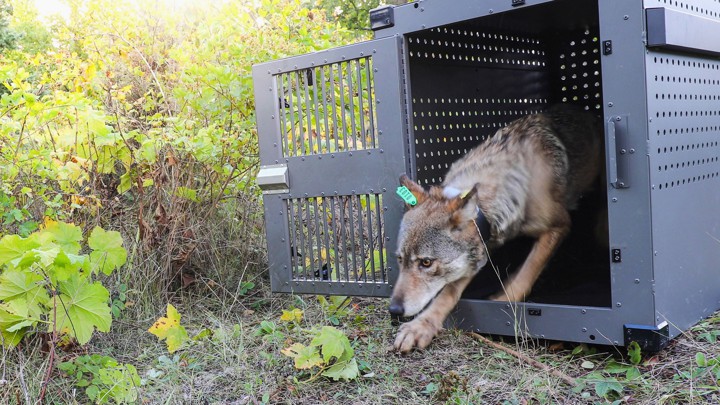
Isle Royale is 200 square miles of land in the watery expanse of Lake Superior. One cold winter 70 years ago, wolves came over an ice bridge and settled into a largely isolated island existence. Unfortunately, island life has not been good for them.
By 2016, the number of wolves on Isle Royale declined from a peak of 50 to just two, a male and a female. As a result of inbreeding, they were half-siblings as well as father and daughter. They had a pup together that lived less than a year. Even before that, scientists were finding wolves on Isle Royale with crooked spines and extra ribs.
The wolves of Isle Royale inspired Chris Kyriazis and his colleagues at UCLA to simulate animal populations over hundreds of generations. Their findings were counterintuitive: What doomed the wolves is not just the small number that have lived on the island in modern times, but perhaps also the large number of wolves that lived thousands of years ago. Kyriazis presented his study at the Evolution 2019 conference, and the team posted a preprint of the article, which has not been peer reviewed yet, on bioRxiv.
A large ancestral population can lead more quickly to extinction, the authors argue, because harmful but recessive mutations are not purged over thousands of years. The chances of any one individual getting two copies of the mutation is low, so natural selection doesn’t get a chance to act on it. But if the breeding population then dramatically shrinks—as when the wolves of Isle Royale isolated themselves from wolves on the mainland—those harmful mutations start to come into play.
Sissyfuss on Fri, 5th Jul 2019 3:33 pm
Isle Royale is in my home, the Upper Peninsula of Michigan. But if you look on the map by all rights it should be Canada’s.
It is amazing the amount if complexity Gaia uses to make the entire system sustainable. Consider the relationship between lightening and atmosphere, coral reefs and sea life, humans and the 6th Mass Extinction. Whoops, don’t know if she’s to blame for that last one. That depends on free will rallying against biological imperatives. Something that is in desperate need like never before.
Cloggie on Sun, 7th Jul 2019 5:17 am
The war on tourarism has only just began:
https://edition.cnn.com/travel/article/how-to-stop-overtourism/index.html
Amsterdam (700k) no longer advertises Amsterdam, with 18 million visitors now, 30 million expected in 2030.
Won’t be long until you have to buy an entrance ticket to a beautiful city.
#CO2TaxNow!
Davy on Sun, 7th Jul 2019 6:20 am
This vital effort should be more than just a tax. It is obvious carbon taxes have not been very effective wherever they have been attempted. Late stage capitalism is not environmentally oriented. Corporations will make efforts but competitive pressures limit results. Government policy has a place but like corporate efforts is limited by an electorate not interested in sacrifice. This is not to say these efforts should be given up on but instead there should be stronger moral policy of promotion of good behavior and the penalizing of bad. Education must be pushed at all levels so the general public understand the challenges. This is not just in regards to climate but also general ecological issues.
None of this is happening quick enough nor widespread enough. These efforts are not effective compared to economic growth impulses. It appears planetary problems have now entered a stage where negative feedback loops are converging. This leaves us with the acknowledgement that we are and will be in a generalized decline of both our civilization and the planet we live on. Acknowledgment should be a call to action of the awakened individual. The word awakened is not meant to indicate status but instead a mental state of an individual called to action.
You can lower your foot print through localism. Individuals can do rehabilitation efforts locally. Individuals can do community building efforts that seek to strengthen local sustainability and resilience. Renewables are an important aspect of this effort but so is work on the natural environment. Plant things and grow food is a must. Conservation efforts found through consumption and waste management efforts are vital. This is more about meaning than hope. Hope that the problem will go away is denial. Hope that our collective condition can be made less bad should be the goal instead. It is only by admitting failure can we learn new ways to find meaning through the relevance of survival efforts.