



On Monday, September 29, the Wall Street Journal (WSJ) published a story called “Why Peak Oil Predictions Haven’t Come True.” The story is written as if there are only two possible outcomes:
- The Peak Oil version of what to expect from oil limits is correct, or
- Diminishing Returns can and are being put off by technological progress–the view of the WSJ.
It seems to me, though, that a third outcome is not only possible, but is what is actually happening.
3. Diminishing returns from oil limits are already beginning to hit, but the impacts and the expected shape of the down slope are quite different from those forecast by most Peak Oilers.
Area of Confusion
In many people’s way of thinking, the economy is separate from resources and the extraction of those resources. If we believe economists, the economy can grow indefinitely, with or without the use of resources. Clearly, with this view, the price of these resources doesn’t matter very much. If one kind of resource becomes more expensive, we can substitute other resources, once the scarce resource becomes sufficiently high-priced that the alternative makes financial sense. Incomes can rise arbitrarily high–all it takes is for each of us to pay the other higher wages. And we can fix any problem with the financial system with more money printing and more debt.
This wrong version of how our economy works has been handed down through the academic world, through our system of peer review, with each academic researcher following in the tracks of previous academic researchers. As long as new researchers follow the same wrong thinking as previous researchers, their articles will be published. Economists were especially involved in putting together this wrong world-view, but politicians helped as well. They liked the outcomes of the models the economists produced, since it made it look like the politicians, with the help of economists, were all-powerful. All the politicians needed to do was tweak the financial system, and the world economy would grow forever. There was not even a need for resources!
Peak Oilers’ Involvement
The Peak Oilers walked into a situation with this wrong world view, and started trying to fix pieces of it. One piece that was clearly wrong as the relationship between resources and the economy. Resources, especially energy resources, are needed to make any of the goods and services we buy. If those resources started reaching diminishing returns, it would be harder for the economy to grow. The economy might even shrink. Dr. Charles Hall, recently retired professor from SUNY-ESF, came up with one measure of diminishing returns–falling Energy Returned on Energy Invested (EROEI).
How would shrinkage occur? For this, Peak Oilers turned to the work of M. King Hubbert, who worked in an area of geology. He wrote about how supply of a resource might be expected to decline with diminishing returns.
Hubbert was not concerned about what effect diminishing returns would have on the economy–presumably because that was not his area of specialization. He avoided the issue by only modeling the special case where no economic impact could be expected–the special case where a perfect substitute could be found and be put in place, in advance of the decline caused by diminishing returns.
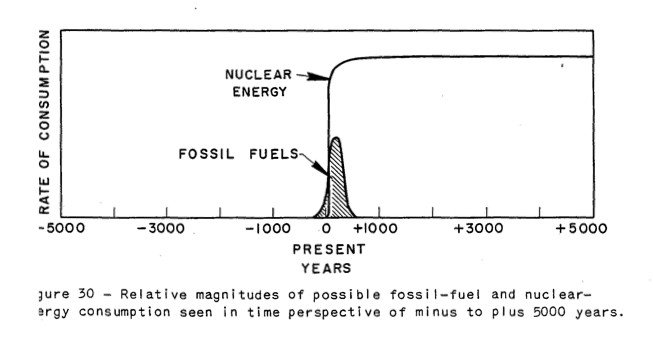
In the example shown above, Hubbert assumes cheap nuclear would take over, before the decline in fossil fuels started. Hubbert even talked about making cheap liquid fuels using the very abundant nuclear resources, so that the system could continue as before.
In this special case, Hubbert suggested that the decline in resources might follow a symmetric curve, slowly declining in a pattern similar to its original rise in consumption, since this is the pattern that often occurs in extracting a resource in nature. Many Peak Oilers seem to believe that this pattern will happen in the more general case, where no perfect substitute is available, as well. A perfect substitute would need to be cheap, abundant, and involve essentially no cost of transition.
In the special case Hubbert modeled, Hubbert indicated that production would start to decline when approximately 50% of reserves had been exhausted. Peak Oilers often used this approach or variations on it (so called “Hubbert Linearization“), to forecast future production, and to determine dates when oil production would “peak.” Of course, as technology improved, additional oil became accessible, raising reserves. Also, as prices rose, resources that had never been economically extractible became extractible. Production continued beyond forecast peak dates, again and again.
Peak Oilers got at least part of the story right–the fact that we are in fact reaching diminishing returns with respect to oil. For this they should be commended. What they didn’t figure out is, however, is (1) how the energy-economy system really works, and (2) which pieces of the system can be expected to break first. This issue is not really the Peak Oilers fault–it is the result of starting with a very bad model of the economy and not understanding which pieces of that model needed to be fixed.
How the Economic System Really Works
We are dealing with a networked economy, one that is self-organized over time. I would represent it as a hollow network, built up of businesses, consumers, and governments.

This economic system uses energy of various kinds plus resources of many kinds to make goods and services. There are many parts to the system, including laws, taxes, and international trade. The system gradually changes and expands, with new laws replacing old ones, new customers replacing old ones, and new products replacing old ones. Growth in the number of consumers tends to lead to a need for more goods and services of all kinds.
An important part of the economy is the financial system. It connects one part of the system with another and almost magically signals when shortages are occurring, so that more of a missing product can be made, or substitutes can be developed.
Debt is part of the system as well. With increasing debt, it is possible to make use of profits that will be earned in the future, or income that will be earned in the future, to fund current investments (such as factories) and current purchases (such as cars, homes, and advanced education). This approach works fine if an economy is growing sufficiently. The additional demand created through the use of debt tends to raise the prices of commodities like oil, metals, and water, giving an economic incentive for companies to extract these items and use them in products they make.
The economy really can’t shrink to any significant extent, for several reasons:
- With rising population, there is a need for more goods and services. There is also a need for more jobs. A growing networked economy provides increasing numbers of both jobs and goods and services. A shrinking economy leads to lay-offs and fewer goods and services produced. It looks like recession.
- The networked economy automatically deletes obsolete products and re-optimizes to produce the goods needed now. For example, buggy whip manufacturers are pretty rare today. Thus, we can’t quickly go back to using horse and buggy, even if should we want to, if oil becomes scarce. There aren’t enough horses and buggies, and there aren’t enough services for cleaning up horse manure.
- The use of debt for financing depends on ever-rising future output. If the economy does shrink, or even stops growing as quickly as in the past, there tends to be a problem with debt defaults.
- If debt does start shrinking, prices of commodities like oil, gold, and even food tend to drop (similar to the situation we are seeing now). These lower prices discourage investment in creating these commodities. Ultimately, they lead to lower production and job layoffs. If deflation occurs, debt can become very difficult to repay.
Under what conditions can the economy grow? Clearly adding more people to the economy adds to growth. This can be done by through adding more babies who live to maturity. It can also be done by globalization–adding groups of people who had previously only made goods and services for each other in limited quantity. As these groups get connected to the wider economy, their older, simpler ways of doing things tend to be replaced by more productive activities (involving more technology and more use of energy) and greater international trade. Of course, at some point, the number of new people who can be connected to the global economy gets to be pretty small. Growth in the world economy lessens, simply because of lessened ability to add “underdeveloped” countries to the networked economy.
Besides adding more people, it is also possible to make individual citizens “better off” by making workers more efficient at producing goods and services. Most people think of greater productivity as happening through technological changes, but to me, it really represents a combination of technological changes, plus a combination of inexpensive resources of various kinds. This combination often includes low-cost fossil fuels; abundant, cheap water supply; fertile soil; and easy to extract metal ores. Having these available makes possible the development of new tools (like new agricultural equipment, sewing machines, and vehicles), so that workers can become more productive.
Diminishing returns are what tend to “mess up” this per capita growth. With diminishing returns, fossil fuels become more expensive to extract. Water often needs to be obtained by desalination, or by much deeper wells. Soil needs more amendments, to be as fertile as in the past. Metal ores contain less and less ore, so more extraneous material needs to be extracted with the metal, and separated out. If population grows as well, there is a need for more agricultural output per acre, leading to a need for more technologically advanced techniques. Working around diminishing returns tends to make many kinds of goods and services more expensive, relative to wages.
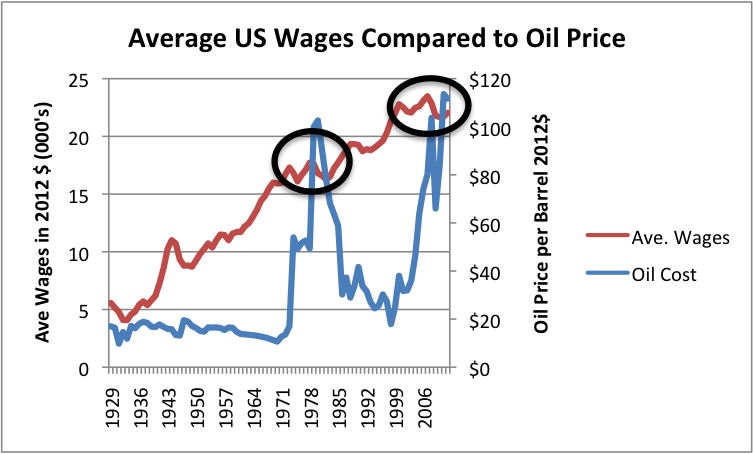
Rising commodity prices would not be a problem, if wages would rise at the same time as the price of goods and services. The problem, though, is that in some sense diminishing returns makes workers less efficient. This happens because of the need to work around problems (such as digging deeper wells and removing more extraneous material from ores). For many years, technological changes may offset the effects of diminishing returns, but at some point, technological gains can no longer keep up. When this happens, instead of wages rising, they tend to stagnate, or even decline. Figure 3 shows that per capita wages have tended to grow in the United States when oil was below about $40 or $50 barrel, but have tended to stagnate when prices are above that level.
What Effects Should We Be Expecting from Diminishing Returns With Respect to Oil Supply?
There are several expected effects of diminishing returns:
- Rising cost of extraction for oil and for other commodities subject to diminishing returns.
- Stagnating or falling wages of all except the most elite workers.
- Ultra low interest rates to try to make goods more affordable for workers stressed by stagnating wages and high prices.
- Rising governmental debt, in an attempt to stimulate the economy and in order to provide programs for the many workers without good-paying jobs.
- Increasing concern about debt defaults, as the amount of debt outstanding becomes increasingly absurd relative to wages of workers, and as all of the stimulus debt runs its course, in countries such as China.
- A two way problem with the price of oil. On one side is recession, when oil prices rise to unaffordable levels. Economist James Hamilton has shown that 10 out of 11 post-World War II recession were associated with oil price spikes. He has also shown that there is good reason to expect that the Great Recession was related to the run-up in oil prices prior to 2007. I have written a related paper–Oil Supply Limits and the Continuing Financial Crisis.
- The second problem with the price of oil is the reverse–price of oil too low relative to the cost of extraction, because wages are not high enough to permit workers to afford the full cost of goods made with high-priced oil. This is really a problem with inadequate affordability (called inadequate demand by economists).
- Eventual collapse of whole system.
There have been many studies of collapses of past economies. These collapses tended to occur when the economies hit diminishing returns after a long period of growth. The problems were often similar to ones we are seeing today: stagnating wages of common workers and growing debt. There were more and more demands on governments to fix the problems of workers, but governments found it increasingly difficult to collect enough taxes for all the needed programs.
Eventually, the economic systems have tended to collapse, over a period of years. The shape of resource use in collapses was definitely not symmetric. Figure 4 shows my view of the typical shape of the collapses in non-fossil fuel economies, based on the work of Peter Turchin and Surgey Nefedof.
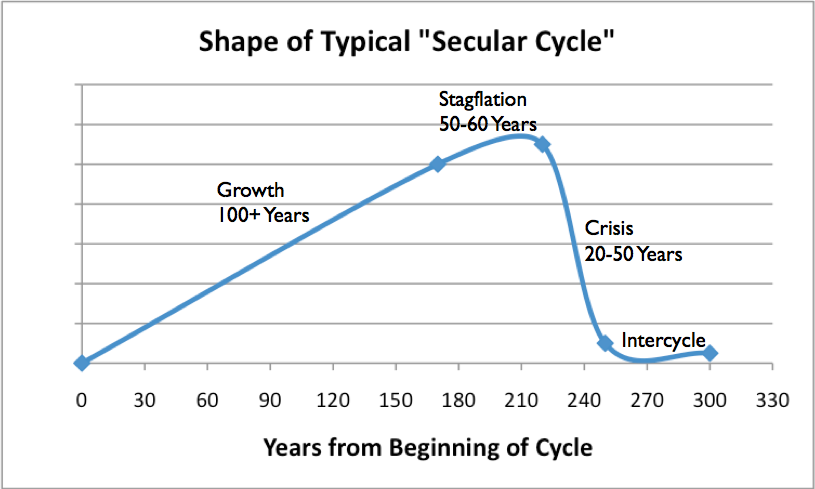
In my view, the date of the drop in oil supply will be determined by what appear to on-lookers to be financial problems. One possible cause is that the oil price will be too low for producers (a condition that is occurring now). Governments will find it unpopular to raise oil prices, but at the same time, will be powerless to stop the adverse impacts the fall in price has on world oil supply.
Falling oil prices have especially adverse effects on oil exporters, because they depend on revenues from oil to fund their programs. We are already seeing this now, with the increased warfare in the Middle East, Russia’s increased belligerence, and the problems of Venezuela. These issues will tend to reduce globalization, leading to less world growth, and a greater tendency for the world economy to shrink.
Unfortunately, there are no obvious ways of fixing our problems. High-priced substitutes for oil (that is, substitutes costing more than $40 or $50 barrel) are likely to have as adverse an impact on the economy as high-priced oil. The idea that energy prices can rise and the economy can adapt to them is based on wishful thinking.
Our networked economy cannot shrink; it tends to break instead. Even well-intentioned attempts to reduce oil usage are likely to backfire because they tend to reduce oil prices and have other unintended effects. Furthermore, a use of oil that one person would consider frivolous (such as a vacation in Greece) represents a needed job to another person.
Should Peak Oilers Be Blamed for Missing the “Real” Oil Limits Story?
No! Peak oilers have made an important contribution, in calling the general problem of diminishing returns in oil supply to our attention. One of their big difficulties was that they started out working with a story of the economy that was very distorted. They understood how to fix parts of the story, but fixing the whole story was beyond their ability. The following chart shows a summary of some ways their views and my views differ:
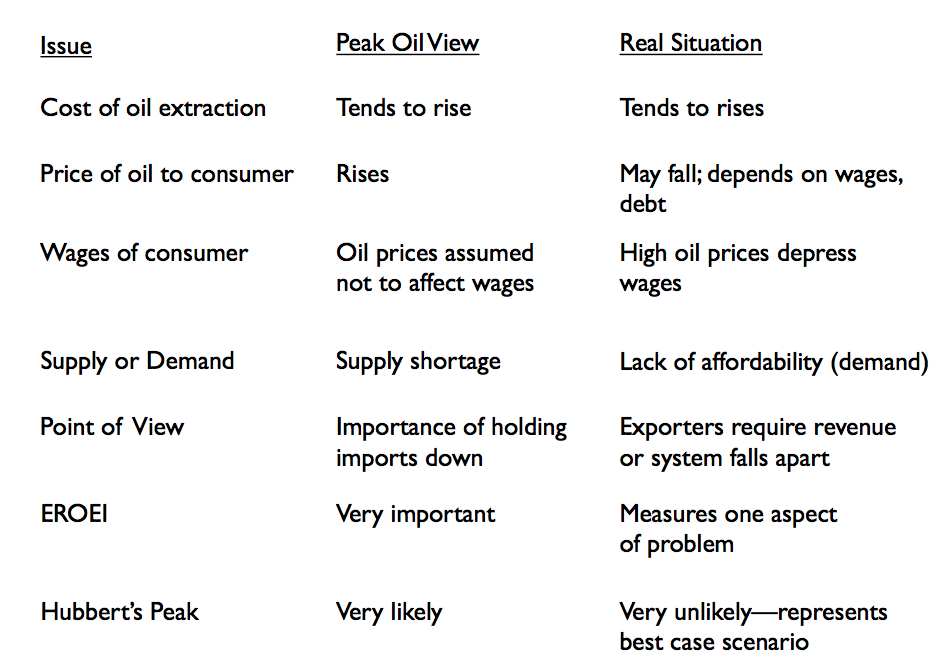
One of the areas that Peak Oilers tended to miss was the fact that an oil substitute needs to be a perfect substitute–that is, be available in huge quantity, cheaply, without major substitution costs–in order not to adversely affect the economy and in order to permit the slow decline rate suggested by Hubbert’s models. Otherwise, the problems with diminishing returns remain, leading to declining wages and rising costs of making goods and services.
One temptation for Peak Oilers has been to jump on the academic bandwagon, looking for substitutes for oil. As long as Peak Oilers don’t make too many demands on substitutes–only EROEI comparisons–wind and solar PV look like they have promise. But once a person realizes that our true need is to keep a networked economy growing, it becomes clear that such “solutions” are woefully inadequate. We need a way of overcoming diminishing returns to keep the whole system operating. In other words, we need a way to make wages rise and the price of finished goods fall relative to wages; there is no chance that wind and solar PV are going to do this for us. We have a much more basic problem than “new renewables” can solve. If we can’t figure out a solution, our economy is likely to reach what looks like financial collapse in the near term. Of course, the real reason is diminishing returns from oil, and from other resources as well.
paulo1 on Mon, 6th Oct 2014 9:33 am
Gail’s outlook is quite a bit more doomerish than mine and maybe that is simply a function of personality, I don’t really know. As far as I am concerned Peak Oil theory has mostly been bang on, with some feedback complications. Hindsight, of course, lets us say, “we should have seen that could have happened, would have happened”, nevertheless, we have been on a Plateau of sorts for almost 10 years. I am reminded of terraced farming. First the valleys are farmed and the crop yields per effort are terrific and considered normal. Then the slopes are utilized with more work and effort. Finally, the sides of steep and poor land are terraced and the soil is either augmented or transported into place. The terraced plots yield and allow for continued survival, but the return is poor in comparrison and it is unlikely further robust population growth is possible.
Maybe this is what Gail says, but she always carries this scenario one step further to a sudden and drastic collapse with great upheavel and misery. Those frequent posters on her site always assume the most doom-laden vision and trade ideas of ultimate survival strategies and safe relocation areas. Every new post it is the same, and after awhile I skim the doom and continue on with the good life that I (and family) still have.
I read the comments of well-meaning posters decrying the destruction of our climate and natural world. The latest is the study that states the world has lost 50% of all wildlife in what, the last 40 years? In my own limited view, and granted I am limited by my optimism and short frame of life, I don’t see it. What I see is: we have never had a garden so bountiful and productive. We have so many elk we had to put up 8’fences to protect our yard and gardens with a steel gate that is locked every night. The salmon runs on our coast were huge this year and Fisheries, for once and not often, managed a strategy for sharing within user groups and there was no conflict or protests. My kids have jobs and continue to progress with their lives. Our health is still good even though my wife has been a type-1 diabetic for 41 years and we are both approaching 60.
Some of you will say, “well you are lucky and life is really much worse for most”, and I accept that. We are lucky, pure and simple. But, BUT we also spend the time and effort to work the gardens, cut the wood, re-build the house, and always learn new skills. At 57 I went back to school and took welding to augment carpentry….and I use this only as an example.
What Gail misses in so many musings is humanity. Sure, the lives of people have greatly impacted the world….I accept that. But most people are simply ‘good’, and perhaps we miss their heroic lives in our negativity. I am reminded of the news broadcasts that show urban hellholes with drug dealers on the corners and drive-bys, dumb kids with pants hanging down and an attitude of ‘gimmee your wallet’ exuding with every swagger. But for every vision of that there are countless folks doing their best to raise and feed their family, that send their kids to school with a “listen to your teacher and work hard”.
It may soon all go to hell in a handbasket, and sure our North American lives are often examples profligate waste; of far too many goods, services, and resources. Many carry needless debt. However, I for one and just one of many will build the terraces and be thankful for what is possible. If it comes to naught, I hope to succumb with a smile.
When were there ever any guarantees in this life?
Paulo
Rita on Mon, 6th Oct 2014 9:42 am
Herman Daly proposes a tax reform for the wages, whereby the social security contributions are replaced with mineral rent.This would increase the wages.
rockman on Mon, 6th Oct 2014 10:01 am
Rita – what’s the “mineral rent”?
Northwest Resident on Mon, 6th Oct 2014 10:46 am
“Our networked economy cannot shrink; it tends to break instead.”
And yet, we are definitely witnessing a shrinking economy on a global scale, despite what the fake numbers being pushed by the governments might try to portray as an alternate reality.
A little shrinkage right before the big break? More than likely.
Plantagenet on Mon, 6th Oct 2014 11:04 am
Gail gets it right again. The peak oilers predictions of a peak in 2005 have NOT been correct. Oil production continues to go up, not down. However, higher oil prices are definitely slowing global GDP growth, and a future peak in oil production remains a distinct possibility.
steve on Mon, 6th Oct 2014 11:52 am
Paulo you hit the nail on the head…I have been looking for a way to describe what is missing from her analysis and that is just it….the comment section on her web site is riddled with people trying to tear down people who are trying to prepare for the end of BAU…Fear is not a good guide…it is a warning sign…Frankly I don’t know why she puts the 1000’s of hours into doing what she is doing if she is coming to a conclusion that the earth is going to be uninhabitable to humans…I do trust her analysis though…I try to get liberals and conservatives alike to read her site but I think she scares them off too much…
Davy on Mon, 6th Oct 2014 12:19 pm
Paulo, I am living what you are living and I don’t want it to end. I have a wonderful simple life well supported and solidly sustainable. Collapse might mean the end of that or I may squeak by. I want to believe in your doom temperance. I tend to be more like NR maybe because of my disposition of fairness and balance. I find myself fighting the cornies who are dangerously misleading people. This is a big world and your vision will fit many areas but many areas are hopelessly doomed. It is a point of focus issue. I am firmly with your vision yet hedging with NR’s “A little shrinkage right before the big break? More than likely.”
Davy on Mon, 6th Oct 2014 12:20 pm
Planter your statement ” Oil production continues to go up, not down” is misleading and you know it. Quality/Quantity/Price sir?????
Northwest Resident on Mon, 6th Oct 2014 12:40 pm
I’m inclined to agree with Gail that once we reach a certain point and the global economy begins to disintegrate in earnest, the drop-off is likely to be very steep, and very deep.
True, like Paulo says, there are lots of really good people. I work with a lot of them and I see them mowing their lawns and riding their bicycles and leaving early for work in the morning, just like me.
But panic and hunger can turn a population of fine upstanding people into something entirely different. A mob. Starvation and desperation brings out the animal survival instinct in us all.
The ONLY thing preventing mass starvation right now, this very moment, is the immense volumes of oil that are pumped into the fertilization, mechanization, preparation, preservation and delivery of food around the world.
There is a crunch time coming for oil supply that will directly impact what food most of us have available. Watching one’s lifelong savings or retirement account evaporate into nothingness is one thing — sure to invoke fear and intense uncertainty — add to that a day or two of no food due to a breakdown of the global food production/delivery system, and we will see the formerly nicest people in the world resorting to desperate acts of survival. Panic sets in, mobs form, dog eat dog, worldwide.
I believe that whoever it is that actually runs our country certainly sees this danger approaching. New executive orders authorizing military force on American soil, militarization of the police nationwide, delivery of military equipment to local police forces and more all point to the realization and acceptance by TPTB that there is a time approaching when civil disorder might just get out of hand. Certainly the US Military anticipates this moment arriving and they discuss it in their strategic and planning documents.
Where one lives when TSHTF will have everything to do with just how bad it gets. Paulo, you’re in an ice paradise up there — wish I had a few acres somewhere around you. Me, I’m going to have to hope that nobody notices I’m growing a substantial amount of quality food in my backyard, or that I have a year or so’s worth of food stored up. Most people don’t have more than a day or two’s worth of food/water, and those people will go full zombie under the right conditions, which do seem to be forming into a perfect storm.
I think Gail has thought all of this through and realizes that there will be no long, slow, step by step descent. Sudden drop off is much more likely, given human nature and the total interconnectivity of everything and our total dependence on fossil fuel. If/when that happens, those nice neighbors and cool acquaintances are likely to have turned into blood-sucking zombies. Watch out.
Davy on Mon, 6th Oct 2014 12:54 pm
A well mapped out doomer argument NR. I want to be more optimistic but your vision fits many doomed locations.
bs on Mon, 6th Oct 2014 1:05 pm
It seems to me americans in particular have become greedy and self centered.
The thought occurred to me what would happen if a soccer mom was asked to kill a chicken?
Plantagenet on Mon, 6th Oct 2014 1:38 pm
Davi—of course US and global oil production continue to go up. Its not just my point—its Gail’s point as well—-Peak Oil theory called for global oil production to peak in 2005, not to be still rising 9 years later. Nonetheless, we are in a “Peak Oil Dynamic” to use Rockman’s terminology. The shift to higher priced oil is inexorably slowing global GDP growth.
Plantagenet on Mon, 6th Oct 2014 1:42 pm
@NWR It is certainly possible that civilization will end rapidly when some “tipping point” is passed, but it is also possible a long slow grinding decline will occur for most people, with pockets of wealth and affluence surviving—-after all, that is what is going on in the US and the EU right now. My personal prediction is the future will be much like now only worse.
J-Gav on Mon, 6th Oct 2014 1:45 pm
Interesting comments above – interesting article too.
Rita – Of course, Daly is not the only one calling for a complete restructuring of the tax system, Michael Hudson for another has been active there for not quite as many years. Why? To reduce, if not entirely eliminate, the share of common wealth which accrues to rent-seekers.
In a tighter sens, and concerning Rockman’s question: “What are mineral rents?” here’s the definition – “The difference between the value of production for a stock of minerals at world prices and their total costs of production.”
Not sure how easy that is to calculate but the latest figures I’ve seen show it in terms of GDP to be 0% in the UK, France and Germany and 0.2% in the U.S.
Which comes to $34 billion if my reckoning is not off.
steve on Mon, 6th Oct 2014 1:55 pm
NWR I was in your neck of the woods this summer and holy shit I see why you are fearful…way to many idiot people over there with not many skills or do it yourself people…sorry man I just tell it like it is…
J-Gav on Mon, 6th Oct 2014 1:55 pm
Doom-laden or not, Gail does makes some good points. How people choose to interpret or deal with them will always depend on individual psychological make-up.
If reading an article or watching one video is enough to make somebody depressed (not talking about you here, JP – I think you’re made of sterner stuff) then the conditions for that depressions were already well in place.
Beyond the optimist vs pessimist mystification, today even trying take the neutral position of “neither one of those, realism is better” has begun to become suspect for many. In this warped linguistic atmosphere, I generally avoid using all three terms now.
steve on Mon, 6th Oct 2014 1:58 pm
This is a quote from the main page of CNBC ”
Imagine a world without Google or Starbucks, or a world without Jeff Bezos or Bill Gates. It’s inconceivable.
YEP we are in trouble……
J-Gav on Mon, 6th Oct 2014 2:02 pm
NR – I feel close to a lot of what you write and this post (though longish) is no exception.
However, imho, step-wise descent and sudden drop are not mutually exclusive.
Au contraire, they could function in ‘lock-step.’
To explain : Step-wise MEANS sudden drops, then (maybe, hopefully?) a period where some sort of stability is temporarily recovered. Then another hit and reset at a lower level of complexity (aka resource use). And that’s not only fossil fuels …
Northwest Resident on Mon, 6th Oct 2014 2:20 pm
Plant, steve, J-Gav:
Plant, your point of view on this subject is very valid. It “could” go that way. I tend to think that we are in the “long slow decline” part of the road right now as TPTB barely hold the economy together and little wars are popping up and things are just grinding ever downward. I don’t see how we’ll be able to maintain transportation with a fully functioning BAU, and I don’t see how we’ll be able to finance oil extraction/processing and delivery without a fully functioning BAU. I think it is all tied together and when one goes down, they all go down.
Yeah, steve, what you see in my neck of the woods are hoards of formerly Southern California residents who got out while the real estate market was good, moved to “the promised land” of the Pacific Northwest, bought a bunch of land and converted it all to dude ranches. Big, huge, magnificent homes on 5 – 10 acre plots everywhere and some guy on a riding lawnmower out there on weekends mowing all the weeds down, but otherwise not doing much with it. In my particular mini-neck of the woods however there are a lot of old-time orchard and vineyard growers — but very few farmers due to the fact that the soil in my area really truly sucks — microscopic pieces of sand and organic debris that turn to sticky clay when wet and to nearly solid rock when dry. I’ve told the story here before about all the hard manual labor I have put in to convert that soil into something that will actually grow food. If/When TSHTF, if people in my general area think all they have to do is go into their backyard and sow a few seeds, they are in for a very rude surprise.
J-Gav — Longish is my style. I type at lightning speed and my brain moves about that fast too. Sorry! I get hit with that all the time. But I do agree with your major stepdown POV — I just think that first big step down is going to be a WHOPPER!
J-Gav on Mon, 6th Oct 2014 2:48 pm
NR – Yeah, that first big speed bump’s likely to be an eye-opener. Well, who knows? People seem to broadly prefer the option “The show must go on.” Until it can’t of course.
J-Gav on Mon, 6th Oct 2014 2:57 pm
Steve – I’ve yet to set foot in a Starbuck’s, though here in Paris and environs we have dozens of them. Ethiopian coffee is much better. My step-son just brought back 2 kilos worth after a for-TV doc film shoot there.
Bezos I’ve used a couple of times. Gates even more, if Hotmail equals Gates … but that’s probably not the case since he stole (aka bought out) most of the stuff that today makes up their ‘system.’ More stuff gonna be changing there for sure pretty soon I’d bet.
Northwest Resident on Mon, 6th Oct 2014 3:04 pm
J-Gav: I am very hopeful that the government has plans to maintain order and do what it must so that the show CAN go on. In my wildest fantasy, we reach a point where the current rubber-stamper in chief walks to the national microphone/teleprompter and describes a national initiative to re-localize our communities around local food production and other local economic efforts. I’d like to think that in my small town the farmers and people will organize for action, with people pitching in to do their part. If pulled off correctly, a great speech and a new and viable vision of an endurable (if not necessarily “better” future) could mitigate a lot of the panic and fear and desperation, and reduce the worst case scenarios somewhat. One can always hope!
Davy on Mon, 6th Oct 2014 3:22 pm
Trying to predict descent is like forecasting the weather. We know reasonably well the important variables. We have a good handle on the complexity involved. We know production, distribution, and trade exchange mechanisms have thresholds of functionality. At some point global functionality will cease with a shock of enough degree and duration. This global system is very fragile and vulnerable to lower complexity and lower growth. This may not be immediate but over medium to longer term. This is a descent precursor and indicator. There will be regions that fare relatively well in relation to other regions with no sustainability. Las Vegas comes to mind as a city. The world’s mega population corridors come to mind having little postmodern future. It is common sense that mega population areas will not be supportable in a collapse situation where distribution breaks down. Locations supported by distribution because of food, water, climate, and or isolation also come to mind. A European energy war could bring down globalism but we know the descent may be worst in Europe in that situation. A full scale war in ME would surely ruin that regions survivability but also end globalism. A slow widespread BAU death is possible in a great depression environment. We need to practice risk management as a society and alert locations of their collapse risk. This can never happen in a world with only business as usual risk analysis. For respected BAU leadership to discuss the real and immediate dangers of collapse will spook the system into collapse. Witness the cornucopian forward guidance tools central banks are using. Have you ever heard true pessimism from TPTB? We are all helpless in a sense of not knowing when, how, and where plus the amplitude of degree and duration. We are not helpless with the knowledge of common sense sustainability traits in a variety of descent scenarios. We can and should do the risk analysis and mitigate accordingly per region. Instead we fight wars on terror and drugs when the true dangers are from our vulnerabilities to collapse.
ghung on Mon, 6th Oct 2014 3:31 pm
NWR: “In my wildest fantasy, we reach a point where the current rubber-stamper in chief walks to the national microphone/teleprompter and describes a national initiative to re-localize our communities around local food production and other local economic efforts”
As I mentioned last week, I’m attending weekly classes about growing in high-tunnel greenhouses which can be had at little or no cost with the help of the government. There are a number of programs to help with more localized food production for those motivated enough to go after them. While Obama isn’t going on national TV to promote these things, it seems like someone in govt. certainly sees the need for such.
I’m filling out my application for a 72′ x 30′ high-tunnel in the morning. Looks like a go at this point. I also have an appointment with the extension agent to evaluated what grants are available to get our goat operation up and running, among other things. Some of these programs will pay 100% of start-up costs and provide ongoing assistance. Total out-of-pocket costs so far – $25.
Davy on Mon, 6th Oct 2014 3:53 pm
G, I met with NRCS this morning for a MIG operation plan (management intensive grazing). I hope you have better luck with the government money. It is drying up around here. Our waiting list here in Mo Ozarks is 2 years out. I told her I will do the plan without government help. I think it depends on where you are and the local demand. As I doomer I am not sure we have 2 years. I am kinda now or never.
shortonoil on Mon, 6th Oct 2014 3:57 pm
“Diminishing Returns can and are being put off by technological progress–the view of the WSJ.”
Putting off diminishing returns with technology would mean the repeal of the most fundamental, and well tested theories known to modern science. The First and Second Law. It is called entropy production, and is associated with any process. No process can go forward without it. Without entropy production, there would not be any oil production. Period. Writers at the WSJ are either massively deficient in basic science, or they are being intentionally deceptive.
“This issue is not really the Peak Oilers fault–it is the result of starting with a very bad model of the economy and not understanding which pieces of that model needed to be fixed.”
The error that the Peak Oilers made was in using an economic model to solve an energy problem. Energy is an area of science that has a well developed, and proven bases. Using economics to solve energy questions is like hunting gnats with a sledge hammer. They answered a few questions, but broke up the furniture in the process.
Gail is certainly right in calling the WSJ on to the carpet for their misrepresentation of the situation. She does it very well, and should be applauded for her effort. The oil age will soon be ending, and that we know with a very high level of certainty. How we are going to handle it should now be the question that all are asking. If handled very well there will still be massive world wide disruptions; if we continue to wallow in ignorance, there will be catastrophe.
http://www.thehillsgroup.org/
Northwest Resident on Mon, 6th Oct 2014 4:02 pm
ghung — Here is a high tunnel greenhouse that is selling for close to $700 (below). Are you saying that with government assistance I could get one of those for little or no cost?!! If so, where do I sign up?!!!
Given that I already have my growing space raised planters all constructed, I might need to get some custom width/length ones built. But if the government is paying for (most of) these with all that hard-earned freshly printed QE money (snark), then I’ll take a half dozen.
ht tp://livingoutfitters.com/shelterlogic-pro-roundtop-greenhouse-10x19x8?CAWELAID=320013300000037079&CAGPSPN=pla&catargetid=320013300000049662&cadevice=c&gclid=CPzVmpX1mMECFUeTfgod060AiQ
Apneaman on Mon, 6th Oct 2014 4:44 pm
The uncertainty is the killer. The stress and anxiety of knowing it’s coming, yet not knowing when is worse than if you had an actual date. Sometimes I still get angry (but not as much as before) at all the sheep happily living on consumer cloud 9. Some of the sheep are family and they are mostly decent, kind people even if they think I’m crazy for walking away from most of it, so whats a fella to do?
ghung on Mon, 6th Oct 2014 5:10 pm
Davy/NWR – My understanding is that much of the money isn’t tax funds or QE money but money from various settlements that can’t be put into the general fund. The agent who does some of the classes mentioned environmental, tobacco and TVA settlements. Contact your county agricultural extension office. In our case they’ll pay $4 and change per square foot up to 2172 square feet. You then shop around to find the best deal on the kit (within their specs) and construction costs. I’m planning to do the construction and put the balance into upgrades. Caveat: your plot of land has to have a “farm (agricultural)” tracking number”. Not sure what the minimum acreage is. Contact the Farm Services Administration or NRCS who administer most of these programs. Some vendors will also help to expedite the process:
Search: Farmtek- “Applying for NRCS High Tunnel Funding”
Here’s an NRCS link:
h ttp://www.nrcs.usda.gov/wps/portal/nrcs/detailfull/national/programs/?cid=stelprdb1046250
Scroll down for the different States’ links.
As Davy mentioned, these programs vary from State to State so it’s up to you guys to see what’s available. NC may have gotten a bump from the big TVA settlement when they fudged their numbers about how much sulphur and stuff they were dumping on our state, especially here in the mountains.
ghung on Mon, 6th Oct 2014 5:19 pm
NWR – I’m planning for a commercial Gothic style like this:
h ttps://www.farmtek.com/farm/supplies/prod1;ft_high_tunnels_cold_frames-ft_gromax_tall_hightunnels-ft_gromax_tall_hightunnel_30w;pg108190h.html
I can get this from a local vendor and save on shipping; put those funds into venting upgrades and roll-up sides.
Davy on Mon, 6th Oct 2014 6:42 pm
G, I am looking at farmtech for a cattle shelter in much the same style.
Energy Investor on Mon, 6th Oct 2014 10:21 pm
The speed of a crash can seldom be forecast. The more complex the society, history tells us the faster they tend to crash as inter-relationships with other critical factors come into play and prevent timely solutions. Like with a financial bust the Hemmingway example is the way it always happens…(I am in a position to know as a turnaround and corporate recovery specialist)
How did you go broke? At first slowly, then suddenly.
The GFC was quite predictable on that basis (I was sending out warnings a year out). Our society has become more complex and more brittle financially. The mixture of debt levels and the USD750trillion derivatives position means that major counterparties tanking can have unintended consequences…including the collapse of the global financial system. This of course was the lesson from the GFC and the reason we now have G20 meetings. But I have no idea this time when we may hit the skids…it may come by month’s end or in a few years time.
The fact is that no-one in charge ever remembers how long they have been screwing things up before the coup de grace comes along.
An example is water use from aquifers. I recall flying over USA about 25 years ago and seeing the round green fields of irrigated land stretching as far as the eye could see in the Ogallala served area. The aqifer was even then slowly depleting with no-one thinking about its probable future demise. Now people wake up and state authoritatively that the depletion is due to climate change – same for the California drought. The small incremental causes years ago are never factored in.
Joseph Tainter’s book “The collapse of Complex Societies” is a fantastic read alongside what Gail has written, because when collapse finally comes it is so fast moving and the problems are too complex and inter-related to make solutions easy or even possible.
What makes Tainter worth reading is that I have never found anyone who could fault the book.
When Malthus published his population concerns in 1794 he was trumped by the emigration of vast swathes of English, Irish and Scotish folk who otherwise would have died of starvation as the UK was in early 1800s overpopulated relative to food supplies. But think on this, the origins of our over-population problems pre-dated fossil fuels. So we expanded to cover the globe as unwitting as yeast in a petri dish 🙂
2000 years ago there were less than 300 million people in the world and with our livestock we comprised between about 5-7% of land mamals. We are now 7.2 billion and over 97% of all land mamals. Each year our net population growth is more than 80 million people – together with our increased herds of domestic animals and our expanded resource demands. Our fish catch is now declining and much of the “rubbish fish” caught are being used to increase fish farming. The USGS regularly looks at mineral resources to figure out how much longer we can continue to exploit known reserves and estimated resources.
Being sensible, how much more can we grow in a finite planet…even with our techie fixes?
Last week I saw mentioned (I think on this web site – just from memory, so correct me if I am wrong) that in about the last 40 years, 50% of the remaining non human related animals have gone.
We are so clever we can work out ways to examine the earth to figure out ways to extract the last of her bounty. Ways to substitute one thing for another.
So how just will this end with a wimper and not with a bang?
I just read profs Oreskes and Conway’s book on their view from the year 2100 titled “The Collapse of Western Civilisation”. I don’t agree with their opinions on causation but I do believe we will leave the edge of the cliff…running faster and faster until we can run no more. Like Wiley E. Coyote 🙂
But let’s face it, we are just “beating our gums” because the time for action is past. Most of us posting here are now talking about personal mitigation strategies.
Aren’t we?
Northwest Resident on Mon, 6th Oct 2014 11:27 pm
ghung — Nice greenhouse in that link!
Northwest Resident on Mon, 6th Oct 2014 11:36 pm
Energy Investor — Yes, we are!
Your point about complex societies being prone to rapid collapse is one that I agree with. Some here believe that a collapse in America might be more of a stepdown descent, and I guess I can see that too, except that the first big step down will be a collapse in its own right. From there, yeah, more little gradual steps down, for who knows how far.
Davy on Tue, 7th Oct 2014 3:59 am
E Investor, you and I are on the same page. It is going to be fascinating to know the historical “maker event” or event “s” of our collapse. I see and feel a slow collapse currently at least in our foundational complexity. We still see population and consumption growing but this is unhealthy growth at this point. Can we consider unhealthy growth collapse? Probably! Our basic foundation for a stable society is collapsing. This is especially true with our resource base, ecological support, social fabric, financial networks, and fracturing political control. Limits of growth, diminishing returns, predicaments, and black swan events are appearing like the northern lights. Our dynamic system is in turbulence from extended growth beyond its sustainability envelope. In general high thermal energy is associated with disorder and low thermal energy with ordering. I see our dynamic system with high thermal energy and consequently we see disorder and with this disorder phase transition turbulence. We can look at our dynamic system in another way using material science. I see something called quenching where rapid cooling prevents low temperature processes from occurring leaving a narrow thermodynamically favorable window for growth. Our high thermal energy system is being quenched by limits of growth and diminishing returns which has narrowed our thermodynamic window for future growth. We are now brittle being quenched of our ability to order. Our system is not a material it is a system which does not leave glass like a quenched material might. What is left is a self-organizing system that must grow but is at the end of growth. There is no other alternative but a shattering in the systematic process of bifurcation. Our human system is a particularly interesting phenomenon within the greater earth ecosystem. We have no indication in science of this type of occurrence anywhere though we speculate about complex life elsewhere. I believe we have to look at nature and our scientific understanding of nature when we look at our collapse scenarios. Our dynamic system is a unique work tool of nature but it is still part of nature and consequently will follow natural laws. Our feeling of exceptionalism is understandable considering our unique natural system but we are no more exceptional than nature itself. The above is a word salad but I feel this type of language must be applied to our situation to have a foundation to base our scenarios of collapse on.
westexas on Tue, 7th Oct 2014 7:25 am
I added my two cents worth in the comments section following the WSJ article:
In reality, it’s very likely that actual global crude oil production, generally defined as 45 or lower API gravity crude oil, stopped increasing in 2005.
Global liquids production, consisting of crude oil + condensate + natural gas liquids (NGL) + biofuels, has so far continued to increase. Condensate (basically natural gasoline) and NGL are byproducts of natural gas production. Actual global crude oil production probably effectively peaked in 2005, but global natural gas production and associated liquids–condensate and NGL–have so far continued to increase.
Note that when we ask for the price of oil, we get the price of 45 or lower API gravity crude oil, but when we ask for the volume of oil, we get some combination of crude oil + condensate + NGL + biofuels. Shouldn’t the price of an item directly relate to the volume of that item, not to the volume of the item plus partial substitutes?
For more info, you can search for: Did global crude oil production actually peak in 2005?
What about net exports?
When we calculate Global Net Exports of oil (GNE), we have to deal with total petroleum liquids + other liquids (EIA data base). I define GNE as the combined net exports from the top 33 net oil exporters in 2005. The EIA shows that GNE have been below the 2005 rate of 46 mbpd (million barrels per day) for 8 straight years, with GNE in 2013 falling to 43 mbpd.
While falling US liquids consumption (relative to 2005) and rising US oil production have lessened the demand for GNE (and had an effect on global crude oil prices), by definition, this had no (direct) impact on the supply of GNE, and the most recent EIA data show that the US is reliant on net crude oil imports for 44% of the crude oil processed daily in US refineries.
And while we have recently some signs of softening demand in China, the volume of GNE available to importers other than China & India fell from 41 mbpd in 2005 to 34 mbpd in 2013.
For more info, you can search for: Export Capacity Index.
marmico on Tue, 7th Oct 2014 8:13 am
In reality, it’s very likely that actual global crude oil production, generally defined as 45 or lower API gravity crude oil, stopped increasing in 2005.
Citation please instead of cut and paste. As you are aware and fail to acknowledge EIA data on the >API 45 gravity is available and the conclusion is that U.S. LTO crude production defined as <API 45 has increased since 2005.
westexas on Tue, 7th Oct 2014 8:18 am
Peak (Crude) Oil in 2005?
In my opinion it is very likely that actual global crude oil production (45 or lower API gravity crude oil) peaked in 2005, while global natural gas production and associated liquids (condensates & natural gas liquids) have so far continued to increase.
I’ve always thought it odd that when we ask for the price of oil, we get the price of 45 or lower API gravity crude oil, but when we ask for the volume of oil, we get some combination of crude oil + condensate + NGL (Natural Gas Liquids) + biofuels + refinery gains.
This is analogous to asking a butcher for the price of beef, and he gives you the price of steak, but if you ask him how much beef he has on hand, he gives you total pounds of steak + roast + ground beef. Shouldn’t the price of an item directly relate to the quantity of the item being priced, and not to the quantity of the item plus the quantity of (partial) substitutes?
In any case, the closest measure of global crude oil production that we have is the EIA data base that tracts global Crude + Condensate (C+C). In regard to this data base, a key question is the ratio of global condensate to C+C production.
Unfortunately, we don’t appear to have any global data on the Condensate/(C+C) Ratio. Note that when the EIA discusses “crude oil” they are talking about C+C.
Insofar as I know, the only complete Condensate/(C+C) data base, from one agency, is the Texas RRC data base for Texas, which showed that the Texas Condensate/(C+C) ratio increased from 11.1% in 2005 to 15.4% in 2012. The 2013 ratio (more subject to revision than the 2012 data) shows that the 2013 ratio fell slightly, down to about 15%, which probably reflects more focus on the crude oil prone areas in the Eagle Ford. The EIA shows that Texas marketed gas production increased at 5%/year from 2005 to 2012, versus a 13%/year rate of increase in Condensate production. So, Texas condensate production increased 2.6 times faster than Texas marketed gas production increased, from 2005 to 2012.
The EIA shows that global dry gas production increased at 2.8%/year from 2005 to 2012, a 22% increase in seven years. If the increase in global condensate production only matched the increase in global gas production, global condensate production would be up by 22% in seven years. If global condensate production matched the 2005 to 2012 Texas rates of change (relative to the global increase in gas production), global condensate production would be up by about 67% in seven years.
In any case, we don’t know by what percentage that global condensate production increased from 2005 to 2012. What we do know is that global C+C production increased at only 0.4%/year from 2005 to 2012. In my opinion, the only reasonable conclusion is that rising condensate production accounted for virtually all of the increase in global C+C production from 2005 to 2012, which implies that actual global crude oil production was flat to down from 2005 to 2012, as annual Brent crude oil prices doubled from $55 in 2005 to $112 in 2012.
The following chart shows normalized global gas, NGL and C+C production from 2002 to 2012 (2005 values = 100%).
http://i1095.photobucket.com/albums/i475/westexas/Slide1_zps45f11d98.jpg
The following chart shows estimated normalized global condensate and crude oil production from 2002 to 2012 (2005 values = 100%). I’m assuming that the global Condensate/(C+C) Ratio was about 10% for 2002 to 2005 (versus 11% for Texas in 2005), and then I (conservatively) assume that condensate increased at the same rate as global gas production from 2005 to 2012, which is a much lower rate of increase in condensate (relative to the increase in gas production) than what we saw in Texas from 2005 to 2012.
http://i1095.photobucket.com/albums/i475/westexas/Slide2_zpse294f080.jpg
Based on foregoing assumptions, I estimate that actual annual global crude oil production (45 or lower API gravity crude oil) increased from about 60 mbpd (million barrels per day) in 2002 to about 67 mbpd in 2005, as annual Brent crude oil prices doubled from $25 in 2002 to $55 in 2005.
At the (estimated) 2002 to 2005 rate of increase in global crude oil production, global crude oil production would have been up to about 90 mbpd in 2013.
As annual Brent crude oil prices doubled again, from $55 in 2005 to an average of about $110 for 2011 to 2013 inclusive, I estimate that annual global crude oil production did not materially exceed about 67 mbpd, and probably
averaged about 66 mbpd for 2006 to 2013 inclusive.
marmico on Tue, 7th Oct 2014 9:19 am
Who cares about your “cherry-picked” 2002-2005 gap? The U.S. LTO production surge has confined the 10 year old ELM to the back of the classroom.
Empiricism not opinion rules. You must demonstrate that the rest of world API 45 production by volume. Good luck.
You remind me of the 1994 NFL rule change where the kicking team kicked from the 30 yard line, a setback from the 35 yard line.
westexas on Tue, 7th Oct 2014 11:35 am
I rechecked the data base of the top 33 net oil exporters, and as I remembered, there were no data points in the 2002 to 2013 time period for net importers with either increasing production, e.g., the US, or declining production, e.g., the UK.
GregT on Tue, 7th Oct 2014 11:47 am
“Empiricism not opinion rules. You must demonstrate that the rest of world API 45 production by volume. Good luck.”
Playing the fiddle, while Rome burns.
marmico on Tue, 7th Oct 2014 11:52 am
Who cares?
Between 2002 and 2014, net oil exports are on an undulating plateau.
The NFL should make another rule change. Kickers should kick from the 25 yard line. Kicking from the 30 yard line is a useless play. A 10 knot headwind means the ball sails over the endzone every single time and no wind means that the receiver catches the ball 7 yards deep in the endzone and knees down.
You are setback another 5 yards.
Demonstrate empirically that the increase in U.S. LTO 45 API production has been offset by rest of world decline in 45 API production.
marmico on Tue, 7th Oct 2014 12:00 pm
Playing the fiddle, while Rome burns
If you have an interest in chatting, I am willing to engage. Otherwise, piss off.
westexas on Tue, 7th Oct 2014 12:32 pm
I’m sure that if we go back to 1952, we have seen a substantial increase in global net exports (GNE), but the fact remains that GNE have been below the 2005 rate for eight straight years.
marmico on Tue, 7th Oct 2014 12:52 pm
WTF?
That’s the best you offer after you cease with the beyond due date plastic packaged word salad cut and paste routine; global net exports since 2005 are 42 mb/d plus/minus 5%. You are clueless. Since 2010, the U.S. imports 7 mb/d less. Stick that in your GNE pipe and inhale.
westexas on Tue, 7th Oct 2014 12:56 pm
As usual, you seem to have problems with math.
Actually, GNE (combined net exports from top 33 net exporters in 2005) were 46 mbpd in 2005, falling to 43 mbpd in 2013.
I estimate that we have already burned through about 30% of post-2005 Global CNE (Cumulative Net Exports).
Aspera on Tue, 7th Oct 2014 12:57 pm
ghung: On those FarmTec gothic hoop-houses/greenhouses. We had trouble last winter (with record snowfall here in the Midwest) with snow sliding down the roof, piling up on the sides and growing so high so fast that the piles began to push the hoop-house sides inward (and we worried about collapsing the structure).
We learned to quickly get out there and move the snow away from the sidewalls; wait too long and it got heavy/icy and near impossible to move.
But on a sunny day, with the polar vortex outside, we worked in shirtsleeves. On cloudy days, it stayed above freezing except near the outer wall (with no added heat).
GregT on Tue, 7th Oct 2014 1:17 pm
“If you have an interest in chatting, I am willing to engage. Otherwise, piss off.”
Huffing and puffing and beating one’s chest isn’t going to change reality Marmico. Peak oil dynamics are already very much in play. Even if oil was an infinite resource, which it clearly is not, we can’t continue burning it if we expect to survive as a species on this planet.
You appear to be afraid of the implications of Peak Oil, otherwise you wouldn’t be spending so much of your time attempting to sway the opinions of those on a Peak Oil forum. There are plenty out there that would agree with you. Plenty of comforting places for you to hang out. This is not one of them.
Northwest Resident on Tue, 7th Oct 2014 1:21 pm
GregT — I think some people come here to prove how “smart” they are, but all they ever really end up doing is proving what an “ass” they are. That may or may not be the case in this particular instance (but I have my strong suspicions).
marmico on Tue, 7th Oct 2014 1:29 pm
As usual, you seem to have problems with math
I have no problems with math. Where is your chart of GNE since 2005.
Remember 2014, Russia was supposed to GNE x and KSA was to GNE y.
I really don’t know where you are coming from. If you were the ASPO oil expert and Berman was the ASPO natty expert, both of you failed in a predictive sense. Some would describe the failure as spectacular. I would say that your parameters were misguided. That is not a problem. But you exacerbate (cut and paste) your problem. Berman doesn’t.