
Peak Oil is You

Donate Bitcoins ;-) or Paypal :-)


Page added on July 5, 2016

World’s Top Oil Trader Says Prices Won’t Rise Much Further
Oil prices won’t rise much further over the next year and a half as demand growth slows and refiners comfortably meet gasoline consumption, according to the world’s largest independent oil-trading house.
“I cannot see the market really roaring ahead,” Vitol Group of Cos. Chief Executive Officer Ian Taylor told Bloomberg Television in an interview. “We have a lot of oil in the system and it will take us considerable time to work that off.”
Since rallying from a 12-year low of $27.10 a barrel in January, Brent crude has been hovering around $50 a barrel for the last month. The international benchmark will probably end the year “not too far away from where we are today” and rise to about $60 by the end of 2017, Taylor said.
The forecast, which coincides with a similar view from Goldman Sachs Group Inc., would mean oil-rich countries and the energy industry face a prolonged period of low prices, more akin to the 1986 to 1999 downturn than the swift recovery after the 2008 financial crisis. Vitol trades more than 6 million barrels a day of crude and refined products — enough to cover the needs of Germany, France, Italy and Spain together — and its views are closely followed in the energy market.
Brent crude fell to $49.09 a barrel in London at 12:53 p.m. local time, down $1.01 on the day. In New York, West Texas Intermediate, the U.S. benchmark, fell to $47.87 a barrel.
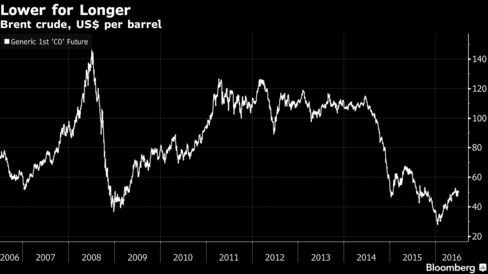
Taylor, who has traded oil for nearly four decades, said one-off factors, including supply disruptions and stronger-than-expected demand growth, helped to tighten the market in the first half, lifting prices.
Demand Growth
“We probably expect demand growth to be slightly less in the second half of the year,” he said. “There is a little less pull from the Far East” and basic Chinese refineries, known as teapots, seem well satisfied after having “overbought” crude in the first months of the year, he said.
The summer driving in the U.S. may not be so bullish for oil because “the refinery system of the world has clearly been able to make enough gasoline, and the gasoline stocks are healthy,” Taylor said.
U.S. wholesale gasoline futures for August delivery — traditionally the peak of the driving season — traded at $1.50 a gallon in New York at 12:01 p.m. Monday, below the price for futures to delivery in September, suggesting current supplies are plentiful. “We don’t see any shortages of gasoline,” Taylor said.
Supply Disruptions
At the same time, “most of the disruptions are beginning to correct themselves,” such as wildfires that halted Canadian output, Taylor said.
The oil price outlook is unlikely to change significantly in 2017 as supply from new oilfields, including the super-giant Kashagan in Kazakhstan and others in the U.S. Gulf of Mexico, offset production drops elsewhere, Taylor said. The wild card for next year is U.S. shale supply, which appears to have reached a bottom, but it’s too early to say whether growth will resume.
U.S. oil production was hit hard by the plunge in oil prices after the Organization of Petroleum Exporting Countries diverged from its traditional policy of adjusting supply to manage prices, announcing in late 2014 that it would maintain output to defend its position in the market. The nation pumped 8.6 million barrels a day last month, down from a peak of 9.6 million in June 2015.
Vitol, which celebrates its 50th anniversary this year and is owned by its employees, didn’t made as much money in the first half of the year as in the same period in 2015, Taylor said. It earned $1.6 billion last year, the most since 2011, as it profited from price swings in the energy market.
5 Comments on "World’s Top Oil Trader Says Prices Won’t Rise Much Further"
Mr. Pockets on Tue, 5th Jul 2016 3:50 pm
despite a track record of not being able to accurately predict oil prices, these people insist on trying to do so. … The results? Predictions that are all over the place, as you might expect.
tita on Wed, 6th Jul 2016 12:14 am
“The wild card for next year is U.S. shale supply, which appears to have reached a bottom, but it’s too early to say whether growth will resume.”
On what information do they rely to make this assertion? Everything indicates that US shale will continue to plunge for a while… Until prices are high enough to stimulate the investors.
And Kashagan also require large investments to produce something more than the 90k bbl/d they are going to resume this autumn. It’s not an easy place to drill.
But in the end, they are not so wrong for oil not rising much further this year. Some DW projects are coming online, and it seems that Lybia is resolving some of its problems. But again, nobody really knows what the future will be made of. As they say, we are in the 1986-1999 (glut caused by a persistent oversupply), not the 2008-2009 (temporary demand plunge).
In facts, we are more in the 1999 situation, with a world rig count at its lowest, than the 1986 situation with plenty projects scheduled and a global production steady for many years.
The real wildcard is KSA and the spare capacity they claim to have. Wait and see.
rockman on Wed, 6th Jul 2016 12:41 am
tita – There you go again: letting facts get in the way of a good story. LOL.
GregT on Wed, 6th Jul 2016 11:17 am
“Until prices are high enough to stimulate the investors.”
And therein lies the entire problem with the world’s economies. Lack of investor stimulation. I’m sure that the pharmaceutical companies can come up with something……
penury on Wed, 6th Jul 2016 5:50 pm
I do not see much of a price increase in the next year barring one of two (or 3 or 4) or more things happening. Until and unless consumer spending increases, enough to re-ignite the production of energy consuming factories, construction, shipping etc,etc, or Paul Krugmans wet dream, of war greater than WWII conducted against the aliens. I do not see anywhere in the world that will be economically able to increase utilization enough to really affect prices.