
Peak Oil is You

Donate Bitcoins ;-) or Paypal :-)


Page added on October 15, 2014

World may not have enough food by 2050: Report
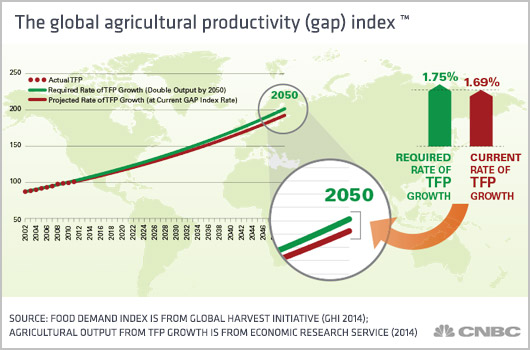
The world may not be able to feed itself by 2050 if it doesn’t increase food productivity, according to a report released Wednesday.
The report, from the Global Harvest Initiative, states that with a world population expected to be at least 9 billion people in 2050, the demand for food, feed, fiber and fuel will likely outpace food production if the current rate of output remains the same.
“This is a call to action,” said Margaret Zeigler, executive director of GHI, a private sector agriculture group with members that include Monsanto, John Deere, DuPont and the World Wildlife Fund.
“Countries need to prioritize agriculture and the growing of food in more sustainable methods,” Zeigler argued. “If we don’t start now, we’ll have a problem sooner, even by 2030.”
Zeigler explained that GHI has done reports on global food productivity over the last five years, but this is the first time the analysis has found food output a major concern.
Doing nothing, Zeigler said, would force hardships on the world’s smaller and poorer farmers, who would likely suffer rising food costs as food supplies fail to meet demands.
It could also damage the environment, she said, by reducing water levels as that resource becomes scarcer from overpopulation and its increased use in agriculture. And sitting still could add to climate change, she said.”We’re also going to see more levels of methane emission from cattle if we don’t learn how to produce more using less or the same resources,” Zeigler said.
Agriculture gaps in India, Africa
The report’s regional analysis uncovers what it calls significant productivity gaps in agriculture:
- At the current rate of agricultural productivity growth in India, domestic production will only meet 59 percent of the country’s food demand by 2030.
- In East Asia, only 67 percent of food demand by 2030 will be met from within the region if the current rate of productivity growth is maintained.
- At current rates of productivity growth, Sub-Saharan Africa is projected to meet only 15 percent of food demand in 2030, which will require significant imports, or food assistance, or opening up new land to development that may not be suitable for sustainable production.
“As the population grows and more people move into the middle class in these areas,” said Zeigler.
“They will eat beef, poultry and more dairy products,” she said. “That’s good for nutrition, but it puts more stress on food resources.”
But at least one area should be able to feed itself and others, according to the study: Latin AmericaOverall regional production there is expected to exceed demand, with Argentina, Brazil, Chile, Paraguay and Uruguay leading this increase in productivity.
The report said that the region will likely serve as a critical source of food and agricultural supply to meet the demand of Asia’s growing and more affluent and urban population.
Food system ‘at risk’
As for ways to increase agricultural productivity, Zeigler said ideas include genetic modified organism seeds (GMOs) of which Monsanto is the world’s largest producer—but she added that all methods should be up for discussion.
Zeigler added that more women in many countries need to be involved in farm production, not only to help increase output but to raise their incomes, which in places such as India, are traditionally low, she said.
“We need a mix of practices, including technologies that are tailored for farmers in their areas,” she said. “That means working on ideas like proper soil analysis and water conservation.”
But not everyone in farming looks at technology as a cure-all for more food.
“There’s no evidence that GMOs significantly increase yields of crops, as many of its proponents claim,” said John Kempf, a farmer in Oho and CEO of Advancing Eco Agriculture, a soil nutrition consulting firm.
“It’s too early to tell if all this technology is good or not for farming,” Frank Aragona, CEO of Agricultural Innovations, an information source for agricultural strategies.
Aragona, who has a master’s degree in forestry, said the worry is that large farm operations can more easily afford the new high-tech advances, while smaller farms can’t, creating a technology gap of sorts.
Putting aside the battle over GMOs and whether technology can help feed the world, most experts agree that increasing food production is imperative.
“The world’s entire food system is at risk if we don’t act,” Zeigler said.
21 Comments on "World may not have enough food by 2050: Report"
Davy on Wed, 15th Oct 2014 1:48 pm
OK, there is the admission that food production is not going to be adequate. Yet again the focus is 2050 instead of 2020 but we have an admission. I thought it interesting the reports on Asia having a food deficit of 1/3 and Africa in serious deficit by 2030. Mak, any comments? or just MSM propaganda as your usual retort to any negative Asian news. What we have to do is to take these reports and go a step further. We have to honestly admit in a follow up report productivity likely cannot be raised and further will likely drop significantly. We can then start embracing real plan B ideas. We have to start addressing food insecurity and famine potential with mitigation and adjustment strategies. Maybe population control can become a central topic to the discussion if the admission is both there is not enough food and productivity likely cannot be raised. Once honesty and reality are part of the equation then real concrete action can be developed. The calls to increase food productivity alone are just further marketing efforts of the industrial food giants. This is a win win for the food giants fleece job. It will allow them to further corner the global food market at the expense of the world’s subsistence farmers.
MSN Fanboy on Wed, 15th Oct 2014 2:08 pm
The social contract will have broken circa 2050.
All our economics are going haywire.
Shaved Monkey on Wed, 15th Oct 2014 4:09 pm
If you feed them they will continue to breed and need.
noobtube on Wed, 15th Oct 2014 4:46 pm
This is the same low-grade trash that was screaming about how Zimbabwe would starve because Mugabe kicked out all those leeching scumbags out of the country and returned the land back to native Africans.
Hmmm… I wonder why “the West” never decided to check back to see if their bullshit turned out to be true.
“the West” has this inferiority complex that anyone in Asia or Africa cannot possibly exist without “the West” leeching off them.
The world existed before Americans, quite fine. It will exist WITHOUT Americans, quite fine.
GregT on Wed, 15th Oct 2014 5:40 pm
The Price of Bad Governance in Zimbabwe:
Mugabe took over a country with a small but honest and efficient administration, a well-educated minority and a people who, despite all the struggles and conflicts of the past, had the second highest standard of living in southern Africa after South Africa.
At the same moment, in time China emerged from its long night under Mao Tse Tung — its economy was at about the same stage as that of Zimbabwe, 3% urban, the rural poor in a desperate state with millions dying from starvation each year, low incomes — perhaps half that of Zimbabwe and barely able to stand up in the global community. Isolated and shunned.
Had we adopted the approach taken by Deng Zhao Ping in 1980 (“it does not matter whether the cat is black or white, does it catch mice”?) and our economy had grown at 10% per annum for 34 years, our GDP today would be sitting at over US$200 billion. That is nearly half that of South Africa and Nigeria.
Average incomes would be US$17 000 a year and we would be approaching developed country status. We had the potential — well educated elite, rich natural resources, good climate and soils and a large regional market, as well as open access to world markets.
Instead, we have one of the lowest incomes per capita in the world, all our social indicators are negative in regional terms (infant and maternal mortalities, etc) and right now we are unable to pay our civil service decently.
Our public administration is viewed as one of the most corrupt in the world and is bloated and inefficient.
If we forget what we might have become with different policies to guide our society and just examine what we have done with the resources we did control through the past 34 years, then we see an equally dismal story.
In the first 20 years of our Independence we borrowed over US$10 billion from the international community and multilateral financial institutions.
We had an open door to very soft loans and by 2000 we had become a heavily indebted country.
But our record was much worse than that — I estimate that by 2000, we were systematically taking out of our economy a third of GDP in various forms of corruption — this amounted to billions of US dollars.
Price and exchange controls were used to fleece the private sector and transfer billions of dollars of revenue and income from the private sector to the state. Inflation from 2000 onwards did the rest and by 2008, all savings accumulated from 1896 had been wiped out.
All banks and other financial institutions were virtually bankrupt by 2008 and despite inflows of 30–40% of GDP from remittances and foreign aid, the country was unable to feed itself or pay for the most basic services.
The productive sector had shrunk to 30% of what it was in 1980. Zimbabwe was in all economic respects a “failed state”.
South Africa, concerned about the effect that the collapse in Zimbabwe was having on its own society, moved to try and stop the deterioration in our society and economy.
The result after two years of tough negotiations was the Government of National Unity in 2009 following Zimbabwe’s sham presidential run-off of June 2008.
That brought some sanity and relief with the economy bouncing back strongly from 2009 to 2012, only to grind to a halt again in 2013.
The election results of July 2013 put the whole economy into reverse and by the end of the year, revenues to the state were in decline and the banking sector was once again in crisis and unable to honour obligations to depositors.
This situation has not improved and the country’s economic situation is again driving the reform and change agenda. If we do nothing to restore confidence in the state and engage the international community to unlock our economic potential urgently, we are going to be in big trouble by the end of May.
Everyone knows this, but the people who have the power and the responsibility are basically incapable of doing the job. As we have been so often in the past, we are again in crisis and it is difficult to see how we can get ourselves out of the deep hole we have dug for ourselves. Radical measures are urgently needed.
We were all so hopeful that this year we would have something to celebrate other than empty memories of past liberation war achievements and sacrifice.
The reality is that we have nothing to celebrate. We have failed our people and for all those who had so much hope for Zimbabwe, it is a sad day.
http://www.theindependent.co.zw/2014/04/17/price-bad-governance-zim/
Yup, Zimbabwe is doing real fine.
noobtube on Wed, 15th Oct 2014 6:10 pm
I didn’t see anything in there about starving people, which is what CNBC and other American degenerates were screaming about in 2008. It was so sweet to see the American financial system collapse, later that year, as they were screaming about Zimbabwe corruption, back then.
In fact, all the article seems to whine about is that they can’t get rich off the people and live like the foreign leeches in South Africa.
The American scumbags were yelling at the top of their lungs how people were suffering and could not afford to buy bread.
Is that happening? I thought not.
So, once again, American trash is screaming about how bad Africa is, like they did with AIDS.
Oh, you forgot about the rampant hysteria American filth was spreading about how there was an AIDS epidemic in Africa, in the 1980s?
Guess what? The population of Africa has BOOMED since the 1980s.
Americans are fixated with genocide because they are the devils on this Earth.
Americans are THE OVER-population problem.
GregT on Wed, 15th Oct 2014 6:31 pm
All banks and other financial institutions were virtually bankrupt by 2008 and despite inflows of 30–40% of GDP from remittances and foreign aid, THE COUNTRY WAS UNABLE TO FEED ITSELF or pay for the most basic services.
noobtube on Wed, 15th Oct 2014 6:50 pm
If Zimbabwe was unable to feed itself, why does Zimbabwe still exist?
According to the American trash, Zimbabwe should have collapsed back in 2008.
But, it didn’t.
According to American low-grade garbage, Africa basically shouldn’t exist because of war, disease, and famine.
Yet, Africa is still around and in fact doing better now, than ever.
Americans didn’t forEsee its own financial collapse in 2008, yet, is supposed to be an expert on Africa and Asia.
Americans eat their own shit. Then, ask for 2nd helpings.
Don’t Americans ever get tired of eating their own shit?
GregT on Wed, 15th Oct 2014 7:07 pm
You are only digging yourself into deeper hole Noob.
Davy on Wed, 15th Oct 2014 7:52 pm
Noobster, accept defeat son. You got your clock cleaned. There will be another day to battle the evil Americans. Chill and go play your Wii U.
noobtube on Wed, 15th Oct 2014 7:58 pm
Americans are the experts on the problems with everyone else… BUT THEMSELVES.
Must be that American exceptionalism I keep hearing about.
Kenz300 on Wed, 15th Oct 2014 9:08 pm
Maybe we should stop adding 80 million more mouths to feed every year………..
If population stabilized then problems like food shortages, water shortages, declining fish stock, unemployment and Climate Change might be easier to solve.
Endless population growth is the worlds worst environmental problem.
Makati1 on Wed, 15th Oct 2014 9:45 pm
Davy, we will both be dead before 2050.
The USSA will be third world, if it exists at all. As for Asia, you only hope you are correct. But with the new Dust Bowl creeping East from California, I would not be surprised if the US would be importing more than the current ~20% of it’s food before long. You are going back to the time of fruits and veggies ‘in season only’. But you have lost the ability to family farm for the most part and even fewer know how to garden or store home-grown food. Those that do/can will be over-run by the armed mobs that cannot. Wait and see. Missouri is not immune. See Ferguson and St Louis.
I don’t see the same future you do. That’s why I chose to move to the Ps over 6 years ago. I buy little that comes from the States. I support my neighbors and convert to Pesos ASAP after I receive my income. I don’t trust banks. Especially US based ones.
Freedom from debt is the most wonderful feeling in the world. I have been totally debt free for over 12 years. Perhaps that is why I have no health problems at age 70?
I have nothing I could not leave behind if I had to evacuate. ‘Things’ are NOT important. That is a hard lesson to truly unlearn. It is brainwashed into every American mind from birth, along with America’s ‘exceptionalism’. Both are lies.
I wish you all the success on your farm and with your family. You will need it more than me.
Beery on Thu, 16th Oct 2014 6:44 am
The world doesn’t have enough food NOW. That’s why people starve in various third world countries from decade to decade.
bobinget on Thu, 16th Oct 2014 10:45 am
Except in Ebola effected African states, food prices are actually FALLING .. this year.
OVER PRODUCTION in the US and Brazil caused lower commodity pricing.
Consumers in the developed world are benefitting from the lower food and (of course, oil) prices.
These low prices will boomerang into unemployment
in the oil and agriculture sectors forcing SMALL operators out. Milk in the UK, for instance is already
BELOW cost of production. Back in the day a dairy with
30 cows could make a living. Later, after milking machines, it took one to two hundred animals. Today,
even ‘small’ 200 heard dairy are not profitable compared to completely automated thousand cow
operatons.
Early on, vertical oil wells were fracced once.
Today we have wells drilled five to seven MILES
horizontally and fracced God knows how many times.
Obviously, when a tight shale well begins to poop out
many more wells can be drilled from the same pad.
At the end of the decade (2020) we should be feeling
the effects of both oil and fuel shortages.
The result form all this automation is to force small operators with limited capital to sell out or go broke.
Davy on Thu, 16th Oct 2014 10:57 am
Bob, economics is as important to oil and food as production. The volitility of the economics are symptomatic of a crisis period. A healthy economy does not have such swings in the sense of our swings are related to limits of growth and diminishing returns. The difference is sustainability going forward currently is being damage by the swings. The goldilocks range has been compressed leaving little room for healthy swings. Swings are now a sign of instability not healthy market moves we have known in the past.
PrestonSturges on Fri, 17th Oct 2014 1:05 am
Plant some fruit trees! They won’t keep us from starving, but they will fend off scurvy.
HIruit Nguyse on Sat, 18th Oct 2014 7:06 pm
Makatai1:
I always considered your comments to be outstanding, and followed them. I never knew you emigrated to the Philippines from the USA before today.
I am on the cusp of giving up things for freedom at this time in my life.
If you have any Blog or information to share about Walking Way from Empire (as GMcP would say), I would love to know how you accomplished it step by step.
There are so many people who wish to vacate and leave their chains of bandage behind them, but do not know the procedure to follow.
HN
Osh University on Tue, 20th Feb 2024 12:29 pm
Osh University consistently ranks among the best medical universities . With a focus on academic excellence and global recognition, it’s a top choice for aspiring healthcare professionals.
Tempo Garments on Tue, 20th Feb 2024 12:30 pm
Discover top-notch mens shirts in Pakistan at Tempo Garments. Elevate your style with our premium collection crafted for men, alongside options for women and kids.
Shalamar Hospital on Tue, 20th Feb 2024 12:31 pm
Shalamar Hospital’s dental clinic in Lahore is committed to providing top-notch dental services, combining expertise with a patient-focused approach for your complete satisfaction.