
Peak Oil is You

Donate Bitcoins ;-) or Paypal :-)


Page added on October 5, 2016

Why Oil Will Power Past $100
Summary
In recent years, many factors have caused a big drop in the price of oil.
Many of these changes that have hurt oil seem permanent; trends toward alternative energy in particular are accelerating.
However, the price of oil won’t stay low forever. It will rebound and hit $100/barrel again in the next few years.
Even people opposed to fossil fuels will put up with oil for awhile longer; it’s a far better fuel than coal.
Oil is simply too indispensable for humanity for prices to stay this low.
In 2014, crude oil (NYSEARCA:USO) got hit by a perfect storm of negative factors. On the demand side, the world economy slowed, China’s entered a major spot of turbulence, the US dollar has reached multi-year highs. All these pushed the price of oil lower. And on the supply side, major technological breakthroughs revealed a more robust oil supply than we’d expected ten years ago.
Over just the past decade, we’ve gone from near $150/barrel oil and long serious discussions about “peak oil” to the idea that oil is in its twilight days. More than a few reasonable investors are suggesting the oil majors should unload their reserves now, even at today’s discounted prices, since they could become nearly “worthless” within a generation or two. A branch of the Canadian government, for example, is now forecasting what will happen to Canada if oil hits $0 per barrel in the near future.
Is this turn in sentiment justified? My friend and gracious debate partner, Finsight Funds, makes the affirmative case here.
He suggests the price of oil will never again see $100/barrel. He offers several reasons for this view, focusing in particular on which alternative energy is picking up momentum.
And right from the top of the debate, I’d like to agree with that point. Unlike in the, say, 1970s, solar in particular is making huge leaps on an affordability and efficiency basis. While you could argue solar isn’t cost efficient without government subsidies – full stop – 10 years ago, the math today is much more competitive.
In fact, I’ll go so far as to say that I could see renewables doubling their share of global energy supply and reaching 30-40% of the total pie over the next generation. We do appear to be at a point of rapid transition; a concept Finsight elaborates more on in his article.
With all that said, I don’t think a brighter future for renewables necessarily means that oil is on its last legs. In this article, I’ll argue that oil is the best and most indispensable of the fossil fuels – and while coal in particular may be heading the way of whale oil sooner than later, we’ll still have petroleum (and oil price spikes) with us for several more generations.
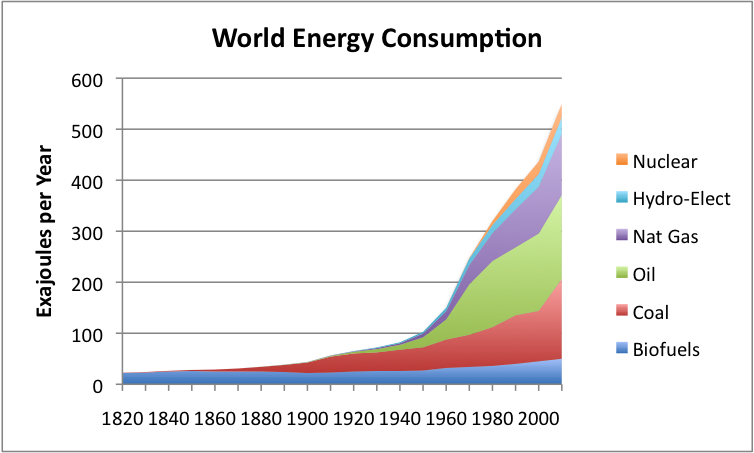
Oil has already declined from 48% of the world’s total energy usage in 1973 to just 35% by 2008. Despite that, actual oil usage still rose significantly over those years (source).
Global energy consumption will continue to rise in coming decades and there’s plenty of space for oil – even as a shrinking portion of the total pie – to continue serving in a few categories where it provides the most bang for the buck while renewables take a larger share of the overall picture. (All data in this article from Robert Bryce’s book Power Hungry unless otherwise cited)
Why We Still Need Oil
There are at least four main reasons why, even as environmentally-aware persons, we should think twice before kicking oil to the curb. First, oil is by far the best source of transportation fuel that we have. Yes, electric cars are coming online quickly and depending on how things develop, they may serve as a practical wide-scale replacement for combustion cars over the next 10 or 20 years (then again, they also may not – it depends on batteries).
However, even if we grant that gasoline-powered cars are heading into decline, you still need oil for transportation. How will you power airplanes, trucks, and cargo ships? It’s one thing to power a few thousand pound car for a couple of hundred miles on an (expensive) battery. It’s an entirely different matter to fly a jet across the ocean.
A 2010 Ford Fusion puts out 175 horsepower. That’s not at all impossible to do with an electric battery. A Formula 1 race car uses 750 horsepower – that’d require more than 4x the battery for the same range, a bigger challenge. A Boeing 757, on the other hand, puts out 86,000 horsepower. The technology that makes electric cars possible simply won’t work for airplanes, you’d need batteries hundreds of times more dense.
As it is, a tank of gasoline comes with more than 50x as much power per unit of space inside a vehicle as compared with the most efficient batteries we have today. You could make batteries 5x more energy-dense (well maybe, you could try) and they’d still be a far cry from what oil can provide with today’s technology. Also, gasoline can be replenished virtually immediately (as compared to several hours to recharge a battery) and gas tanks are dirt cheap and easy to fabricate, as opposed to high-tech batteries, which require rare metals and typically cost thousands of dollars.
So while electric cars are coming quickly, especially for people that don’t need long driving ranges, we’re still going to need oil (and lots of it) for transportation. There’s no practical substitute for trucks, planes, or heavy vessels coming in the near term.
Yes, you can use natural gas (NYSEARCA:UNG) to replace oil in some of these use cases. But it’s still a fossil fuel and one that is very closely tied to oil at that. The prices of oil and natural gas tend to follow each other, and profitability of major projects, such as LNG plants, are tied to the price of oil. Thus, if natural gas becomes more popular, it would likely have the effect of also boosting the price of oil, due to the moderate substitutability of the two goods. (And as for why the US probably doesn’t have unlimited cheap natural gas for the next 50 years, as some optimists are now forecasting, see this book).
Oil is simply too good at what it does – safe to transport, light, exceptionally energy-dense, and affordable, that it will remain a key fuel for transportation, especially of large vehicles, for at least the next few decades. And with annual aviation traffic growing at a 6% rate compounded (doubling every 12 years), we’ll need lots of jet fuel in the future.
Second, it’s unclear how we’d get many other goods that are oil-byproducts if we dramatically cut back our oil usage. Aside from the obvious things we use oil for, modern civilization is deeply reliant on petroleum for fertilizers, chemicals, plastics, lubricants, solvents, synthetic rubber, roofing, medical devices, fabrics and so on.
Sure, you can make (often inferior) versions of these oil-based goods, but generally at considerable time, expense and often environmental degradation. For example, you can make an alternative to asphalt out of potatoes if you really wish. But you’d soon find it a lot more expensive to pave roads for your electric cars to drive on.
While out of sight to most wealthy folks, there’s another key argument for keeping oil around. More than a third of the world’s population still depends on solid fuels, such as straw, dung, wood, and coal, to cook their meals. That’s two billion people we’re talking about. And they’re often doing so inside their houses with little ventilation.
This is both a human crisis and an environmental one. In a world as modern as ours, it’s difficult to imagine that two billion people still have to use primitive fuels to cook with, and that the people exposed to the noxious indoor air pollution this causes are primarily women and children. Additionally, these fuels are very inefficient and cause tremendous amounts of air pollution; witness the haze you find in rural areas of third-world countries such as Guatemala despite a near absence of cars.
The lack of useful fuels doesn’t just impact cooking. Wood and charcoal are widely used for heating and in place of electricity. A house where I lived in Guatemala for several months had a firewood-powered water heater. If the owners didn’t have money for firewood any given day, we’d burn trash instead. This produced fine showers, but with plenty of environmental harm attached.
Remember the massive landslides in Guatemala last year that killed at least 271 people? The cause of this is deforestation. Deforestation occurs because people cut down the forests to heat their houses and cook food. Without the forests, there’s nothing to hold up the hillsides when torrential rains come.
Give poor people propane or kerosene, and this wouldn’t happen, and you prevent both human misery and far broader environmentally degradation. Oil is a far superior fuel to charcoal and other such primitive fuels, and we owe it to the world’s poor to give them access to reliable affordable and safe forms of fuel.
Similarly, the destruction of the Amazons in Brazil is directly related to the use of biofuels – a woefully inefficient substitute for oil. This is an all too typical scene in South America:

Rainforests in Indonesia are also being destroyed at a rapid rate to make inefficient fuel out of palm oil. Proponents claim these are “green” fuels, but they’re actually turning the planet brown at an alarming rate.
Rather than destroying some of the world’s last pristine natural areas, couldn’t we drill a few more wells in Siberia, the US Midwest and other such low-impact areas that are of far less importance to global biodiversity?
Finally, we still need oil because it makes the transition to alternative and renewable fuel sources easier. The world still uses roughly 70 million barrels a day of oil equivalent in the form of coal. (Amazingly, that’s not substantially less than the amount of actual oil we use)
A wise and green plan for energy transition would utilize cleaner fossil fuels, such as petroleum and natural gas, along with uranium, to aid the transition away from coal. The amount of mining and steel-making needed to base an energy grid on renewables (particularly wind) is extreme, and if we’re not careful, we’ll end up using way too much coal in this process.
Witness Germany – a top-tier developed nation – seeing rising carbon emissions and flat coal usage in recent years despite investing overwhelming amounts in wind and solar capacity. If even Germany can’t transition effectively from coal directly to renewables (unaffordable battery storage still being a key problem), it’s unreasonable to expect poorer countries not to use oil and natural gas as a cleaner intermediate stop as they transition away from coal.
Oil Remains In A Cyclical Pattern That Ensures Another Spike
Coal (NYSEARCA:KOL) still accounts for 30% of total global energy usage, and half of new energy usage between 2000 and 2012 around the world was with coal. Not only is coal not in terminal decline yet, it’s actually still a growing energy source!
It’s simply unthinkable that the world would stop using oil while coal is still so widely in use. Coal causes far more harm – both to human health and the climate – than oil does. It’d be silly to focus primarily on curtailing oil usage before taking care of our coal problem.
So oil isn’t going anywhere in the near term. There’s no plausible economic replacement for oil as a wide-adoption transportation fuel in the near term, and even if there were, we’d still prefer to use oil/natural gas rather than coal for electricity generation. So you don’t need to worry about oil falling out of use in the next twenty years.
Oil Isn’t Going Away, But Is Its Price Going Up?
That doesn’t guarantee the price will go back up, however. Critics claim that supply for oil now permanently exceeds demand.
In their favor, they make a few points. First, gasoline demand has leveled off in many places, including the US. Some of this is due to slow economies, but much of it is due to energy efficiency. Higher mileage standards, changing consumer preferences away from sprawl and long commutes, and improvements in public transportation have made a difference.
Second, the oil boom in the US unlocked a large new supply that hadn’t been forecast by the “peak oil” crowd. This is very much true, US oil production is up by 4 million barrels a day over the past five years, accounting for most of the increase in global supply over that stretch. The US now accounts for roughly 10% of global petroleum production, up from around half that a decade ago.
The camp that suggests oil prices will stay low forever expects that falling demand for oil due to things such as electric cars will kick in before supply becomes tight again.
This, I’m not sure about. The new energy finds (in both oil and natural gas) deplete quickly, unlikely traditional wells. Many of the bankrupt E&P firms collapsed because production fell off far more quickly than the companies’ geologists had anticipated – see Sandridge and the fiasco with their SandRidge Mississippian Trusts (NYSE:SDT) (NYSE:SDR) if you want a concrete example with numbers.
Many people say that the new natural gas firms made most of their money during the good years flipping land leases, rather than actually producing gas. So, durability of these new resources is a question mark.
Also, scalability to other countries is an issue. The US can see new drilling technologies take off quickly, since private individuals own mineral rights. The US is an exception here, virtually no other countries permit individuals to own mineral rights, and thus techniques such as fracking will take far longer to go global, held up by plodding state bureaucracy and far more concentrated NIMBY-ism (since foreign land owners have less incentive to permit wells on their land).
While fracking has been a big temporary boost to global energy supplies, it is not clear how long that boost will last. And on the flipside, the low price of oil itself plants the seeds for a high price later. The majority of the world’s oil still comes from states, such as OPEC members, that rely on oil prices to fund their budgets. These countries are investing far less in capital expenditures now, since they are forced to focus on mere survival, rather than planning a long-term budget.
Oil states such as Venezuela have already collapsed and numerous others appear headed in that direction if prices stay low for too long. The collapse of petro-states, by itself, takes vast amounts of oil off the market and sends the price back up. When citizens have spent decades used to living off oil, and the government suddenly can’t do its part anymore, citizens will protest, voting in radical governments and overthrowing totalitarian states.
All you need is for two countries the size of Venezuela to disconnect from the global oil market due to internal instability and you remove the equivalent of all the oil US fracking has added to the market over the past decade.
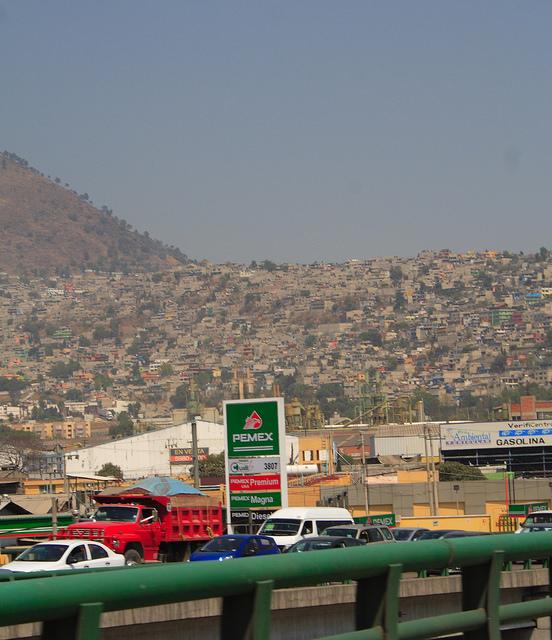
Additionally, a prolonged low price of oil will, by itself, create vast new demand in emerging markets. Unlike in the US and Europe, most emerging markets don’t care about sustainability, and will gladly use every drop of oil that they can while making a profit. Drive through emerging global metropolises, Mexico City’s fringe (pictured below), for example, and you’ll see 10-mile stretches of highway like this – stalled out traffic, with gas stations and endless low-end sprawl (source):
Emerging markets have been in a down cycle; however, signs are appearing that this bad stretch is breaking. Low food and oil prices are in fact a big part of this, relieved of inflationary tensions, consumers have more money for discretionary goods. The manufacture and transportation of these products require large amounts of electricity and gasoline. Thus, low prices actually stimulate the very economic growth needed to drive oil prices back up.
If you look at GDP growth and energy usage, they are almost perfectly correlated (to the extent economists can use Chinese electricity data as a more accurate measure of activity than official Chinese GDP claims). The next boom in emerging markets will create large new drivers of demand for oil, that much is certain.
Mark My Words: Oil Will Be Expensive Again One Day
There are plenty of things that could make oil go back to $100/barrel sooner than later. The rise of more militant and nationalist governments, which does appear to be a trend at this point, could do it on its own. Similarly, tensions are rising in the Middle East, and should the increased terrorism of late continue, it’s not hard to imagine the West’s eventual response causing a massive rally in oil.
But even excluding more black swan type factors, oil almost inevitably must rebound one day. It’s simply too useful a fuel for it not to. The low price of oil makes it exceedingly tempting to use for both monetary gains and for the betterment of the world’s billions of poor people. Sure, some environmentally-minded folks in rich countries may voluntarily swear off oil usage, but the majority of emerging markets won’t, and given demographic trends, they’ll soon be the marginal buyer of petroleum.
Even from a sustainability standpoint, it’s far better that we use oil, rather than coal, during the transition period where we don’t yet have enough renewable resources with which to power the world.
Great changes are afoot in the alternative energy sector. After decades of promises, actual technology is starting to catch up to the hype in various areas. However, the transition period will be one measured in decades. Remember that coal came into use in the early 1800s, but it wasn’t until 1885 that coal finally dethroned wood as the top fuel source in the US.
I suspect the people proclaiming the death of oil will similarly be surprised – oil has already peaked in its importance to humanity, but that doesn’t mean it’s heading straight to the grave either. Several of the things that made oil cheap recently – such as the strong US dollar, emerging market slowdown, and fracking breakthroughs are bound to diminish in importance in coming years. Oil is very much a boom and bust commodity, driven by powerful cycles that will remain in force for many years to come.
70 Comments on "Why Oil Will Power Past $100"
Hello on Wed, 5th Oct 2016 6:41 am
Not good news for the etp peddlers.
Or is it? Opens the door for etp version 3, which is similar to version 1, predicting $400 oil by 2030 or something.
Davy on Wed, 5th Oct 2016 6:59 am
Same old shit another day article. When these status quo minds talk about the future with energy they consider a constant economy. You know a steady state of markets, price with rational demand and supply relationships. The steady state is growing growth of some kind with innovation and progress. With this as a constant all kinds of beautiful outcomes are possible. Innovation with substitution powers transition. Progress lifts the poor up and the rich become more efficient freeing up more resources for more growth. This article accommodates all the bad in the world today with the understanding that markets and price will adapt and shape a new reality that is an old reality of growth. This is the same old song and dance because this is what has been reality for humans and this steady state has habituated humans to a growth mentality. The idea we may have shifted to a decline and deflating global economy with all other activities in relation to this is not considered. If macro deflation is the case none of these projections are valid. Every one of the projections and predictions is just a shit in shit out.
brough on Wed, 5th Oct 2016 7:36 am
If oil is going to reach $100/barrel, somebody is going to have to come up with a whole new economic model. The present model is way past it’s sell by date.
Using free market moneterism the bank system is going to have to find a whole shed load of capital to pump it up. And if someone tells me about ‘helicoper money’, I don’t think the world got enough helicopters.
joe on Wed, 5th Oct 2016 8:01 am
Everything the FED and treasury have done has only impacted the ten year view. Bonds are maturing and need to get refinanced. That means more of the same. Does the treasury want a high rate on maturity? To have high rates now would not improve outlook, only confidence, for some. What does that mean? It means some people want another building boom, like banks and builders, yet bad debts remains on many banks books, particularly Europe and China. Oil needs consumers. A price spike will only make alternatives more attractive, risky investment will go there, not into say housing. The next price spike will hurt the oil industry.
makati1 on Wed, 5th Oct 2016 8:33 am
I see Alpha is still seeking suckers for their investment offers. Headline told me to not waste time reading. I could smell the bullshit even over here. lol
rockman on Wed, 5th Oct 2016 8:44 am
Always interested in future oil price predictions. At least that from someone who correctly predicted $20/bbl in ’02, $40/bbl in ’04, $60/bbl in ’05, $80/bbl in ’08, $100/bbl in 3/2008, $145/bbl in 7/2008, $31/bbl in 12/2008, $70/bbl in 6/2009, $100/bbl in 2/2011, $77/bbl in 10/2011, $100/bbl in 12/2011, $78/bbl in 6/2012, $110/bbl in 9/2013, $75/bbl in 11/2014, $30/bbl in 2/2016, $50/bbl in 6/2016.
Now I MIGHT pay attention to someone who had made those predictions; maybe even if he hit only 75%; maybe even 50%.
The rest of the price predictors? I would suggest a Ouija board first. LOL.
shortonoil on Wed, 5th Oct 2016 9:25 am
“Many of these changes that have hurt oil seem permanent; trends toward alternative energy in particular are accelerating. “
Between 1960 and 2005 world production grew at an annual rate of 5.47%. Between 2005 and 2014 it grew by 0.43%. Between 1960 and 2005 there was no inventory build. Between 2005 and 2014, with a production growth rate of 8% of the previous growth rate, inventories exploded. Now who exactly is going to be buying this fantasy $100 oil. They sure don’t want it at $50, but this author thinks that we are stupid enough to believe that the market is going to want it at $100.
Maybe the author thinks that Martians are going to be looking for for a little extra oil. There sure hasn’t been anyone interested in it for the last decade from this planet. As we have been saying for some time the only increase in demand is coming from the petroleum industry itself. They are requiring more and more of their own product to produce it. If that surprises anyone they are not only from a different planet; they just came in from a different universe.
Kenz300 on Wed, 5th Oct 2016 9:46 am
Electric cars, trucks, bicycles and mass transit are the future. Fossil fuel ICE cars are the past.
Think teen agers vs your grand father. cell phones vs land lines.
NO EMISSIONS. Climate change is real.
Save money. no stopping at gas stations, no oil changes. less overall maintenance.
penury on Wed, 5th Oct 2016 10:04 am
People would probably “want” the oil at 100 d a barrel, but very few would be able to buy. The use of oil for manufacturing is dropping, oil for transporting manufactured goods is decreasing. The price can be whatever,as far as renewables go, lets go, the sooner the better, if the U.S auto industry is forecasting sales of 18 million petrol users in 2016 I think we have a way to go.
shortonoil on Wed, 5th Oct 2016 10:15 am
” Now I MIGHT pay attention to someone who had made those predictions; maybe even if he hit only 75%; maybe even 50%. “
On an annual price bases we have hit that criteria with a ±4.5 % margin of error for the last 57 years. I have posted this graph about 50 times, and for some reason you seem unable to see it?
http://www.thehillsgroup.org/depletion2_007.htm
All you have to do is plug the year into the Etp function and that gives the value of Etp.
Etp = 1.4*10^5 / (1+ 368.72e^(-0.053x));
where x = year with 1900 as year zero (0). That is 1960 = year 60, 2001 = year 101, etc.
Then use the graph above to give the price.
After 2012 using the function from this page gives the forward maximum price. That is going down.
http://www.thehillsgroup.org/depletion2_022.htm
May I suggest a good optician, and retiring the Ouija board. You may be wearing the numerals off of it, which makes them hard to see.
Of course you could wait another 56 years to see how the Etp function turns out? Have someone type it up, and tape it fast to your headstone when the time comes.
Brent01 on Wed, 5th Oct 2016 10:52 am
If oil goes to $100 a barrel again, this country will be going into a Depression this time around considering that there are parts of our country that never have fully come out of the last recession. Too much Greed on Wall Street for anything to improve for the working man, ya the one who drives this economy.
Apneaman on Wed, 5th Oct 2016 11:02 am
Predictions – ha. Ok, in the aggregate what difference has any prediction or collection of predictions ever made? Has anyone or government stopped an oil bust with a prediction? Just look at all the people in the industry, at all levels, who are completely caught off guard every time the bust hits. Standing there with that stupid stunned look in their eyes with no plan B. Oil predictions are as useful as Dallas Cowboys predictions. If the prediction is for the Cowboys to win, everyone will still watch the game and if it’s for the Cowboys to lose everyone will still watch the game. Same as oil, no matter what the predictions are, the game goes on with everyone playing as if the game is eternal. That Mentality – short-termisim, is why the humans are going bye bye. Blame it on evolution. Ironically, countries who practice short-terminsim to the fullest are the ones who gain power and sometimes become the empire….in the short term.
mx on Wed, 5th Oct 2016 11:47 am
Oil At $100 requires a market boom/bubble of some kind.
I don’t see a real estate bubble in the near future, unless all of the Chinese Rich move to the West Coast.
Also, you’ve got the EU destroying itself with Hayek economics ( Austerity Budgets ), so no growth there.
No Boom No $100 oil.
mx on Wed, 5th Oct 2016 11:49 am
Secondly, a $100 boom would take TESLA to $1000 a share, and Blow Up Solar Stocks.
So, the play here is to get into TAN NOW, and buy some TESLA.
Conrad Maher on Wed, 5th Oct 2016 12:20 pm
The slow growth in GDP is upon us because of the high price if energy. The world economy has not adjusted to these high prices. Of course, growth was always limited by the decline in the supply of all essential commodities. Oil became much more important as we took the turn (rightly or wrongly to the personal auto) and use in manufacture. It does make sense to try to substitute oil products for wood products that consume forests. None of us can predict the short or long term price of oil. We never know how useful looking backwards will be. Over 55 years experience in the upstream end of oil and gas suggests to me that we have a temporary balance between the needs of OPEC and the price at which hydraulically fractured oil production can be put on the market and return an acceptable profit. It looks like this balance could be in the range of $40 to $50 per barrel for another decade or more. We live in interesting times.
rockman on Wed, 5th Oct 2016 12:52 pm
Shorty – “On an annual price bases we have hit that criteria with a ±4.5 % margin of error for the last 57 years.”
Wow! That’s great…congrats. So in 1959 your group predicted (+/- 4.5%, of course) an ANNUAL oil price of $11 in 1998, $27 in 2000, $94 in 2008, $54 in 2009, $96 in 2013 and $44 in 2015. Just predicting a $96/bbl price in 4 years at the time when it was only $54/bbl is amazing all by itself.
That’s amazing to have been that accurate to predict the current price 57 years ago. Almost unbelievable. LOL. But after you post your 1959 published report no one could say you didn’t.
Richard Sittel on Wed, 5th Oct 2016 12:57 pm
Three years ago my neighbor bought an electric car, now he has two. His newest car goes 3X as far on a charge as his old one. 150 miles, instead of just 50. His new car cost less than his old one too. I’m buying an electric in the next few months, it will go 200 miles per charge instead of 150. Do any of you oil people know that electric cars will travel 25 miles on $1 of electricity? So if gas costs $1 a gallon and you get 25 MPG, you can compete with an electric. But, once my neighbor puts up his solar panels it will be like driving for free.Just imagine gas going up to $4 gallon again………..LOL
rockman on Wed, 5th Oct 2016 1:03 pm
Conrad – “It looks like this balance could be in the range of $40 to $50 per barrel for another decade or more.” And would you have taken that same position in 2004 when the annual price of oil was around $40/bbl? If so how would you have been explained the annual price increase more then doubling in not “a decade or more” but in just 4 years going to $96/bbl in 2008?
And would you have been as confident in your 2004 prediction as you are in your current expectation?
poop on Wed, 5th Oct 2016 1:04 pm
Oil me up Deter!
rockman on Wed, 5th Oct 2016 1:15 pm
mx – I see the world as you do. When folks predict future oil prices they are really predicting future economic vitality…whether they realize it or not. Just look at the fluctuations of oil prices and production in just the last 8 years. It had little to do with the PO date (whenever that might be), new oil discoveries, oil depletion, political upheavals, etc. Prices the CONSUMERS were willing to pay changed dramatically from time to time while those factors mentioned above were still out there.
So what changed how much OIL CONSUMERS could pay for refinery products? Maybe their financial condition played a minor role…ya think? LOL.
Joe D on Wed, 5th Oct 2016 1:22 pm
Mr. Hill, is the equation 1.4E2/(1+368.72e^(-0.053x)) and not 1.4E5?
Example: for 1.4E5 and @x=60 the equation yields 8571.36…
For 1.4E2 and x=60 the equation yields 8.57…
Or am I doing something wrong?
rockman on Wed, 5th Oct 2016 1:42 pm
Richard – “Do any of you oil people know that electric cars will travel 25 miles on $1 of electricity?” Of course we do. So what? LOL. Our profitability has nothing to do with any us buying or not buying an electric car. Like many you seem to think the oil patch is concerned about any and all alternatives. In reality they are very low on our list of concerns. A lot of companies got slaughtered and hundreds of thousands of hands lost their jobs in the last 2 years. And that didn’t have a f*cking thing to do with e-cars. LOL.
If I needed a new car right now I would look at the e-cars just like some oil patch hands I know are doing. But since I own 2 paid off ICE’s that should last me another 8+ years why would I spend tens of thousands to save a few thousand?
Which is one of the big problems with e-car growth: saving money on miles driven often doesn’t justify investing in a new vehicle if you already have what you need. Same problem for new high mpg ICE’s: they are having a small impact of the average mpg of the entire ROLLING FLEET.
In time replacements will have an impact. But the key word there is “time”. On average folks are hanging on to their paid off ICE’s for more then 10 years.
dave thompson on Wed, 5th Oct 2016 2:01 pm
@Richard Sittel, Sounds great until you include the cost of replacing the batteries. So in another couple years let me know how much you paid to replace the batteries in that first car.
Charles Accetta on Wed, 5th Oct 2016 2:35 pm
Someone is sitting on a ream of long-term futures commitments. Oil will go up, of course. But not because denand won’t continue dwindling, but because $40bb oil is going to curtail new exploration for smaller players – the capitalization required is no longer there when you’re using projected yields to cover outstnding debt loads and day-to-day costs. Fewer pumps, less oil, higher prices. Goodbye Jed Clampett.
Elmer on Wed, 5th Oct 2016 3:22 pm
How much of the lowered cost of e-cars is a result of significantly lower oil prices over the last couple years? Seems like it would be a big trend component in the manufacturing process and in the fuel consumption component wherever electricity is generated from petroleum products. Same on the manufacturing end with alt energy products such as solar panels and wind turbines….reduced oil prices mean lower mining, transport and production costs in comparison to years past. If oil price spikes, the production cost of alt energy increases. This link to petroleum isn’t discussed when the glowing promise of alt energy is promoted. I’m a proponent of alt energy but many unnecessary dead-ends in its evolution could be avoided by not ignoring the inconvenient truths. And like everything else in our society, money and hopium can really corrupt the truth.
ghung on Wed, 5th Oct 2016 3:24 pm
dave thompson said; “Sounds great until you include the cost of replacing the batteries. So in another couple years let me know how much you paid to replace the batteries in that first car.”
My neighbor has a 2011 Leaf and he just had a new battery put in the trunk. The old battery was still ok but had a lot of cycles on it and rather than buy a new model he decided to upgrade to a 48 kWh battery set from a third party (additional 24 kWh battery in the trunk), almost doubling his range. He had it done in Vegas while visiting his daughter. Cost was about $6500. The car is still in great shape and he expects to keep it 15-20 years. His range is now 140-150 miles.
My sister had the battery in their 2003 Civic hybrid replaced for about $1000, and costs have come down since.
There’s an aftermarket industry growing around hybrids and EVs driving costs down significantly. Give it a few years,, if we survive :-/
brian on Wed, 5th Oct 2016 3:32 pm
here is why this article is wrong. There is a massive amount of capacity just waiting to start up. 60/barrel sustained and the headwinds of capacity will keep oil under 70 for a long time.
ghung on Wed, 5th Oct 2016 3:37 pm
Elmer said; “…Same on the manufacturing end with alt energy products such as solar panels and wind turbines….reduced oil prices mean lower mining, transport and production costs in comparison to years past….”
Jeez, Elmer, PV prices are already below 50 cents per watt. Balance of system costs are down as well. Installation, permits, connection charges, not so much.
frank on Wed, 5th Oct 2016 5:09 pm
Dream on dirtballs Greed will fracture every output agreement Plus the Huge Alaskan discovery and the discovery in England and Israel dream on piggies
Apneaman on Wed, 5th Oct 2016 5:11 pm
What if it gets to $100, but only “glided” there instead of POWERED!!!!? Does it still count? If it gets to $101, but “skipped to my lou” to get there, then what? The oil biz must have many insecure men with micro penises given the amount of macho compensating language in most of these lame assed oil prediction articles.
dave thompson on Wed, 5th Oct 2016 7:42 pm
Ghung: Sorry but $6500 for a new battery in an EV does not sound like much of a bargain to me. 4-5 years later you will be buying another battery array and over the life of the car 10-15 years later who will want an old EV without a new set of batteries? Unless you give the damn thing away for free?
makati1 on Wed, 5th Oct 2016 8:44 pm
Dave, few here think that far ahead or even to tomorrow. An EV without a battery is just junk. And few will have the price of a new battery in 5 years. Maybe much less. You won’t even be able to give it away. Wait and see.
rockman on Wed, 5th Oct 2016 8:55 pm
Charles – “But not because denand won’t continue dwindling”. I keep hearing this from a variety of posters. But according to the EIA from 2Q 2015 to 2Q 2016 (their most recent number) global consumption INCREASED from 92.9 mm bopd to 95.04 mm bopd. And from the beginning of 2016 INCREASED from 94.14 mm bopd.
If you or anyone else has a different trend from a more credible source indicating consumption is decreasing as a result of significantly lower oil prices we would appreciate knowing.
ghung on Wed, 5th Oct 2016 11:14 pm
dave thompson said; “Sorry but $6500 for a new battery in an EV does not sound like much of a bargain to me. 4-5 years later you will be buying another battery array and over the life of the car 10-15 years later who will want an old EV without a new set of batteries? Unless you give the damn thing away for free?”
You make a lot of assumptions indicative of bias, Dave, like assuming batteries will only last 4-5 years, and that the prices won’t drop significantly. As for who will want these older EVs? There’s already a secondary market for refurbishing these vehicles.
I heard the same sort of shit from people 20 years ago when I went off-grid solar. They were wrong, really wrong, but some still stick to the “solar doesn’t work” bullshit.
Enjoy your nasty 19th century technology while it lasts. I personally don’t think we’ll be able to support any of this much longer, but not for the reasons you conjure up. Meanwhile, I know a couple of very frugal folks of modest means that use their EVs as daily drivers; have been for years. .
makati1 on Thu, 6th Oct 2016 12:23 am
ghung, the price will NIOT go down. In 5 years, there will be zero demand for EVs or any personal vehicle more complex than a bicycle. You make a lot of HUGE assumptions about the future financial system and economy without any proof or even a reason for your assumption. History is not proof. We are in uncharted territory.
CREDIT is all that keeps current BAU running and that includes any EVs or alternate energy toys. When the SHTF, cars will be left wherever they stopped.
Have you noticed that CREDIT is also fast evaporating for the sheeple consumers? If not, you need to get into the real world and look around, me thinks. lol
Davy on Thu, 6th Oct 2016 6:24 am
Ghung, I serviced my Trojan batteries the other day and they are still showing a full charge after 5 years of use. The rest of the solar system is doing fine also. I think if these components get proper care they will last significantly longer than many expect. The problem today with so many people is they don’t do the service and they don’t operate the equipment within their healthy envelope of use. Internal combustion suffers the same degradation with improper service and poor operation. Fail to change oil and filters in a dusty environment would be hazardous to any ICE vehicle.
shortonoil on Thu, 6th Oct 2016 7:36 am
“Mr. Hill, is the equation 1.4E2/(1+368.72e^(-0.053x)) and not 1.4E5?
Example: for 1.4E5 and @x=60 the equation yields 8571.36… “
8571.36 is correct. That produces BTU/gal. For 1960 that gave 360,000 BTU per barrel, of a 5.88 million BTU barrel, which was the energy to produce it, and its products. About 6% of the energy content of the oil.
In 2016 it will require 56% of the 5.88 million BTU in a barrel to produce it, and its products. It is a true measure of the depletion rate that is occurring to the world’s petroleum reserves.
At 100% they will not be able to give the stuff away!
ghung on Thu, 6th Oct 2016 8:08 am
Mak said; “…You make a lot of HUGE assumptions about the future financial system and economy without any proof or even a reason for your assumption. History is not proof. We are in uncharted territory.”
WTF, Mak? Funny you skipped the part where I said; ” I personally don’t think we’ll be able to support any of this much longer, but not for the reasons you conjure up.”
Try to be a little more honest in your criticisms, eh? We’ve both been here long enough for you to know my assessments of our future. One of us has spent the last 20 years actually preparing for that eventual future, and, as far as I can tell, that isn’t you.
ghung on Thu, 6th Oct 2016 8:20 am
Davy: Right on. Our current battery set celebrated its 9th birthday yesterday, and will have been in operation for 9 years tomorrow; still going strong. Of course, I still get folks insisting that lead-acid batteries only last 2-3 years. Will our batteries need to be replaced in the next few years? Sure. Their amortized cost is currently about $640/year and going down. Not going to break the bank.
If TSHTF in the next few years and batteries aren’t available, the rest of the folks on this board will likely be struggling to pay their energy bills, while we off-gridders are used to solving these things and finding local solutions. I’ve been walking that walk for decades while folks like Mak just talk the talk.
makati1 on Thu, 6th Oct 2016 8:43 am
ghung. I do not try to remember all of the quirks of the people who post here. Not important. I take each comment separately and comment on that. Many here believe that they are prepared, but their comments prove otherwise.
You have no idea what my preps are and you never will. Let’s just say that they are more than ‘adequate’ for the future I see coming and let it go at that. I moved all of my resources to the Ps in the years since I moved here I have nothing in the US that I need to go back for, nor would I want to go back.
As for my SS income, yep, that will go along with the financial system and everyone else’ income, savings, investments, 401Ks, mutual funds and bank accounts, I believe. It will be an inconvenience, but not life threatening for me. If you do not own it outright and have it in your hand, you will not have it.
Ghung, you have NO idea what your neighbors and their relatives will do when the SHTF. You might be in for a nasty shock. But your government will be your biggest problem, before you even get to the SHTF stage. Wait and see.
I don’t brag about my preps. That is not an intelligent thing to do in today’s world. Especially in the FSA Police State. I only call it like I see it. If you don’t like what I type, ignore me. LOL
BTW: When I see your avatar pic, I see that weird kid in the Mad Max movie and assume it is your personality also. Am I correct? ^_^
Davy on Thu, 6th Oct 2016 9:02 am
Makati!, it is called dementia if you can’t remember what Ghung is all about. You look foolish when you stick your foot in your mouth, dumbass.
dave thompson on Thu, 6th Oct 2016 9:10 am
Ghung, If it all works for you that is great. The few rechargeable battery applications I have been using and replaced have been a convenience but hardly affordable. I have a battery powered lawn mower that I had to replace the battery on after four and a half summer mowing seasons. Cost of $112.00 us. I use a battery powered PA that is still going strong after five years of sporadic use(once or twice a year). If you got ten years off a battery array you are doing good (lucky?). It all depends on the draw down/recharge cycle. In my experience going below 50% is not a good idea if you want to get the most charges out of a battery. Still very expensive, but off grid where you have no chance of hooking up to the power company it makes sense. BUT be careful, you start running toaster ovens, refrigeration compressors, heavy amp draw, on a regular basis the battery life will suffer. I found very little up to date information on battery array replacement for EV’s. $10,000.00 for a Tesla, $100,000.00 model.
ghung on Thu, 6th Oct 2016 9:35 am
Mak; “I see that weird kid in the Mad Max movie and assume it is your personality also. Am I correct? ^_^”
His name is Scrooloos. Yes, weird kid; the quiet thinker who doesn’t get phased by much. Pays attention while watching others fucking up. Swings a mean frying pan.
As for “Ghung, you have NO idea what your neighbors and their relatives will do when the SHTF.” Again, you underestimate me, and certainly don’t understand where I live. There are essentially two groups here:
Native Appalachian folks who are still family/church oriented and quite self-reliant in many ways; still honoring and practicing the old ways, living fairly humble lives, along with transplants who have integrated nicely into the community.
Then we have the well-heeled transplants/retirees, some with second homes here who will flee as soon as they discover our area is at the end of a long industrial supply chain that will likely be the first to fail. Many will move back to the suburbs and cities when they find out there is still stuff on the store shelves there, or be put in their place by the locals.
Case-in-point: During our recent fuel ‘crisis’ here in the SE US, we were the first to run out and the last to get fuel deliveries. Deliveries to the grocery stores were delayed and some things ran out quickly. The just-in-time supply chain began to break down here first; just a couple of weeks of fuel shortage did that.
Relatively rich, ‘entitled’, retirees from Florida won’t stick around for long under those conditions, and won’t last long if they try to take stuff from their neighbors. Some have learned that they need only ask, because we help each other and have little tolerance for ‘takers’. Unlike much of the US, we still have a culture of community and cooperation, here in semi-remote ‘Smallville’. Local law enforcement and government are very much a part of the community. Their kids go to school and play sports with our kids and grandkids, they attend the same events, know who their good neighbors are, and know we know where they live, go to church, and what they stand for.
There’s a lot of resilience to be found in small communities.
Davy on Thu, 6th Oct 2016 9:51 am
Your description of the Appalachia is nearly the same as the Ozarks probably because we were populated by the Appalachians as those areas filled up and they moved west.
ghung on Thu, 6th Oct 2016 10:34 am
dave thompson said; “…BUT be careful, you start running toaster ovens, refrigeration compressors, heavy amp draw, on a regular basis the battery life will suffer.”
Says the guy who has a battery-powered lawnmower to the guy who has been off-grid for 20 years. Funny that.
Gosh, Dave, I run air compressors, a toaster oven, an inductive stove burner, microwave, a 12 cuft chest freezer, a standard class c (efficient) Whirlpool refrigerator, a 5000 BTU air conditioner on hot days, fans, two big screen TVs, a small welder, grinders, electric chain saw, much more. Hot water is solar with a tankless propane backup which never gets used (required by code). Wood stove supplements solar hot water in winter. Our cooking range is propane.
Luck has little to do with it. As Davy pointed out, proper management is key.
We rarely cycle our batteries below 85%, and often do/use these things when we have surplus PV output. Today, our 52 kWh battery will be fully-charged before noon and I’ll do laundry, run the vacuum cleaner and run the dishwasher. After that I’ll go to the greenhouse and run our electric tiller to prep a bed for a winter cabbage crop (separate system at the greenhouse). All-the-while, two other separate (battery free) systems will be humming along pumping water to the tanks on the ridge; stored ‘energy’ for later use. We have about 4000 gallons of combined water storage.
Battery has an automatic watering system and is well-maintained. Many of it’s loads are automated for when battery voltage goes above 28.8 volts (AC in summer, dump to hot water tank in winter, etc.). I paid $5800 for this (commercial forklift) battery set in October 2007. These battery cells get a hard charge (mini-equalization/stirred) almost every sunny day, dramatically increasing their lifespans. They were designed for years of industrial use while being cycled much harder than we ever do. System sizing/design is critical for off-grid systems.
rockman on Thu, 6th Oct 2016 10:39 am
Ghung – “Some have learned that they need only ask”. Just the same in Texas…at least outside the major metro area. But are your neighbors like most of mine: try taking without asking and they’ll kill you deader then snail snot. LOL.
Seriously. My caught lives in a developed semi-rural area. There’s only two roads in and out of a fairly large onclaive…more then 100 families. I can guarantee you that during any major civil disturbance if you’re driving in one of those two roads you’ll stop when you reach a couple of pickups blocking the road with some well armed locals sitting in lawn chairs. If you can’t prove a good reason for being there you’ll be “invited” to turn around.
And probably like in your neck of the woods she would have a much easier time sustaining herself with help from the neighbors the a city dweller.
ghung on Thu, 6th Oct 2016 10:58 am
Yeah, Davy, I visited a friend some miles outside of Fayetteville about 20 years ago. Felt right at home. He passed on a few years ago, but his son and wife are still on solar and a nice little micro-hydro system, last I heard. Off-grid living often becomes generational.
One of our daughters (limits-to-growth aware) moved back here last spring and is off-grid; living in a big camper until she can build her tiny house. I donated 750 watts of my spare panels and set her up a nice little 12 volt system for the camper, with a small inverter for her blender 😉 They get their water from the same system I built for the garden. She’s hard-coded to avoid debt and reliance on complex top-down systems. Her kids (6 and 8) are now in charge of the chickens, helping with picking and canning, and even have their own garden bed in the high tunnel.They made/canned their own pickles this year, and ‘put by’ beans and stuff. Their “chores” are like play time, when they aren’t playing in the creek or fishing in the pond. Their whole family walks to the bus stop every morning, rain or shine; maybe half a mile.
Hoping the simpler life will stick. At least they’ll have a fall-back position, WTSHTF.
Kenz300 on Thu, 6th Oct 2016 11:07 am
Climate Change is real. It will be the defining issue of our lives.
Go electric. No emissions.
dave thompson on Thu, 6th Oct 2016 11:30 am
Ghung, good to hear you have enough sense to keep your batteries above 85%. Also good to hear you think talking down to people makes sense, it should all work out fine for you. You do own certain bragging rights with a fully functional off grid system compared to my silly experience. I live in an urban setting and spending tens of thousands of dollars to run my blender or ac unit ect. off grid the way you would be a fools errand. Keep us posted for what you have to spend to replace those batteries in the coming months/year.
GregT on Thu, 6th Oct 2016 11:56 am
“Go electric. No emissions.”
Now you’re just being plain silly Kenz.