
Peak Oil is You

Donate Bitcoins ;-) or Paypal :-)


Page added on November 16, 2015

Why oil could rally in 2016
Despite the astounding surge in the oil supply over the last year, the Bank of England reported that 60 percent of the recent decline in oil prices was due to demand factors.

Cumulative percentage change in the Brent oil price since June 19, 2014, based on 200 commodity price co-Movements
Source: Bank of England November 2015 Inflation Report
The BOE bases this analysis on the co-movement of oil prices with those of other commodities. If oil prices drop simultaneously with other commodity prices, then presumably some common cause is the source. The supply of a range of commodities is unlikely to balloon all at the same time. Therefore, if supply is not the cause, then weak demand is likely to blame.
The BOE cited weaker growth in countries such as China among the reasons for weak demand. (The Paris attacks, as grave as they were, have no immediate, direct and material implications for the oil supply. Syria itself is a minor supplier, and bombing of ISIS in Iraq and Syria are not new, even if their intensity and scope is likely to increase.)

China, directly or indirectly, has been the driver of commodities-demand growth in the last 10 years. Thus, weak global demand implies China’s demand must be weak. But here’s the problem with that theory: Demand isn’t weak. Oil demand year to date is up 6 percent in China, according to China Oil, Gas & Petrochemicals.
And more than that, oil demand globally is posting a stellar year. Over the last quarter, the US Energy Information Administration sees annual global oil demand up 1.3 million barrels per day (mbpd)—a solid performance. Private consultancies put it even higher, with demand up as much as 1.9 million barrels per day. There is no demand weakness as such.

Nor can China’s economy be said to be so weak. Official estimates put gross domestic product growth around 6.9 percent for the third quarter, down from 7.7 percent at mid year 2014.
Certainly, this is deceleration, but hardly Armageddon. Of course, unofficial estimates put growth lower, anywhere from 3.5 percent to 5.5 percent. For example, consulting firm Capital Economics estimates China’s third-quarter GDP growth at just over 4 percent.
But was this slowdown sufficient to torpedo commodity prices by 35 percent?

China activity proxy and official GDP – percent change year-on-year
Source: Capital Economics
Capital Economics’ graph (above) provides a clue to the mystery. Although China’s proxy GDP had been trending down since 2011, it took a sharp dive in the second half of 2014. What explains this sudden deterioration?
The Bank of England’s analysis suggests that supply and demand were simultaneously afflicting oil prices, and in similar magnitudes. In simple terms, the model suggests that China was collapsing just as an oil-supply surge was tanking oil prices. But how likely are two such momentous events to occur independently within weeks of each other? Not very likely at all.
However, the collapse of oil prices did have a profound impact on China, and for a simple reason: China failed to devalue the yuan. Shale production in the U.S. has enormously improved U.S. terms of trade. The U.S. trade deficit in oil has shrunk dramatically, from $30 billion per month from the dawn of the shale revolution in early 2012, to a mere $6 billion recently.

On an annual basis, the trade-deficit reduction is more than $300 billion, almost 2 percent of GDP. This, in turn, has supported a strong dollar, made even stronger with the collapse in the price of U.S. oil imports last summer. In response, America’s key trading partners — the euro zone, Japan and South Korea — all devalued their currencies against the dollar. The euro, for example, has fallen by 22 percent against the dollar in the last 18 months.
Not so for the yuan. China has steadfastly pegged the yuan against the dollar, resulting in a substantial yuan revaluation against the euro, yen and won from summer 2014. This led to substantial loss of China’s competitiveness across the globe.
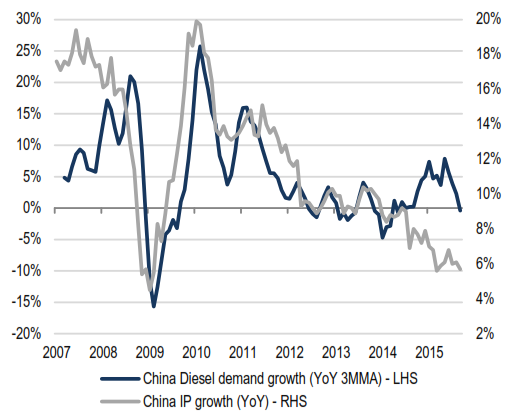
The effects show up quite clearly in industrial production. From 2012 to the first half of 2014, industrial-production growth in China was reported at a steady 9 percent rate. From mid-year 2014, when oil prices collapsed, Chinese industrial production growth also faltered.
By contrast, China’s diesel demand, which has historically tracked industrial production, soared. This lends credence to the notion that exchange rates were the principal driver of perceived Chinese economic weakness from mid-2014.
A failure to devalue the yuan made China’s oil imports disproportionately cheap, while making China’s manufactured exports unnecessarily expensive.
China’s diesel-demand growth vs. industrial-production growth
Source: Credit Suisse, using China OGP, CEIC data
By this line of reasoning, therefore, there was no weakness in global demand; rather, there was specific weakness in China’s industrial sector — the primary purchaser of global commodities — specifically due to China’s failure to devalue the yuan in line with the currencies of other U.S. trading partners.
For oil markets, this interpretation is mostly good news. U.S. terms of trade have probably peaked. U.S. oil production is falling and oil prices are more likely to rise than fall over the medium term. Oil, as a driver of dollar appreciation, is largely played out.
At the same time, China seems to be adjusting to a stronger exchange rate. Capital outflows are easing and China turned a record surplus in the goods trade in September.

The country is showing signs of adapting, and by mid-year 2016, could be back on track even in the absence of yuan devaluation. If so, the Bank of England model suggests demand weakness should ease, and with it, oil prices could rally quite substantially — by as much as $35 per barrel, if the model is to be believed.
I’ll confess to some skepticism about all this. From the analyst’s perspective, the last year has been all about oil-supply growth. There has been no collapse in demand in any major market. Still, it is hard to explain the broad-based collapse in commodity prices except through demand weakness.
Consequently, we have to give some credence to the Bank of England’s model. And if that’s so,expect a big rally in oil prices — probably in the second half of 2016.
22 Comments on "Why oil could rally in 2016"
Peak Oil Prognosticator on Mon, 16th Nov 2015 3:57 pm
Who wants to bet me $20 that gas will be under $30/barrel by the end of 2016? (Priced in 2015 dollars, assuming no hyper-inflation)
BobInget on Mon, 16th Nov 2015 6:18 pm
Published: Nov 16, 2015
Iraq is on its way to becoming a high-cost oil producer despite its oilfields being arguably the cheapest in the world, according to a former Iraq oil ministry adviser. Saadallah al- Fathi, who now works as a Dubai-based consultant, claims operating costs are now as high as $26 a barrel for some of the incremental crude that has come to market since 2009. “It seems everyone needs a massive salary, armed guards and a bullet-proof car to work in Iraq’s oil industry now,” he says. “All of this costs money, money that Iraq doesn’t have.” (kevin.baxter@wsj.com)
BobInget on Mon, 16th Nov 2015 6:32 pm
I’m on Prognosticator.
$20. even money.
Dec 31, 2016
The bet: oil under $30. any feeling about NG Prognost ? Bob Inget, my actual name.
Anyone want to bet $20 oil is over $80 ?
$100 ? $150 ? 2 to 1 $80, 3 to one $100
4 to one $150
IOW’s you pay me two bucks for every USD
if oil closes out year over $80. $20 gets ya $40. The prog man thinks oil goes to $30,
he musty know!
Davy on Mon, 16th Nov 2015 6:39 pm
Bob, I have our bet from a few months ago in my notes. I am not sure you remember it. Do I need to copy and paste it to refresh your memory?
makati1 on Mon, 16th Nov 2015 7:01 pm
More guessing to sell ads…
rockman on Mon, 16th Nov 2015 7:54 pm
Again what am I missing: “In simple terms, the model suggests that China was collapsing just as an oil-supply surge was tanking oil prices.” Yet at the top they point out the increase in oil consumption by China. So as China “collapsed” their response was to by more oil then the year before?
I don’t understand why so many don’t see the obvious: the demand for $90+/bbl oil eventually declined. And the demand for $45/bbl oil quickly increased. And for an obvious reason IMHO: the demand for $45/bbl oil had existed ever since prices rose above that level. Doesn’t that explain the dynamics we just saw?
Now why demand for higher priced oil decreased is a separate question. But that one doesn’t seem very complicated either.
Peak Oil Prognosticator on Mon, 16th Nov 2015 7:58 pm
I’ll be back to collect my $20 Bob, I won’t forget it. If I lose, I’ll give you $20.
GregT on Mon, 16th Nov 2015 10:22 pm
“I don’t understand why so many don’t see the obvious”
Because the average IQ in North America is less than 100. It really doesn’t get much easier to understand. 🙂
Boat on Tue, 17th Nov 2015 12:01 am
Bob,
Were you not the one who assured $100 per barrel by January? OPEC was gonna meet and then you went quiet.
Boat on Tue, 17th Nov 2015 12:21 am
World Growth was always there. Growth in GDP was always there. Some of us have been pointing that out for some time now. Only to be labeled cornucopian. lol Why do we know there is an oil glut? Storage capacity has been and is still is filling up with no drop off in sales, in fact growth in consumption. All you have to do is look around. Effects of depletion are no where to be seen, only effects of overproduction.
GregT on Tue, 17th Nov 2015 12:41 am
“World Growth was always there. Growth in GDP was always there. Some of us have been pointing that out for some time now. Only to be labeled cornucopian.”
Anybody who disputes the fact that world GDP continues to grow would be a total idiot Boat. Just like you.
Boat on Tue, 17th Nov 2015 12:53 am
GregT,
Glad you finally came around. Now convince Davy and Mak. Talk to short about depletion. He is a little lost.
GregT on Tue, 17th Nov 2015 1:25 am
Davy, Mak, and Short are all above average intelligence Boat.
Your not.
Davy on Tue, 17th Nov 2015 3:59 am
Bob as promised our bet and how sweet a month to date. Bob, we are in November and no $78!!!!!!
BobInget on Sat, 17th Oct 2015 7:24 pm
PS… I’m sticking with a January price prediction; $200. oil inter-day. $170 close December 31st 2015.
I’m guessing we will see $60 this month,
$78 in November.
Davy on Sat, 17th Oct 2015 8:11 pm
Bob, I will go off line for 2 week to honor such a ridiculous prediction if it were to happen in December. I am going to copy and paste to my notes your above prediction for future reference and a reminder to you of the folly of your cornucopian delusions.
Revi on Tue, 17th Nov 2015 12:16 pm
I think it will rebound to around $66 next year, but then it will affect the economy which will tank the price again and it will try for around $50 the year after that and it will have a weak rebound until it dies a whimpering death around the year 2020. That’s the year that only legacy fields will keep pumping.
Boat on Tue, 17th Nov 2015 12:28 pm
I had predicted $60 by the end of February. I have learned about the DUC inventory since then if oil doesn’t hit $60 by June I have an excuse.
Boat on Tue, 17th Nov 2015 12:40 pm
Davy/bob
I am going to copy and paste to my notes your above prediction for future reference and a reminder to you of the folly of your cornucopian delusions.
A high price for oil is cornucopian? Here I thought low prices were cornucopian. I get confused Davy. Explain?
I could use another explanation while your at it. Supply and demand says a lack of oil equals a higher price. How is it prices drop as the effects of depleation kick in?
Revi on Tue, 17th Nov 2015 12:16 pm
I think it will rebound to around $66 next year, but then it will affect the economy which will tank the price again and it will try for around $50 the year after that and it will have a weak rebound until it dies a whimpering death around the year 2020. That’s the year that only legacy fields will keep pumping.
So does that mean I can fill up in 2020 off the legacy fields for like $.25 a gallon?
Davy on Tue, 17th Nov 2015 2:13 pm
Boat said “A high price for oil is cornucopian? Here I thought low prices were cornucopian. I get confused Davy. Explain?” Boat, we all know you are in a permanent state of confusion. Maybe this will help:
Boat, high sustained oil prices would indicate an economy that is capable of functioning at higher prices. That scenario is cornucopian. This scenario is the old normal pre 08 crisis and likely over for good. It is appearing the global economy is no longer healthy enough to accommodate high prices. It is likely we will see some price gyrations caused by market forces. These gyration will almost certainly include high prices. I am subscribing to Shorts ETP model for prices long term which means down but I do acknowledge points of high volatility.
The confusion you cornucopians have is your love of low prices because you see a win for consumers. You dismiss the damage low prices have on the oil complex. You cornucopians also dismiss what is clearly demand destruction. I want to clarify demand destruction. I am not talking oil demand. Oil is a special case commodity. It is foundational and also has a significant discretionary element to it. People will drive for multiple reason beyond productive activities. These activities are rational and irrational. Some reasons are elastic and others inelastic.
The demand destruction I am talking about is primarily with the macro we call China. China had a monster of a growth period that is over. The US had a monster of a shale rush that is winding down. There are some other bubbles. These bubbles are deflating and taking demand with it in a vicious deflationary cycle down.
This deflationary demand destruction is masked by central bank and market activity. This is the smoke and mirror duck and cover we call the global financial system that is completely corrupted, manipulated, and repressed. Price discovery is dysfunctional. The financial system’s connection to the real economy is irrational. Moral hazard has been legalized. The normal realization of bad debt from malinvestment of overcapacity and non-performing assets are being extended and pretended. This extend and pretend just increases an already huge global debt load. These activities have the unintended consequences of wealth transfer and social instability.
This can go on until confidence is lost. Confidence is human nature and there is no way to forecast human nature. We can forecast depletion and visualize entropic decay. These forces are forces of nature that do not sleep. They are the ultimate end game just in case confidence holds and the economy does not collapse. IOW a train wreck is either sooner with lost confidence or latter with shortages of food and fuel. Eventually when food and fuel go into shortages all confidence will be lost. These forces are like sands through an hour glass. Our days are number Boat. In the not too distant future you are going to be crying over your failed American dream that is shatters before your eyes.
rockman on Tue, 17th Nov 2015 2:31 pm
Greg – And of course that means half the population has an IQ under 100. LOL.
Boat on Tue, 17th Nov 2015 2:41 pm
Davy,
The confusion you cornucopians have is your love of low prices because you see a win for consumers. You dismiss the damage low prices have on the oil complex.
Of course I love low oil prices because I believe in a bottom up economy. Just about the opposite we have now.
You’re right I am dismissive about the damage to the oil complex with low prices because I know low prices are temporary and the market will find the balance of development and profit in the end. For 6 years we were at the high end because of mainly because of geopolitical forces in the Middle East and now that things have calmed down a bit Iran and Iraq will go back to helping supply the world as fracking takes a back seat.
The shale bubble you suggest was fracked and tar sand oil replacing lost production from the middle east. Now the middle east is reclaiming market share. I don’t see any of that as a fundamental problem.
China’s huge growth came from borrowed dollars and had to slow down at some point. The some point happened. But there are 1.3 billion there and still growing. This is just a temporary blip on their economic radar.
If geopolitical forces calm some for a few years the lower price of oil will energize the world economy. Bad for climate change but good for business.
It’s ok Davy, we can have different views.
bug on Tue, 17th Nov 2015 4:22 pm
“If geopolitical forces calm some”.
Yes, if. Like never?
If this , maybe this or that, but not that because that would be bad.
Boat on Tue, 17th Nov 2015 6:03 pm
bug,
Check Iraq oil production. Saudi production. Soon to be Iran production? Kuwait, UAE, for all the turmoil the Middle east pumps a lot of oil and set to pump more.