
Peak Oil is You

Donate Bitcoins ;-) or Paypal :-)


Page added on June 6, 2016

Why Oil Bears Are Still Wrong
Summary
Oil production is probably close to its peak level currently. At best supply can stay the same, but is more likely to drop.
Global oil demand, though, has been growing rapidly since the Credit Crisis.
Demand is likely to exceed supply in 2017 and probably 2018. Prices will then rise significantly.
The OPEC has had its June 2nd meeting and the cartel has once again failed to come to an agreement to limit oil production. No consensus was expected except for a brief moment just before the meeting. The cartel did discuss a proposal floated by the new Saudi Arabian energy minister, Khalid al-Falih, that would limit OPEC oil output to between 31.8 and 32.5 million barrels per day (bpd). The dysfunctional group couldn’t even agree to this very minimal drop in production. OPEC is currently pumping 32.77 million bpd. Despite the bearish news of no change in policy, WTI crude oil actually went up on the day, rising 0.3% to $49.17. By the end of the week, it was down 1.4%, but this was after experiencing sizable gains the previous three weeks.
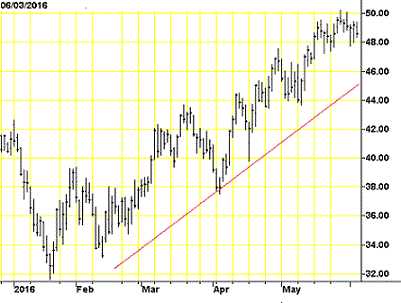
Oil Has Consistently Rallied Since February 2016
While OPEC is pumping full speed ahead, U.S. oil production is estimated to be down approximately 500,000 bpd since its peak in April 2015. Moreover, market supply for non-OPEC members is now predicted to be lower by 740,000 barrels per day in 2016. Unusually low prices are responsible for this, but the 20% reduction in global exploration and production spending in 2015 is going to make matters worse going forward. A further 15% drop in spending to keep production up is anticipated this year. At the same time, global oil consumption has grown on average 1.6 million bpd each year since the Credit Crisis bottom in 2009. Lower crude prices have fed the above trend growth by users (and will continue to do so as long as crude prices remain below historical norms).
Most analysts and commentators have been continually negative about oil prices since the low of $26.21 on the NYMEX WTI futures contract on February 11th. Now, in early June, the price of oil has almost doubled. Most of the same voices continue to call a top in the price (similar things happened in the spring of 2009 after oil rose off its low in February, beginning a powerful and long-lasting rally that eventually took it to over $100 a barrel). The recent big drop in oil prices that began in 2014 is by no means historically unique. There was an even bigger percentage drop in 2008-09, and major price drops in 2000-01, 1990-91 and 1985-86. Oil is prone to large up and down price swings. At each major drop, the doom-and-gloomers came out of the woodwork and predicted that the price low was the new permanent state of the market. It never was, and it won’t be this time either. Oil prices always shoot back up and eventually go much higher.
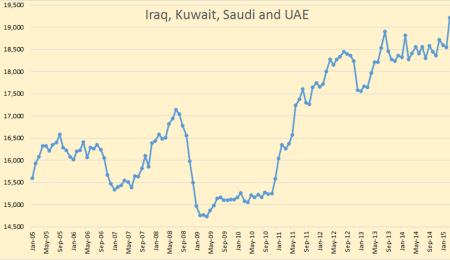
The temporary glut in the market that began in 2014 is actually the result of increased oil pumping from Saudi Arabia and its Gulf state neighbors. Collectively, they’ve increased their oil output by approximately four million bpd since 2010 (for more about this, see here). This strategy is not without considerable risk to their future production. Most oil fields in the Middle East are in advanced old age by industry standards. The giant Ghawar field in Saudi Arabia, responsible for half of all Saudi oil production over time, has been producing since 1951 or for 65 years. This is far more elderly than a human being of an equivalent number of years. Old oil fields that are overworked can experience something called “field collapse,” where production drops significantly without warning and stays much lower thereafter.
Surge in Middle East Production Has Caused the Current Oil Glut
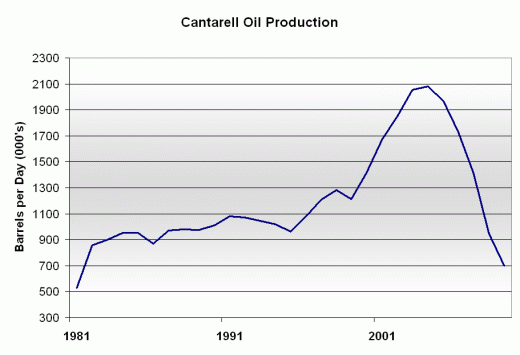
A more common danger is that speeding up production just depletes oil reserves faster and production goes into a steady, irreversible decline. This happened in the Cantarell oil field in the Gulf of Mexico. Cantarell, which only came online in 1981, was once the second largest producing oil field in the world (after Ghawar). At the suggestion of the U.S., its Mexican owner, Pemex, utilized technology that made it possible to pump out oil faster. Production peaked at 2.1 million bpd in 2003. It then dropped continually for more than a decade and by 2014 was only 340,000 bpd. Currently, Pemex is spending billions of dollars to prevent it from falling even further. Faster output didn’t mean additional output, it only meant a large drop in production a few years down the road. Currently, the much, much older oil fields of the Middle East are susceptible to the same fate.
The rate of conventional oil production that has been taking place in the last couple of years is not sustainable. It is happening because every effort has been made to push production to the max. Technology can always be used to ramp up production temporarily, but the cost will be lower than trend production later on. Increasingly larger amounts of funding will be needed to slow the rate of the upcoming decline. That funding, however, was reduced in 2015 and will be lower this year as well. With Iranian production coming back to market after the lifting of sanctions, global oil production has little room to move higher. It does have a lot of room to move lower, though, in 2017 and even 2018. Despite media reports to the contrary, demand keeps growing at a rapid clip (annual global oil demand almost never decreases). This makes the supply/demand picture very bullish for rising oil prices.
Investors can use ETFs to take positions in oil and oil stocks. Investors can participate in the rally by buying ETFs for the commodity, such as: USO, OIL, DBO and USL. ETFs for oil stocks are: XOP, OIH, IEO, IEZ, XES and PXJ. Investors who want to buy individual stocks can consider: Exxon Mobil (NYSE:XOM), Imperial Oil (NYSEMKT:IMO), PetroChina (NYSE:PTR), Royal Dutch Shell (NYSE:RDS.A), Sasol (NYSE:SSL), Statoil (NYSE:STO), Suncor (NYSE:SU) and Total (NYSE:TOT).
38 Comments on "Why Oil Bears Are Still Wrong"
Plantagenet on Mon, 6th Jun 2016 4:54 pm
KSA just cut their price for oil they are selling in Europe.
The oil glut continues.
Cheers!
Outcast_Searcher on Mon, 6th Jun 2016 5:14 pm
If oil prices do rise significantly and stay high for any length of time, then production can and will most assuredly increase.
And always with the “steady irreversible decline” of production meme. The one that’s always just around the corner. Like economic doom.
Sure. Because all the technological improvements that increase available reserves like Fracking don’t actually exist.
dave thompson on Mon, 6th Jun 2016 5:58 pm
The claim of glut can be countered with the fact of affordability. There can no longer be economic growth with the price of oil over $20 per bbl. Unafordable crude = a so called glut.
noobtube on Mon, 6th Jun 2016 6:00 pm
This price collapse will end, no later than, around election time, October/November 2016.
Pulling this purely out of my ass. But I think 2 years is about as far as this “glut” will go before gas prices skyrocket (perm) in the United States.
HARM on Mon, 6th Jun 2016 6:26 pm
@dave,
In real (inflation adjusted terms), the price of oil today is only a little above the long-term historical average. Not cheap, no, but also not nearly as expensive as 8 years ago, or during the mid-70s.
https://upload.wikimedia.org/wikipedia/commons/thumb/b/b0/Crude_oil_prices_since_1861.png/700px-Crude_oil_prices_since_1861.png
HARM on Mon, 6th Jun 2016 6:32 pm
Personally, I wish we would have already hit the global (and U.S.) peak as that would have forced the majority mouth-breathing/overbreeding public and so-called world “leaders” into making some hard choices *before* we destroyed our biosphere beyond recovery. Too bad that window of opportunity is past and the peak is still nowhere in sight.
Just experienced three more straight days of 95-100 degree weather in PNW, a region that almost never gets this hot so soon. At this rate, Portland could become as chronically hot and dry as SoCal before I am laid to rest.
As George Monbiot (correctly) observed, “we were wrong on peak oil; there’s enough to fry us all”.
makati1 on Mon, 6th Jun 2016 7:43 pm
Dream on noob. Dream on. We are in a Catch 22 where low oil prices are killing off future oil supplies and higher prices will kill the economy. I don’t see any increase that matters, ever. If it spikes, you better be prepared for a new life that will make the Great Depression seem like a fun party.
onlooker on Mon, 6th Jun 2016 8:22 pm
Mak, got it right Noob. That is basically part of peak oil dynamics. And remember all this disruption in Oil for the Economy is weakening it ever more. Kind of like someone who is losing blood.
twocats on Mon, 6th Jun 2016 8:39 pm
Almost everything is functioning at a deficit at this point, why not the oil industry itself. As long as printing presses exist there will be cheap enough money to give 15% interest loans to oil companies. Which means oil production will bleed slowly lower.
But still, at some point, some year (2017/18 probably), I do believe that demand (oil extraction + general consumption) will overtake supply. At that point peak oil will be tested. Figure the 1st mbpd or so will be easy (tight oil, Iran, etc) but if the gap between the old peak and the starting point is more than a couple million barrels per day… its gonna start looking very peaky.
twocats on Mon, 6th Jun 2016 8:41 pm
and yes that’s no typo – extraction is (a large components of) the demand.
noobtube on Mon, 6th Jun 2016 9:07 pm
@makati1 @onlooker
Maybe, your’re right.
But, I fully expect the United States to break into 4 or 5 separate countries once the oil situation strangles the JIT/globalization economy for the last time.
Pacifica (California, Oregon, Washington)
Independent Mormon State (Nevada, Utah, Northern Arizona, Northern New Mexico)
Redneckistan (South / Northern Florida)
El Norte (SoCal, South Arizona/NM/Texas,Northern Mexico)
Free States of America (Everything else)
makati1 on Mon, 6th Jun 2016 10:05 pm
Noob, you could be right on that, but think about the civil wars and the chaos, that will last for years, to make that possible. Those who live through it will be a small percentage of the current population. Very small.
El Norte will be all desert by then.
Ditto for Most of Pacifica as the forests are burn off. Not to mention the major fault quakes that are long overdue.
IMS, cannot support themselves today. Still mostly desert and will be even more dry by then.
Redneckistan will be pummeled by storms, typhoons and hurricanes on a regular basis, not to mention sea rise. And there is always the New Madrid Fault to decide to drastically change the landscape.
Free States? Oh, you mean the Midwest dust bowl? LOL
I don’t know of anywhere that is a good place to be in the US. None. Maybe New England (Free States) but I doubt it. Weather swings will make food production difficult and then there is the possible slowing of the Gulf Stream that would bring a colder climate and more hurricanes making it ashore in the north.
Whee I live in the Ps has it’s own problems, but none as radical or desperate as those in America. It is heating up a bit and the population is high, but that is true of most places that humans live. We are a prolific bacteria. lol
noobtube on Mon, 6th Jun 2016 10:38 pm
What can I say? It is going to be hell. But, that is the bed the USA has made for itself.
Northwest Resident on Tue, 7th Jun 2016 1:44 am
“…demand keeps growing at a rapid clip.”
The elites who run the world think that the general population is really stupid, and they are not mistaken. The master plan has been and obviously still is to just keep the sheep calm, tell them what they want to hear, entice them to keep their money in the stock “market” where it is desperately needed, urge them to take on more debt and spend spend spend — to manipulate perceptions in every way possible just to keep things as normal as possible. Until when? Certainly the elites know that this game of propaganda and deceit can’t go on forever, or even much longer. Things are much, much worse than they’re letting on. Reality is intruding on the carefully crafted narrative. It is breaking down. The elites and their armies of analysts can’t possibly NOT be seeing what we are seeing. So, what’s the plan? Maybe there is no plan. But the fact that they went through the trouble of authorizing American military to operate on American soil to preserve and protect government property, and the fact that they authorized the federal government to take over critical industries in case of some national emergency, and the fact that they’re spying on everybody and everything — all that and more tends to hint at the possibility that they DO have a plan. Not one we’re going to like, that’s pretty much a guarantee. And how good of a plan is it? Will it be implemented with the decisive skill and dedication we saw in New Orleans when Katrina hit? Or will they do a little better this time? So many questions, so much bullshit lies and propaganda, so much happening behind the scenes that we don’t know about, such a big event looming in the future that we can only speculate about and wait for it to hit.
Hello on Tue, 7th Jun 2016 7:31 am
$20 oil? $500 oil?
No difference for the economy. What matters is the total amount of oil/day, not it’s price.
rockman on Tue, 7th Jun 2016 7:36 am
I wonder how many folks realize that the companies that explore for and produce oil/NG can’t reasreaslly be classified as bulls or bears. We typically base decision’s on the economics of current prices. Of course higher prices lead tyo more drilling but that’s based on those currernt prices and not future expectations.
Consider the current dynamic: despite oil prices increasing 50% in the last few months the oil patch hasn’t increased drilling. Multiple reasons, of course. But bullish expectations do not exist in tyhe oiooiol patch.
Of course investors and future players are differrernt animals and are driven by different dynamics.
Trust me: the oil patch isn’t being bearish…we’re just following simple economics.
makati1 on Tue, 7th Jun 2016 7:42 am
Hello, you really need to get educated.
forbin on Tue, 7th Jun 2016 8:14 am
Mr Hello , I presume your comment was not based on the economics practice and theory but on some other factor / meaning .
Please elucidate .
if not, then Mak is right , you need education on economics, use google and search economics 101 for a start
Forbin
Cloud9 on Tue, 7th Jun 2016 8:28 am
Orlov and others dream of a collapsed U.S. It may come to that but if we return to federalism as it was intended states can go in their own direction without civil war. State courts simply need to start nullifying egregious federal laws. That process would unwind much of the tension between local populations and federal dictates. Case in point it is the stupidity of the federal government in its effort to open up children’s bathrooms to gender confused twits. That and ten thousand other edicts and dictates have nothing to do with national security. These things are the purview of the states and local governments.
There is no doubt in my mind that we will return to regionalism. We are already there. There are no go zones in every major American city.
Hello on Tue, 7th Jun 2016 8:44 am
It is strange that doomers think that $500 oil will kill the economy. Whereas even resident oil man Rockman tells stories time after time how his industry is booming with high oil prices.
Davy on Tue, 7th Jun 2016 8:46 am
Hello, friggen “Hello yourself” what planet are you on and where did you get your education?
makati1 on Tue, 7th Jun 2016 9:01 am
Cloud9, I would love to have a dollar for every time I have read “IF” in some article or comment. The dreamers us “IF” all the time or at least once in every fairy tale. We are past any “IFs” making a difference. Way past. The fate of America, and the rest of the world, is sealed.
Davy on Tue, 7th Jun 2016 9:33 am
You are the “IF” queen Makati Bill. Cloud is on the right track more than you.
shortonoil on Tue, 7th Jun 2016 10:50 am
” “…demand keeps growing at a rapid clip.” “
That is simply magical thinking; demand is now growing at the slowest rate that it has grown in the last 57 years. 0.43% per year in comparison to its 5.46% rate between 1960 and 2005. Those numbers come straight from the EIA data set. If anyone thinks it is other wise, contact the EIA; they probably have a form letter specifically designed for delusional commentators!
Davy on Tue, 7th Jun 2016 11:07 am
” “…demand keeps growing at a rapid clip.” “
“US Seeks “Total Ban” on Chinese Steel: Alarm Bells Ring Over “Nuclear” Option”
https://mishtalk.com/2016/06/06/alarm-bells-ring-over-nuclear-protectionist-trade-option/
“A huge global trade war is on the horizon, regardless of whether Hillary or Trump wins the election.”
“But a wholesale ban on US imports of Chinese steel would be materially different and could set a protectionist tone for the next US presidency, said Simon Evenett”
Davy on Tue, 7th Jun 2016 11:13 am
” “…demand keeps growing at a rapid clip.” “
“Global Trade Bellwether Taiwan Posts 16 Straight Months Of Sliding Exports”
http://www.zerohedge.com/news/2016-06-07/global-trade-bellwether-taiwan-posts-16-straight-months-export-declines
“The declines highlight a slowing global economy, specifically in China which is a significant trading partner with Taiwan. We have highlighted for some time that there have been massive amounts of layoffs in China, and the impact is now making its way to the broader global economy. Countries exporting to China will continue to face headwinds, because as we pointed out yesterday the real unemployment rate in China is 12.9%, triple the official reported rate.”
“Tuesday’s performance showed persistent weakness in key markets, as declines in shipments bound for China and the United States were both down, but the drops were less than April.”
HARM on Tue, 7th Jun 2016 12:36 pm
Given how unilateral globalism has devastated the working class here, wiped out tens of millions of good paying blue collar jobs, and made the U.S. almost totally dependent on China for practically everything, I would not mind some protectionism for a change.
How has “protectionism” worked out for countries that still choose to enforce it: Japan, Taiwan, China itself, Germany, Sweden, Denmark, France, etc.? Are those countries’ workers still supplied with good paying high-skilled jobs (+benefits) or not?
How has “free trade” (the one-sided variety where only American workers give up their protections) worked our for average blue collar Americans?
Which is more stupid? The constantly maligned “protectionism” that actually protects something worth protecting (high wages and standard of living for citizens), or blind faith in one-sided “free trade”, which only benefits the state-less ruling class?
Hello on Tue, 7th Jun 2016 12:48 pm
HARM:
Protectionism alone will not help.
40% of USA manufacturing output is controlled by 4 corporations alone. Competition is necessary.
Protectionism with a smash up of big corporation is probably a good solution. But unfortunately not one that will likely ever be implemented.
shortonoil on Tue, 7th Jun 2016 12:56 pm
“$20 oil? $500 oil?
No difference for the economy. What matters is the total amount of oil/day, not it’s price. “
$500 oil produces $16.53 gasoline. $500 oil results from an ERoEI of 2.17 : 1. $500 oil will produce a very big demand for buggy whips. What will matter will be if your are in 1860 or 2016. $500 oil will put the world back to 1860 really fast. $500 oil will be real useful for treating the seven year itch; as far as running a modern civilization it is useless.
Hello on Tue, 7th Jun 2016 1:05 pm
shortonoil:
What matters is the volume of oil put to use per time unit. Not it’s price.
Davy on Tue, 7th Jun 2016 1:52 pm
Harm, I am for protectionism but not for the usual reasons. My reasons are for forced localism. Any kind of trade war environment will kill globalism. It is a good death for globalism because it will follow a time frame allowing for a drawn out hard landing.
My view is anything that kills globalism slowly now is good. We need time to adapt and adjust to lower economic activity and lower prosperity. Bring on trade wars and tightening borders anything to force the status quo to its knees.
Boat on Tue, 7th Jun 2016 2:21 pm
Davy,
We have been adjusting to slower growth for a couple decades in developed countries. A saturation of products leaves less to buy. Even the poor can afford many on the gadgets. The products last longer and use less energy. Homes are tighter and use less energy. Cars last longer and use less energy. Wind for example will create 18x the btu than it took to build it.
Demand will continue to shrink in developed countries as tech advances.
Boat on Tue, 7th Jun 2016 2:25 pm
If all countries eliminated immigration world populations would stabilize and many would start to shrink.
shortonoil on Tue, 7th Jun 2016 3:43 pm
” shortonoil:
What matters is the volume of oil put to use per time unit. Not it’s price.”
That completely ignores why oil is used in the first place. Petroleum is used as an energy source. Its primary purpose is not to fill up gas tanks; water would be a much cheaper alternative if that was the intention. Petroleum must be able to power machinery to be of any practical purpose. 21% of the world’s liquid hydrocarbon production is not capable of doing that. Adding more feedstock to the world’s inventory is not going to add to the economy. It is the quantity of energy that petroleum can supply that matters. With an ERoEI now at 8.7:1, and going down, soon no quantity – no matter how large, will serve any purpose. Any number (no matter how large) time zero equals zero.
Hello on Tue, 7th Jun 2016 4:11 pm
shortonoil: “Petroleum is used as an energy source.”
Exactly. Or in other words:
energy = volume * energy_per_volume
Nowhere is there a $$ sign in the equation. We have to conclude that price doesn’t matter to calculate available energy.
As for ERoEI, you are off the chart in not understanding what that means and why it doesn’t matter.
It takes approx 3 kWh of energy to lift one barrel of oil from a depth of 6000m.
A barrel contains 1.6 MWh. Hence ERoEI = 1600/3 = 500 !!!
All other energy expenses are not lost, but are in fact what we call collectively ECONOMY.
Joe D on Tue, 7th Jun 2016 4:36 pm
“energy = volume * energy_per_volume
Nowhere is there a $$ sign in the equation”.
So E=V*(E/V) or E=E. THAT IS PRICELESS! LOL
Must be an economist.
shortonoil on Tue, 7th Jun 2016 5:41 pm
” energy = volume * energy_per_volume”
E = V*E/V: which equals E. Amazing, energy equals energy! Then we get : “As for ERoEI, you are off the chart in not understanding what that means and why it doesn’t matter.”
Energy Returned / Energy Invested doesn’t matter because we don’t use energy we use volume. This is better than watching the Three Stooges!
Sissyfuss on Tue, 7th Jun 2016 6:15 pm
Just a shout out to Aunt Plant, the glut nut!