
Peak Oil is You

Donate Bitcoins ;-) or Paypal :-)


Page added on December 13, 2012

Why Malthus Got His Forecast Wrong

Most of us have heard that Thomas Malthus made a forecast in 1798 that the world would run short of food, and that great famine would result. But most of us don’t understand why he was wrong. This issue is relevant today, as we grapple with the issues of world hunger and of oil consumption that is not growing as rapidly as consumers would like–certainly it is not keeping oil prices down to historic levels.
What Malthus Didn’t Anticipate
Malthus was writing immediately before fossil fuel use started to ramp up.
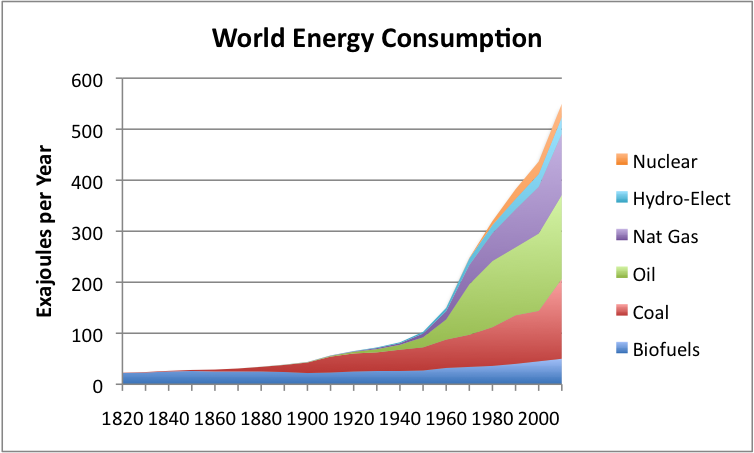 Figure 1. World Energy Consumption by Source, Based on Vaclav Smil estimates from Energy Transitions: History, Requirements and Prospects and together with BP Statistical Data on 1965 and subsequent
The availability of coal allowed more and better metal products (such as metal plows, barbed wire fences, and trains for long distance transport). These and other inventions allowed the number of farmers to decrease at the same time the amount of food produced (per farmer and in total) rose. On a per capita basis, energy consumption rose (Figure 2) allowing farmers and others more efficient ways of growing crops and manufacturing goods.
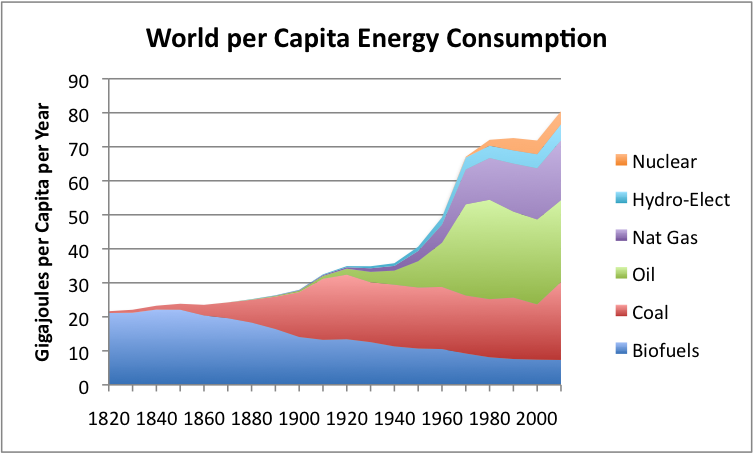 Figure 2. Per capita world energy consumption, calculated by dividing world energy consumption (based on Vaclav Smil estimates from Energy Transitions: History, Requirements and Prospects together with BP Statistical Data for 1965 and subsequent) by population estimates, based on Angus Maddison data.
If it hadn’t been for the fossil fuel ramp up, starting first with coal, Malthus might in fact have been right. As it was, population was able to ramp up quickly after the addition of fossil fuels.
 Figure 3. World Population, based on Angus Maddison estimates, interpolated where necessary.
A person can see that there was a particularly steep rise in population, right after World War II, in the 1950s and 1960s (Figure 3). This is when oil consumption mushroomed (Figure 2, above), and when oil enabled better transport of crops to market, use of tractors and other farm equipment, and medical advances such as antibiotics.
It is likely that increased consumer and business debt following World War II (Figure 4) also played a role in the post-World War II ramp up.
 Figure 4. US Debt excluding Federal Debt as Ratio to GDP, based on Z1 Debt data of the Federal Reserve and GDP from the US Bureau of Economic Analysis.
The reason I say that debt likely played a role in this ramp is because at the end of World War II, people were, on average, pretty poor. The United States had recently been through the Depression. Many were soldiers coming back from war, without jobs. Without a ramp up in factory work and related employment, many would be unemployed. A ramp up in debt fixed several problems at once:
- Allowed low-paid workers funds to buy new products, such as cars, that used oil
- Allowed entrepreneurs funds to set up factories
- Allowed pipelines to be built, and other support for ramped up oil extraction
- Provided jobs for many coming home from the war effort
The debt ramp up, and the resulting increase in oil production, raised living standards. Figure 2 shows that the increase in per capita energy consumption was far greater in the 1950 to 1970 period when oil production was ramped up than in the coal ramp-up between 1840 and 1920. The long coal ramp-up period does not appear to have been accompanied by such a big ramp-up in debt.
Tentative Conclusion
A tentative conclusion might be that as long as we can keep ramping up availability of energy products and debt, Malthus’s views are not very relevant.
Of course, things aren’t looking as benign today. World oil production has been close to flat since about 2005 (Figure 5).
 Figure 5. World crude oil production (including condensate) based primarily on US Energy Information Administration data, with trend lines fitted by the author.
The world has been able to increase production of other fuels to compensate so far. Unfortunately, the big increase is in coal (Figures 1 and 2). This mostly relates to growth in the economies of Asian countries, which are large users of coal.
The cost of oil has more than tripled in the last ten years. The higher cost of oil is a problem, because it leads to recession, unemployment, and governmental debt problems in oil-importing countries. See my posts High-Priced Fuel Syndrome, Understanding Our Oil-Related Fiscal Cliff, and The Close Tie Between Energy Consumption, Employment, and Recession.
Continued increase in debt now seems to be running into limits. Federal government debt is in the news every day, and non-government debt seems to be contracting relative to GDP, based on Figure 4.
Looking Ahead
I am not sure that we can conclude that we are headed for catastrophe the day after tomorrow, but the graphs give a person reason to pause to think about the situation.
The reason I write posts is to try to pull together the big picture. If we only look at the latest new item forecasting huge increases in tight oil production or talking about 200 years of natural gas, it is easy to reach the conclusion that all of our problems are past. If we look at the big picture, they clearly are not.
Debt problems are closely related to high oil prices in recent years. Debt problems are today’s issue, and they are not being considered in the huge oil and gas forecasts we see everywhere. The new tight oil and the new shale gas resources likely will need to be financed by increasing amounts of debt, so there is a direct connection with debt. There is also an indirect connection, through governmental debt problems, higher taxes, and the likely resulting recession (leading to lower oil prices, perhaps too low to sustain the high cost of extraction).
Also, it is interesting that the supposedly huge increases in US oil supply don’t really translate to any discernible bump in world oil supply in Figure 5.
We know that the world is finite, and that in some way, at some point in the future, easily extractable supplies of many types of resources will run short. We also know that pollution (at least the way humans define pollution) can be expected to become an increasing problem, as an increasing number of humans inhabit the earth, and as we pull increasingly “dilute” resources from the ground.
Based on earth’s long-term history, and on the experience of other finite systems, it is clear that at some point, perhaps hundreds or thousands of years from now, the earth will cycle to a new state–a new climate with different dominant species. It may turn out that these new species are plants, rather than animals. The new dominant species will likely ones that can benefit from our waste. Humans would of course like to push this possibility back as long as we can.
At this point, my goal is to pull together a view of the big picture, in a way that other analysts usually miss. The picture may not be pretty, but we at least need to understand what the issues are. Is the shift in the cycle very close at hand? If so, what should our response be?
12 Comments on "Why Malthus Got His Forecast Wrong"
BillT on Thu, 13th Dec 2012 12:37 pm
It appears that this article says it like it is. Extinction of homo sapiens also included. When, not if. I agree.
We have passed the point of no return. Now it is a matter of how soon. Five years, ten, twenty? Next year?
DC on Thu, 13th Dec 2012 2:53 pm
Gail T is probably the most highly over-rated commentor among PO bloggers. Im not even sure why she is one.
I mean come on!
Q/Allowed entrepreneurs funds to set up factories
No Gail, ‘entrepreneurs’ did not set up factories in the US. What we today call the “1%” did. And the US rise in its post-war SoL was due to US control and manipulation of the *trade* in oil, and its innovative petro-dollar recycling program. Even in the post-war period the US imperial wealth pump was siphoning the worlds resources, not just oil, and directing them towards itself.
And no Gail, Malthus was not ‘wrong’. He never made specific prediction, aka Mayan 2012 style, he simply observed that if left, unchecked, populations tend to outgrow there food supply. In this, he was not ‘wrong’ at all. His essay and its conclusions can be applied * independent* of technology. Again, Gail is not the type of person that can appreciate the technology does not ‘solve’ problems as such, but only provide temporary relief until a new equilibrium is achieved, often at a high level of energy and resource use than the the ‘old’ situation. If you look at how we ‘use’ our technology, its not to ‘solve’ problems as such, except in a very limited or local sense, but its to used mainly as a means to boost growth.
As far as food production goes, we can the Red-Queen race in full swing today in a frantic effort to expand food production in the face of surging populations. Industrial food production is already doing huge damage to the world, and now the corporate food cartels are introducing GMO’s into the wild. Again, not so much to ‘solve’ any problem, but in order to feed the growth machine.
Malthus was attacked both in his day, and even now, for essentially the same reason. He was one of the first prominent persons to speak out against the idea of growth for the sake of growth. Which in his day, was starting to really take hold in western thought. The progress principle, and by progress, they mean economic growth, and the attendant growth in population that implicitly goes with it, had firmly taken root. Malthus observed this situation was rather untenable. This idea of course, was toxic to the idea of economic growth and expansion, and had to derided and ridiculed at all costs.(Sound familiar?) If Malthus were alive today, he would likely be running the Growth Busters website or one similar.
Sorry, Gail, Malthus did not get it ‘wrong’ at all, you should read his essay some time, you might actually learn a thing or two…..
Bor on Thu, 13th Dec 2012 3:43 pm
DC,
Bravo!
Rick on Thu, 13th Dec 2012 4:12 pm
DC, I agree with you.
GregT on Thu, 13th Dec 2012 4:26 pm
DC,
Exactly!
poaecdotcom on Thu, 13th Dec 2012 4:44 pm
Why so much ‘Malthus’ hate?
I suspect because his work is the reciprocal to our current paradigm….. denial deludes even the smartest…
The Dude was late 18th century and WAY beyond his time…
Bottom line is mathematics and NOT up for debate.
Any and all exponential growth in a finite system will hit limits at some point in time.
It is a simple Mathematically proof and it should be known as Malthus’s Lawfrom hence forth to foil all this ‘Mathus got it wrong’ BS. … denial is childish
If every 14 year old is taught this LAW in school then we could perhaps ‘grow up’ as a society (sadly too late now to avoid collapse first) to one that understands and respects our place in the universe, namely on a beautiful, bountiful, fragile but FINITE rock.
Go local
Newfie on Thu, 13th Dec 2012 6:09 pm
Just because a person wakes up in the morning (alive) for 10,000 consecutive days does not mean that person will continue to do so indefinitely. Just because the population increases for 25,000 consecutive years does not mean it will continue to do so forever. Duh.
Malthus will eventually be right. It’s a no brainer. Never ending exponential growth is impossible in a finite world. Duh.
econ101 on Thu, 13th Dec 2012 7:18 pm
He is absolutely wrong about governement debt. It has nothing to do with oil prices rather is directly related to out of control government spending, all causes, even in relation to rising revenue. QE4 anyone?
In fact if the government changed its policies to pro oil their debt would probably disappear.
econ101 on Thu, 13th Dec 2012 7:22 pm
Ps. Mathus is of course correct. He also made no predictions about a catistrophic end. Some probably thought growth was over the minute they reat Mahus?
DC on Thu, 13th Dec 2012 7:22 pm
……wrong article SoS….
Plantagenet on Thu, 13th Dec 2012 7:54 pm
The attacks on Gail are silly. She simply points out the obvious—that fossil fuels have played a huge role in allowing the population to grow rapidly since Malthus’ time.
And then Gail asks….what will happen now that we are facing peak oil? That isn’t anti-Malthusian—that is the very essence of Malthusian thinking.
simon on Thu, 13th Dec 2012 8:36 pm
Finally someone (@Plantagenet) actually read Gail’s post.
Amazing how much jubjub guano can be written by going on title of the piece and first two paragraphs.
Read DC. Slowdown.Read.