
Peak Oil is You

Donate Bitcoins ;-) or Paypal :-)


Page added on November 3, 2015

We Won’t Have $100 Oil For At Least A Decade
Summary
People have been worrying about running out of commodities for thousands of years. History will once again prove Malthusian arguments wrong.
OECD oil demand has peaked and China isn’t coming to the rescue.
Short-term, the next global recession is at our doorsteps, and weak economies mean less oil consumption.
Long-term, America has the best engineers in the world, and our leading methods will be adopted internationally.
We won’t see $100 oil for a decade, maybe forever. Oil isn’t like other commodities. When talking about oil, all rational thought is thrown out the window. People that have never bought commodities, never looked at supply, never looked at demand irrationally have strong opinions about price. Maybe they also have opinions on the price of tea in China? Most of these opinions stem from a constant fear of running out that has been propagated by the media for 100 years.
Past Oil prognostications and here.
- The peak of production will soon be passed, possibly within 3 years. … There are many well-informed geologists and engineers who believe that the peak in the production of natural petroleum in this country will be reached by 1921 and who present impressive evidence that it may come even before 1920. – David White, Chief Geologist, United States Geological Survey – 1919
- The average middle-aged man of today will live to see the virtual exhaustion of the world’s supply of oil from wells. – Victor C. Anderson, president of the Colorado School of Mines – 1921
- In 2001, Kenneth S. Deffeyes, professor emeritus of geology at Princeton University, used Hubbert’s theory to predict that world oil production would peak in 2005.
- Not oil related, but in 1865, Stanley Jevons predicted that England would run out of coal by 1900 and their factories would shut down.
- In 1865, the U.S. Geological survey said there was little to no chance there was oil in California; in 1891, they said there was little to no chance there was oil in Texas or Kansas.
- In 1939, the U.S. Department of Interior said America had 13 more years of oil supplies.
- In 1944, the government predicted we’d exhaust 21 of 41 commodities they studied.
- In 1949, the U.S. Secretary announced the end of U.S. oil was in sight.
Good enough for Government work! At one time, all of these people were considered “experts”. Today we read so many articles that lead with, “Experts believe that (insert author’s point)”. Sure, some experts probably agree, but other experts also disagree. Hyping up somebody’s credentials to prove a point – even worse to anonymously say “experts” is a propaganda technique to drown out discussion and create submission in people that haven’t studied the issue.
These quotes are mostly about oil and mostly from the last 100 years or so but isn’t a recent phenomenon. There have been claims of running out of commodities for over a thousand years. A thousand years ago in England, they lamented that they’d run out of trees, and trees are a renewable resource.
Oil is different. Oil is a non-renewable natural resource although there are people who argue Oil is actually for all intensive purposes renewable. Black gold was created by dinosaur, plant and animal bones that were basically buried and cooked at high pressure temperatures over long periods of time by Mother Earth. So, unless we are going to wait millions of years for the next batch…
Let’s say the conventional wisdom is right and oil is non-renewable. Our methods of extraction, usage, conservation, and efficiency have greatly improved. Our intellectual capital of complimentary goods is also increasing. If the average car gets 40 MPG instead of 20 MPG then we need half as much oil. If we figure out how to crack rocks and take the oil out of them we increase our supply. If we figure out how to drill into the earth down and sideways to hit the entire reservoir we get a lot more oil. If we convert cars to run on natural gas we don’t need as much oil. If we figure out how to make plug in electric cars using electricity from nuclear power plants, the demand for oil goes down.
We have consumed oil, but we have gained valuable knowledge. The idea of singularity also says that knowledge grows exponentially. Humanity improved from the years 200-600 or 800-1200, but it has improved much more in the years 1400-1800 or 1600 to 2000 or 1900 to 2015. Saying we won’t improve our knowledge is like saying we should shut down the U.S. Patient office because every idea that could possibly be thought of has already been thought of. It’s the opposite, the more ideas the more possibilities.
BP Energy Outlook 2035
The BP (NYSE:BP) Energy Outlook 2035 projects that world demand for oil will increase by around 0.8% each year to 2035. The rising demand comes entirely from the non-OECD countries; oil consumption within the OECD demand peaked in 2005 and by 2035 is expected to have fallen to levels not seen since 1986. By 2035 China is likely to have overtaken the US as the largest single consumer of oil globally. “Peak oil” is such a buzzword, what about “Peak consumption?”
Weak economies consume less oil. OECD demand peaked in 2005. America is consuming less oil, Canada is officially in recession, Australian growth came in lower than expected at 0.2% last quarter and Europe is stagnant.
How are the BRICS doing? Brazil is in recession. Russian is in a recession and their GDP dropped 4.6% last quarter. India’s economy slowed to 7% (although people doubt their official government numbers) and China is in free fall.
The big one is obviously China. When data is ignored, logic is suspended and we start getting into feelings and emotion. It comes back to that million dollar argument you just can’t argue with, “Don’t you think people in China want cars too?” It’s like saying, “Don’t you think Tech companies will change the world” in 1999 or “Housing can only go up” in 2005. BRIC companies, China in particular are the saving grace for oil bulls. So what happens if China overbuilt their cities, their demographics are going against them and they are in a massive bubble?
Facts
China and Emerging Markets are coming to rescue us??? China is projected to consume less oil 3 quarters in a row. Their stock market is in shambles.
The U.S. consumed more oil per day 10 years ago than we do today – and that’s with a higher GDP. We consumed 20.8 mbpd in 2005 vs 19.03 mbpd in 2014 per EIA data.
USA nearly doubled oil production in last 10 years.
Yes, U.S. oil production peaked in 1972 – but we are close to surpassing that peak 1972 number.
(click to enlarge)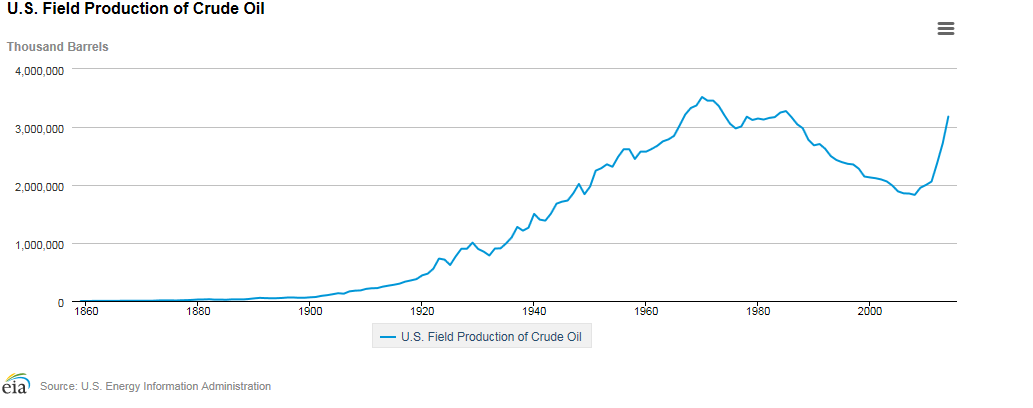
Every time a Tesla (NASDAQ:TSLA)/Nissan (OTCPK:NSANY) Leaf/ LNG car hits the road, demand for oil goes down.
Oil Tech
The U.S. has the best petroleum engineers in the world. Nobody predicted our oil production was going to double from 2005 to 2010. Fracking is a media buzz word but we’ve actually been fracking since the 1950s. Horizontal drilling in tandem with fracking, deep offshore drilling and the shale revolution are driving our oil production to levels past any prognosticators imagination.
Other countries haven’t adopted our ways yet but they will, America is just leading the way. Once other countries adopt our methods the world’s future oil supply will grow even larger.
The naysayer’s will say…
1. Middle East Turmoil – “Hey if the situation in the Middle East heats up, $100 will seem cheap”. We’ve had turmoil in the Middle East for my entire lifetime. There has been conflict in the Middle East for 2000 years. Conflict is baked into the cake and not a reason to speculate on oil.
A) Iraq’s oil production dropped from nearly 2.6 mpbd in 01′ to a little over 1.3 mpbd in 03′. So in two years the world lost 1.3 million barrels of oil per day. Losing oil production is a very promoted event, but it coming back on line is rarely tracked with the same interest level. In 2014 Iraq was above the pre-war levels and produced 3.375 mpbd.
B) Libya dropped from 1.9 mpbd in 10′ to .52 mpbd in 14′. The world has another million and a half barrels per day it can “get back” into production.
C) Iran lost over a million barrels per day in production from 2011 to 2013.
Yes additional conflict would mean a reduced production and higher prices, but conclusions to war and economic sanctions in being lifted could be bearish to oil prices. The loss is always a much more publicized event than the gain.
2. High U.S. inflation – Oil is denominated in dollars. If the dollar depreciates ceteris paribus oil prices go up. That’s part of the reason why oil prices were so high (and a weak spare capacity), and now the dollar has massively strengthened and oil prices are down. Does the dollar have issues? Sure but it’s the cleanest dirty shirt out there. The U.S. doesn’t appear to have meaningful inflation anytime soon. 30-year government debt is trading around 2%. The gold-inspired inflationists have been wrong. The only way the U.S. sees meaningful inflation anytime soon is if the economy gets out of the 2% or less junky growth cycle and we get meaningful economic growth. We can’t do that with an anti-business President.
3. World War 3 – The last time we had 10+ years of Depression in OECD countries it ended in World War. People might dismiss this as crazy talk and maybe it is but the probability of a massive war is larger than people realize. Countries generally don’t go to war during prosperous times, they go to war during desperate times when other people and countries are scapegoated.
People say that history doesn’t “repeat” itself but it does “rhyme”. This period of history is often compared to the Great Depression that led to WWII, but this period of history reminds me of the time before WWI.
Before WWI, there was a long period of peace. After the conflict filled 19th century, Europe had decades of peace to the point that people thought war and conflict was a thing of the past. The Assassination of the ArchDuke Franz Ferdinand happened and people learned of the secret handshakes, treaties and behind the scenes alliances as the dominoes fell. A long period of peace was followed by “The Great War”, the worst war the world had ever seen.
How to Profit?
I’ve shorted oil with the DB Crude Oil Double Short ETN (NYSEARCA:DTO) before. This vehicle is generally better for short-term trading, as it’s supposed to represent 2x the daily inverse of the price of oil. There are other vehicles such as ProShares UltraShort Bloomberg Crude Oil ETF (NYSEARCA:SCO) and PowerShares DB Crude Oil Short ETN (NYSEARCA:SZO).
Currently, I am not short; I shorted from north of $100. I’d like a nice entry point to short again.
Conclusion
We have a recession on the horizon, which will keep prices at bay for a few years. Oil consumption peaked in 2005 in America. The last oil price run up spooked consumers and visibly changed behavior (shifted the demand curve). It’s not just about car pooling to soccer practice and cutting back on car usage, it’s about buying more fuel efficient vehicles that you will use for the long term. When people were paying $4+ at the pump SUV sales fell off a cliff from 3.3 million units per year in 07′ to 1.7 million units in 09′. Even though fuel prices have subsided, anecdotally consumers are still worried about high gas prices coming back. I’d argue that new car shoppers are still a lot more conscious about how many MPG a car gets today than they were 10 years ago.
After the next recession, the technological advancements in fracking, horizontal and offshore drilling being adopted internationally will help expand supply. The technological advancements in efficiency/conservation with automobiles will also help keep oil prices at bay.
If you want to disagree with me in the comments section, great. I challenge you to present hard data and logic, and refrain from immeasurable emotional feelings about the oil market.
If you really don’t like my call, then I challenge you to bookmark this post and come back in 5 years and see how I did.
18 Comments on "We Won’t Have $100 Oil For At Least A Decade"
Peak Oil Prognosticator on Tue, 3rd Nov 2015 12:23 pm
“Long-term, America has the best engineers in the world, and our leading methods will be adopted internationally.”
If the problem was as simple as engineering than the solution would already be there.
“Sure, some experts probably agree, but other experts also disagree. Hyping up somebody’s credentials to prove a point – even worse to anonymously say ‘experts’ is a propaganda technique to drown out discussion and create submission in people that haven’t studied the issue.”
Because the anti-peak oil camp never does that. And so what? There have been dozens of incorrect predictions about global warming in the past 50 years. Yet that is taken now as mainstream science, so why not peak oil?
“If the average car gets 40 MPG instead of 20 MPG then we need half as much oil.”
Jevons Paradox ruins this plan
We won’t have $100 for at least a decade is not an incorrect statement. We won’t have $100 oil ever again.
rockman on Tue, 3rd Nov 2015 12:35 pm
He may well be correct. He seems as confident in his expectations as the vast majority of the oil patch was in 2003 that we wouldn’t see $100/bbl oil by 2012.
rdberg1957 on Tue, 3rd Nov 2015 12:39 pm
I am not very sanguine about the ability of pundits of all stripes to predict the future price of oil. We still have lots of oil, but the amount we will produce will depend on price and other factors. Other factors also include CO2 contributions to global warming. We may need to reduce the amount we produce to a rate which slows atmospheric and oceanic temperature rise. Oil is unlikely to go away soon. But we may be better off in many ways if worldwide production drops by 75%.
shortonoil on Tue, 3rd Nov 2015 1:09 pm
A decade; a century, what is the difference? As the industry is no longer able, within the present price structure, to replace the reserves that they are extracting, they will be long gone before then:
http://www.thehillsgroup.org/depletion2_022.htm
The $39 trillion that will be required to keep world production operating for the next 10 years will eliminate any possibility of future production past a decade.
The world’s usable reserves are depleted out, and it only took 150 years to do it. The remaining 2.4 trillion barrels of liquid hydrocarbons will remain exactly where they are; in the ground.
http://www.thehillsgroup.org/
Ed on Tue, 3rd Nov 2015 1:30 pm
“Black gold was created by dinosaur, plant and animal bones that were basically buried and cooked at high pressure temperatures over long periods of time”
This guy is clueless. An average 12 year old in Britain knows that oil is created by plant matter and nothing to do with bones; but hey, “America has the best engineers in the world”; what do we dumb arses know?
shortonoil on Tue, 3rd Nov 2015 1:38 pm
“But we may be better off in many ways if worldwide production drops by 75%.”
A 75% reduction in production would reduce world GDP by 29%, or $21 trillion per year. The world monetary/ financial system will have collapse, and the integrated global economy will have come to a standstill. Travel will have fallen by 70%, and store shelves will be mostly bare; a BIC pen will be a luxury. The world will be in the worst depression it has seen for the last 1000 years. Half of the children born will have a life expectancy of less than five years.
makati1 on Tue, 3rd Nov 2015 6:59 pm
In a Zimbabwe/Weimer Republic scenario, we may see $1,000,000,000 oil or even $1,000,000,000,000 oil. But will we see $100 oil at today’s exchange? Maybe for a brief few days until we plunge into the 1700s lifestyle, permanently.
Seeking Alpha should seek help for those delusions. LOL
makati1 on Tue, 3rd Nov 2015 7:09 pm
Ed, you might want to take time and watch:
https://www.youtube.com/watch?v=RQm6N60bneo
“The History of Earth by National Geographic”
It is the current thought on our planet’s life and shows how coal and oil was created among other things, like human evolution.
Ted Wilson on Tue, 3rd Nov 2015 9:37 pm
All this forecast is absurd. The day the Saudis cut the production, price will skyrocket to $100 / barrel next day.
apneaman on Tue, 3rd Nov 2015 10:13 pm
mak, Rupert Murdoch just bought Natgeo, so they will probably remake that episode with abiotic oil and coal, a 6000 year old earth creation date and show Jesus riding into Jerusalem on a small brontosaurus.
Something along these lines.
Carl Sagan-Cosmos edited for rednecks
https://www.youtube.com/watch?v=DI9ImScQGAo
Joe D on Tue, 3rd Nov 2015 10:15 pm
“All this forecast is absurd. The day the Saudis cut the production, price will skyrocket to $100 / barrel next day.”
Making an absurd statement about being absurd, PRICELESS!
Ralph on Wed, 4th Nov 2015 3:25 am
Long term $100 oil requires demand to exceed supply and a global economy that can support $100 for the work content that a barrel represents. Unless and until the global economy becomes much more (oil) energy efficient then $100 can only happen for short periods which result in demand destruction. The global supply of sub $100 oil has now peaked, and supply is declining, first in shale, and soon in tar sands, and other high costs sources that have longer lead times. The price will rice to $100 if supply falls faster than demand, and given the deeply unbalanced financial system based on unpayable debt, demand could continue to fall faster than supply. We are in the stairstep decline to a low energy future, but predicting the size and spacing of the the steps is impossible in a chaotic world.
Makati1 on Wed, 4th Nov 2015 3:37 am
Ap, yes, I know. The dumbing down will continue even faster after all of the history and science has been rewritten.
I have watched it several times, along with the one about going to the center of the earth and the one that goes to the stars. They should be required watching for anyone over the age of six, but it would contradict many’s beliefs.
tita on Wed, 4th Nov 2015 7:09 am
History teached us that people fought for ressources. For centuries, as the only available ressources were renewable, growth was sustained with the conquest of territories to gather ressources. Oil (and other fossil fuels) freed humanity from this continuous wars, and let it expand in a way never seen in the history. It feels like a cornucopia, but it is not… At some point, there will be less. And it will stop our growth… which is a big problem, and we don’t know how to deal with it.
There is no point to predict prices for the years coming. We need to prepare our society to adapt to this change. Or not, and adapt the best we can when it come.
And anyway, how can we take seriously someone who say “oil was created by dinosaurs”?
Richard on Wed, 4th Nov 2015 10:30 am
Trees can take a very long time to grow, the idea that they are renewable like solar power is misleading.
It appears conventional crude has been in decline for a decade now, but due to financial problems, this has waned for a while.
Spec on Wed, 4th Nov 2015 1:15 pm
Never say never. Who knows what could happen?
I think a big thing that could really affect prices is the current proxy war between Iran and Saudi Arabia. And it could affect them in either direction. If they both sell as much oil as possible to fund their proxy war, then the price could go down. If one of them directly attacks the other making it a direct war, the price could go way up (but that seems unlikely).
And Russia is a wild card. Their entry into the mid-East fray could cause problems. I wonder if that was part of the reason Putin decided to project power there. If their participation causes chaos then oil prices will go up. So far though, the market has largely ignored them.
Banjo on Wed, 4th Nov 2015 2:09 pm
Its not the price its what you can do with it to run our growth based economies. Globally there is a depression right after the 2008 gfc and 140 bbl oil.
rockman on Wed, 4th Nov 2015 5:17 pm
In 1980 the inflation adjusted price exceeded $100/bbl. And then 6 years later fell to under $30/bbl. And then 22 years later it exceeded $100/bbl briefly and then fell 50%. And then several years later it in increased above $100/bbl and the several years later fell 50% again.
Thus the trend is obvious: oil prices boom for a few years and the collapses for several years to more then 20 years.
Thus the future is easy to predict: oil prices will stay low for the next 3 to 20 years then boom for 3 to 5 years and then collapse again.
Or not. LOL.
l