
Peak Oil is You

Donate Bitcoins ;-) or Paypal :-)


Page added on June 8, 2012

US Air Travel Plateau

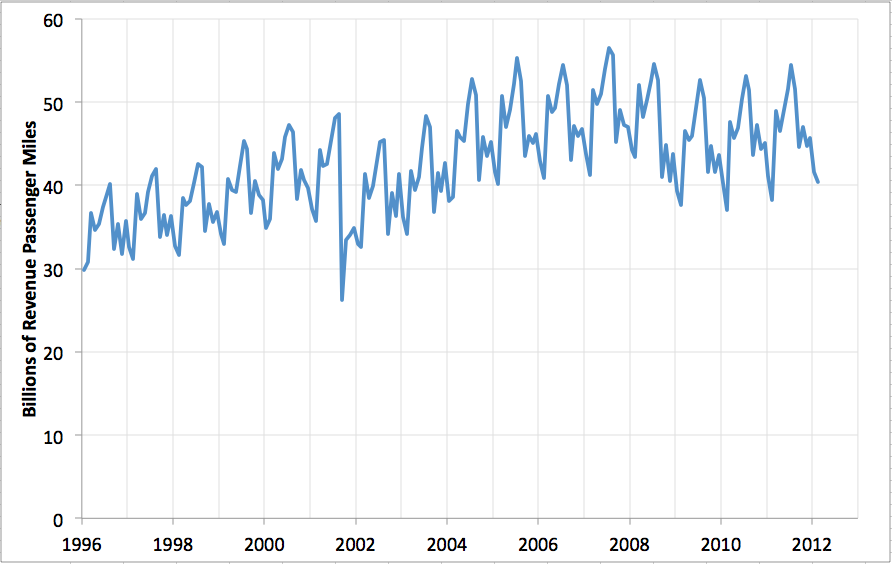
Yesterday, I had a bad air-travel day (one of several lately on work trips) which led me to wonder about all the peak-oil related predictions of the demise of air travel. The above shows the data for total US domestic passenger revenue-miles. The obvious features seem to be:
- Strong growth in the 1990s
- A sharp disruption as a result of 9/11
- Even stronger rebound growth in the early 2000s
- An abrupt leveling off in 2005 with the onset of the plateau in oil production
- A decline with the great recession
- Weak growth since the end of the recession
I think this is more or less exactly what a peak oil moderate would have predicted. Air travel is an interesting case in that there’s no way it’s demand limited. Cars, for example, one might make a somewhat plausible case that further American demand for more vehicle-miles-traveled was going to be limited by already high car ownership and congestion and inability to fit more roads and parking into already crowded cities. However, it seems clear that, unconstrained by costs, many Americans would be jetting around every weekend for fun.
But jet travel is also something that does and will always depend on liquid fuel, so it is likely that constraints in the liquid fuel supply will directly show through into constraints in jet travel.
I would expect air travel to continue for a long time to come, but I also expect it to gradually become more expensive and less accessible to the bulk of the population.
8 Comments on "US Air Travel Plateau"
Rick on Fri, 8th Jun 2012 8:36 pm
The airlines will be the first to go. They are already hurting. I personally don’t fly anymore (and never did much anyway), why:
Bad for the environment, and it’s just a waste.
Bad for your health, many pilots develop cancer, from flying.
sparky on Fri, 8th Jun 2012 10:40 pm
.
This what a peak oil moderate would have expected
Yep , air transport is one of the most energy hungry form of transport
in spite of tinkering about , only fossile fuel have the concentrated energy density ( bang per pound ) to make anything fly .
Some proviso , the use of air cargo is going strong and the international picture is still one of growth , barely
the figure to watch is for the jet fuel production figure , some of it is military of course but it’s all the same anyway
DC on Fri, 8th Jun 2012 11:29 pm
The oil cartel capitlaists would much rather see amerikans fly private jets to the corner store to get a quart of bovine-growth hormone laden milk. But since that is not pratical, 4500 pound toxic gas-burners to make that 2 block round trip will have to suffice.
Harquebus on Sat, 9th Jun 2012 1:29 am
Economies of scale will be lost. Fewer and smaller airlines providing for ever more expensive support services.
The collapse of the aviation industry is imminent. There ain’t no alternative to aviation fuel.
Ham on Sat, 9th Jun 2012 2:14 am
http://www.dailymail.co.uk/travel/article-2155798/Manchester-Airport-fuel-crisis-Holidaymakers-stranded-airport-runs-fuel.html
BillT on Sat, 9th Jun 2012 2:33 am
I live in the Philippines and come back to the States about once per year. Now as to cost, yes, it is going up. BUT…
I travel those 24,000 miles for less than $0.07 per mile. Yes, 7 cents per mile.
I do not own a car now. I used to put that many miles on my car per year, or more, at a cost north of $0.50 per mile. Air travel is still the cheapest way to get from one point to another. If you were going by car, you would need at least 7 in the vehicle to equal that cost per person/mile. Cars are by far the biggest waste of oil.
Air travel is still cheap. If you factor in inflation, air travel is cheaper now than it was in the 60s and 70s. I go half way around the world for less than $1,600. round trip and in less than 24 hours each way.
Air travel is here for a long time yet or there would not be hundreds of airliners on order to be built over the next decade.
DC on Sat, 9th Jun 2012 4:35 am
Yes, but you know well as I do, that the entire casual air-travel system is, after private gas-powered car travel, the most heavilly subsidized industry on earth. Airlines are bleeding red ink to lower fares to entice people to burn gig-a-tons of fuel in jets just to keep the system from collapsing. And when the airlines bleed red ink, it means the taxpayers are bleeding red ink too, even if there not really aware of it. As for the airliners on order, both Airbus and Boeing exist again, on either massive direct and indirect sudsidies, or in case of boeing military contracts underwrite the civil division. Subsidies again, like car-travel, appear cheap, since govt picks up what % of the tab? Who knows for sure?, except it very high. Air travel might be here for while yet, but Im not sure casual mass-air travel will be. Though I dont doubt 100s of billions of dollars will help extend the shelf life of the industry beyond its normal expirey date. Air travel is not cheaper than the 70s, just more heavily subsidized now. Thats all.
BillT on Sat, 9th Jun 2012 6:34 am
DC, the Us owned airlines have been going broke for decades and have been on life support at least that long. However, other airlines are making profits and growing fast, no subsidies required. Perhaps it is capitalism in the West that is killing the airlines?
US airline pilots average $72,000 gross per year + benes.
Philippine airline pilots average $25,000 per year, but purchasing power in the Philippines makes that equal to the American pilots incomes.
So, you see, most airlines WILL continue long after American airlines are gone.