
Peak Oil is You

Donate Bitcoins ;-) or Paypal :-)


Page added on July 16, 2015

U.S. Shifts Away from Coal and Toward Natural Gas
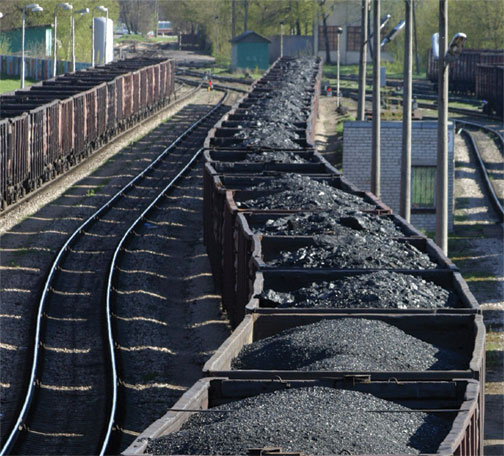
Natural gas overtook coal as the top source of US electric power generation for the first time ever this spring. Natural gas accounted for 31% of electric power generation while coal accounted for 30%, according to a report released by SNL Energy. Nuclear energy came in at third with 20%. This shift is not surprising, however, as natural gas prices have continued their downward slide and new regulations that the EPA is beginning to implement make utilities question the future of coal. This is a much-needed step toward improving US energy security, production, and efficiency.
 While increased power generation via natural gas is a positive development, it is not surprising. The US shale boom that started about a decade ago has increased domestic natural gas production by 30% and made the US the world’s largest combined producer of oil and natural gas. This shale gas produces roughly half of coal’s carbon dioxide emissions and is abundantly available. Indeed, shale gas beats out coal on price point alone. As a result, the US coal industry is in a heavy decline. The Energy Information Administration expects coal production to fall by about 7.5% this year, and shares of large US coal producers like Peabody Energy and Arch Coal have dropped significantly.
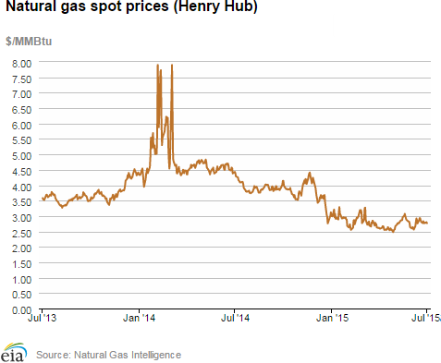
The benefits of a shift toward natural gas and away from coal are clear. Coal is the highest emitting fossil fuel, with 1 short ton (2,000 pounds) emitting about 5,720 pounds of carbon dioxide. Thus, coal represents a clear threat to the climate and environment, and the EPA has pressed for more restrictions on its mining and use. Shifting away from coal and towards natural gas to meet US energy needs is also economically responsible. As of early July, natural gas prices were just under $3.00/MMBtu, or $3.00 per 1 million British thermal units. Increased natural gas production presents export opportunities for the US as well. Secretary of Energy Ernest Moniz announced plans earlier this year for the export of LNG. Asia would seem a natural destination, with nations like China and India among their largest energy consumers.
Although natural gas is a preferable alternative to coal, it is not without issues of its own. The extraction method for natural gas in the US- known as fracking- has been linked to several environmental problems, namely water/air pollution and methane emissions. It is important that this extraction method continues to improve in an effort to mitigate the potential negative effects on the environment and climate.
Taken together, the characteristics of increased reliance on, and production of, natural gas are overwhelmingly positive. Movement away from coal has the dual benefit of protecting the climate and promoting US economic competitiveness worldwide.
41 Comments on "U.S. Shifts Away from Coal and Toward Natural Gas"
Makati1 on Thu, 16th Jul 2015 7:50 am
Until the fraking craze fades into history due to low, below profit, prices.
dmtk on Thu, 16th Jul 2015 7:56 am
And the frack hypers still fantasize about exporting LNG
With domestic consumption picking up, Marcellus peaking, wtf is going to be left for export?
Kenz300 on Thu, 16th Jul 2015 8:21 am
Wind and solar are a better choice than using coal or Natural gas……..
Renewables to Beat Fossil Fuels With $3.7 Trillion Solar Boom – Renewable Energy World
http://www.renewableenergyworld.com/news/2015/06/renewables-to-beat-fossil-fuels-with-3-7-trillion-solar-boom.html
——————–
Climate Change is real….. we need to deal with the cause (fossil fuels)
Listen Up: Pope Calls for the Replacement of Fossil Fuels, Renewable Energy and Solar Subsidies – Renewable Energy World
http://www.renewableenergyworld.com/articles/2015/07/listen-up-pope-calls-for-the-replacement-of-fossil-fuels-renewable-energy-and-solar-subsidies.html
dave thompson on Thu, 16th Jul 2015 9:30 am
Worldwide overall coal use is accelerating.
penury on Thu, 16th Jul 2015 9:51 am
Does anyone really think that over time we will not utilize any carbon based fuel which we are capable of obtaining in an effort to maintain BAU or what passes for normal at that period of time? In these times of excess, humans continue to use whatever is most available and cheapest, in the coming times we will use anything which is available.
Nony on Thu, 16th Jul 2015 10:00 am
Futures curve shows 10 years from now, NG is expected to be about $4.3 average (summer and winter), nominal price. This is about $3.4 in real dollars.
So the futures market, looking out 10 years does not see that shale gas will crash any time soon. Slight increase in price (probably mostly from increased demand/volume), not supply contraction.
Is the futures price a certainty? Heck no. Could be more (or LESS!) than that. But it is the “betting line”. So acting like it is a certainty that shale gas will crash and burn is just ignorant.
Even here a little humility to look at the past comments of peakers is warranted. Where were Berman/Rogers/Hughes in terms of predicting current price and volumes? Did they call the boom? No. Berman said the “Marcellus would disappoint” in 2010. Can anyone look at current production volume from the Marcellus, happening at a very low price, and say that it has under-delivered supply?
Hughes said in 2006, at ASPO, that NG would drop 1.5 BCF/day/year from its then current level of production. Instead of declining like that, we increased! And he said nonventional sources would not stop the decline.
Boat on Thu, 16th Jul 2015 10:12 am
penury
Does anyone really think that over time we will not utilize any carbon based fuel which we are capable of obtaining in an effort to maintain BAU or what passes for normal at that period of time? NO, not in this time period.
In these times of excess, humans continue to use whatever is most available and cheapest, yes your correct. in the coming times we will use anything which is available. Yes your correct. So what is the problem.
Davy on Thu, 16th Jul 2015 10:39 am
Boat, systematically there is a limit to what is available. It may be there and we may be able to get it but to get it and be able to convert that energy into productive activity is another story.
If we stress an economy with declining net energy eventually it will produce at a lower level. It’s just math that tells us this either at the macro or micro scale. We see it in ecosystems and earlier civilizations. Just because you produce something does not mean it has a net gain to that effort.
For some reason we modern men have this mistaken sense of being able to make things happen regardless of the real requirements for productive results.
Humans have a wonderful ability to think about these things much less ability creating a physical result that is productive. This is the most important negative issue with the cornucopians today fantasy vs reality. I see it everyday here on this site.
I think it comes from our abstract system founded on fiat money. It appears we can always find the money, material, and knowledge for most reasonable endeavors. Yet this is not the case because of the laws of thermodynamics. Significant variables must be present for actual positive growth. When this is not the case it is bad debt and mal-investment. IOW Chinese ghost cities and or (maybe) the entire American shale complex.
Plantagenet on Thu, 16th Jul 2015 12:28 pm
Thanks to fracking of tight shales, we have a NG glut AND we have a 100-year-supply of NG.
Its a win-win!
apneaman on Thu, 16th Jul 2015 12:58 pm
Ya planty Alaska really looks like it’s winning big from all that cheap fossil fuel use. Keep cheering along with the rest of the cancer apes.
4,854,924.8 acres burned this year so far. Better get in as many scenic canoe trips as you can while you can because it looks like the picture postcard scenery days are numbered.
http://fire.ak.blm.gov/content/aicc/sitreport/current.pdf
apneaman on Thu, 16th Jul 2015 1:07 pm
I love the smell of smoldering tundra and permafrost in the morning.
Alaska’s Epic 2015 Burning is One Month Ahead of Previous Worst Year; Canada Conflagration Continues, Eastern Siberia Wildfires Light Off
“From Canada to Alaska to Siberia, an immense half-crescent of the Arctic is on fire. The hot spots along this zone include freakish fires with 50 mile fronts, fires that generate thunderstorms from the heat of their updrafts, and fires that paint smokescapes over the lake waters of Canada even as they light the sky red”
“In Alaska, a massive area the size of one and one half Connecticuts (7,300 square miles) has already been consumed by fires. A zone of smoldering tundra, boreal forests turned to ash, smoking bogs, and smoldering, thawing permafrost.”
https://robertscribbler.wordpress.com/2015/07/15/alaskas-2015-epic-burning-is-one-month-ahead-of-previous-worst-year-canada-conflagration-continues-eastern-siberia-wildfires-light-off/
apneaman on Thu, 16th Jul 2015 1:54 pm
New Age of Super Fires
“Our guest John Betts tells us about the new age of super fires, their causes and what communities and individuals can do to reduce the risk of unstoppable fires in the age of global warming.
I think the unreported fires in the far north of Alaska, Canada, and Russia are a big deal. Those forests were once carbon store houses which now become an addition source of greenhouse gases. If the top of the world burns, vast quantities of once frozen life can also be turned into both carbon dioxide and methane. Everyone in the world needs to know about this story, where ever you may live.
So we’ll reach back to 2007, just a year after Radio Ecoshock began. In a short interview, Dr. Tom Gower talks about his research on fires in Northern Canada as a positive feedback loop in climate change. Then from September 2014, Marc-Andre Parisien from the Canadian Forest Service tells us about record mega-fires in the Canadian far north.”
http://www.ecoshock.info/2015/07/new-age-of-super-fires.html
Pennsyguy on Thu, 16th Jul 2015 1:57 pm
Since we’ll never use the last BTU of any domestic fossil fuel, the U.S. has an infinite supply of coal, nat. gas and oil. Why even bother to frac?
Plantagenet on Thu, 16th Jul 2015 3:00 pm
@pennsy
Your suggestion that the US has an infinite supply of FF is similar to what are known as Zeno’s paradoxes—a set of mind puzzles set up by the philosopher Zeno about 2500 years ago.
Cheers!
Dredd on Thu, 16th Jul 2015 4:16 pm
“Yeah, that’s the ticket.”
Switch from poison to poison.
That will stop the invasion Clem (Greenland & Antarctica Invade The United States – 3).
Boat on Thu, 16th Jul 2015 4:26 pm
Dredd, nothing will stop the invasion.
Makati1 on Thu, 16th Jul 2015 8:25 pm
“…in the coming times we will use anything which is available.” AND that the consumer can afford. Unless the government subsidizes it into infinity.
For sure, there will be billions of barrels, tons, and cubic meters left in the ground when the hydrocarbon age ends. The NET energy cost of recovery will prevent it from being used, even if there is enough faux cash to buy it.
rockman on Thu, 16th Jul 2015 9:59 pm
“Futures curve shows 10 years from now, NG is expected to be about $4.3 average (summer and winter), nominal price. This is about $3.4 in real dollars.”
LMFAO: anyone believing that someone, especially the futures market, can predict the price of NG 10 years out is either horribly delusional or is knowing spinning a lie IMHO. Just look at the volatility of NG prices over the last 15 years:
http://www.eia.gov/dnav/ng/hist/n9190us3m.htm.
And guess how close the future players or anyone else predicted the price would swing from $5/mcf to $10.80/mcf to $3.00/mcf in just 5 years between 2004 and 2009?
I’m sure someone has a long list of all those who had correctly predicted these price swings: lets hold our breaths and wait for it to posted. LOL.
James on Thu, 16th Jul 2015 10:39 pm
So why does my electric bill keep going up if the generators use cheaper Natural Gas?
Nony on Thu, 16th Jul 2015 11:34 pm
No one can predict the over/under on a football game either. But the betting line is a good estimate to use. It may be off high or low, but with 50% probability either way.
Peakers sitting here saying they know it will be much higher are just being silly. For all we know it might end up being below 2, rather than way high.
James: NG is not cheaper than coal in older power plants. It’s only cheaper after Obama put huge new restrictions on coal plants. Also, if you live in the Boston area…it’s your fault for not allowing pipelines in.
Nony on Thu, 16th Jul 2015 11:51 pm
Big study came out describing the Utica as almost the size of the Marcellus in terms of recoverable gas.
http://www.slideshare.net/fullscreen/MarcellusDN/utica-shale-playbook-study-from-wvu/2
If you don’t like to read geology details, just google Utica study WVU and you will find lots of news stories giving a synopsis.
marmico on Fri, 17th Jul 2015 4:29 am
Utica shale nattygas production has now bumped the Fayetteville to the back of the class and will overtake both the Barnett and Haynesville by the end of 2016 and Eagle Ford by 2017.
Bank on it Rockman. 🙂
rockman on Fri, 17th Jul 2015 8:13 am
James – The price of NG is only one component of your bill. I don’t have it handy but 6 months ago I read that the differential between the well head and retail/commercial level was at an all time high and increasing. Depending where you live the residential price of NG might be 4X what I’m getting paid at the well head.
One of the days downsides of a lot of folks in one area switching to individual solar: the rates for everyone else goes up since the utilities are guarenteed a certain profit margin.
dave thompson on Fri, 17th Jul 2015 8:43 am
http://www.desdemonadespair.net/2015/07/there-are-2100-new-coal-plants-being.html
dave thompson on Fri, 17th Jul 2015 8:44 am
http://www.desdemonadespair.net/2015/07/the-global-coal-renaissance-is-most.html
Boat on Fri, 17th Jul 2015 8:50 am
dave,
YEP, the future is in deep trouble.
Boat on Fri, 17th Jul 2015 9:01 am
rock,
One of the days downsides of a lot of folks in one area switching to individual solar: the rates for everyone else goes up since the utilities are guarenteed a certain profit margin.
The utilities should fund more solar themselves along with upkeep, windows insulation, heating, cooling in package deals. I think this will become more popular as energy gets higher.
zaphod42 on Fri, 17th Jul 2015 10:22 am
Boat: “The utilities should fund more solar themselves along with upkeep, windows insulation, heating, cooling in package deals.”
Of course you mean they will be loaning users the money for these items. Right?
Nony on Fri, 17th Jul 2015 10:27 am
Utica! Utica! Utica!
https://www.youtube.com/watch?v=f8JMOAXamqY
Boat on Fri, 17th Jul 2015 10:49 am
zap, the utility would install or subcontract. Charge the house owner over 10-30 years depending on the efficiency upgrade.
zaphod42 on Fri, 17th Jul 2015 11:11 am
Boat: Good strategy on their part. I would likely take advantage if my provider had a program like that. 🙂
rockman on Fri, 17th Jul 2015 11:46 am
Boat – “The utilities should fund more solar themselves…”. That’s one of the components that has led Texas to becoming one of the major wind providers in the world.
Boat on Fri, 17th Jul 2015 12:54 pm
Rock,
Cool I didn’t know that.
Tim on Fri, 17th Jul 2015 7:32 pm
Rockman,
I drove thru some part of Texas a couple of years back.What I remember most is the high winds there.I mean I thought my car was going to blow off the road!
I did see a few HUMONGOUS wind turbine farms that were simply beautiful.
Lastly I thought to myself,how much of Texas is windy most of the time? If a large portion,they ought to add wind turbines all over and bill the utility customers for them.Then one day the major portion of electricity would come from wind.
Tim.
rockman on Sat, 18th Jul 2015 2:36 pm
Boat/Tim – It has been an amazing bit of cooperative effort between state and local govts, utilities and rate payers, private investors and industry. What the following article doesn’t detail is that the voters in Austin agreed to pay above normal utilities rates in order to attract investors. And Texas voters didn’t object to having $7 billion of their tax used to expand the state grid which was required to get wind production to consumer markets. As a result Austin had some of the lowest utility costs around.
“The Austin City Council today approved two new wind contracts totaling 291 megawatts (MW) and authorized Austin Energy to negotiate a third wind contract of an additional 200 MW which if approved will bring Austin Energy’s renewable energy portfolio to 30% of its generation needs by the end of 2012 – well within reach of its 35% by 2020 goal.
The new wind projects are near the Texas coast and will produce their highest output during peak demand times in the afternoon throughout the year when generation is needed the most as opposed to West Texas wind that blows primarily during evening hours during the spring and winter. The location of the new wind projects also is in an area with sufficient transmission infrastructure and Austin Energy does not foresee transmission congestion issues similar to wind power from West Texas.
The new projects are priced in the $35 to $45 per megawatt-hour range which is comparable to current and near-term pricing for natural gas power. These prices reflect a significant drop in power prices in general and in wind since 2008. The prices are indicative of the declining demand due to the economic downturn and lower natural gas prices because of increases in shale gas supplies.
“These contracts assist our clean air and sustainability goals, better positions the utility for increasing federal emissions requirements and delivers more wind-generated power on hot summer afternoons — all of which will reduce overall costs to our customers,” said Austin Energy General Manger Larry Weis.
The first contract is a 25-year purchase power agreement totaling $675 million with Duke Energy Generation Services for 200 MW from a wind farm (Los Vientos project) located in Cameron County. The second 25-year agreement approved for $375 million is with MAP Royalty Inc. for 91 MW from the White Tail project in Webb County near Laredo.
The City Council also authorized Austin Energy to negotiate a 25-year purchase power agreement with Iberdrola Renewables Inc. for 200 MW from the Penascal III project in Kenedy County. The projected cost of the contract is estimated at $725 million and is scheduled to be considered by the City Council on Sept. 22.
The Duke and Iberdrola projects are within 15 miles of the coast while the MAP project is 75 miles from the coast. The contract prices are on a per megawatt-hour basis, are fixed and will not change over the term of the agreements. Austin Energy is only obligated to pay for the energy produced.
With a purchase power agreement for 30 MW from a solar project in Travis County scheduled to come online late this year and another purchase power agreement for 100 MW of biomass from East Texas scheduled to come online next year, the three wind contracts due online next year will increase Austin Energy’s renewable energy generation to 30% by the end of 2012 with almost 1,000 MW of renewable energy generation.”
Boat on Sat, 18th Jul 2015 3:18 pm
Rock,
Great information.
A few years back I lived in Georgia. An agreement was made to hike our electricity rate. We started paying the higher rate 2 years or so before the construction even started to help fund the capital intensive project.
Boat on Sat, 18th Jul 2015 3:19 pm
LOL. It was a nuclear power plant. I should mention that.
Makati1 on Sat, 18th Jul 2015 9:45 pm
James, here is the breakdown of a typical monthly Philippine electric bill (with the Peso amounts also):
Generation 41.37%
Transmission 8.38%
System loss 4.34%
Distribution 31.70%
Subsidies 0.87%
Gov’t taxes 9.69%
Universal charges 3.27%
Renewable program 0.38%
————————-
Total 100.00%
Does your electric bill show a breakdown like this?
BTW: Electric here in Makati is $ 0.24/KWh currently.
Davy on Sun, 19th Jul 2015 6:46 am
Dig a little deeper into Mak’s comment and you get this:
Power Struggles in the Philippines
http://blogs.wsj.com/indonesiarealtime/2014/02/24/power-struggles-in-the-philippines/
The high cost and sketchy reliability of electricity supplies in the Philippines are now the main deterrents to investing in the country, according to foreign business leaders, who see the problem as a persuasive reason to invest elsewhere.
Kenz300 on Sun, 19th Jul 2015 8:52 am
Wind and solar are dropping in price and growing in use every day….
Global Renewable Energy Is Status Positive – Renewable Energy World
http://www.renewableenergyworld.com/articles/2015/07/global-renewable-energy-is-status-positive.html
apneaman on Sun, 19th Jul 2015 8:24 pm
Hospitalization rates and fracking site proximity: latest study exposes a link between them
http://www.themarketbusiness.com/2015-07-19-hospitalization-rates-and-fracking-site-proximity-latest-study-exposes-a-link-between-them