
Peak Oil is You

Donate Bitcoins ;-) or Paypal :-)


Page added on November 14, 2013

Turning electricity into food

You know that when energy in agriculture is discussed, the paradigm is energy production in the form of biofuels. But the idea of biofuels manufactured from agricultural products is monumentally wrong. Modern food production depends nearly completely on fossil fuels: agriculture is a consumer of energy, not a producer.
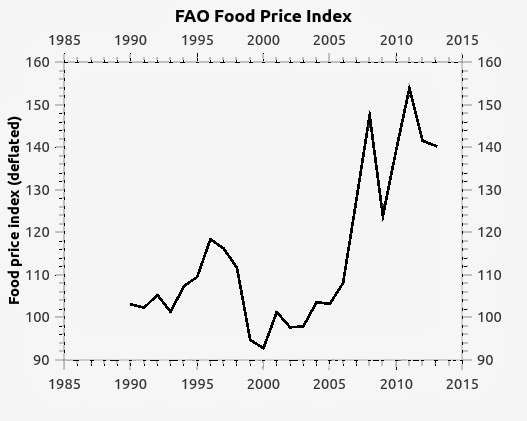
The problem is that gradual depletion is making fossil fuels more and more expensive. And higher prices of fuels immediately generate higher food prices. It has been happening and it is a big problem especially for the poor people of the world (graph below from FAO data)
So, how are we going to do? We need energy for agriculture, there is no doubt about that. To obtain this energy we could go back to human work and pack animals, as in the past. It is the concept of the “50 million farmers” (in the US alone) proposed by Richard Heinberg. But the work of the farmer of old was anything but pleasant and not even very efficient. Pre-industrial agriculture produced only a modest surplus at the expense of the suffering of a large number of people. There is no doubt that the coming of modern, mechanized agriculture was seen everywhere as a great advance in freeing people from the slavery of the heavy manual work of farming. (Image below (1971) courtesy of Stefan Landsberger)

So, can we eliminate fossil fuels in agriculture without having to go back to the back-breaking practices of the past? Myself and some colleagues started asking this question already some years ago and that led us to study the idea of using renewable energy (NOT intended as biofuels) to power agricultural machinery. We noted that modern renewable technologies (mainly wind and solar) produce electricity as output and that transforming electric power into fuels is expensive and inefficient. So, the idea we developed was to use directly electricity to power agriculture.
The result was the “Ramses project” that led us to develop a prototype agricultural vehicle that wasn’t just a tractor, but a multipurpose vehicle for a variety of tasks, including energy storage (in the foto below, from left to right, Toufic El Asmar, Paolo Pasquini, and Ugo Bardi).
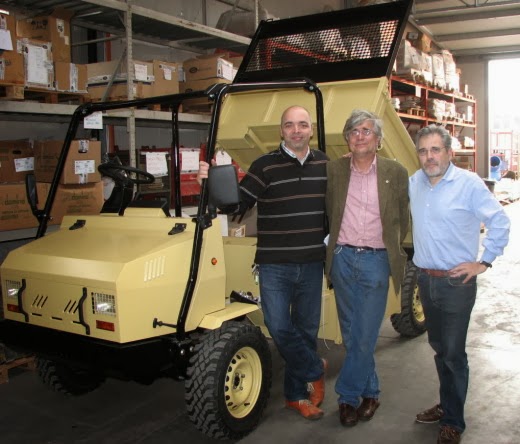
The Ramses vehicle was a success as a prototype, and it has been used in various farm activity for a few years, first in Lebanon and now in Italy. It taught us several things; one is that, making the appropriate calculations, today, electric mechanization in agriculture is still marginally more expensive than conventional, fossil fuel based, engines. Because of this marginally higher costs, farmers still use conventional engines and the Ramses is still just a prototype.
But things are gradually changing and, eventually, because of both depletion oan climate change, we will have to “wean” agriculture away from fossil fuels. This idea led us to a more comprehensive examination of the agricultural process. If the Ramses demonstrated that we can use electric power for many tasks that require mechanical energy, it is also true that agriculture needs much more: it needs fertilizers, pesticides, transportation, refrigeration, and more. Can we perform all those tasks using the electric energy produced by renewable sources?
That is what our recent paper on the “Journal of Cleaner Production” discusses (authors U. Bardi. T. El Asmar and A. Lavacchi, vol. 19, pp. 2034-2048 – 203). It is an extended examination on how energy is used in agriculture and how, in the future, we could obtain this energy from renewable sources, moving away from fossil fuels while at the same time maintaining the high productivity of modern agriculture.
The results? As you can imagine, it will not be an easy task; but it is not an impossible one, either. As modern renewables (wind and solar) increase in efficiency and come at lower costs, it is perfectly possible to think of integrating them with the agricultural process, first reducing and then fully eliminating the need of locally using fossil fuels.
Then, of course, agricultural production is not just based on the local use of fossil fuels: fertilizers, for instance, are produced on large industrial plants. These plants can be powered by renewable energy and it turns out that, for instance, there exist known methods for using electricity to generate ammonia as fertilizer without the need of using methane or hydrogen as feedstock. Even so, even abundant energy can’t solve all problems, for instance the gradual depletion of mineral phosphate resources. For that, only the careful management of what we have can maintain the availability of the necessary phosphate based fertilizers
So, the end result of our study is that modern renewable energy can be a tremendous help to agriculture, but not for the wasteful and unsustainable agriculture of today. It is possible to turn electricity into food and we don’t need to go back to the back-breaking practices of old. But we need to imagine and build an agriculture that doesn’t destroy the resources it uses.
For a copy of our paper on the “Journal of Cleaner Production” write to me at “ugo.bardi(swirlingthing)unifi.it
11 Comments on "Turning electricity into food"
J-Gav on Thu, 14th Nov 2013 8:49 pm
I can’t help but like Ugo Bardi somewhere for taking some strong positions early on concerning energy etc … But he did also for a time ‘almost’ buy into the Andrea Rossi scam. Which leads me to think he may have a little more confidence in tech solutions than I do. Not that appropriate tech can’t play an important role in the future power-down. It’s the definition of that word ‘appropriate’ which gets kinda sticky.
sunweb on Thu, 14th Nov 2013 9:09 pm
On his own website for this essay, he has been challenged from multiple perspectives.
There is a new excellent one just posted their. It challenges the use of electricity. As do I from a total systems point of view.
One of my posts was:
Solar and wind energy capturing devices as well as nuclear are not alternative energy sources. They are extensions of the fossil fuel supply system. There is an illusion of looking at the trees and not the forest in the “Renewable” energy world. Not seeing the systems, machineries, fossil fuel uses and environmental degradation that create the devices to capture the sun, wind and biofuels allows myopia and false claims of renewable, clean, green and sustainable.
Energy Return on Energy Invested (ERoEI) is only a part of the equation. There is a massive infrastructure of mining, processing, manufacturing, fabricating, installation, transportation and the associated environmental assaults. Each of these processes and machines may only add a miniscule amount of energy to the final component of solar or wind devices yet the devices cannot arise without them. There would be no devices with out this infrastructure.
How else would we do it? There is always the old way. Who of us will go down in the mine first?
A story in pictures and diagrams:
From Machines making machines making machines
http://sunweber.blogspot.com/2011/12/machines-making-machines-making.html
ghung on Thu, 14th Nov 2013 10:27 pm
Unless I’m having deja vu, the last time this article appeared I commented that the fuel problem is the most easily solved. Farmers can easily produce their own biofuels using only a small fraction of their production.
I consider the availability of water, soil fertility (i.e.rock phosphate), global supply chains, and climate change to be the greater threats to industrial agriculture, along with the problem of organisms adapting to herbicides and insecticides. It doesn’t matter how the machines are powered if the machines can’t be produced, repaired, or replaced, if the soil is worthless and dry, or super-weeds and pestilence are taking over.
Norm on Thu, 14th Nov 2013 10:30 pm
It is so true. Food system consumes energy, not making it. Seems like electric tractor might work, but would need long extension cord. How about go back to Steam Tractor. Search words like Case Traction engine on YouTube. Those rock. From 1910 or so. Nowadays, chuck old tires and TV sets into the firebox. No coal required!
BillT on Fri, 15th Nov 2013 1:36 am
ghung, you too are delusional… biofuels are a negative energy source. And no farm has enough ‘excess’ to run their equipment. Have you ever lived on a real farm? All of that biomass has to go back into the sol to maintain a living ecology that makes a crop possible. It goes back as dung from animals or as chaff that is plowed under. It cannot be used for other things without depleting the soil.
And the US would need about 300 of it’s 320 million people back on the farm to make it possible for the 320 million to survive. Think pre-oil history for the reason.
RICHARD RALPH ROEHL on Fri, 15th Nov 2013 9:32 am
Hey! Great news! This will surely be the answer to exponential growth of the human population in a closed looped system of finite resources like Planet Over-birth Earth. 7 billion baboonies on the planet today. 9 billion tomorrow. 11 billion after that. Let us go forth and multiply!
J-Gav on Fri, 15th Nov 2013 10:55 am
Ghung and BillT – I don’t know from personal experience but I remember seeing a report here in France a few years ago where several small/medium farms pooled their biomass resources and low-tech know-how to produce plenty of fuel for their ag equipment. They seemed happy with the result though I can’t say if it’s still operational …
Of course that sort of thing is illegal here, like most activities which allow people to escape the clutches of the State. But the government didn’t crack down in this case, I suppose 1 – because the scale was so small it didn’t make a dent in the big energy companies’ racket; 2 – because a crackdown would have been very unpopular politically.
In any case, it’s not something that could be scaled up to replace fossil fuels to any meaningful degree.
BillT on Fri, 15th Nov 2013 1:35 pm
J-Gav, they were burning their future if they were using their biomass to make fuel. It should be plowed back into the soil every year as manure or chaff. Rich, living, soil requires the decomposition of biomass to keep the soil loose and to hold moisture. Without it, you get desert.
ghung on Fri, 15th Nov 2013 2:36 pm
@BillT: I guess you skipped the part where I said I consider soil fertility, etc. the greater problems. Even if farmers could solve their fuel problems, it would be pointless if the other requirements for continuing industrial ag aren’t being met sustainably. Considering the current scale of biofuel production in the US, the fuel issue doesn’t top my list. Perhaps Ugo and friends are foreseeing electric energy slaves as part of a more sustainable system of post-industrial agriculture, but I’m with you in that the current scale of food production can’t/won’t continue, for a lot of reasons…
… and yes, I’ve lived on a smaller farm, in an agricultural community for most of my life. On our own property, I’ve determined that the best method for preserving and restoring soil fertility is to let areas remain fallow, not for a season or two, but for years. I’ve let 10-15 acres of our property go fallow for over ten years. I’ll put goats on it for a few years before it goes back into any kind of production. They should do a fine job of converting the brush, brambles and small trees that are now growing into soil amendments. No fossil fuels required.
Of course, a civilization trying to feed 7+ billion humans can’t afford to take a third or more of its arable land out of production at any one time. Then, again, it’ll happen anyway at some point.
J-Gav on Fri, 15th Nov 2013 3:39 pm
Agreed, BillT, soil is the key to ag anywhere. However, on a small scale, a place with abundant hedgerows generates quite a bit of biomass which doesn’t compromise soil quality if it’s used for fuel. Natural regrowth and some planting can make up for such use as well, on a scale scale of course. It’s all about getting that Permaculture equilibrium right – when you take something out, you’d better put something back in …
GregT on Fri, 15th Nov 2013 4:39 pm
My response to this article remains the same as the last time it was posted:
Yet one more article that fails to see the forest through the trees.
I wonder where, exactly, will the energy and resources come from, to build the billions of these so called ‘renewable’ vehicles?
” it is also true that agriculture needs much more: it needs fertilizers, pesticides, transportation, refrigeration, and more.”
All of which require fossil fuel feedstocks.
Nothing more that another techno-fix, wet dream.