
Peak Oil is You

Donate Bitcoins ;-) or Paypal :-)


Page added on May 21, 2014

The World’s Demand For Oil Is Slowing
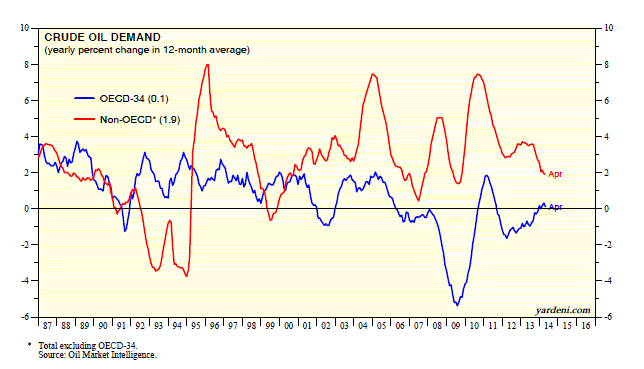
According to Oil Market Intelligence (OMI), world crude oil supply rose to a record 90.2mbd on average over the past 12 months through April. The price of a barrel of Brent crude oil has been remarkably flat (with some volatility) around $110 since early 2011. World oil supply has been well balanced with world oil demand at this price.
Let’s review some of the highlights of the latest demand data compiled by OMI through April using 12-month averages to smooth out seasonal volatility:
(1) World. World crude oil demand rose to a record 91.7mbd last month. However, the growth rate has slowed from a recent high of 1.5% y/y during September 2013 to 1.0% during April. This suggests that the global economy is growing, but at a relatively slow pace.
(2) Emerging countries. Most of the recent slowdown is attributable to emerging economies. The OMI data show that the growth rate among non-OECD countries is down from 3.7% a year ago to 1.9% currently. Among the 34 advanced economies of the OECD, oil demand growth is close to zero on a y/y basis, but that’s an improvement from negative readings during 2012 and 2013.
(3) China & India. Oil demand rose sharply in China from 2009 through mid-2013. Since then, it’s been flat around a record 10mbd, confirming that the country’s economy is in the midst of a significant slowdown. On the other hand, India’s oil demand rose to a record high of 3.8mbd last month, up 3.8% y/y.
(4) Europe. I have often shown that oil demand is a useful indicator of economic growth. In addition to suggesting a significant slowdown in China, it is confirming that the Eurozone’s economic recovery is very weak. Oil demand in Germany has been flat around 2.4mbd since 2010. Demand in France, Italy, and Spain remains on a downtrend that’s been going on for over five years.

23 Comments on "The World’s Demand For Oil Is Slowing"
bobinget on Wed, 21st May 2014 7:13 pm
http://allafrica.com/stories/201405200333.html
Demand is still higher this month. Perhaps the growth RATE has slowed but demand is still higher. This week or next the US will consume over 19 Million B p/d
By July 4th 20 million B p/d.
Oh, President Obama just sent 60 troops to Nigeria in attempt to recover 200 school girls.
Remember, this is strictly a humanitarian mission.
Most certainly NOT about terrorist suppression.
The Nigerian Army simply refuses to fight.
How much ya wanna bet the next group of Special Forces quadruples that initial 60 troop force?
Our Special Troops intend a surgical strike. Tactics are well advertised. What could go wrong?
dissident on Wed, 21st May 2014 7:14 pm
The 90+ million barrels per day figure is a composite of all liquids including biofuels. It’s not self-evident that the demand for oil has stalled from this composite number. Maybe it is the biofuels and liquids demand that has slowed or fallen.
GregT on Wed, 21st May 2014 7:22 pm
A had a chuckle at this one:
“Oil Market Intelligence”
Plantagenet on Wed, 21st May 2014 7:47 pm
Quadruple the price of a barrel of oil and the demand for oil slows. — Gosh-a-rooonies…what a big sooo-prise.
pat on Thu, 22nd May 2014 12:34 am
the economic numbers and the voices hearing are all but only saying of recovery, increasing employment numbers, sales, growth etc. the peak oil and the 150 dollar oil is going to have huge impact on the world. the early signs of mass storage, squandering of the ff oil has already begun and the shortages as early 2015 only to get more worse.
Norm on Thu, 22nd May 2014 2:17 am
‘Demand has slowed’. What a stupid phuck. No, the supply has slowed. Too stupid to know the difference. ROTFLMAO.
Kenz300 on Thu, 22nd May 2014 5:43 am
The price of oil, coal and nuclear keeps rising…… no surprise that rising prices reduces demand……..
The price of wind and solar keeps dropping……. no surprise that demand for wind and solar is rising…….
BIofuels are now part of the transportation fuel mix and growing in use around the world…….
Biofuels can now be made from waste or trash…….
Landfills can now be converted to produce biofuels, energy and recycled raw materials for new products….
As this technology spreads around the world there will be more local production of biofuels and more local jobs…… turn garbage into fuel and reduce the cost for importing fuels……..seems like this idea will spread quickly around the world.
Laci on Thu, 22nd May 2014 8:40 am
Demand is slowing because prices are high and as a result global economic growth is slowing. from 2008 till now average global growth has been in the under 3% per year range as opposed to over 4% on average in the years and decades before.
Why is this so hard to comprehend?
GregT on Thu, 22nd May 2014 8:40 am
Kenz,
How long do you believe that garbage will last as a fuel source? Or do you simply believe that by burning garbage, we can just create more garbage to burn?
rockman on Thu, 22nd May 2014 9:12 am
Laci – Good point IMHO. It seems no more complicated then simple supply/demand dynamics: all the economies that can afford the current price have sufficient supplies available to them…for now. Unfortunately some will take this as evidence that PO isn’t a significant factor.
Norm on Thu, 22nd May 2014 10:20 am
You can see by what was written, Kenz300 is enjoying the legalized pot. ;o)
Norm on Thu, 22nd May 2014 10:23 am
Attendant: “Nice Chevrolet, great wax job, hey do you want 87, 89, or 91 octane gasoline?”
Kenz300: “I don’t need any of those, this trash can next to the gas pump has everything I need. Excuse me while i shove some hamburger wrappers and cigarette boxes into this here gas tank filler hole”.
Attendant: “hey boss call 911, some guy is shoving trash out of our garbage can, into his Chevrolet gas tank”.
Northwest Resident on Thu, 22nd May 2014 11:21 am
World demand is slowing?
So, are the oil producers scaling back production efforts in order to avoid producing barrels of oil that will be difficult to sell due to slowing demand?
Or, are oil producers selling every single barrel of oil they produce regardless of “slowing demand”?
And if oil producers are selling every single barrel of oil they produce (hint: they are), then why wouldn’t they ramp up production to produce and sell even more barrels of oil — despite “slowing demand”?
Answer: Because oil producers are pretty much pumping and selling as much and as fast as they can right now, regardless of “slowing demand”. Slowing demand or not, every barrel of oil is still be swooped up even at the high price it is selling for, oil companies are pumping as fast as they can and scouring the deep ocean floors and subcontinental rock layers for even more oil to produce.
Slowing demand or not, there still isn’t enough oil to keep the party going. Kind of like one of those keg parties I went to in college — around two in the morning, everybody passed out or in a stupor, demand “slowed” but there were still plenty of us left to keep draining that keg until the last drop. Of course we severely regretted it the next day — just like human civilization is going to wake up one day to a “dry oil keg” and there will be very severe regret.
shortonoil on Thu, 22nd May 2014 11:49 am
The volume of petroleum production may have flattened out, but the energy it delivers to the general economy is continuing to decline. That is because the energy to produce petroleum, and its products is continuing to increase along the same curve that it has followed for the last 100 years. The relationship between petroleum, and the economy can be expressed as an energy relationship, it is not a volumetric relationship. The relationship between volume, and the economy was very strong between 1960 and 2000, as most of the world’s production during that period was conventional crude. Beginning around 2000 a greater volume of lower quality crude began entering the market, and that relationship broke down. The energy delivered to the economy from petroleum is now declining on a per unit bases by about 3% per year. Part of that decline is being compensated for by other energy sources, other technologies, and most of all changes in life style.
According to HSBC’s latest PMI report China, Japan, and India are experiencing slowing economies. Southern Europe is in the equivalent of a depression, and the US is only maintaining a precarious balance through mass currency printing. That is likely to fail at some point when the leverage used by the financial system increases beyond a sustainable level. Unless a geopolitical crisis hits this decline will continue for about 20 years. At that point we will have reached the end of the oil age where the energy delivered to the end consumer from an average unit of petroleum will have reached zero. This will be recognizable because it will also be the point where production costs have become equal to the price.
http://www.thehillsgroup.org
Northwest Resident on Thu, 22nd May 2014 12:28 pm
“Unless a geopolitical crisis hits this decline will continue for about 20 years.”
So, 20 years “best case” scenario.
Of course, continuing to burn all that oil over the next 20 years would be a disaster for the atmosphere and for all life on earth — minor point when compared with the need to keep selling all those Big Macs (snark…).
My guess is that an unsustainable level of financial leverage will be achieved long before that 20 year mark is reached (like, tomorrow or next week maybe), and THAT in itself will result in a geopolitical crisis of epic proportions.
Aaron Sheldon on Thu, 22nd May 2014 12:29 pm
It is not demand that is slowing, it is that there is not enough entropy left over in the fossil fuels.
Low EROEI reserves that require high thermal gradients to extract, process, refine, and deliver leave little entropy left over to run a complex society.
Like a wet log burning out, we will hit the thermodynamic brick wall of no longer being able to maintain self-sustaining dissipation of fossil fuel energy, long before the physical reserves run out.
meld on Thu, 22nd May 2014 1:02 pm
Well US GDP has been collapsing for a number of years now as reported by shadowstats
http://www.shadowstats.com/alternate_data/gross-domestic-product-charts
Northwest Resident on Thu, 22nd May 2014 1:43 pm
meld — Good point. The official line is that the USA GDP/economy is growing at a very tiny pace. But using real numbers instead of fudged numbers, it becomes clear that the USA economy is actually contracting and has been for a while. IMO, the unsustainable level of financial leverage has already been reached and we are currently on a long slow ride down. There probably will come a point where we hit some “turbulence”, and when that happens, we will all experience that sinking feeling.
Perk Earl on Thu, 22nd May 2014 3:37 pm
“There probably will come a point where we hit some “turbulence”, and when that happens, we will all experience that sinking feeling.”
The writings on the wall. The only thing I wonder about at this point (although it is fun to analyze) is what will be the tipping point catalyst and when? My sense of it is the charge is packed pretty tight, meaning just about as much fancy fiscal follies has taken place as can be done to compensate for higher priced energy, but I’m no expert in cooking the books, so how much longer is a vexing question.
shortonoil on Thu, 22nd May 2014 4:19 pm
NR said:
“My guess is that an unsustainable level of financial leverage will be achieved long before that 20 year mark is reached (like, tomorrow or next week maybe), and THAT in itself will result in a geopolitical crisis of epic proportions.”
Most probably; the monetary financial system is definitely in a very precarious state. Leverage in the TBTF banks is already exceeding Lehman era levels, and the $1000 trillion derivative market is still hanging over everyone’s head. But the catalyst for a major crisis could come from anywhere: war, civil unrest, pandemic, natural disaster; that’s why it is called a Black Swan event. But I must agree with you, the chances of us hitting our theoretical limit of 2035 is very close to zero.
http://www.thehillsgroup.org
Davey on Thu, 22nd May 2014 5:42 pm
Short, well put. I see the systematic risks in the financial system in relation to the global economy as the clear and present danger. The other major global stresses will impact the financial system. Food is the weak link in the equation for an eventual collapse. Energy is the brick wall. This break to a lower level “MUST” happen by the nature of the global system at limits of growth facing diminishing returns with the global population in overshoot to carrying capacity. In the short term it is all about the confidence in the financial system.
Perk Earl on Thu, 22nd May 2014 7:16 pm
“This break to a lower level “MUST” happen by the nature of the global system at limits of growth facing diminishing returns with the global population in overshoot to carrying capacity.”
True, but is it a smooth or rough transition? It seems like the more efforts that are forced to keep BAU going as long as possible by any fiscal means will draw the harshest recoil. But then again how does one plan for a shift downward?
Davy, Hermann, MO on Thu, 22nd May 2014 8:50 pm
True Perk, I imagine this event will be large, ugly, and painful. The real test will be how much complexity is lost and never recovered before the reboot. Our global system relies on ever increasing complexity. There is a complexity level that this global system will not function bellow. This would not be an issue in the past. Regions and locals could decouple and still manage. Today all locals depend on the global and this dependence has become extreme. This extreme dependence will be what causes the ugliness. The weak link is food. People become very upset if food is scarce especially if they have never experienced food insecurity. This food insecurity is much more serious then today’s food insecurity with the poor. When store shelves are bare for everyone this will create and panic dynamics leading to further systematic risks feeding back to other areas. I highly recommend stocking up on long shelf life foods.