
Peak Oil is You

Donate Bitcoins ;-) or Paypal :-)


Page added on June 6, 2017

The World’s $100 Trillion Question: Why Is Inflation So Low?

Central bankers and investors are grappling with a $100 trillion question: why consumer price inflation remains so low in most parts of the world even as economic growth quickens.
Compounding the riddle, question marks are now emerging over the one part of the global inflation picture that had been moving higher — producer prices. That’s because two engines of that turnaround — China’s resurgent factories and prospects for tax-cut fueled stimulus under President Donald Trump — are showing signs of fading.
Which way the inflation mystery unravels is crucial for the global monetary policy outlook and the world’s $100 trillion bond market. And as with any puzzle, there are rival camps out there in the eco-sphere, with Michael Shaoul, chief executive officer at Marketfield Asset Management in New York, among the PPI-reflation believers.
“This remains an obviously reflationary period for the global economy, with the broadest rise in input cost seen since the global V-shaped recovery hit the skids in 2011,” Shaoul wrote in a recent email. He charts producer prices in China, the U.S., Germany and South Korea — which make up more than 50 percent of traded goods — to show the trend.

While that chart makes compelling viewing, reflation skeptics had their case bolstered by China’s May manufacturing purchasing managers’ indexes. The government’s PMI reading showed the sub components for both input and output prices dropped sharply even as the headline reading held steady. Caixin Media and Markit Economic’s private report fell back into contractionary territory for the first time since last June.
“While China is crucial to global inflation trends, there is little to suggest that China will be a major driver of global reflation in the coming 12 months,” said Louis Kuijs, head of Asia economics at Oxford Economics in Hong Kong. “We expect China’s real estate construction to slow down in the second half of 2017. Combined with remaining excess capacity in China’s heavy industry, this implies reduced support to commodity prices, domestically and internationally.”
Bloomberg Intelligence Chief Asia Economist Tom Orlik was even more definitive: “China’s factory reflation story is over,” he wrote after the Caixin report was released on June 1.
Tumpflation, Xiflation
That leaves the reflationary ball back in Trump’s court. The U.S. president has promised to plow ahead with hundreds of billions of dollars in spending on new roads and bridges, funded by the public and private sectors, along with pledges for far reaching tax reforms.
“What happens next in the U.S. has become critical,” economists at Societe Generale wrote in a recent note. Their verdict: “Trumpflation” will be “insufficient to offset fading Xiflation” — a reference to Chinese President Xi Jinping.
Markets too seem to share that view, with bets on accelerating inflation late last year and early in 2017 now unwinding.
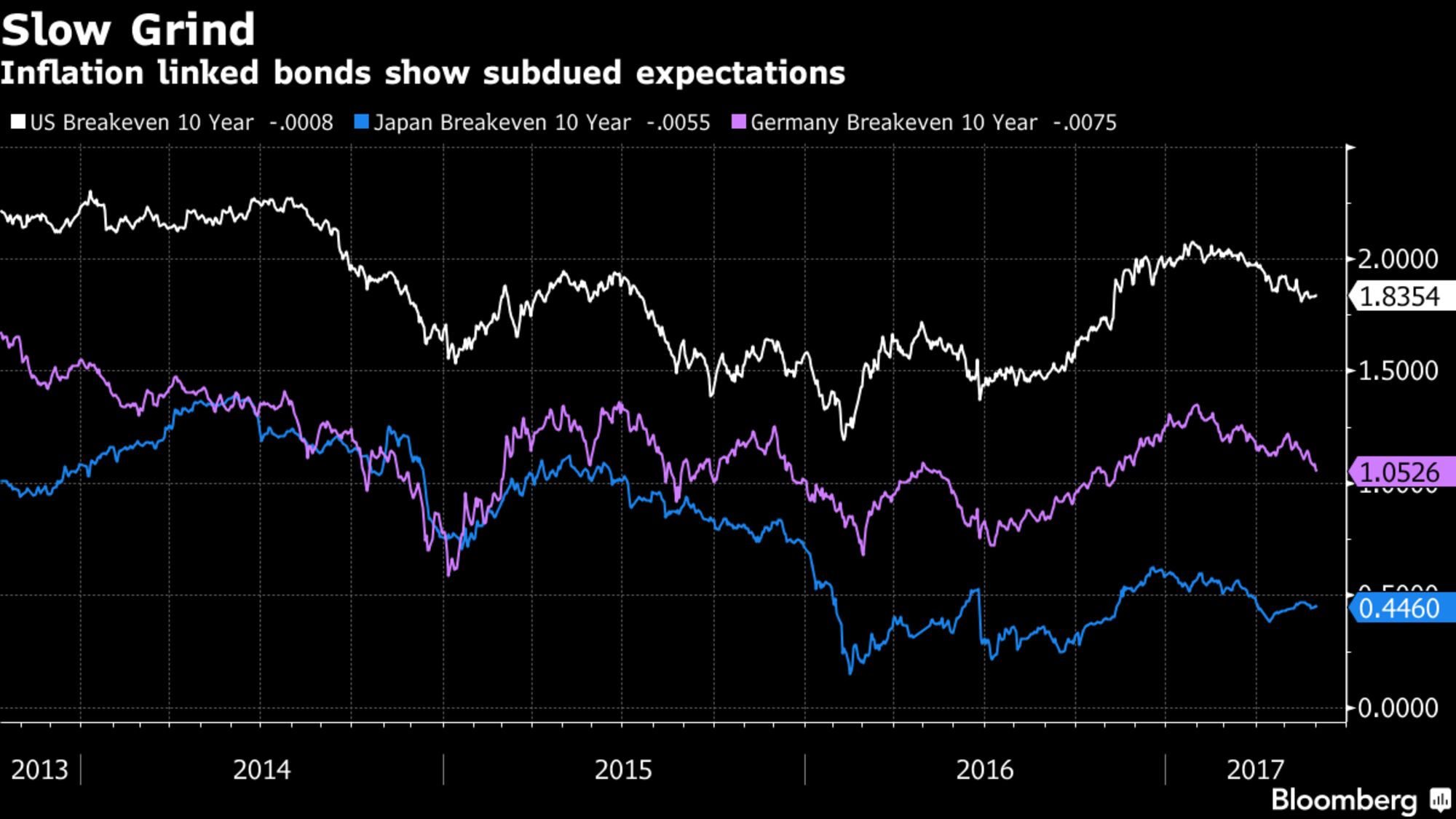
At the same time, upstream pressures continue to build in the U.S. Producer prices there rose a more than forecast 2.5 percent in April from a year earlier.
Yet, American consumer prices are showing few signs of following the pick up in PPI. The Federal Reserve’s preferred price measure rose 1.7 percent in April from a year ago, down from 1.9 percent in March and 2.1 percent in February. Core inflation — which strips out volatile oil and food costs — also slowed to the weakest annual pace since 2015.
In the euro zone, while producer prices rose 4.3 percent from a year earlier in May, that pressure has yet to flow through to consumer inflation either. Euro-area inflation decelerated to 1.4 percent in May — the weakest reading this year — from 1.9 percent a month earlier.
Those readings will support European Central Bank President Mario Draghi’s argument that it’s too early to commit to an exit from monetary stimulus.
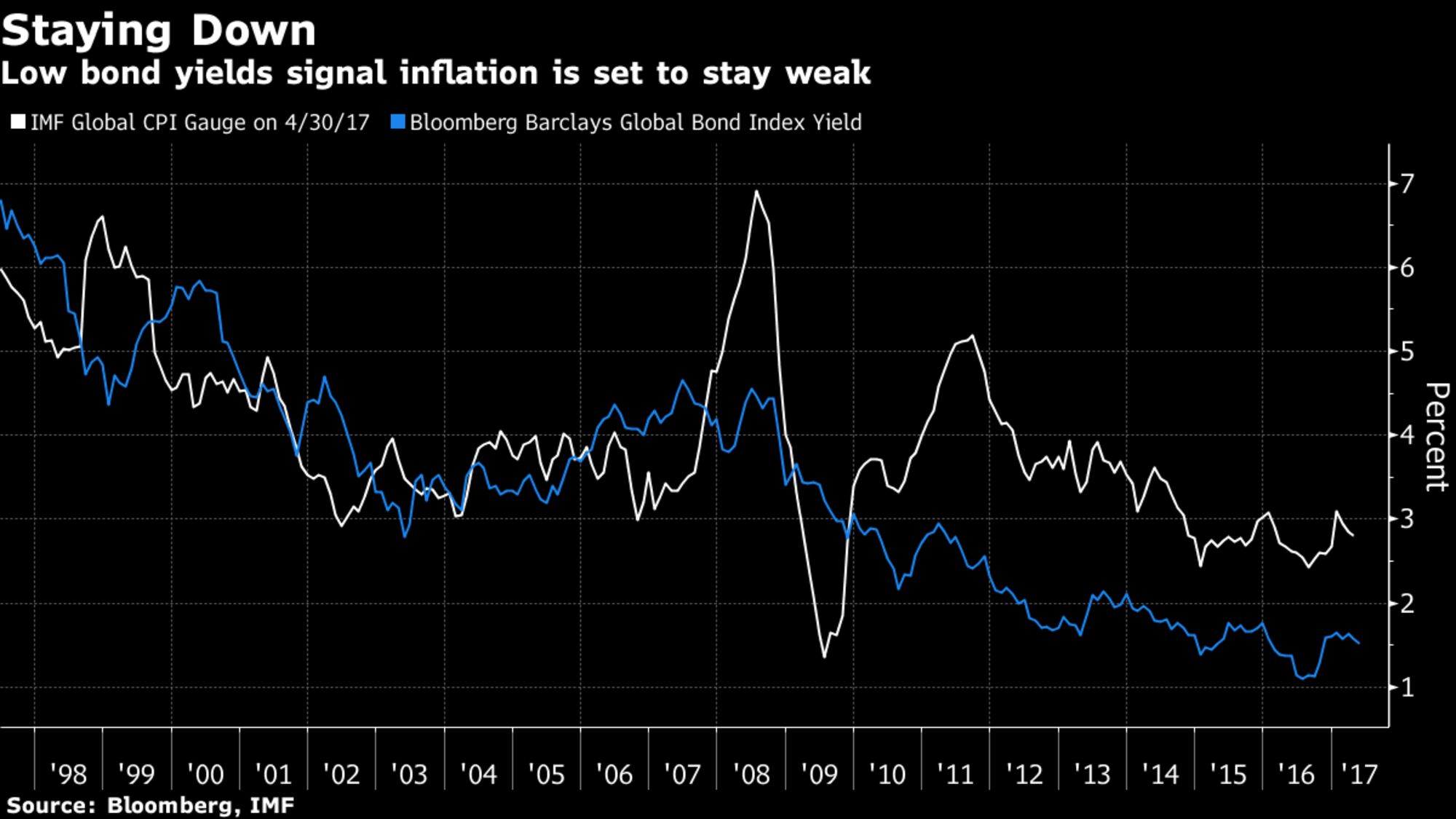
Reflationists argue that trade is improving with the global economy and PPI pressures will keep building. With all the liquidity sloshing around after years of central bank support, it’s just a matter of time until wages and consumer prices head north as well, they say. Problem is, the latest data from around the world just aren’t following that script.
“In many places, upside CPI surprises have turned into downside surprises, and central bankers no longer seem as keen to tighten the screws,” said Frederic Neumann, co-head of Asian economic research at HSBC Holdings Plc in Hong Kong. “With China’s construction engine likely to ease back over the coming months, the global reflation risks running out of runway.”
25 Comments on "The World’s $100 Trillion Question: Why Is Inflation So Low?"
joe on Tue, 6th Jun 2017 7:26 am
Inflation is when prices rise in a basket of goods. The current measure of inflation involves things like oil etc, also prices rise I relationship with wages, 2 seperate dynamic cycles are underway, the post Great Recession has seen debt transformed into cash at low rates which the elites have used to create a stock market bubble, second globalisation and lower than inflation wage hikes are keeping general prices down. If interest rates go up now, we would burst the stock market bubble and the world would enter a Depression. This is caused mainly by peak oil and also and aging and slowing world generally. Costs are shifting from mass consumerism to mass care of the aged, people in their 70s cost around 10 times more in healthcare than sombody in their 30s. Thats one thing. Peak oil is quite another dynamic at play and its changing everything.
Revi on Tue, 6th Jun 2017 7:53 am
It’s a deflationary world. When the whole world becomes one big yard sale, prices go down.
Jef on Tue, 6th Jun 2017 8:39 am
Inflation is always a monetary thing. If you can get enough money into the hands of the masses then the price of things can and will go up. If you can’t get money into the hands of the masses, as is the situation now, prices can’t move much but down.
Prices of things can also go up when there are real constraints on the production/distribution of those things but only so long as there are enough people who can afford them.
Davy on Tue, 6th Jun 2017 8:54 am
Inflation is also a systematic thing. Systematic conditions like bubbles and popping bubbles. We also have rate repression, easing and tapering. All of these are in their many forms. We have sentiment and moral hazards of policy. You combine this with traditional money supply resource scarcity or glut and you have one big mess. There are so many issues alive today that feint to focus on any one is futile for solid answers. What is apparent is destructive change is at work because our civilization is entering it late term. All late term civilizations collapse. We will collapse together without prejudice. The big question is when and how and no one will figure that out until well after it has happened.
rockman on Tue, 6th Jun 2017 9:02 am
Jef – “…but only so long as there are enough people who can afford them.” Exactly. Why do they have to make it so complex? Maybe to justify their paychecks. LOL. Sellers can’t force buyers to pay more then they are willing. They can only limit how much the bring to the market placer. Oil is a good example: OPEC et al can cut production all they want. But if a large number of consumers don’t buy the more costly refinery products oil sales still can produce lower producer incomes despite higher per bbl prices. And that’s what we’ve experienced the last few years. IOW as has always, and will always, be the case: the refinery industry sets the price of oil based on its projection of what consumers will be willing to pay.
A rather simple dynamic that doesn’t require high paid analysts to analyze. LOL.
bobinget on Tue, 6th Jun 2017 9:51 am
Six words;
Lower then production cost oil prices.
Because of financial obligations incurred when oil was being revalued….
Because Saudi Arabia thought they could starve out fellow non Gulf OPEC members… Destroy
so called ‘non conventional’ shale and oil sands
producers….
Because no one made a profit, EVERYONE
needed to over-produce to survive.
So much cheap oil was called “glut”.
The up side: Low cost oil made everything cheaper.
and continues to do so.
Over-stressing wells in KSA, Iran, Iraq, North Dakota or Texas has the same effect. Early death.
Not reinvesting in new infrastructure, exploration,
as is now the case, combined with excessive refinancing when PoO remains still under cost of (finance, labor, materials, field services etc.) inevitably will lead to unaffordable diesel.
W/O low cost diesel, affordable food goes away as does disinflation and jobs and money for that mortgage and car payment.
Venezuela (today) offering Bonds at 30% discount. Watch African producers to do the same.
Watch tomorrow’s EIA’s report. My sources say it will show a six million barrel draw (or better).
Will the market rise to the occasion and give oil prices a boost. Yes and No. Yes for one or two hours, no for the year. The facts are clear now.
No oil company on earth can make a profit @ $47.
To keep this con alive, banks, private lenders, need to be both lenders and short sellers.
Obviously, at some point, (watch Venezuela) existing well depletion catches us all with no swim suits and low tide.
ALCIADA-MOLE on Tue, 6th Jun 2017 10:34 am
My answer: Bill Gates, Warren Buffet, Walmart, Amazon all act as gigantic vacuum and suck up all money in circulation.
I also read that billionaires’ worries include trivial things such as how to pay for their children’s college education.
For those reasons I think a lot of money is captive.
bobinget on Tue, 6th Jun 2017 11:00 am
Automated trading of commodity futures accelerating – Financial Times
Use of algorithms is controversial as study finds rise in volumes of traffic
The machines are taking over markets for energy, metals and food.
Automated trading systems now account for half the volume in many commodity futures after proliferating over the past two years, a government study has found.
The rise of trading run without human intervention has sparked controversy among the farmers, ranchers, industrial companies and hedge funds that trade futures. Some contend prices have become disconnected from forces of supply and demand because of algorithms, while others welcome added volumes. “This is a charged debate,” said Rick Lane, chief executive of Trading Technologies, a software vendor.
The US Commodity Futures Trading Commission, a derivatives watchdog, has suggested rules to lessen the risk of mayhem from a computer gone awry. Industry groups have pushed back.
Automation can range from sophisticated black-box trading systems to off-the-shelf kit that helps execute large orders. As electronic networks replaced exchange floors, trading speeds have accelerated to the point that someone clicking with a computer mouse is considered slow.
Financial Times
rockman on Tue, 6th Jun 2017 11:25 am
“Some contend prices have become disconnected from forces of supply and demand because of algorithms” The parameters that are set into those algorithms are chosen by human beings. IOW the algorithms are making the same moves as a human would if they were sitting at a computer…just not as fast.
No different the the thermostat in your home: you set the temperature. The thermostat doesn’t “decide” what your home’s temperature should be. It sets the temp even when you’re not there…that doesn’t mean it’s “in control”. Just as those algorithms don’t decide what price to buy a futures contract at…a human decided that price point by the parameters that human chose. The algorithm just makes the trade when the human determined it wanted buy.
Outcast_Searcher on Tue, 6th Jun 2017 11:35 am
Bob Inget: so what?
Today I can get fast, reliable trades on stocks and options, very consistently, and pay a very TINY fee, and trade as fast or slow as I (humanly) want in the comfort of my house.
The bid/asked spreads are miniscule in all but very fast markets. I can protect myself from getting shafted by using simple limit orders.
All of this is orders of magnitude better than things were 30ish years ago, on all fronts.
People constantly cry about automated trading in misinformed books like “Flash Boys”.
All technology has side effects, and regulators try to deal with those. And for fast moving fields, regulators have trouble keeping up.
Nothing new here. Nothing meaningful to see here.
Market panics and crashes were happening LONG before computers were even invented, much less actively trading in large volumes. Did they use a time machine to cause the crashes before, say, 1987? LOL
Outcast_Searcher on Tue, 6th Jun 2017 11:37 am
ALCAIDA-MOLE:
Except that we know that everything written isn’t true. Like your idea of the “poor” billionare conspiracy.
So relax, and don’t be so gullible as to believe everything you read.
Outcast_Searcher on Tue, 6th Jun 2017 11:39 am
Jef: All true.
What I find so interesting is that we still are clueless at forecasting, with any accuracy, what will happen economically, including inflation.
If you could accurately forecast it, then you could make literally $trillions on the bond market over the course of a lifetime.
Outcast_Searcher on Tue, 6th Jun 2017 11:46 am
Revi: If the whole world is a yard sale, why do we endlessly have things like property prices escalating madly in places like Canada or China?
If there is less demand for stuff, net (what I think you’re implying) then people wouldn’t be madly chasing stuff with lots of dollars.
Just look at the prices paid for things like modern art in recent years.
And in the first world, subdued inflation is very good for savers and investors. They actually get rewarded for a change (as long as they’re willing to invest beyond bank accounts).
That’s sure better than, say, the late 70’s and early 80’s, where inflation was averaging over 10%, your wages might increase 7%, and then the government took about a third of your income on interest in taxes, so you were losing HUGELY to inflation.
Oh, and the stock market generally doesn’t like inflation, so stocks were doing poorly at the same time.
I’ll take stable, modest inflation any day.
ALCIADA-MOLE on Tue, 6th Jun 2017 11:59 am
@outcast I meant to say billionaires don’t have any common sense and they’re still tethered to simple concerns, no matter how illogical.
I really meant to say due to these unfounded fear, they participate even more in the act of making money captive.
bobinget on Tue, 6th Jun 2017 12:38 pm
Thank Jim Comey,
https://tradingeconomics.com/united-states/currency
Anonymouse on Tue, 6th Jun 2017 12:45 pm
Inflation is so ‘low’, because official statistics on the matter are patently false. Falsification of such data has been uS policy for decades now. It is not difficult to find discussions of the deceptive, and selective reporting methods employed by the uS on the net. Of course, jewberg endorse the ‘official’ stats. The hidden message here is, neo-liberal economics have been an un-qualified success at keeping inflation ‘low’. They have done nothing of the sort of course, but neither jewberg or amerikans ever let reality get in the way of a good narrative…
Many of washingdums colonies have similar polices and practices in place.
Dave Thompson on Tue, 6th Jun 2017 1:06 pm
If you don not count things like the cost of healthcare/insurance, college education, food, and housing sure inflation is low.
rockman on Tue, 6th Jun 2017 1:57 pm
Outcast – “Today I can get fast, reliable trades on stocks and options…”. Exactly my point: are you making those decisions or your computer? The decision making dynamic hasn’t changed at all: instead of like years ago telling your broker to make your trade you now just tell your computer.
Sissyfuss on Tue, 6th Jun 2017 2:01 pm
Coleman is either an idiot savant(emphasis on the idiot) or he is smoking the beejeezus out of some seriously potent chronic.
Sissyfuss on Tue, 6th Jun 2017 2:02 pm
Moleman. Even the tablet can’t believe him.
Go Speed Racer on Tue, 6th Jun 2017 3:05 pm
Hmmmmmm
My house has been going up $10,000 a month, serious, and doing that for 5 months straight.
Can’t get out of a McDonald’s for less than $8.
The wages don’t keep up.
Maybe that is whats called inflation?
DMyers on Tue, 6th Jun 2017 7:11 pm
The answer to the title question is given in the comments above. Too much stuff, and the money’s tied up.
But there’s the matter of debt saturation. The Fed and its legion of MBA, govt. economist, trained parrot, politicians believe that debt is the lubricating oil of the economy. They contend that without debt, the economy cannot survive. So, their solution to debt saturation is to encourage more debt. The subjects cannot assume more debt, as the fabric of their very being is already soaked in it.
In addition to factually maxed out consumption and maxed out debt, the money is all invested in the so-called market or being used to cover past bank mistakes, so it does not arrive for circulation by consumers.
On top of that, and in spite of that, inflation is much higher than any official numbers dare acknowledge. This must be due to some money leakage, which happens to drip in just the right places. Groceries, rent, insurance, health care, utilities, newspaper, and toiletries, these don’t count? All are up sharply in recent years, although always gradually in the short term.
The subject defies discussion, because no one knows what the rate of inflation really is. The government numbers are rigged to minimize and do not accurately describe consumer reality (a contradiction in terms if there ever was one). Without true, valid inflation data, which doesn’t exist outside of Shadowstats.com, a non-approved source of information, this discussion is little more than speculation and spin.
_______________________________ on Tue, 6th Jun 2017 11:29 pm
Because all of the debt money is moving into ponzi stocks and other imaginary things. The rotchilds can only buy so much milk and honey.
Dooma on Tue, 6th Jun 2017 11:41 pm
The high paid analysts who make a killing win or lose are basically of a certain faith but money is by far their greatest god. I wonder what Bloomberg are tipping?
DerHundistlos on Wed, 7th Jun 2017 11:33 pm
“What I find so interesting is that we still are clueless at forecasting, with any accuracy, what will happen economically, including inflation.”
Why do you find economic forecasting surprisingly difficult? So much of forecasting is dependent upon human psychology, and we all know just how illogical is the human animal.
And any individual not directly affiliated with Wall Street trading securities is doomed. Computerized trading only works for the institutions trading in large volumes.