
Peak Oil is You

Donate Bitcoins ;-) or Paypal :-)


Page added on October 13, 2012

The soaring cost of Sunday roast: Dramatic price rises are forcing families to cut back on meat, veg and fruit

- Wild global weather has damaged harvests and driven up food costs
- Shoppers see some basic ingredients more than double in price in a year
In fact, many are cutting back on fresh food altogether.
Farmers and supermarkets are blaming the meat price explosion – which is likely to continue beyond Christmas – on the rising cost of feed for livestock.
 Soaring prices: Unpredictable global weather has hit harvests, forcing up the price of food
Harvests of grain to make the feed have been hit by the wettest summer in a century in the UK while there have been droughts in major grain producers America and Russia.
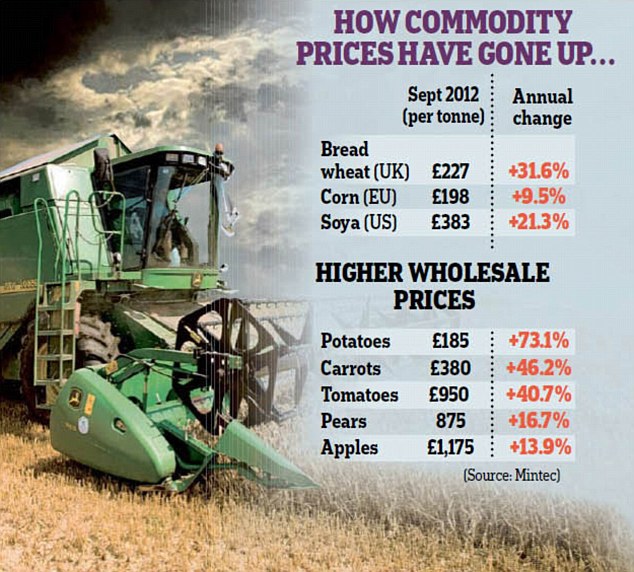
Those droughts and, more importantly, the wet weather here, have driven up the cost of fruit, vegetables and basics such as potatoes and corn.
More…
- ‘They’re mooning us, giving us the finger, wearing union jacks’: Video emerges of angry French fishermen as they clash with British boats in row over shellfish
- Hot stuff! British farmer becomes first in Europe to grow Japanese superfood wasabi
- Run out of Marmite? Grab your Marmife! Savoury spread that divides a nation launches special knife for reaching sticky morsels at bottom of jar
For families on tight budgets in the middle of the worst economic downturn since the 1930s, the perfect storm of global events and national factors has caused one of the most dramatic increases in prices on supermarket shelves for decades.
Startling rises in the cost of meat over the past year – only a taste of what is to come – have been revealed by the MySupermarket price comparison website.
For example, 251g packs of British diced chicken sold by Sainsbury’s are up by 50 per cent in a year to £2.50, while its own-label thick pork sausages rose 42 per cent to £1.19. At Asda, the price of rump steak is up by 22 per cent to £11 a kilo.
 Counting the cost: Shoppers have seen the price of some food in supermarkets more than double in a year
For those preparing a Sunday roast, a whole leg of Waitrose West Country lamb of around 1.8kg is up 13 per cent to £23.38, while at Sainsbury’s a 600g Taste the Difference Outdoor Reared British Pork Shoulder with bramley apple stuffing is up 8 per cent at £4.19.
Many shoppers are turning to value lines to put meat on the table, though some of the biggest rises have come in this area.
An 800g pack of Tesco’s Everyday Value Beef Mince is up by 50 per cent to £2.89, while an 800g pack of Everyday Value Pork Chops is up by a quarter to £2.50.
The price rises on meat are not universal and some products are cheaper. However, the poorest ten per cent of households are buying 26 per cent less meat than five years ago, according to a study for the Government’s food and farming department, Defra.
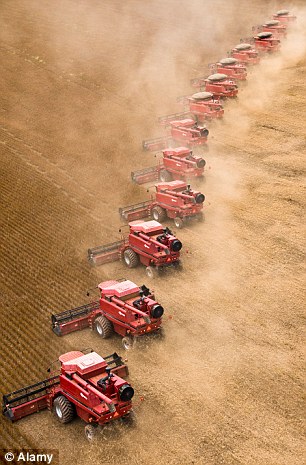 Lean year: 2012 has been bad for farming
This pattern is being repeated among Middle Britain households, and one study suggests 93 per cent of shoppers rely on vouchers and coupons to save on their food bills.
The same Defra study found that poorer households are also eating 25 per cent less fresh fruit and 15 per cent less vegetables than five years ago.
Tim Lang, professor of food policy at London’s City University, warns that this threatens a ‘disaster for public health’.
The National Farmers Union says that the higher cost of feed means that some members will not re-stock with chickens and pigs because they cannot make them pay. That could, in the long-term, reduce supply and drive up prices in the shops.
Spokesman Tom Hind said: ‘The volatility we have been experiencing in feed costs is likely to stay. Feed is the single biggest cost to poultry producers.’
At the same time, a change in EU farm welfare rules to limit the use of sow stalls or cages for holding pregnant pigs is also expected to lead to higher prices for pork, bacon, ham and sausages. Supermarkets and manufacturers import pork and bacon from countries in which they are still used.
A further factor in world food prices is the fact that the rising middle classes in China and India are adopting a more western diet, putting pressure on global meat and dairy supplies. Green ‘diktats’ from governments which require a proportion of crops to be turned into biofuels only compound fears that the era of cheap food is over.
The Government’s preferred measure of inflation, the Consumer Prices Index puts high street price rises at 2.5 per cent. However, prices at supermarket tills show much bigger increases on vegetables and fruit.
Health warning: Experts fear a disaster for public health if families cut back because of soaring food costs (Posed by models)
At Asda, a 2.5kg pack of Maris Piper potatoes has doubled to £2 in a year, while a bag of Gala apples is up by 70 per cent to £1.70. Sainsbury’s has put up the price of carrots by 58 per cent.
The bulk of the produce price rises have been blamed on the rain in this country that meant some crops had to be left to rot. The national potato harvest is likely to be the lowest in 35 years; the apple crop is down around 25 per cent, and wheat by 15 per cent.
Both Sainsbury’s and Tesco have warned of shortages of home grown produce ahead of Christmas.
The quality of harvested products has suffered. Supermarkets have had to allow smaller and blemished produce on to their shelves.
The British Retail Consortium, which speaks for supermarkets, says its members are trying to protect shoppers against price rises.
Spokesman Richard Dodd said: ‘Our own figures for the shop price inflation for food show that it has been very, very stable – it has been 3.1 per cent for the last three months which is a two-year low.’
5 Comments on "The soaring cost of Sunday roast: Dramatic price rises are forcing families to cut back on meat, veg and fruit"
PrestonSturges on Sat, 13th Oct 2012 7:07 pm
In the US, lentils are near $3 a pound.
And late frosts have driven the price of apples up to near $2 a pound, but prices seem to have drifted down a bit possibly because nobody was buying $2 apples.
Shaved Monkey on Sat, 13th Oct 2012 10:20 pm
Surprisingly in Australia
Meat is quite cheap recently, all the heavy rains mean good grass and the high Australian dollar means less exports.
Same with Apples and wine due to high dollar killing exports.
Regular fruit and veg is through the roof though.
Mainly due to an unusual cold spell in the growing region at a vital time.
Good time to have an active veggie garden and community garden my tomatoes are virtually free (I’m giving them away) and the shops have them at nearly $10 a kilo.
BillT on Sun, 14th Oct 2012 1:33 am
Not a big jump here in the Philippines. Meats, fruits and veggies may be up a bit, but not noticeable. Beef comes from Australia or New Zealand. Fruits from many places in the world. Rice is cheap. Veggies from Mindanao and northern Luzon.
Biggest increases have been in things like instant coffee and other Us imports which I have cut back on and will cut off completely soon. I am slowly switching to local coffee and chocolate. Almost everything from the Us and Europe is over priced and is being cut from my shopping list.
Kenz300 on Sun, 14th Oct 2012 12:29 pm
Too many people and too few resources.
Global population growth will exceed our ability to supply food, water, energy and jobs.
If you can not provide for yourself you can not provide for a child.
Access to family planning services needs to be available to all that want it.
beamofthewave on Sun, 14th Oct 2012 6:42 pm
They need to be given money and enough money to motivate everyone to sign up for sterilization. Give me some money like 20,000 and I would go for it. this is the biggest problem, too many people and we as a species need to solve it or the earth will solve it for us.