
Peak Oil is You
Donate Bitcoins ;-) or Paypal :-)


Page added on May 12, 2016

The real oil limits story; what other researchers missed

For a long time, a common assumption has been that the world will eventually “run out” of oil and other non-renewable resources. Instead, we seem to be running into surpluses and low prices. What is going on that was missed by M. King Hubbert, Harold Hotelling, and by the popular understanding of supply and demand?
The underlying assumption in these models is that scarcity would appear before the final cut off of consumption. Hubbert looked at the situation from a geologist’s point of view in the 1950s to 1980s, without an understanding of the extent to which geological availability could change with higher price and improved technology. Harold Hotelling’s work came out of the conservationist movement of 1890 to 1920, which was concerned about running out of non-renewable resources. Those using supply and demand models have equivalent concerns–too little fossil fuel supply relative to demand, especially when environmental considerations are included.
Virtually no one realizes that the economy is a self-organized networked system. There are many interconnections within the system. The real situation is that as prices rise, supply tends to rise as well, because new sources of production become available at the higher price. At the same time, demand tends to fall for a variety of reasons:
- Lower affordability
- Lower productivity growth
- Falling relative wages of non-elite workers
The potential mismatch between amount of supply and demand is exacerbated by the oversized role that debt plays in determining the level of commodity prices. Because the oil problem is one of diminishing returns, adding debt becomes less and less profitable over time. There is a potential for a sharp decrease in debt from a combination of defaults and planned debt reductions, leading to very much lower oil prices, and severe problems for oil producers. Financial institutions tend to be badly affected as well. If a person looks at only past history, the situation looks secure, but it really is not.

Figure 1. By Merzperson at English Wikipedia – Transferred from en.wikipedia to Commons, Public Domain, https://commons.wikimedia.org/w/index.php?curid=2570936
Substitutes aren’t really helpful; they tend to be high-priced and dependent on the use of fossil fuels, including oil. They cannot possibly operate on their own. They add to the “oversupply at high prices” problem, but don’t really fix the need for low-priced supply.
Why supply tends to rise as prices rise
For any non-renewable commodity, there are a wide variety of resources that will “sort of” work as substitutes, if the price is high enough. If the price can be raised to a very high level, the funds available will encourage the development of more advanced (and expensive) technology.
If it is possible to raise the price to a very high level, it is likely that a very large quantity of oil will be available. Figure 1 shows some of the types of oil available:
 I got my idea for Figure 2 from a natural gas resource triangle by Stephen Holditch.

Figure 3. Stephen Holditch’s resource triangle for natural gas
A similar resource triangle is available for coal (from National Academies Press; Coal Resource, Reserve, and Quality Assessments):
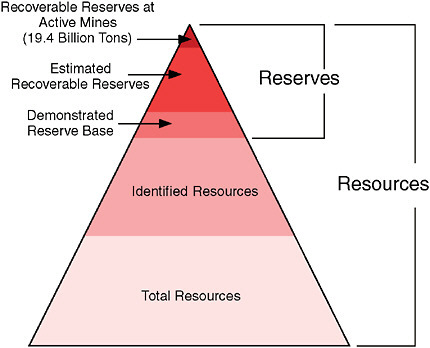
Figure 4. Coal resources in 1997, based on EIA data. Image from National Academies Press.
Because of the availability of an increasing amount of resources, we are likely to get more oil, natural gas, and coal, if prices rise. We associate high prices with scarcity; instead, high prices tend to make a larger quantity of energy product available.
The International Energy Agency (IEA) has a different way of illustrating the likelihood of huge future oil supply, if prices can only rise high enough.

Figure 5. Figure 1.4 from International Energy Agency’s 2015 World Energy Outlook.
The implication of this chart is that the IEA believes that oil prices can rise to $300 per barrel, giving the world plenty of oil to extract for many years ahead.
Can consumers really afford very high-priced energy products?
In my view, the answer is “No!” If oil is high priced, then the many things made with oil will tend to be high priced as well. Wages don’t rise with oil prices; most of us remember this from the oil price run-up of 2003 to 2008.
Because of this affordability issue, the limit to oil production is really an invisible price limit, represented as a dotted line. We can’t know in advance where this is, so it is easy to assume that it doesn’t exist.
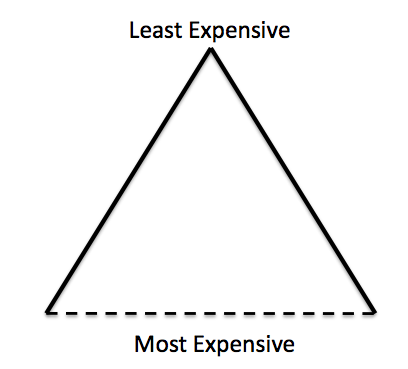
Figure 6. Resource triangle, with dotted line indicating uncertain financial cut-off.
The higher cost of extraction is equivalent to diminishing returns.
As we are forced to seek out ever more expensive to extract resources, the economy is in some sense becoming less and less efficient. We are devoting more of our human labor and other resources to extracting fossil fuels, and to extracting minerals from ever-lower quality ores. In some sense, we could just as well be putting these resources into a pit and burying them–they no longer help us grow the rest of the economy. Using resources in this way leaves fewer resources to “grow” the rest of the economy. As a result, we should expect economic contraction when the cost of oil extraction rises.
In fact, economic contraction seems to happen when oil prices rise, at least for oil importing countries. Economist James Hamilton has shown that 10 out of 11 post-World War II recessions were associated with oil price spikes. A 2004 IEA report says, “. . . a sustained $10 per barrel increase in oil prices from $25 to $35 would result in the OECD as a whole losing 0.4% of GDP in the first and second years of higher prices. Inflation would rise by half a percentage point and unemployment would also increase.”
Energy products play a critical role in the economy.
Economic activity is based on many kinds of physical changes. For example:
- Using heat to transform materials from one form to another;
- Using energy products to help move goods from one place to another;
- Moving electrons in such a way that light is provided
- Moving electrons in such a way that Internet transmission can be provided.
A human being, by himself, exerts only about 100 watts of power. A human being is also quite limited in what he can do; he can provide a little heat, but no light, for example. Energy products are very helpful for making capital goods such as buildings, machines, roads, electricity transmission lines, cars and trucks.
We can think of energy products, and capital goods made using energy products, as ways of leveraging human energy. If per capita energy consumption increases over time, leveraging of human labor can grow. As a result, humans can become ever more productive–think of new and better machines to help humans do their work. Dips in this leveraging tend to correspond to economic contraction (Figure 7).

Figure 7. World energy consumption per capita, based on BP Statistical Review of World Energy 2105 data. Year 2015 estimate and notes by G. Tverberg.
To have a growing economy, wages of non-elite workers need to be growing.
Our economy is in a sense a “circular economy,” in which non-elite workers (less educated, non-managerial workers) play a pivotal role because they are both producers of goods and potential consumers of the output of the economy. Because there are so many non-elite workers, their demand for homes, cars, and electronic goods plays a critical role in maintaining the total demand of the economy.

Figure 8. Representation of two major parts of the economy by author.
If the wages of these non-elite workers are growing, thanks to increased productivity, the economy as a whole can grow. If the wages of these workers are shrinking or are flat (in inflation-adjusted terms), the economy is in trouble. The recycling process cannot work very well.
If there is not enough economic growth–often caused by not enough growth in energy consumption to leverage human labor–then we tend to get a growing imbalance between the sector on the left with businesses, governments, and elite workers, and the sector on the right, with non-elite workers. Part of this wage imbalance comes from sending jobs to low-wage countries. As jobs are shifted to low-wage countries, the workers of the world increasingly cannot afford the goods that they and other workers are producing.

Figure 9. Representation by author of imbalance that occurs.
If the wages of non-elite workers are not rising sufficiently, rising debt can be used to hide this problem for a while. The way this is done is by allowing workers to buy goods at ever-lower interest rates, over ever-longer time periods. This strategy has an endpoint, which we seem to be close to reaching.
Debt is a key factor in creating an economy that operates using energy.
A generally overlooked problem of our current system is the fact that we do not receive the benefit of energy products until well after they are used. This is especially the case for energy used to make capital investments, such as buildings, roads, machines, and vehicles. Even education and health care represent energy investments that have benefits long after the investment is made.
The reason debt (and close substitutes) are needed is because it is necessary to bring forward hoped-for future benefits of energy products to the current period if workers are to be paid. In addition, the use of debt makes it possible to pay for consumer products such as automobiles and houses over a period of years. It also allows factories and other capital goods to be financed over the period they provide their benefits. (See my post Debt: The Key Factor Connecting Energy and the Economy.)
When debt is used to move forward hoped-for future benefits to the present, oil prices can be higher, as can be the prices of other commodities. In fact, the price of assets in general can be higher. With the higher price of oil, it is possible for businesses to use the hoped-for future benefits of oil to pay current workers. This system works, as long as the price set by this system doesn’t exceed the actual benefit to the economy of the added energy.
The amount of benefits that oil products provide to the economy is determined by their physical characteristics–for example, how far oil can make a truck move. These benefits can increase a bit over time, with rising efficiency, but in general, physics sets an upper bound to this increase. Thus, the value of oil and other energy products cannot rise without limit.
Using hoped-for benefits to set oil prices is likely to lead to oil prices that overshoot their maximum sustainable level, and then fall back.
A debt-based system of setting oil prices is different from what most of us would have considered possible. If wages of non-elite workers had been growing fast enough (Figure 9), increasing debt would not even be needed, because the whole system could grow thanks to the increased buying power of the many non-elite workers. These workers could buy new houses and cars, have more meat in their diet, and travel on international vacations, adding to demand for oil and other energy products, thereby keeping prices up.
As wages of non-elite workers fall behind, an increasing amount of debt is needed. For the US, the ratio of the increase in debt to the increase in GDP (including the rise in inflation) is as shown in Figure 10:

Figure 10. United States increase in debt over five-year period, divided by increase in GDP (with inflation!) in that five-year period. GDP from Bureau of Economic Analysis; debt is non-financial debt, from BIS compilation for all countries.
Thus, the increase in debt has never been less than the corresponding increase in GDP over five-year periods, even when oil prices were low prior to 1970. In general, the pattern would suggest that the higher the oil price, the higher the increase in debt needs to be to generate one dollar of GDP. This is to be expected, if economic growth depends on Btus of energy, and higher prices lead to the need for more debt to cover the purchase of necessary Btus of energy.
We are reaching a head-on collision between (1) the rising cost of energy production and (2) the falling ability of non-elite workers to pay for this high-priced energy.
The head on collision we are reaching is what causes the potential instability referred to at the beginning of this article, as illustrated in Figure 1. Of course, such a collision has the potential to cause debt defaults, as it becomes impossible to repay debt with interest.
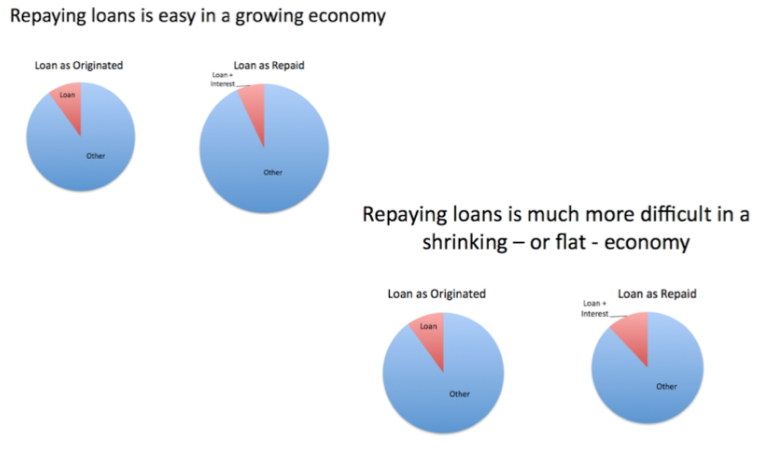
Figure 11. Repaying loans is easy in a growing economy, but much more difficult in a shrinking economy.
Turchin and Nefedov in the academic book Secular Cycles analyzed eight agricultural economies that eventually collapsed. The problem that these economies encountered was exactly the same one we are now encountering: falling wages of non-elite workers at the same time that the cost of producing energy products (food, at that time) was rising. Rising costs were often an end result of too many people for the arable land. A workaround could be found, such as building irrigation or adding a larger army to conquer a neighboring land, but it would add costs.
As the problems of these economies progressed, debt defaults became more of a problem. Governments found it hard to collect enough taxes, because so many of the workers were increasingly impoverished. Often, workers became sufficiently weakened by an inadequate diet that they became vulnerable to epidemics. Governments often collapsed.
In the economies analyzed by Turchin and Nefedov, food prices temporarily spiked, but it is not clear that this was the final outcome, given the inability of workers to pay the high prices. Debt defaults would tend to further reduce ability to pay. Thus, it would not be surprising if prices ended up low (from lack of demand), rather than high. We know that ancient Babylon is an example of one economy that collapsed. Revelation 18:11-13 seems to describe the situation after Babylon’s collapse as one of lack of demand.
11 “The merchants of the earth will weep and mourn over her because no one buys their cargoes anymore— 12 cargoes of gold, silver, precious stones and pearls; fine linen, purple, silk and scarlet cloth; every sort of citron wood, and articles of every kind made of ivory, costly wood, bronze, iron and marble; 13 cargoes of cinnamon and spice, of incense, myrrh and frankincense, of wine and olive oil, of fine flour and wheat; cattle and sheep; horses and carriages; and human beings sold as slaves.
Other parts of the oil limits story that researchers have missed
As I have previously mentioned, most researchers begin with the view that soon there will be a problem with energy scarcity. The real issue that tends to bring the system down is related, but it is fairly different. It is the fact that as we use energy, the system necessarily generates entropy. This entropy takes the form of rising debt and increased pollution. It is these entropy-related issues, rather than a shortage of energy products per se, that tends to bring the system down. See my post, Our economic growth system is reaching limits in a strange way.
We could, in theory, fix our problems by adding infinite debt at the same time that wages of non-elite workers tend toward zero. We could then use this additional debt to fight pollution problems and pay all of the workers. All of us know that this solution would not work in the real world, however.
The two-sided economy I have described in Figures 8 and 9 is one part of our problem. There is a popular saying, “We pay each other’s wages.” Unfortunately, paying each other’s wages does not work well, if the wage level of elite workers differs too much from the wage level of the non-elite workers. A worker making $7.50 per hour in a part-time job is not going to be able to pay the wages of a surgeon making $300,000 per year, no matter how an insurance policy is designed to spread costs evenly. A worker in India or Africa will not be able to afford goods made by human workers in the United States, because of wage differences.
Governments can try to fix the problem of non-elite workers getting too small a share of the output of the system, but this is not easy to do. The real problem is that the system as a whole is not producing enough goods and services. This happens because the high cost of energy extraction (plus related issues–pollution control; need for more education for workers; need for ever-larger government and more elite workers) is removing too many resources from the system. The result is that the economy as a whole tends to grow ever more slowly. The quantity of goods and services produced by the economy does not rise very rapidly. When there are not enough goods produced in total, non-elite workers tend to find that their allocation has been reduced.
If governments attempt to add debt to fix the problems with the system, the addition of debt tends to raise asset prices on the left side of Figures 8 and 9. Unfortunately, the additional debt usually has little impact on the wages of non-elite workers (that is, the right hand part of the system).
Governments have talked about minimum income programs to raise incomes of those who are not elite workers. Whether or not this approach can work depends on many things–how much additional debt can be added to the system; whether this debt will actually raise the total amount of goods and services produced; how tolerant those in the left-hand side of Figures 8 and 9 are of losing their share of goods and services; the impact on relative currency levels.
Research involving Energy Returned on Energy Investment (EROEI) ratios for fossil fuels is a frequently used approach for evaluating prospective energy substitutes, such as wind turbines and solar panels. Unfortunately, this ratio only tells part of the story. The real problem is declining return on human labor for the system as a whole–that is, falling inflation adjusted wages of non-elite workers. This could also be described as falling EROEI–falling return on human labor. Declining human labor EROEI represents the same problem that fish swimming upstream have, when pursuit of food starts requiring so much energy that further upstream trips are no longer worthwhile.
Falling fossil fuel EROEI is a contributor to falling EROEI with respect to human labor, but there are other contributors as well (Figure 12). (My list is probably not exhaustive.)
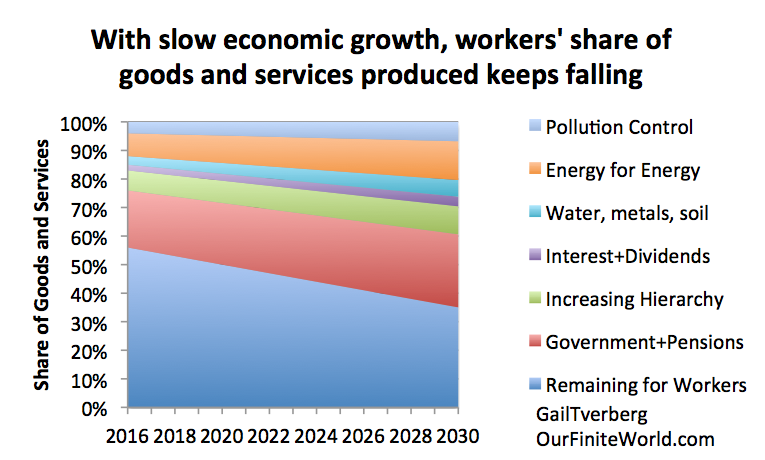
Figure 12. Authors’ depiction of changes to workers share of output of economy, as costs keep rising for other portions of the economy.
If our problem is a shortage of fossil fuels, fossil fuel EROEI analysis is ideal for determining how to best leverage our small remaining fossil fuel supply. For each type of fossil fuel evaluated, the fossil fuel EROEI calculation determines the amount of energy output from a given quantity of fossil fuel inputs. If a decision is made to focus primarily on the energy products with the highest EROEI ratios, then our existing fossil fuel supply can be used as sparingly as possible.
If our problem isn’t really a shortage of fossil fuels, EROEI is much less helpful. In fact, the EROEI calculation strips out the timing over which the energy return is made, even though this may vary greatly. The delay (and thus needed amount of debt) is likely to be greatest for those energy products where large front-end capital expenditures are required. Nuclear would tend to be a problem in this regard; so would wind and solar.
To evaluate the extent to which a given energy product tends to raise debt levels, a better approach might be to look at debt levels directly. Another measure might be to compare the required system-wide capital expenditures for a particular purpose, for example, to provide sufficient non-intermittent electricity for the state of California over a period of say, 50 years, using different electricity generation scenarios.
Our academic system of inquiry, with its peer reviewed literature system, has let us down.
Our peer reviewed academic system is not telling this story. Part of the problem is that this is a difficult story. It has taken me most of the last ten years to figure it out.
Part of the problem with our academic system seems to be excessive reliance on past analyses. Once one direction has been set, it is hard to change. Another part of the problem is that the focus of each researcher tends to be quite narrow. The result can be that it is hard to “see the forest for the trees.”
Furthermore, politicians and academic publishers tend to “push” results in the direction of a desired outcome. Grant money goes to researchers who follow the government-preferred fields of inquiry; publishers prefer books that are not too alarming to students.
I am coming at this issue from “out in left field.” I don’t have a Ph.D., although I am a Fellow of the Casualty Actuarial Society, which many would consider similar. I also have an M. S. in Mathematics. I do not work in a university setting. I do not have a strong background in subjects a person might expect, such as geology, economic theory, or physics. I do have a fair amount of practical experience with financial modeling from my actuarial background, however.
My approach is very different from that of most researchers. I come to the problem from the point of view of how a finite world might be expected to operate. I write most of my articles on the Internet, where I get the benefit of comments from readers. Many of these commenters point me in the direction of articles or books I should read, or raise additional issues I should consider.
Over the years, I have become acquainted with many researchers in related fields. These people have generally reached out to me–invited me to speak at their conferences, or corresponded with me about issues they considered important. As a result of this collaboration, I have been able to put together a more complete story than others.
I have stayed away from publishers and funding sources that might try to influence what I say. I have not been taking donations, and do not run ads on my website. The story is one that needs to be told, but it easily gets distorted if the person telling the story is influenced by what will generate the largest donations, or the most grant money.
30 Comments on "The real oil limits story; what other researchers missed"
makati1 on Thu, 12th May 2016 7:21 pm
Maybe Gail has made enough and is doing this ‘education’ out of charity? A public service? I’m just cynical, I guess. Not that ten thousand articles will change anything.
BTW: My oldest grandson has an actuary degree. After a few years, he found that he could make more money opening a hotdog stand at Home Depot. He now owns several at different locations and makes a nice living. Soon, there is not going to be ANY income for economy type degrees or for financial advisors, investment fund managers, stock brokers, etc. The capitalist clock is fast approaching midnight.
Where have YOU invested your life and career? Will it become extinct long before your projected passing? There will be no social safety nets in the future. No SS, Medicare, welfare, 401k, mutual funds, insurances, secure income, secure jobs, etc. Are YOU prepared/preparing?
Dustin Hoffman on Thu, 12th May 2016 7:39 pm
Remember back in the day I was told the future was “Plastics”….now I hear someone telling the future is in “Hotdogs”! Am I preparing? Hell no, from what you wrote not much to prepare for!
Been reading OFW with Gail for over a year now, I like her advice about it…best to enjoy the here and now with family and friends. You get the drift, I hope. Thank you Gail for another very good essay.
makati1 on Thu, 12th May 2016 8:10 pm
Dustin, a typical American sheeple… LOL
makati1 on Thu, 12th May 2016 8:13 pm
No Dustin, the future is not hotdogs, it is about personal survival in a situation no one alive today in the 1st world has had to face. Many 3rd worlders face it everyday. They are not fat lazy Americans that believe doing nothing is better than preparing. Gail says what sells. Feeding the sheeple has been very profitable for those who write economic fiction.
Davy on Thu, 12th May 2016 8:19 pm
Dustin, you don’t have to hate yourself like people on this board would like you to. Ignore them because they hate themselves. They can never live up to those fake lofty standards they constantly try to crush others with. It is an illness and it is call delusional narcissism. Personalities lapse into this when they spend too much time alone and in their head and not enough time like you mentioned above. Glad you dropped in.
shortonoil on Thu, 12th May 2016 9:33 pm
“If our problem isn’t really a shortage of fossil fuels, EROEI is much less helpful. In fact, the EROEI calculation strips out the timing over which the energy return is made, even though this may vary greatly.”
That is unequivocally not the case:
http://www.thehillsgroup.org/depletion2_009.htm
ERoEI is a function for a point in time. It is a differential that states what the Energy Returned/ Energy Invested is at an instant in time. The author apparently completely fails to understand its significance, and meaning.
shortonoil on Thu, 12th May 2016 10:51 pm
One further note on the above:
The above graph hit a discontinuity in 2012. It no longer holds for future reference. 2012 was the energy half way point for petroleum. The point where one unit of petroleum can no longer provide enough energy to power the production of more than two units of petroleum. It is the point where petroleum production must reduce the energy to the remainder of the economy to maintain a specific production level.
Harquebus on Thu, 12th May 2016 11:43 pm
Short.
Please post your response to Gail.
https://ourfiniteworld.com/2016/05/12/the-real-oil-limits-story-what-other-researchers-missed/
Or perhaps, with your permission, I will do it for you.
I always appreciate your comments.
Cheers.
GregT on Fri, 13th May 2016 12:40 am
“Personalities lapse into this when they spend too much time alone and in their head and not enough time like you mentioned above. Glad you dropped in.”
Translation:
Davy needs a friend Dustin, he’s lonely. Send him a PM and exchange numbers. He’ll be glad if you did.
Davy on Fri, 13th May 2016 5:59 am
There you go Greggar, you prove my point that you cannot let go of your attacks. You are a sick man.
Davy on Fri, 13th May 2016 6:07 am
“Bloody Start To Friday The 13th For Global Markets”
http://www.zerohedge.com/news/2016-05-13/red-start-friday-13th-global-markets
“Global stocks have started Friday the 13th on the wrong foot, with not only Hong Kong GDP unexpectedly tumbling by 0.4%, the worst print in years while retail sales fell for a thirteenth straight month in March, the longest stretch since 1999 as the Chinese hard landing spreads to the wealthy enclave, but also following a predicted collapse in Chinese new loan creation, which will reverberate not only in China but around the globe in the coming weeks. The latest overnight drop in the Yuan hinted that should the recent USD strength continue, China will have no choice but to repeat its devaluation from last summer and winter.”
Davy on Fri, 13th May 2016 6:11 am
Venezuela is out of control and descending into chaos and anarchy. It is important to watch this because this type of breakdown will become common globally as the global economy disintegrates.
“Raw Venezuela: Looter Burned Alive, While “Streets Filled With People Killing Animals For Food”
http://www.zerohedge.com/news/2016-05-12/raw-venezuela-looter-burned-alive-while-streets-filled-people-killing-animals-food
rockman on Fri, 13th May 2016 6:13 am
And once again EROEI doesn’t determine how much effort goes into developing oil/NG. As pointed out many times before the insufficient economics of a drilling project will kill it long before the EROEI gets very low. In the last 2 years we’ve seen $BILLIONS in such project canceled. Projects that have the same EROEI today as they did 3 years ago.
In fact the same is true for the alts unless they are being funded by the govt. IOW no one is going to INVEST 100’s of $million in a wind farm unless it returns an acceptable profit. No one is going to put up a wind turbine with an EROEI of 50 if that INVESTMENT develops a very small ROR. And what are the two primary factors that determine that ROR: the cost to build/install that turbine AND what that electricity sells for.
Fossil fuel sourced e- has gotten much less expensive with lower oil prices but the real damage to alt economics has come from long standing lower NG prices which have recently gotten even lower. So even as some of the alts have significantly improved efficient while also becoming less expensive they are still in a race to the bottom with NG.
Davy on Fri, 13th May 2016 6:18 am
This is turning into a very interesting story as we close in on the elections and with Trump waiting in the wings. It is almost like “House of Cards” in real life.
“LewRockwell.com”
https://www.lewrockwell.com/2016/05/andrew-p-napolitano/perfect-storm-legal-misery/
“While all of this has been going on, intelligence community sources have reported about a below the radar screen, yet largely known debate in the Kremlin between the Russian Foreign Ministry and the Russian Intelligence Services. They are trying to come to a meeting of the minds to determine whether the Russian government should release some 20,000 of Mrs. Clinton’s emails that it obtained either by hacking her directly or by hacking into the email of her confidante, Sid Blumenthal.”
shortonoil on Fri, 13th May 2016 6:38 am
“And once again EROEI doesn’t determine how much effort goes into developing oil/NG.”
Anyone who knowingly develops an oil/NG field that requires more energy to develop than it produces is a fool, and deserves to lose their money. As my father used to say, “there is no substitute for stupidity”.
Cloud9 on Fri, 13th May 2016 6:58 am
Short, how much longer do you think we have?
Davy on Fri, 13th May 2016 7:28 am
Cloud, short’s dead state of oil is a marker. It is the approach to that marker period that some kind of break will occur. Another marker is the current financial turmoil. It may well be the real global killer because without an economy oil has no use and it cannot be produced in quantities. The other marker is a blue water Arctic event. That will likely begin a serious round of violent climatic responses. If it is anything like recent climate activity it will be worse than we expect but in any case it is an unknown in the very short term of 5 years. Humans have a 5-10 year attention span at best so that is my take. Longer term looks very poor for all involved meaning the earth and its creatures.
onlooker on Fri, 13th May 2016 7:44 am
In fact, Cloud we are already seeing the faults and the seismic activity in the price of oil. Considering the money invested, the Oil companies would love to charge more per barrel and oil futures would love to price oil higher. All that is not feasible as consumers of Oil products cannot and/or are not willing to pay more. Economic fundamentals and high priced Oil in 2008 and the aftermath and left the World economy teetering and that explains much better what happening than some allusion to a “glut”
PracticalMaina on Fri, 13th May 2016 7:47 am
Rockman, I wonder if this is part of the reason for bonuses based on production? Are the NatGas companys protecting market share, copying Saudis odd strategy? Renewables and nat are splitting the market being opened up by coal leaving pretty evenly, in my opinion.
JuanP on Fri, 13th May 2016 8:05 am
I no longer read what Gail writes because she has been repeating herself for years now and sounds like a broken record. I mostly agree with her, but I have nothing new to learn from her.
shortonoil on Fri, 13th May 2016 8:42 am
“Short, how much longer do you think we have?”
see our post here for a more complete answer to that question:
it is toward the bottom of the first page.
http://peakoil.com/forums/viewtopic.php?f=1&t=72559
Thanks for the question.
shortonoil on Fri, 13th May 2016 8:50 am
“I no longer read what Gail writes because she has been repeating herself for years now and sounds like a broken record.”
Someday Gail’s infinite supply of monkeys will pound out a Shakespearean play, in the mean time we get mostly Vogon poetry.
rockman on Fri, 13th May 2016 8:59 am
“Anyone who knowingly develops an oil/NG field that requires more MONEY (not energy) to develop than it RETURNS (not produces) is a fool, and deserves to lose their money.”
IOW anyone that thinks a field with a positive EROEI will be developed if it loses money might be judged a fool by some. Not by the Rockman, of course: he’s too polite to say such things. LOL.
rockman on Fri, 13th May 2016 9:25 am
Practical – Some bonuses are based as such and some aren’t. I think the bigger issue today for most NG production managers is not getting the butts fired. LOL.
And I’m not sure what you’re asking about NG market share. First, given that the US is a net NG importer (granted by very little) there is no lack of NG buyers here. Every NG producer is selling every bit of production they want. And it’s just like the price of oil: we NG producers have no control over the price…the utility companies and other major buyers determine the price. The only control we have is how much we sell. And today for almost all producers that is as much as possible.
And renewable aren’t taking anything close to a meaningful amount of market share from NG. Consider one of the biggest wind power generators on the planet…Texas. But we consume more NG than any other state: 40% more than #2 CA. Just from 2009 thru 2014 NG consumption increased in Texas by 20%. And that was during the fastest buildout of Texas wind power. We also produce 10% of our electricity from nuclear power…in the top 10 in the US. As mentioned before: the surge in Texas alt energy hasn’t replaced coal or NG: it’s been develop to supplement those sources of electricity. Unlike most of the country the Texas economy continues to be strong despite the loss of oil patch jobs. The current trend forecasts a huge increase in electrical demand for the next 20+ years. And given that the state produces more coal, NG and alt energy than any other state it’s not difficult to predict what our future sources will be: NG, coal, nuclear and wind power.
penury on Fri, 13th May 2016 9:49 am
My only problem with Gail’s articles is that they require time and effort to assimilate. Not an easy read, might take a day or two to absorb the full article. Too complicated to allow for immediate snarky comments. Uselly ignore posting comments on these articles.
PracticalMaina on Fri, 13th May 2016 10:32 am
Rockman, Texas uses a great deal of Nat gas for petrochemicals correct? I am more suggesting that nat gas and renewables are competing over the market share that is being opened up by coal starting to be scaled down in some areas. Indiana is going to be one interesting case as a major utility is talking about potentially taking 2 gigawatts of coal power offline this year.
I wonder how much industry has moved to Texas because of cheap power rates?
marmico on Fri, 13th May 2016 10:53 am
Too complicated to allow for immediate snarky comments.
Hardly, take one of the bolded statements in the article:
We are reaching a head-on collision between (1) the rising cost of energy production and (2) the falling ability of non-elite workers to pay for this high-priced energy.
The only head-on collision that happened is The Turdburg became an editor of The Oil Drum.
Energy is at the lowest-priced in The Turdberg’s lifetime.
https://research.stlouisfed.org/fred2/graph/fredgraph.png?g=4o3A
penury on Fri, 13th May 2016 2:44 pm
Hey Marmico, try pricing your energy costs in dollars if you live in any nation that purchases oil that must be sold or bought in American dollars. Try you will like it.
shortonoil on Fri, 13th May 2016 3:07 pm
“Energy is at the lowest-priced in The Turdberg’s lifetime.”
So low in fact that the world’s oil producers net worth is declining at about the same rate as their gross sales. They are not replacing their reserves, so what they are selling is their assets. Isn’t that wonderful news; the oil industry is going broke at $1.5 trillion per year? Happy Days are here again!
marmico on Fri, 13th May 2016 5:33 pm
You keep ordering your take-out Turdburgers, penury.
Real Trade weighted dollar index and WTI.
The Turdburg ranks right up there with the quart shy of oil as a fuctard.