
Peak Oil is You

Donate Bitcoins ;-) or Paypal :-)


Page added on November 21, 2016

The Imminent Peak Oil Demand Myth
Summary
Soon after peak oil supply theory became widely denounced in the wake of the shale boom, more and more voices proclaimed that peak demand will soon happen.
Breaking down GDP growth and oil demand relationship into components in a simple formula suggests that there is no evidence of it starting to occur, or that it will soon.
Formula could be affected in future by technologies such as EV’s, but likely will not happen for decades to come.
This concept has been going around for a while and seems to be gaining more and more traction. It started soon after the shale boom, when it was widely publicly proclaimed that we will never ever reach peak oil production. Theories started to emerge that oil will soon peak due to lack of demand, rather than lack of supply. More and more prominent voices are being added to this chorus. The latest was the CEO of Shell, who stated this month that demand could peak in five years.
The IEA recently waded in on the subject. It was the first major voice of reason in my view. They do not see peak oil demand at least by 2040, due to the fact that there are few alternatives to oil. I want to add to that argument by pointing out the fact that there is no evidence of oil demand slowing down in relation to economic growth. It is important to point out the oil demand growth relation to the level of global economic growth. There is a very well defined relationship between the two. It seems that the public lacks a clear visualization of it, even though we do acknowledge it on a regular basis. For instance, Whenever the IEA, OPEC or the EIA release an oil demand forecast, one of the main factors they cite is economic growth.
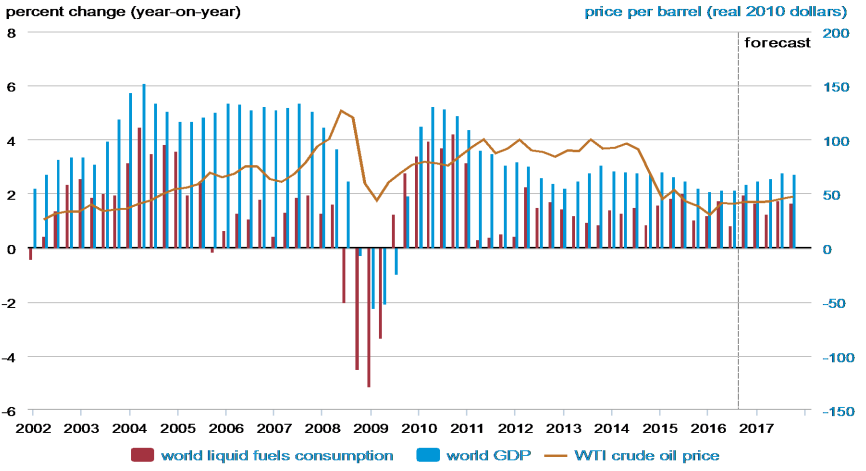
Source: EIA.
I looked at this relationship in the past, including it in articles whenever the issue of peak oil demand had to be addressed. I was mainly trying to answer the question of how much oil is needed in order to allow for a certain rate of global economic growth every cycle. It is sort of almost like answering the question of how far one can go on a tank of gas in any particular car. I came up with the following relationship, based on historical data.
1.5 (rate of efficiency growth) + (rate of oil supply growth x 2 (rate of increase of less oil intensive service sector as society becomes more wealthy) ) = GDP growth rate.
The formula was meant to figure out maximum potential growth allowed by the supply of oil, with real growth usually ending up a few tenths of a percentage points bellow the maximum.
For the current cycle, we have been experiencing global economic growth rate of about 3% since 2008. In the past nine years since 2008, global demand for crude oil and production increased by about 6 mb/d, or about .9% per year, according to EIA data. I am looking at crude oil only, not total liquids for this exercise. If we look at how the reality of the current economic cycle fits in with my formula, we see that it is a pretty good fit.
1.5 + (.9 x 2) = 3.3% maximum potential global economic growth.
The relationship may be off by a few percentage points on occasion, if we go back to past economic cycles, but it is usually off by just a few tenths of a percentage points. For instance, during the 2001-2007 economic cycle, a broad global real estate bubble was in large part responsible for skewing the DGP growth/oil demand growth ratio, in large part because we were counting the sale of houses that were far more expensive than they should have been. Interestingly enough, if we were to calculate the relationship over both the current and the previous economic cycle, the formula remains more of less intact. This means that the current relationship pattern is holding more or less in place. There is therefore no evidence that in the absence of a severe slowdown to an average yearly global economic growth rate of 1.5% per year or less, there is likely to be a peak in oil demand. We may see occasional declines during recession years, but that is about it.
Likelihood of GDP growth/oil demand relationship changing in the future.
I do believe that lack of robust global economic growth will most likely impact global oil demand. For instance, a further downshift in growth from about 3% per year in the current cycle, to perhaps 2.5%/year in the next cycle, which I do believe will happen, will shift demand for crude oil down to just .5% per year, if the values of the factors involved in the formula remain the same. But in reality, a long-term slowdown in economic growth will not on its own cause a peak in demand. If there were to be a peak in demand, it would have to come from a very dramatic technological shift in the way we approach public, private and freight transport.
In this regard, some people seem to believe that the current rate of growth in EV’s is likely to be the thing that will cause a decline in crude oil demand. Fact is however that EV’s currently make up about .5% of new cars sold per year. That rate is growing, but I do believe that it would have to reach a volume that would be at least twenty-fold compared with current sales levels in about a decade, in order to reach the point where the number of ICE cars on the world’s roadways will no longer continue to increase. The way we have to think about this is as follows; Current car sales are in the 100 million units/year range. If average yearly new car demand increases by only 1%/year, in a decade’s time we would need 10 million EV sales just to keep ICE car sales at current rates. But if total global car sales will increase by 2%/year, then we would need to see 20 million EV’s sales volume ten years from now. I personally do not believe that we will see more than 2-3 million EV’s sold/year in a decade’s time. Even that will only happen if current global subsidies of about $10,000/EV on average will continue to be maintained. EV sales will increasingly become a burden on taxpayers if they continue to need this subsidy, while sales volumes increase.
We should also keep in mind the fact that personal vehicles are not the only consumers of crude oil. Aviation, freight transport on land and on water, construction machinery and other users will not see their demand for crude curtailed by EV’s in any way. There are few viable alternatives to oil which can make a significant dent in the current growth trajectory in these fields. Natural gas has been presented as a viable alternative for the trucking industry, but to date the conversion to natural gas has not made huge inroads.
There is also something that needs to be addressed in regards to the effect that a slowing global economy will have on increasing efficiency. While new technologies such as EV’s coming on the market in greater numbers might increase the 1.5% variable in the equation, which represents efficiencies gains, a slower growing economy might decrease it, because technological innovation tends not to make it on to the market when the economy slows. For instance, a slower economy will cause firms to defer investments, such as new factories and choose to stay with existing older ones. Any new technologies they might have otherwise introduced, which would have made the new factories more efficient will not be able to penetrate to a sufficient degree if business investment slows due to lack of economic growth. Even the EV subsidies will be more likely to be scrapped as governments will have to deal with a worsening fiscal situation and the need to invest in other projects, which might soak up the slack in the labor market, such as construction of infrastructure.
Some people might be wandering at this point why I did not deal with growth in efficiency and growth in the less oil-intensive services sector as one factor. The reason for that is because we also have to account for the growth in the services sector in relation to the size of the overall economy when economic growth causes societies to become wealthier, as a separate factor, which is a byproduct of growth allowed by the increase in oil supplies to the economy. A wealthier society, especially when it means gains in size and wealth of the global the middle class, leads to an outsized increase in the service sector in most cases. The service sector tends to be less energy-intense than other sectors of the economy, which is why every 1% increase in oil supply/demand will have twice the effect on the economy.
If the economy slows, the 2x multiplier will most likely shrink. If too much of the slower economic growth gains will go to the global 1%, it might even lead to the global service sector starting to shrink, meaning that the multiplier might drop bellow 1x. A slowing global economy might in fact lead to crude oil demand not declining by as much as one might think in the longer run. This is why I think it is important to break down the relationship between economic growth and the need to increase oil supplies into the formula I fit the relationship into. We need to understand how different parts of the economy will behave under certain conditions.
In conclusion, peak oil demand will happen eventually, if the world reaches a similar situation to what we see currently in Europe, with population growth stagnated, the economy more or less stagnated as it is in Europe, with average yearly GDP gains in the .3% range since 2008, as well as a strong commitment to environmentalist ideology, leading to measures such as high sales taxes on gasoline, mandatory emissions standards, and so on. The world would also have to reach an infrastructure availability level that we see in Europe, because otherwise construction will lead to a lot of oil demand growth. The world is currently very far from resembling Europe in most of these respects, therefore the world is far from peak oil demand.
5 Comments on "The Imminent Peak Oil Demand Myth"
rockman on Mon, 21st Nov 2016 8:57 am
“…with population growth stagnated” Small picky point: due to refugee migration the stagnation in the Europe has ended…for now.
Seems the PD conversation has gone the same route as PO had in the past: emphasis on a relatively unimportant date. We’ve discussed the POD, Peak Oil Dynamic, in detail. Of all those factors involved in the POD the date is one of the least important. So now the Rockman day is made by offering another silly acronym: the PDD…Peak Demand Dynamic. Which actually seems to embody even more serious implications then the POD.
What drives us to that “magical” date of PDD? Could be as simple as the POD: regardless of economic health and requirements if the oil isn’t there POD = PDD. Or if the price of oil reaches a high enough level we reach PDD because consumers can’t afford to buy all the oil available. Remember the days of $145+/bbl?
But that emphasizes the Dynamic portion of the PDD: the system is never static very long. Consider how the high oil prices edging the world towards PDD has now evaporated. But lower oil prices will, to some degree, support growth especially in those emerging economies such as China and India. The growth RATE in both those countries have declined…but both are still growing with increasing energy demands. But then back to the moving goal posts: increased consumption of cheaper oil satisfying the demand increases will eventually lead to higher prices especially as we approach GPO…Global Peak Oil.
But again we may reach GPO but as a result of higher oil prices PD may be less then the global oil supply capability at that time. Which means, subject to one’s expectations of future oil development, we may currently be at or near PD.
So in reality part of the POD is the PDD. And a portion of the PDD is the POD. Which is why there will be continuous debates of the PDD as the POD experienced as folks focus on that individual piece of the energy elephant they’ve chosen to latch on to. LOL.
penury on Mon, 21st Nov 2016 10:01 am
I understand the articles positive spin, but what I question is the conclusion. I still believe that more energy (fuels) are expended in the collection, processing, transportation and manufacturing than in consumption. O.K. we have an increase in consumers each year, does the increase in consumption provide a smooth upward slope which clearly demonstrates the amount of increase per added consumer” No that part is ignored. Does the article account for the 7 wars being conducted across the world? Why no, that does not count. Rock is correct simple answers from simple people only tell the simple part of the story, the truth takes a while longer.
Dredd on Mon, 21st Nov 2016 10:17 am
“The Imminent Peak Oil Demand Myth” is another problem for the military to solve (Mega Infrastructure Bill To Make Jobs? – 2).
shortonoil on Mon, 21st Nov 2016 11:01 am
“Breaking down GDP growth and oil demand relationship into components in a simple formula suggests that there is no evidence of it starting to occur, or that it will soon. “
Between 1960 and 2005 production (and accordingly demand) grew by 5.46% per year. Between 2005 and 2015 production grew by 0.75%, or at 13.7% of its previous 46 year rate. That there is no evidence for a decline in demand from the data simply means that the author is ignoring the data! It simply means that they are more interested in putting forth their opinion than the reality of the situation. It is a rather convenient thing way to go about it if one is promoting an agenda!
The data above was derived from the EIA world production data base, and processed by the program EtpPro – Production
http://www.thehillsgroup.org/
rockman on Mon, 21st Nov 2016 2:55 pm
p – Here is perhaps part of the answer: energy consumption. I would take the EIA’s numbers with a grain of salt. But for decades the trend was increasing. Until about 10 years ago when it hit a plateau. And then a small decline by 2013 which may have leveled off with the oil production increase the last two years.
http://www.eia.gov/beta/international/data/browser/#/?vs=INTL.44-1-AFRC-QBTU.A&cy=2013&vo=0&v=T&start=1980&end=2014
But back to my point about the PDD. Just like my point about the POD: at the point where either is reached it may be the best of times (abundant affordable fossil fuel substitutes available) or the worst of times (global recession and widespread misery due to a lack of energy). Neither is PO or PD necessarily good or bad. It will depend on the nature of the dynamics that led us to that point.
Long ago I joked about the similarity to an obese person losing at lot of weight…good thing or bad thing? Good if they’ve become health conscious. Bad if they’ve developed cancer.