
Peak Oil is You

Donate Bitcoins ;-) or Paypal :-)


Page added on August 2, 2013

The future of Oil: Yesterday’s fuel
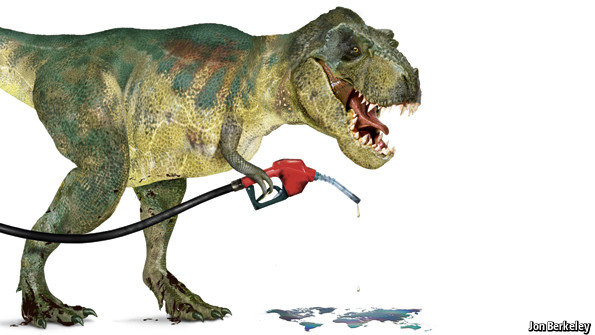
The world’s thirst for oil could be nearing a peak. That is bad news for producers, excellent for everyone else
THE dawn of the oil age was fairly recent. Although the stuff was used to waterproof boats in the Middle East 6,000 years ago, extracting it in earnest began only in 1859 after an oil strike in Pennsylvania. The first barrels of crude fetched $18 (around $450 at today’s prices). It was used to make kerosene, the main fuel for artificial lighting after overfishing led to a shortage of whale blubber. Other liquids produced in the refining process, too unstable or smoky for lamplight, were burned or dumped. But the unwanted petrol and diesel did not go to waste for long, thanks to the development of the internal-combustion engine a few years later.
Since then demand for oil has, with a couple of blips in the 1970s and 1980s, risen steadily alongside ever-increasing travel by car, plane and ship. Three-fifths of it ends up in fuel tanks. With billions of Chinese and Indians growing richer and itching to get behind the wheel of a car, the big oil companies, the International Energy Agency (IEA) and America’s Energy Information Administration all predict that demand will keep on rising. One of the oil giants, Britain’s BP, reckons it will grow from 89m b/d now to 104m b/d by 2030.
Scraping the barrel
We believe that they are wrong, and that oil is close to a peak. This is not the “peak oil” widely discussed several years ago, when several theorists, who have since gone strangely quiet, reckoned that supply would flatten and then fall. We believe that demand, not supply, could decline. In the rich world oil demand has already peaked: it has fallen since 2005. Even allowing for all those new drivers in Beijing and Delhi, two revolutions in technology will dampen the world’s thirst for the black stuff.
The first revolution was led by a Texan who has just died (see article). George Mitchell championed “fracking” as a way to release huge supplies of “unconventional” gas from shale beds. This, along with vast new discoveries of conventional gas, has recently helped increase the world’s reserves from 50 to 200 years. In America, where thanks to Mr Mitchell shale gas already billows from the ground, liquefied or compressed gas is finding its way into the tanks of lorries, buses and local-delivery vehicles. Gas could also replace oil in ships, power stations, petrochemical plants and domestic and industrial heating systems, and thus displace a few million barrels of oil a day by 2020.
The other great change is in automotive technology. Rapid advances in engine and vehicle design also threaten oil’s dominance. Foremost is the efficiency of the internal-combustion engine itself. Petrol and diesel engines are becoming ever more frugal. The materials used to make cars are getting lighter and stronger. The growing popularity of electric and hybrid cars, as well as vehicles powered by natural gas or hydrogen fuel cells, will also have an effect on demand for oil. Analysts at Citi, a bank, calculate that if the fuel-efficiency of cars and trucks improves by an average of 2.5% a year it will be enough to constrain oil demand; they predict that a peak of less than 92m b/d will come in the next few years. Ricardo, a big automotive engineer, has come to a similar conclusion.
Not surprisingly, the oil “supermajors” and the IEA disagree. They point out that most of the emerging world has a long way to go before it owns as many cars, or drives as many miles per head, as America.
But it would be foolish to extrapolate from the rich world’s past to booming Asia’s future. The sort of environmental policies that are reducing the thirst for fuel in Europe and America by imposing ever-tougher fuel-efficiency standards on vehicles are also being adopted in the emerging economies. China recently introduced its own set of fuel-economy measures. If, as a result of its determination to reduce its dependence on imported oil, the regime imposes policies designed to “leapfrog” the country’s transport system to hybrids, oil demand will come under even more pressure.
A fit of peak
A couple of countervailing factors could kick in to increase consumption. First, the Saudis, who control 11% of output and have the most spare capacity, may decide to push out more, lowering prices and thus increasing demand. Then again, they might cut production to try to raise prices, thereby lowering demand further. Second, if declining demand pushes down the oil price, drivers may turn back to gas-guzzling cars, as they did when oil was cheap in the 1990s. But tightening emissions standards should make that harder in future.
If the demand for oil merely stabilises, it will have important consequences. The environment should fare a little better. Gas vehicles emit less carbon dioxide than equivalent petrol-powered ones.
The corporate pecking order will change, too. Currently, Exxon Mobil vies with Apple as the world’s biggest listed company. Yet Exxon and the other oil supermajors are more vulnerable than they look (see article). Bernstein, a research firm, reckons that new barrels of oil from the Arctic or other technologically (or politically) demanding environments now cost $100 to extract. Big Oil can still have a decent future as Big Gas, but that will not prove as profitable.
The biggest impact of declining demand could be geopolitical. Oil underpins Vladimir Putin’s kleptocracy. The Kremlin will find it more difficult to impose its will on the country if its main source of patronage is diminished. The Saudi princes have relied on a high oil price to balance their budgets while paying for lavish social programmes to placate the restless young generation that has taken to the streets elsewhere. Their huge financial reserves can plug the gap for a while; but if the oil flows into the kingdom’s coffers less readily, buying off the opposition will be harder and the chances of upheaval greater. And if America is heading towards shale-powered energy self-sufficiency, it is unlikely to be as indulgent in future towards the Arab allies it propped up in the past. In its rise, oil has fuelled many conflicts. It may continue to do so as it falls. For all that, most people will welcome the change.
10 Comments on "The future of Oil: Yesterday’s fuel"
Plantagenet on Fri, 2nd Aug 2013 5:46 pm
The Economist says that oil production is nearing a peak but it isn’t peak oil.
But peak oil isn’t a word game, where sophists argue over what the definition of “is” is. Peak is simple and empirical—when oil production reaches its maximum the world is at peak oil.
shortonoil on Fri, 2nd Aug 2013 6:18 pm
“This is not the “peak oil” widely discussed several years ago, when several theorists, who have since gone strangely quiet, reckoned that supply would flatten and then fall.”
The theorists weren’t wrong. The world’s production is described by a logistic function; Hubbert was right. Analysis of hundred of fields around the world prove it. The only thing he didn’t second guess was that the function is slightly skewed. It moves the peak forward a few years.
Just realize that most of the so called “oil” that today is being heralded as the savior of the world, the industry wouldn’t have touched with a ten foot pole twenty years ago. Its quality is that poor compared to just a few decades ago. The high quality crude of years past (that powers the world) is going with the 1% of large fields that supply 60% of the world’s petroleum
rollin on Fri, 2nd Aug 2013 6:43 pm
Gas taking over from oil? Don’t make me laugh. The gas industry is on the same “Red Queen” journey that the oil industry is experiencing. Drill, drill, drill just to stay even then drill some more to try and increase production. Next year drill even more to stay even. The gas industry would need to double production to replace oil and it will be lucky to raise it’s level 20 percent before peaking out.
The problem with this new fracking technology is the two fold. Huge monetary investment is required and rapid descent in well output with time.
The oil and gas industry are mimicking Olympic athletes just to increase production.
GregT on Fri, 2nd Aug 2013 8:47 pm
The end of the oil age will catch most completely off guard. We have not developed alternate energy infrastructure that will even begin to offset the decline in oil for electric power generation. We have no plan in effect at all as to how we are going to feed ourselves. We continue to spend massive amounts of energy and resources to keep our unsustainable automobile culture alive, even though it will eventually come to a grinding halt. We continue to act like BAU is a God given right, instead of a temporary blip in human history. We believe the technologies that fossil fuels provide us with, will save us after the fuels that provided us the tech in the first place become too expensive, or not available at all.
Yup, absolutely brilliant we are. Modern industrial civilization is in for a huge wake up call, in the very near future.
The opportunity still exists for those that understand what is going on, to do something positive to prepare for their futures. Those that believe that someone else is going to save them, are going to be gravely disappointed.
Kenneth on Fri, 2nd Aug 2013 10:27 pm
An important philosophical idea suggests that a statement is nonsense if it can’t be falsified. How could we falsify the basic statements of the peak oil demand theory? I suppose we could take a poll of consumers and ask them if they are conserving to save the planet or to save money. Assuming they know the real causes for their actions and answer truthfully that might help us. But this is complete silliness. Automotive technology has been improving for years. When oil was cheap those improvements went into greater horsepower rather than greater efficiency because oil was cheap not because people didn’t care about the environment or because governments didn’t strangle automakers with unpopular regulations.
BillC on Sat, 3rd Aug 2013 12:02 am
This article appears to be written by a college student who crammed all night. He has not even scratched the surface of the topic. I give him a D-
RICHARD RALPH ROEHL on Sat, 3rd Aug 2013 1:20 am
Amerika’s mindless profligate material consumption of the Earth’s resources, an insane and irresponsible misbehavior that’s ludicrously disguised with jingoistic euphonisms like the ‘Amerikan dream’, shall finally come home to roost. The Amerikan corn syrup sheeple of faster poo-food nation shall reap the karma that they so rich-lie deserve. And the rest humanity shall not fair much better.
I predict that the United States of Perpetual War Profiteering will NOT exist by 2050 or 2060… and the remainder of ewe-man-unkind will be perched at the edge of EXTINCTION by the end of the 21st century. Enjoy!
DMyers on Sat, 3rd Aug 2013 1:32 am
“And if America is heading towards shale-powered energy self-sufficiency,….” When you’re reading that sentence, everything after the “if” should be discarded. The article assumes this glut of energy will be forthcoming. He should have opened with the question instead of closing with it. The author has drunk the kool-aid and bought into the natural gas boom propaganda.
I realize the 200 year supply assertion has been refuted on technical grounds. I’m too lazy to go that far, but I arrive at the same conclusion. First, the 200 year calculation must assume current usage going forward. Here, they advocate vast new demands on gas resources, by utilizing gas for transportation. That, in itself would probably reduce the 200 years to 100 years, if there were, in fact, two hundred years to begin with.
There is historical precedent. The Indiana Gas Boom, circa 1900-1920, was a similarly sure thing. Indiana had so much gas, it gave free gas to factories that would locate there. A process was begun to move the state capital from Indianapolis to the small town of Upland in the geographic center of the Gas Boom.
The Indiana Gas Boom fizzled out in 20 years. That’s what I predict for the current shale gas boom. Twenty years would be a top but, more likely, it will fizzle in five to ten. I base that prediction on historical precedent, along with the likely increase of demand.
The article does make some good points. There are factors leading to declining demand for oil. The most important of those is the internet, although not mentioned.
BillT on Sat, 3rd Aug 2013 1:33 am
Well covered by the above comments. ^_^
Myopic Hyperbole on Sat, 3rd Aug 2013 1:51 am
It’s fascinating how MSM keeps coming up with the same old tired lines about ‘peak demand’ replacing ‘peak oil’, going from 50 years of natural gas to 200 years and how technical advances reduce our need for so much oil. That article even suggested Russia would have less influence due to reduced oil demand. Never a word about how high oil prices are forcing a peak.
It’s almost as if there is some grand poo bah overseeing MSM reporting, editing the scope of misinformation to perpetrate BAU for as long as possible.