
Peak Oil is You

Donate Bitcoins ;-) or Paypal :-)


Page added on June 15, 2015

The Future History of Political Economy – Part 2
You can read Part 1 here.
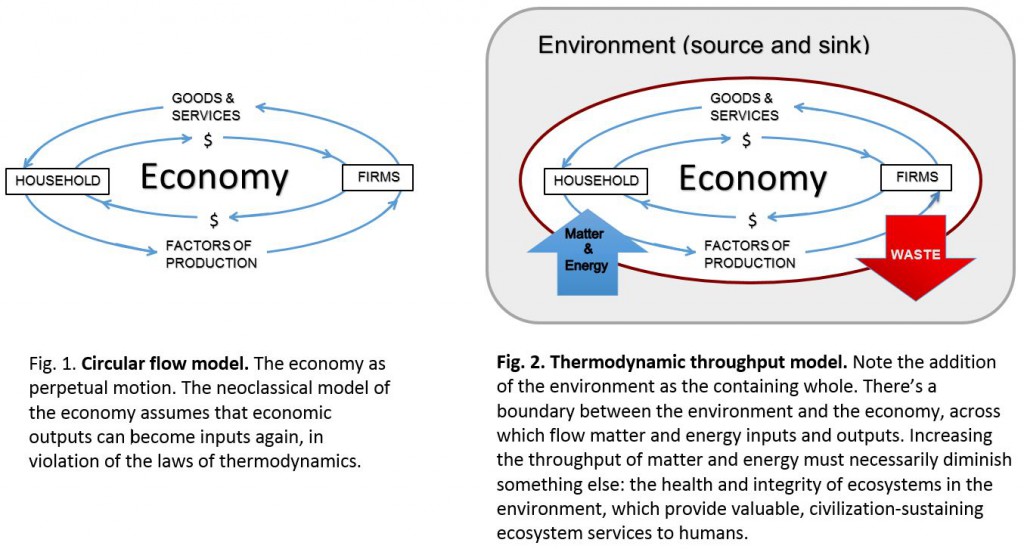
Ecological Economics represents the extension into economics of the thermodynamic revolution of the nineteenth and twentieth centuries. In physics, that revolution dethroned Newton and brought relativity. In biology, it was midwife to the birth of ecology, the study of ecosystems as wholes in which energy networks—food webs—are a defining structure. In chemistry the laws of thermodynamics brought clarity and rigor to a science that struggled to bring theoretical unity to diverse phenomena. So far, though, most economists are perfectly willing to treat their subject matter as if the laws of thermodynamics simply don’t apply to it.
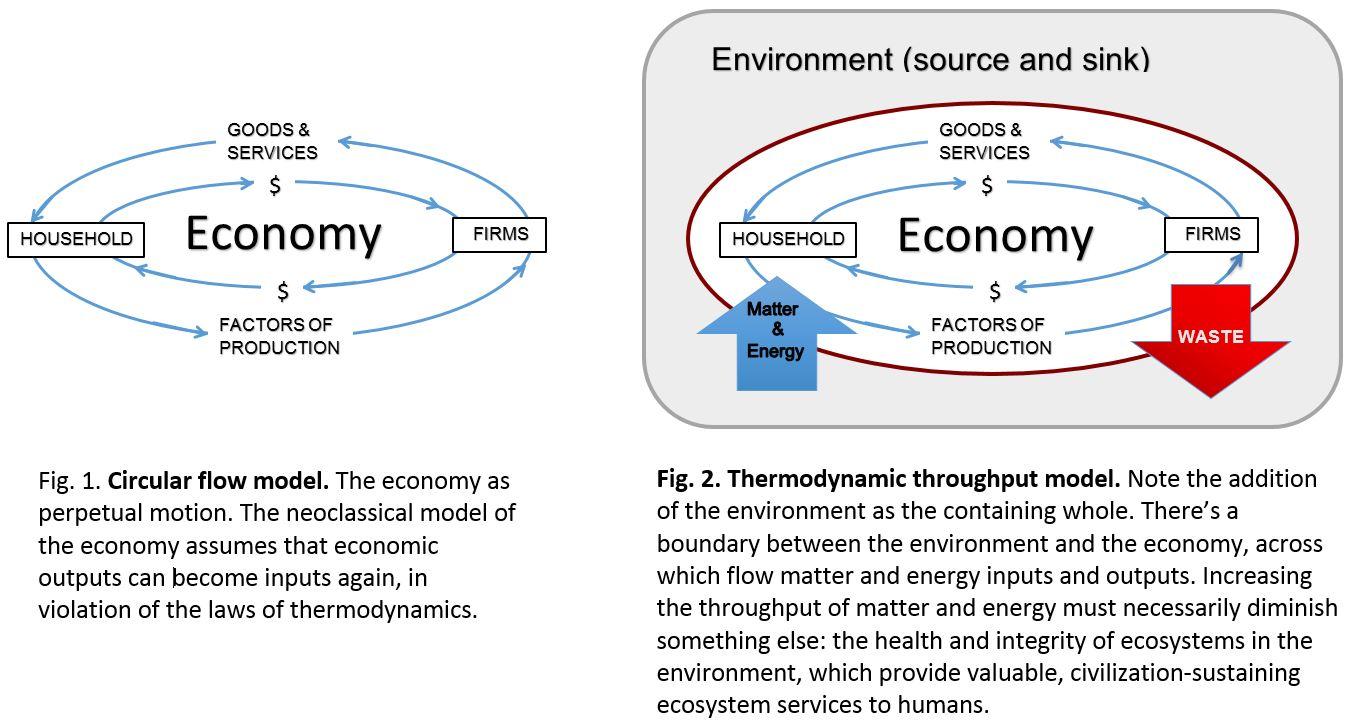
But the thermodynamic revolution in economics can’t be permanently forestalled. For one thing, it’s getting harder and harder for the neoclassical model to reassure us that its system of Newtonian abstractions is a good fit to the real world. The Great Collapse of 2008 demonstrated that whatever else it is, the discipline of economics isn’t very good at predicting major economic phenomena. Climate change and the Sixth Extinction make it hard for economics to maintain its pretense that economic activity takes place in abstractia, on the clean white pages of textbooks or on whiteboards holding formulae, with no roots in or consequences for anything outside of itself. Truths derived on the model of Newtonian mechanism are supposed to be abstract and ahistorical, but our planet and our economy are most assuredly evolving concretely and over time.
The driving dynamic of this economic and planetary change—the driver of history for the past three centuries—has been human use of high-EROI fossil fuel. The driving dynamic of the history yet to come will be the declining EROI of our civilization’s energy sources.
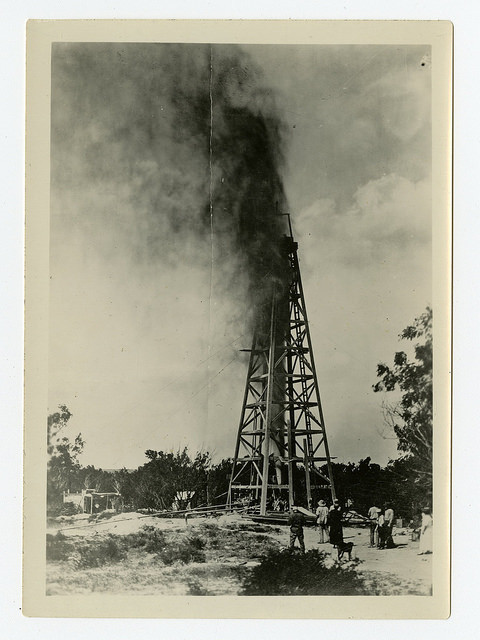
Oil used to gush out of the ground under pressure, making for a very high Energy Return on Energy Invested (EROI). In the 1920s, wells like this gave the industry an average EROI of 100 to 1 or more. Today’s petroleum industry has a much lower EROI. Photo Credit: Texas State Archives
You can see some of the consequences of declining EROI already:
- Despite a rising real per capita GDP, for a significant percentage of workers in OECD nations personal income has flatlined or is declining. An increasing concentration of income helps explain this but another dynamic is at work as well. As EROI falls, it takes more economic effort to get the energy that’s needed to support economic effort. Even as gross economic activity (GDP) grows, production of net benefit is shrinking.
- Other sectors of the economy have been affected by this ongoing increase in the economy’s matter-and-energy overhead. “Austerity” has become the watchword for governmental budgets, even in the wealthiest nations in the world. Developed countries find it increasingly difficult if not impossible to pay maintenance and upgrade costs on infrastructure investments made in the heyday of 100-to-1 oil.
- In its 2013 report card on America’s infrastructure, The American Society of Civil Engineers estimated that the U.S. needs to invest $3.6 trillion over seven years to restore and maintain existing infrastructure.
- Worldwide, many of the ecosystems that support human civilization are degraded and close to collapse. Forced by both ideology and declining EROI into austerity budgeting, governments are reducing their scope and energy at the exact moment that sustainability would have them take strong action to rein in the rational, free-market tendency of corporations to maximize profits by degrading the commons and externalizing other costs.
- Pension-fund wipeouts are becoming common as one way to fulfill the economy’s structural need for debt repudiation—a need that lies in our system’s willingness to let debt grow faster than a declining EROI economy can pay back, even after growth has been stimulated by lifting or reducing regulations that limit the environmental damage done by economic activity.
- The planetary carbon sink is full, producing climatic effects that even an abstraction-inhabiting, arithmo-morphizing economist has to acknowledge as a troubling reality.
Centuries from now economic historians are likely to understand the relationship between EROI and wealth creation much better than does the average economist of today. I think it likely that future political economists will express wonder not at the 20th century’s enormous economic success, but at how little we actually added to our stock of wealth for all the high-EROI coal and oil it was our pleasure to burn. They are almost certain to shake their heads in wonder that we, enjoying an energy supply and an EROI never seen on the planet before or since, could ever have experienced an economic downturn, could ever have let a human starve from want, could ever have been so programmatically blind to the physical origins of our fortunes.
7 Comments on "The Future History of Political Economy – Part 2"
Apneaman on Mon, 15th Jun 2015 7:30 pm
Photos of ruptured oil pipeline provide clues of spill cause
“Bea said the photos provided by Santa Barbara County show about 10 percent of the pipe’s outer wall had deteriorated from corrosion.
A test conducted for the company two weeks before the spill showed up to 45 percent of the pipe’s interior wall was gone. Bea calculated that with the walls at least half corroded, the pipe would have failed during a restart when the pressure surged to a reported 700 pounds per square inch.
What alarmed Bea was that an external examination of the pipe in three other areas showed up to 74 percent of the pipe wall had deteriorated.
“I don’t think I’d want to start pumping crude through this existing pipeline,” he said. “I’d just replace the whole pipeline. I wouldn’t try to patch it.”
http://bigstory.ap.org/article/2de7ed2cfb9e4d83af22f825dc66ae44/photos-ruptured-oil-pipeline-provide-clues-spill-cause
Cloud9 on Tue, 16th Jun 2015 8:37 am
Darwin’s theory: Things evolve from the simple to the complex. What happens when things have evolved to their maximum level of complexity? They devolve, slowly at first, and then all at once.
Hubbert on Tue, 16th Jun 2015 1:21 pm
Whole world is going through a process of collapse. Living in denial is not going to change anything.
One way or another, nature is going to solve this problem of overpopulation for us, whether that’s through war or starvation.
Apneaman on Tue, 16th Jun 2015 5:42 pm
Economics is a Fraud Redux
As the United States deindustrialized in the late 1970’s through the 1980’s and one factory after another shuttered its doors, the economics profession cheered on this development. They took to the pages of op-ed columns and appeared on TV stations and assured us that we would now be living in something called the “service economy” where manufacturing jobs would be replaced by retail jobs selling the products now made in Asia, along with other various assorted “services.” This was an unstoppable and perfectly natural development, they told us, and nothing to worry about.
Today, in the 2000’s whenever workers in these service industries point out that they cannot earn enough to live on and agitate for higher wages, we are told that these service workers are not worth anything more. We are told by these same economists that this is their “marginal product” and they do not deserve to paid any more than they are. That this is what the “natural” wages of retail workers should be, and to pay them more would cause unemployment. Somehow, they neglected to mention that when they cheered on deindustrialization thirty years prior. If a service economy leads to a poorer population overall, then why was deindustrialization so good for us back in the 1980’s? Economists are silent.
http://hipcrime.blogspot.ca/2015/06/economics-is-fraud-redux.html
GregT on Tue, 16th Jun 2015 6:06 pm
Excellent articles, (part one included)
Nony-Marm,
Read them over and over and over until they sink in. When you finally come to your senses in a few years time, it will already be too late for you to do anything to save yourself.
For everybody else, man those lifeboats.
yukonfisher on Wed, 17th Jun 2015 12:34 am
“Centuries from now economic historians are likely to understand the relationship between EROI and wealth creation much better than does the average economist of today.” Wow, that would be a wonderful future; a future that includes economic historians. I rather suspect that centuries from now humanity’s thinkers will be concentrating on more mundane matters. Perhaps a better bow and arrow, or atlatl.
Northwest Resident on Wed, 17th Jun 2015 1:12 am
yukonfisher — My thinking exactly. It is a pretty big assumption to think that there will be historians a few hundred years in the future — at least, what we think of as historians today, with access to vast archives of research and documents. To maintain such a vast store of knowledge and make it accessible to historians requires infrastructure that might not exist a few hundred years from now. Maybe the historians that the writer has in mind are more on the level of monks with their hand-written scrolls documenting the collapse of civilization over the centuries, describing an ancient evil known as The Elite who, through their greed and utter disregard for Mother Nature, plunged humanity into times of great evil.
Future historians — what a concept!